

6 min read

Google Review Requests by Text for InSync EHR Patients

Google Review Requests by Text for InSync EHR Patients
💡Easy Google review requests for InSync EHR patients by text are what Curogram adds to an InSync practice. A short, friendly post-appointment survey arrives as an ordinary SMS, and satisfied patients are one tap from Google. No app, no account, no portal login.

InSync's own path runs through a browser-based portal most behavioral health clients never open, so even grateful patients are never offered a way to say so.

Requests are built for this audience: no PHI, no mention of program or diagnosis, and full patient control over whether, what, and how anonymously to post.

At one multi-location practice, 90% of surveyed patients left 5-star reviews — 1,064 of them in three months, per our internal case data.


A therapist keeps a thank-you card in a desk drawer. It runs three paragraphs; it is specific, and it is the best thing anyone has written about that practice in years. No prospective client will ever read it.

Meanwhile, the top review on the practice's Google profile is a two-year-old complaint about parking.

That distance between private gratitude and public record is no accident, and it says nothing about the care.

It comes from a simple asymmetry. Frustrated patients need no invitation to post. Satisfied ones need both an invitation and a path that takes under a minute. Give neither, and your unhappiest 2% writes the profile.

Our claim: your patients are not withholding praise. Nobody has handed them a way to give it, and the portal was never going to.

Finding a practice's Google listing unprompted, on the right day, with the right motivation, is a task even delighted patients never get to. Life resumes. Later never comes.

For a behavioral health client, the barrier sits higher. Posting can feel like announcing a diagnosis, so silence wins by default.

Ahead, from the patient's side. What gratitude has to overcome now, and what a 30-second request looks like when it is built for this audience. Then what changes for the next person searching at 1 a.m.

The Three-Star Ceiling From the Patient's Side

Gratitude With Nowhere to Go

Give the portal its due. It serves the minority who use it for records, forms, and payments.

What it has never done is ask a question. Nobody prompts the patient, the portal certainly does not, and the practice has no other channel that reaches them. So the good experience stays in the room where it happened.

Two Patients Who Never Posted

Follow a behavioral health client first. She finishes a hard, successful course of treatment and would recommend the practice to anyone who asked.

Posting publicly, though, means attaching her name to the fact that she needed this kind of care. Weighed against a stranger's benefit, that trade rarely wins.

Now a post-op patient discharging from PT, pain-free and grateful. He fully intends to leave a review later. He drives home, the week restarts, and the intention dissolves without a single moment of ill will behind it.

Why the Unhappy 2% Write Your Profile

Both patients wanted to help. Neither had a path shorter than "remember, search, find, write."

A frustrated patient clears that same path easily, because irritation supplies the motivation that gratitude lacks. Run that asymmetry for two years, and the arithmetic is not surprising. The people who had the worst day write most of the profile.

The consequence lands on the next patient rather than on you. Roughly 90% of new patient leads see the Google Business Profile before the website. So a stigma-wary family or a clinic-comparing PT patient meets that skewed record first, then picks the 4.8-star competitor with 300+ reviews.

The Thank-You Card Nobody Else Sees

Which brings us back to the drawer. Somewhere in your practice sits physical evidence of excellent care. It is invisible to every person deciding tonight whether to call you.

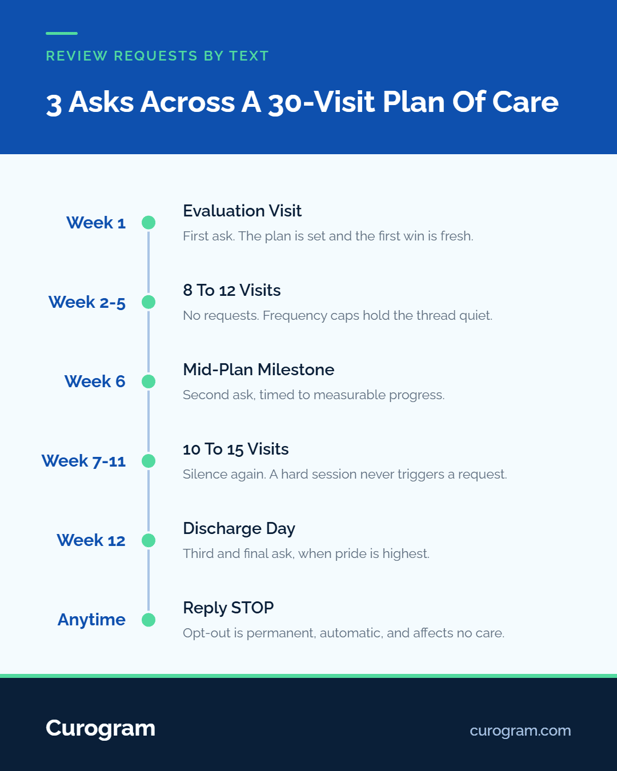
Timeline infographic showing 3 text review requests across a 30-visit patient plan of care

The Review Engine on the Patient's Phone

Thirty Seconds, One Thread

Walk it from the patient's side. A short "How was your visit?" text arrives after the appointment, in the same thread that carries their reminders. They answer with a tap.

Satisfied patients get one more tap to the practice's Google review page. Patients flagging a concern get a private line back to the practice. Total time, about 30 seconds, with no app download and no portal login anywhere in it.

Curogram Highlight: Automated Post-Appointment Surveys

Automated Post-Appointment Surveys carry the request over ordinary SMS, which opens at about 98%. Request texts hold no PHI and never name the program, specialty, or diagnosis.

Patients decide what to write and how identifiable to be, since a Google profile can use any display name. Declining costs nothing and produces no follow-up nagging.

Frequency caps and opt-out are honored automatically. Curogram operates under a Business Associate Agreement, with SOC 2 Type II certification and 42 CFR Part 2-ready messaging.

What the Message Never Says

The request includes

The request never includes

The practice name

The program or specialty

A neutral question about the visit

Any diagnosis or treatment type

A one-tap link, if satisfied

PHI of any kind

A private option, if not

Anything a bystander could interpret

Standard opt-out language

A second ask after declining


That right-hand column is the design. A client reading the text on a lock screen in a shared kitchen gives nothing away.

What a Patient Can Safely Write

Worth telling patients directly. Most assume a review means explaining why they came, and the useful ones rarely do.

A good review can cover the front desk, how easy scheduling was, whether the clinician listened, how the space felt. None of that names a diagnosis or a program. Patients who want to say more still can, and that stays their call.

Some practices add a line of guidance to the request for this reason. It lowers the barrier for a client who wants to help without explaining themselves.

Asked at the Right Moment

Timing follows the treatment arc rather than the calendar. For therapy patients, requests land after the evaluation win, the mid-plan milestone, or discharge day. Pride is highest then, and the memory is specific.

A PT patient attending 2–3 sessions a week for 6–12 weeks would see dozens of visits. Frequency caps mean they see a handful of requests, and never one after a session that went badly.

From Silent Gratitude to Public Proof

What Patients Did When Asked

Ask satisfied patients properly, and about nine in ten give five stars. At one multi-location practice that produced 1,064 new five-star reviews in three months, with 90% of surveyed patients left five stars. Both figures come from our internal client data.

Nothing about those patients' feelings changed. The request did.

Three Searches That Ended Differently

A mother researching adolescent counseling at 1 a.m. reads forty recent five-star accounts and books the intake she had almost talked herself out of.

A runner choosing between two PT clinics finds reviews that mention his exact injury, which no clinic website could have told him.

And a family comparing outpatient programs sees recent activity rather than a two-year gap. That answers a question they could not have asked out loud.

The Review That Mentions Nothing Clinical

Scan a mature profile at one of these practices, and a pattern shows up. Most five-star reviews talk about scheduling, kindness, and whether the plan made sense. Diagnoses rarely come up at all.

That is the profile working as designed. A future patient learns the practice is easy to deal with, which is the question they were asking in the first place.

Why Recency Beats a Burst

One thing worth telling owners plainly: a steady trickle serves patients better than a campaign. Searchers weigh recency alongside volume. A profile with forty reviews all dated the same fortnight reads as manufactured.

Running off completed appointments produces the opposite pattern. Requests go out as care happens, so the profile refreshes every week at whatever rate your practice actually treats people.

That matters most to the anxious searcher. A family checking an outpatient program wants evidence that people were helped last month. A two-year gap tells them something else entirely.

Where the Ask Does Not Belong

Some visits should never trigger a request, and this is worth setting deliberately rather than discovering later.

A session that went badly is the obvious one. So is any crisis-adjacent contact, and a first appointment the patient no-showed. So is any client who asked for no contact beyond scheduling.

Timing rules handle all of these once written down, but somebody who knows the program has to write them.

Our rule of thumb: anchor the request to a completion milestone the patient would recognize as a win. If you cannot name the win, do not send the ask.

What Declining Costs a Patient

Nothing, and this deserves saying plainly to patients and staff alike. A patient who ignores the survey hears nothing further about it. A patient who replies STOP is opted out permanently, automatically, with no effect on their care.

Public posting stays entirely the patient's decision, made on their own device, in their own words.

Give Your Grateful Patients a Voice

Your patients already want to recommend you. What they have lacked is a microphone that takes 30 seconds and reveals nothing they did not choose to reveal.

Split it by purpose. InSync holds your record of care. Curogram handles their freedom to talk about it, safely and only if they want to.

Every silent success story is a patient somebody else never finds you through.

Book a Demo. Walk the survey-to-review flow exactly as your patients would, on your own phone.


Frequently Asked Questions

How do we keep a review from identifying someone as a mental health or SUD patient?

Request texts contain no PHI and never mention program, specialty, or diagnosis, and the patient controls every word they post, including using a Google display name that does not identify them.

What do patients need installed to respond to a review request?

Nothing. The survey arrives as a standard text and takes seconds. Posting to Google uses the account most people already have on their phone, and those who prefer not to post can still give private feedback.

How often will a therapy patient attending three sessions a week be asked?

At meaningful milestones only — evaluation, progress, discharge — not after every visit. Frequency caps enforce that, and declining a request produces no follow-up.

Why does a private feedback route matter to the patient rather than the practice?

Somebody having a bad week gets a human response instead of a public exchange they may later regret. The option to post publicly stays open to them regardless.

How should a practice respond to reviews without breaching privacy?

Never confirm publicly that a reviewer is a patient, and keep specifics out of the reply. Anything requiring detail moves to the private channel the survey already opened.