
1 min read
Fill Intake by Text: Skip the Clipboard
 Jo Galvez : Jul 3, 2026, 11:00:00 AM
💡CollaborateMD patient intake forms by text no clipboard let patients finish their forms on the phone before they arrive.They fill demographic,...

Nineteen pages. That is the average new-patient packet at a behavioral health or therapy practice, and every one of those pages has to end up somewhere.
Somewhere usually means a staff member with a keyboard.
If your practice runs InSync EHR by Qualifacts, you already know the clinical side is strong. Configurable templates. Native screener scoring. ASAM-aligned assessments.
Once patient data is inside the chart, InSync does its job well.
The trouble starts one step earlier, in the gap between booking the appointment and getting the paperwork back.
That gap has a name in most offices: the portal. You send the invitation. The patient hits identity verification. A good share of them quietly give up.
So the packet defaults to paper. And paper defaults to your front desk.
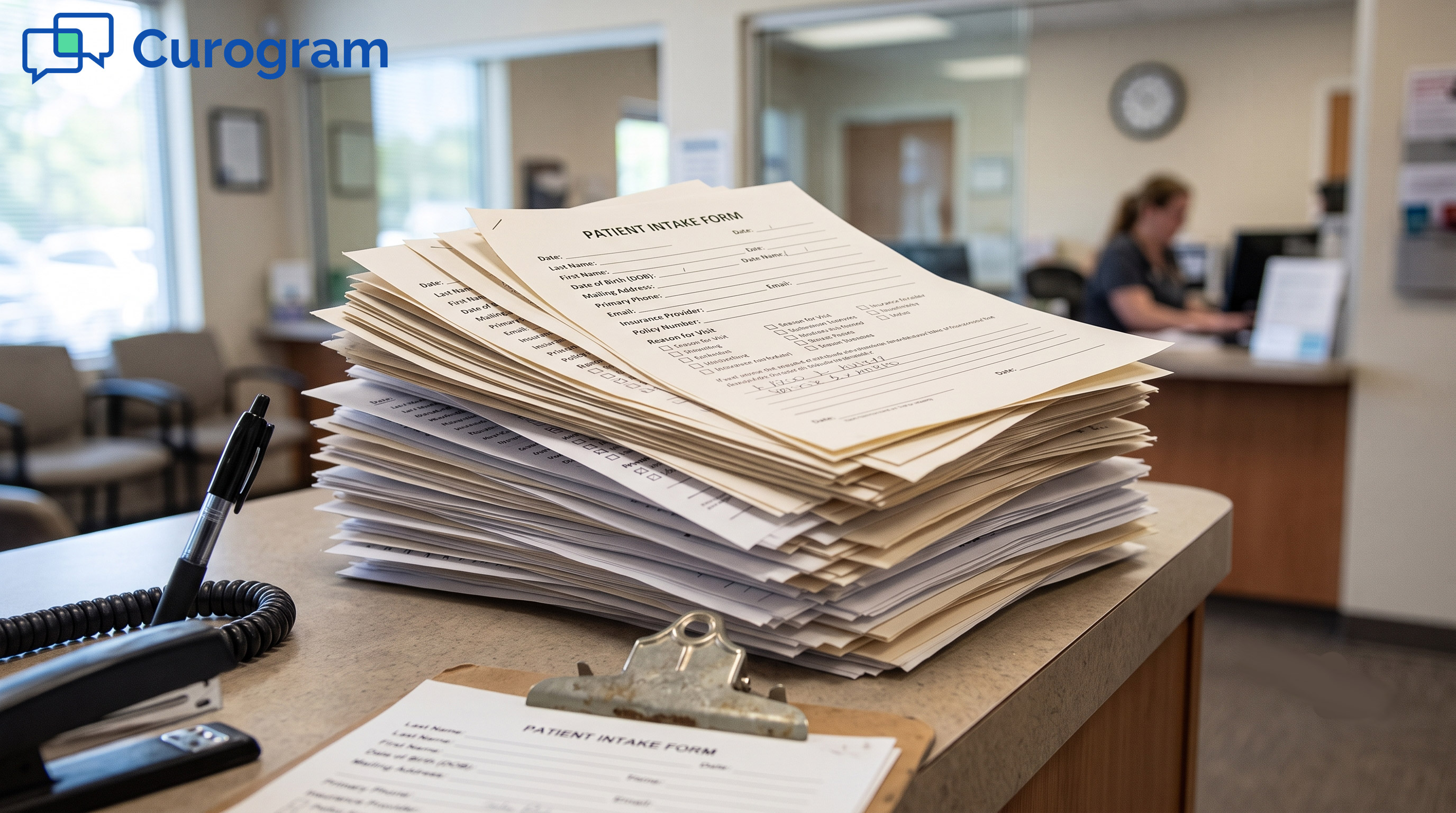
What happens next is familiar. Reminder calls stack on top of the 80+ calls your desk already fields each day. Clipboards come out because three clients arrived with nothing. An afternoon disappears into deciphering a handwritten DAST-10 and retyping a biopsychosocial that should have arrived complete.
It looks like a paperwork problem. It isn't. It is a scheduling problem, a revenue problem, and a staffing problem wearing a paperwork costume.
Your front desk feels it first. Then your schedule feels it. By month's end, revenue feels it too.
An InSync EHR intake paperwork workflow for front office staff should begin three days before the appointment, not three minutes after the patient walks in. Text instead of portal. Before instead of during. That one change turns hours of transcription into a glance at a dashboard.
This article covers why the current workflow breaks down, what a text-first alternative looks like day to day, and what your team gets back when packets arrive finished.
No system replacement required. InSync stays exactly where it is.
InSync handles documentation well once the data is inside it. The problem is not what happens in the chart. It is how the paperwork gets there.
Right now, it mostly gets there through a portal your patients never sign into. Behavioral health portal engagement runs around 15–20%. So the packet falls back to paper, and paper falls back to you.
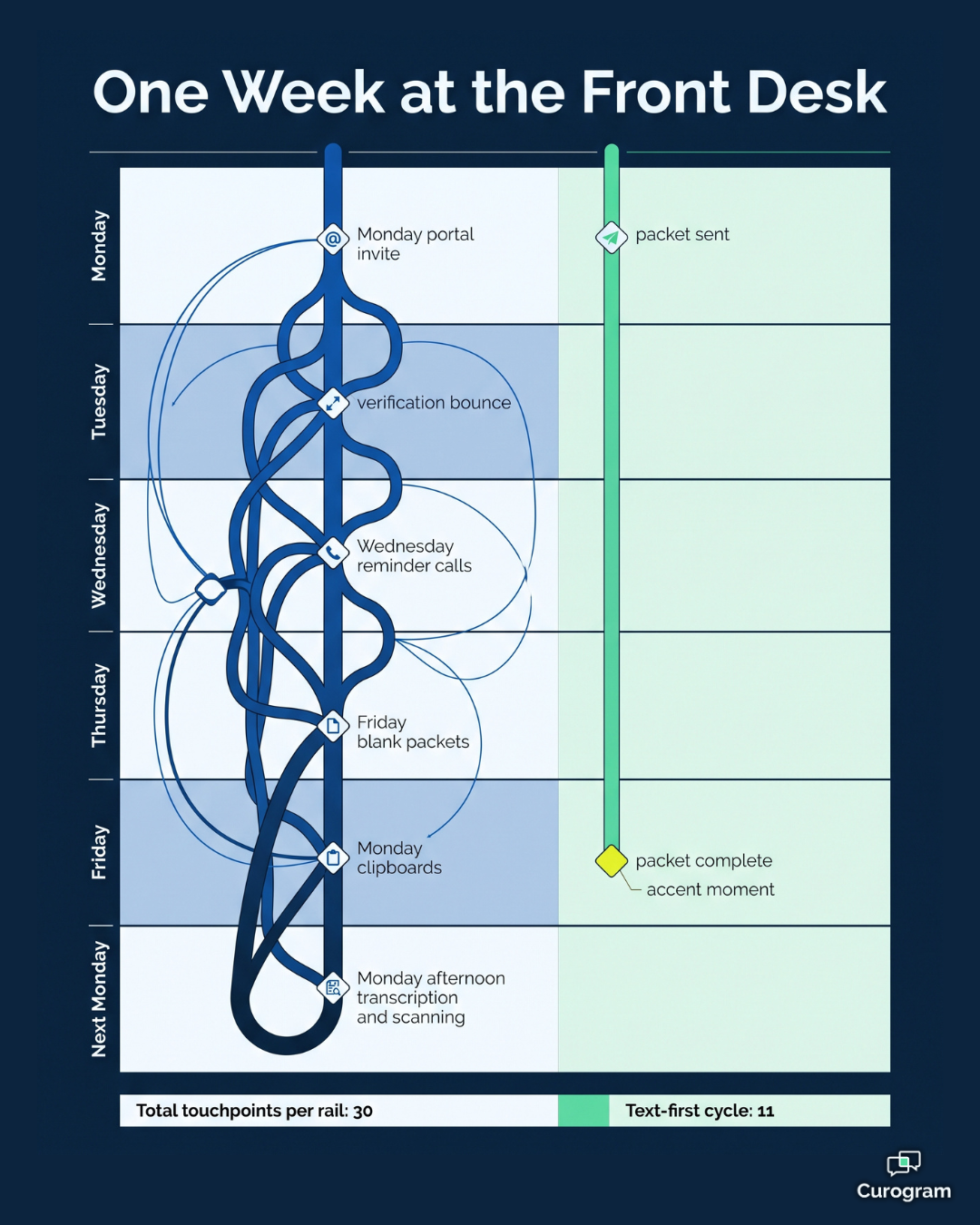
Here is how a normal week plays out.
| Day | What happens | Who absorbs it |
|---|---|---|
| Monday | Portal invites go out; many bounce off identity verification | Front desk sends follow-ups |
| Wednesday | Reminder calls join the 80+ calls the desk already fields | The whole team |
| Friday | Tomorrow's intakes still show blank packets | Office manager |
| Monday | Three clients arrive with nothing and start on clipboards | The lobby backs up |
| Monday PM | Someone retypes a biopsychosocial and scans consents | One person's afternoon |
Substance use programs add a second pass, because the 42 CFR Part 2 authorization page came back unsigned.
Now put numbers on it. 19 pages per new patient. Transcription and scanning measured in staff hours per week, not minutes.
First visits get pushed back 20–30 minutes. Clinicians bill less time, because the session opens with paperwork instead of care.
Then there is the quieter cost.
A patient who never finished the packet is a patient who never really engaged. In a field running 23–50% no-show rates, that pattern shows up on the schedule fast.
At 10–15 providers, practices lose $15,000–$25,000+ a month to missed visits.
The intake packet transcription burden behavioral health teams carry is heavier than almost any other outpatient specialty. Screeners, consents, releases, and program-specific authorizations all arrive at once, and all of them arrive by hand.
You can see it on your team. Your front desk lead can spot an incomplete packet from across the lobby and already knows what her afternoon just became. Your therapy office manager has the insurance authorization form memorized, because she fills in the blanks herself on half the evaluations.
The fix is not a better portal. It is a different channel, and a different moment.
When the appointment is booked, Curogram's Secure Online Forms sends the packet as a secure text link. No app. No login. No identity check to fail.
Patients open SMS 98% of the time. Most of them start within minutes.
Packets get built by appointment type. A behavioral health intake can carry the PHQ-9, GAD-7, AUDIT-C, DAST-10, consents, and Part 2 authorizations. A rehab evaluation can carry medical history, the referral, insurance authorization, and a functional assessment.
E-signature is built in. Nothing gets printed, scanned, or shredded.
Front desk form completion tracking swaps "I think she sent it back" for a status column you can read in five seconds. Unfinished packets get a one-tap nudge text instead of a phone call.
That is how you reduce front desk intake data entry without adding a single task to anyone's morning.
Here is the honest version.
Finished forms come back digitally and flow into your workflows with no manual re-entry. InSync remains your system of record.
InSync's FHIR R4 API is real and well documented. That is more than most behavioral health systems offer.
It also takes signed BAAs with Qualifacts and your practice, plus sandbox access and sign-off. So we map the real connection during onboarding, rather than promise plug-and-play. Your clinical workflow inside InSync does not change.
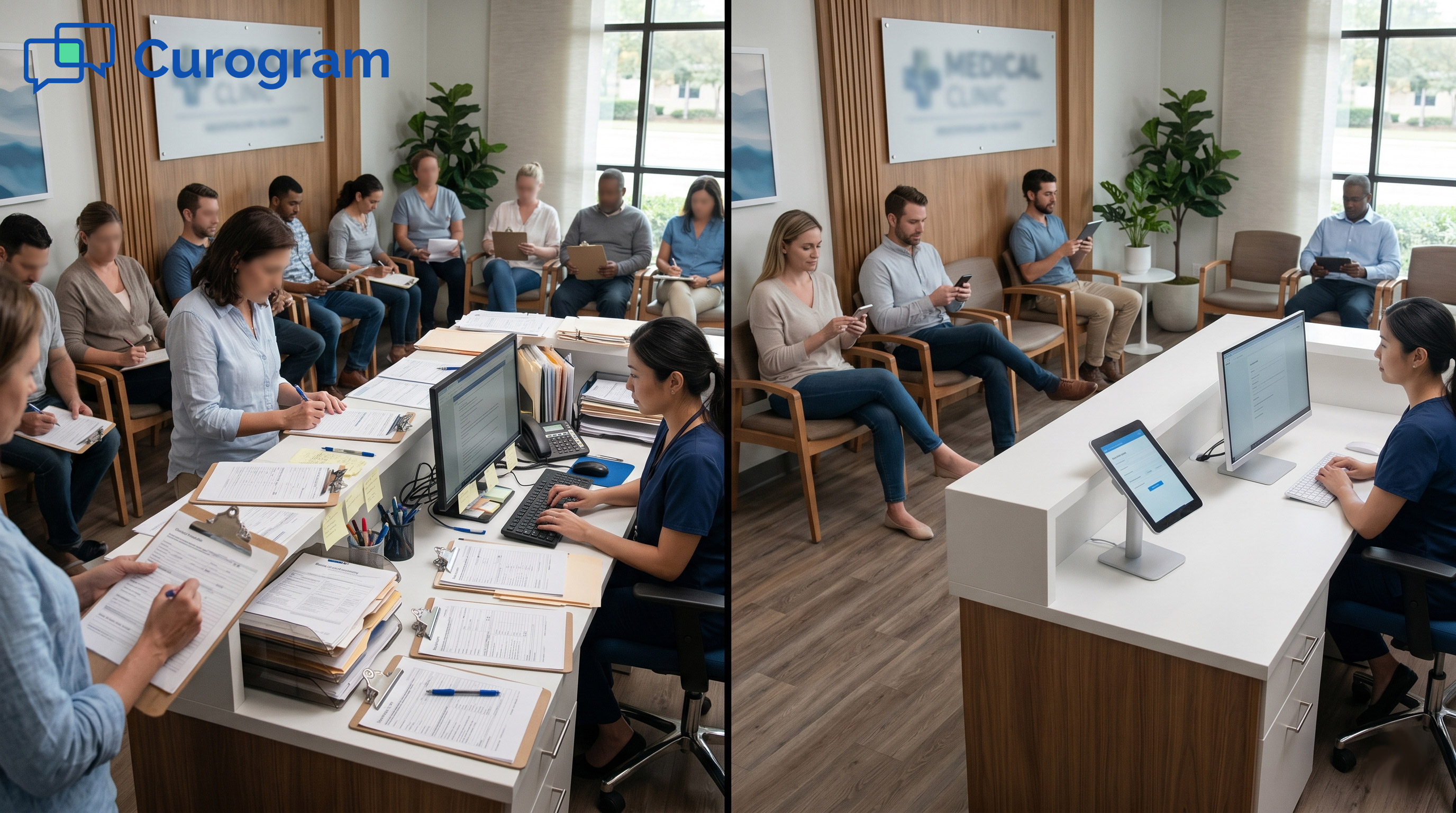
The win here is subtraction. One text workflow replaces the print-chase-transcribe-scan loop. Setup takes days, not months. The only new skill your desk needs is reading a completion dashboard.
A digital intake workflow for therapy clinics does the same job on the rehab side. Missing referral and authorization pages are what stall most evaluations before they start.
And in behavioral health, your staff stop being the awkward middle step. Nobody has to ask a new client to redo a sensitive screener in a public lobby.
Start with the number that moves first. That is 19 pages of paper per patient, removed entirely from the front desk workflow.
Pre-visit completion also changes attendance. Atlas Medical Center went from a 14.20% no-show rate to 4.91% in three months, roughly 3X better than the industry average. Patients who engage before the visit tend to show up for it.
For a 12-provider practice, cutting no-shows by that margin can mean dozens of recovered appointments every month.
From paper chase to completion glance.
The morning huddle changes shape first. Instead of sorting through a stack of paperwork, your team checks a dashboard. The only intake question left is which two patients need a nudge.
Here is what the rest of the day looks like:
That last line is the point. InSync EHR Qualifacts front office efficiency usually gets measured in tasks completed. The better measure is how much of your team's day goes to patients instead of paper.
The fastest operational win available to an InSync front office is not a new module or another hire. It is moving intake collection from portal-and-paper to text-before-the-visit.
Everything else follows from that one move. Packets arrive finished. Screeners arrive scored. First visits start on time because there is nothing left to fill out at the window.
Think of it as a division of labor. InSync is built for your documentation, your scoring, and your compliance record. Curogram is built for their completion, the packet finished on a couch instead of a clipboard.
When you eliminate paper intake scanning medical office staff still do by hand, you are not just saving toner. You are handing back hours that were never supposed to belong to a keyboard.
The math is easy to run. Count the pages in your current new-patient packet. Multiply by next week's intakes. Then ask who is typing all of that today, and what else that person could be doing.
If the answer makes you wince, that is the opportunity.
None of this asks you to leave InSync or change how your clinicians work. Your templates stay. Your scoring stays. Your compliance record stays right where auditors expect it.
What changes is the front end. That is the part your patients touch and your staff rebuild by hand.
Practices make this switch in days, not quarters. There is no IT project, no patient app to support, and no new system for your desk beyond a status screen.
Schedule a Consultation with Curogram and bring your actual intake packet. We will map a text-first workflow against it live, page by page, so you can see exactly which pages disappear from your front desk and which ones simply arrive already done.
1 min read
Jo Galvez : Jul 3, 2026, 11:00:00 AM
💡CollaborateMD patient intake forms by text no clipboard let patients finish their forms on the phone before they arrive.They fill demographic,...
1 min read
Jo Galvez : May 15, 2026, 4:00:00 PM
💡 You can replace paper intake at a GE Centricity practice with secure digital forms. Curogram links straight to GE Centricity Practice Solution...
1 min read
 Aubreigh Lee Daculug : Sep 30, 2026, 10:00:00 AM
💡InSync EHR intake forms patients complete by text remove the biggest barrier between a new patient and a finished packet: the portal login....