
How Athenahealth Users Use Mass Messaging to Engage Patients
Learn how Athenahealth users use mass messaging to engage patients. See use cases like preventive care, recalls, and office updates — all...
9 min read

In healthcare, consistent communication is the key to strong patient relationships. Yet for small and independent practices, it can be a challenge. I can be overwhelming to keep in touch with hundreds or thousands of patients.
Mass messaging changes that. By integrating SMS campaigns into the EMR, clinics can reach all their patients with a few clicks. Clinics can remind patients of preventive visits, share alerts, or promote seasonal checkups.
HIPAA-compliant text messaging ensures every message is secure. Meanwhile, automation ensures patients stay informed without overloading staff.
In this article, we'll explore the following:
Do you want to see how you can make a positive impact in patient engagement and admin workload? Keep reading.
Setup mechanics live in a separate piece. This one starts after the plumbing works, when someone has to decide what goes out. Clinics running our Practice Fusion integration usually pick three campaigns first and grow from there.
Practice Fusion's own blog reports reminder response rates of 52% by text, against 28% by email and 26% by phone. Age doesn't flatten that out much. The same post puts the text response rate at 43% for ages 18 to 34, 56% for 55 to 74, and 39% for 75 to 94.
Our numbers land in the same range. Clients using automated reminders and two-way texting average above a 75% appointment confirmation rate, based on our internal data.
Patient engagement SMS Practice Fusion workflows help clinics reduce no-shows, increase confirmations, and ensure patients stay connected to their care plans.
Patient engagement SMS Practice Fusion workflows depend on that speed. A text asking a patient to confirm Tuesday at 9:15 gets answered from the grocery line. The same ask left as a voicemail sits until Wednesday.
Consistency is a scheduling problem before it's a marketing one. On a good day, a phone tree gets through nine patients in an hour. A queued campaign reaches 1,400 in that same hour. Your staff spends it on the patients standing at the counter.
SMS engagement campaigns also let you send the same message twice without doubling the work. Flu clinic notices go out in September, then again in October to the patients who still haven't come in. Nobody rebuilds the list by hand.
Three controls carry most of the compliance weight:
A signed business associate agreement covers the vendor relationship.
Opt-out handling belongs on that list too. Practice Fusion's help center documents that patients can opt out of SMS text messages from their practice. Your platform has to honor a stop request the moment it arrives.

Four campaigns account for most outbound texts in a small clinic. Each runs on its own trigger, and each pulls a different Practice Fusion field to build the list. Get one working before you add the next, since a badly filtered send costs you subscribers you won't get back.
Preventive care SMS campaigns work when they're filtered. Pull every patient over 50 with no colorectal screening on file, then send one text with a booking link. Flu shots, annual physicals, and mammogram reminders run on the same logic.
Timing matters more than wording. A flu campaign sent the second week of September fills October slots. The same text sent in November competes with the pharmacy down the street.
Overdue follow-ups are the easiest revenue in the building. Recall messaging Practice Fusion clinics send targets patients who never rebooked. Think of the diabetic who missed a three-month check, or the patient told to return in a year who's now at 15 months.
One multi-location practice saw 35% of patients who got an SMS recall book an appointment within a month. That worked out to 1,240 patients seen from recall texts alone, based on our internal data.
Snow days, water main breaks, and provider call-outs need one message sent to everybody at once. Emergency alerts via SMS healthcare teams send beat a website banner, because patients don't check the website before driving over.
Keep the copy short and factual. "Clinic closed today due to flooding. Telehealth visits available. Reply to reschedule." That's enough.
A feedback text goes out a few hours after the visit is marked complete. Ask every patient. Routing only your happy patients to Google conflicts with FTC rules and Google's own review policy.
Done that way, reputation management stops being a project. One multi-location practice collected 1,064 new five-star reviews in three months from automated post-visit surveys. About 90% of the patients who responded left five stars, based on our internal data.
Two of these benefits carry the revenue case. Fewer no-shows and more completed follow-ups are the ones you can put a dollar figure on. Satisfaction and retention take longer to show up, but they decide whether the panel grows.
Patients read texts from a clinic that only texts when it has a reason. Segment by visit type, provider, or last-seen date, so the diabetic education notice doesn't land on the pediatric panel. Practice Fusion integration gives you those fields without a manual export.
Frequency discipline is the other half. Two useful texts a quarter build trust. Two a week train patients to ignore you.
Preventive care runs on reminders, because almost nobody wakes up wanting a screening. Annual exams, chronic care check-ins, and lab follow-ups all show better attendance when the ask arrives by text with a booking link.
Each recovered slot carries real money. Across our client base, recovered appointments track to a 10% to 20% revenue increase, based on our internal data.
No-show rates across Curogram clients run 53% below the industry average, based on our internal data. That comes from confirmation replies arriving early enough to matter.
A patient who cancels Tuesday morning by text frees a slot your staff can fill Tuesday afternoon. A patient who never shows frees nothing anyone can use. Two-way texting makes the first case the common one.
Patients rate a clinic partly on how easy it is to reach. Texting drops the hold music, the phone tree, and the callback that never comes. It also skips the portal login, which helps with patients who never finished signing up.
Texting changes the hours around the visit, which is what most patients end up describing in reviews.
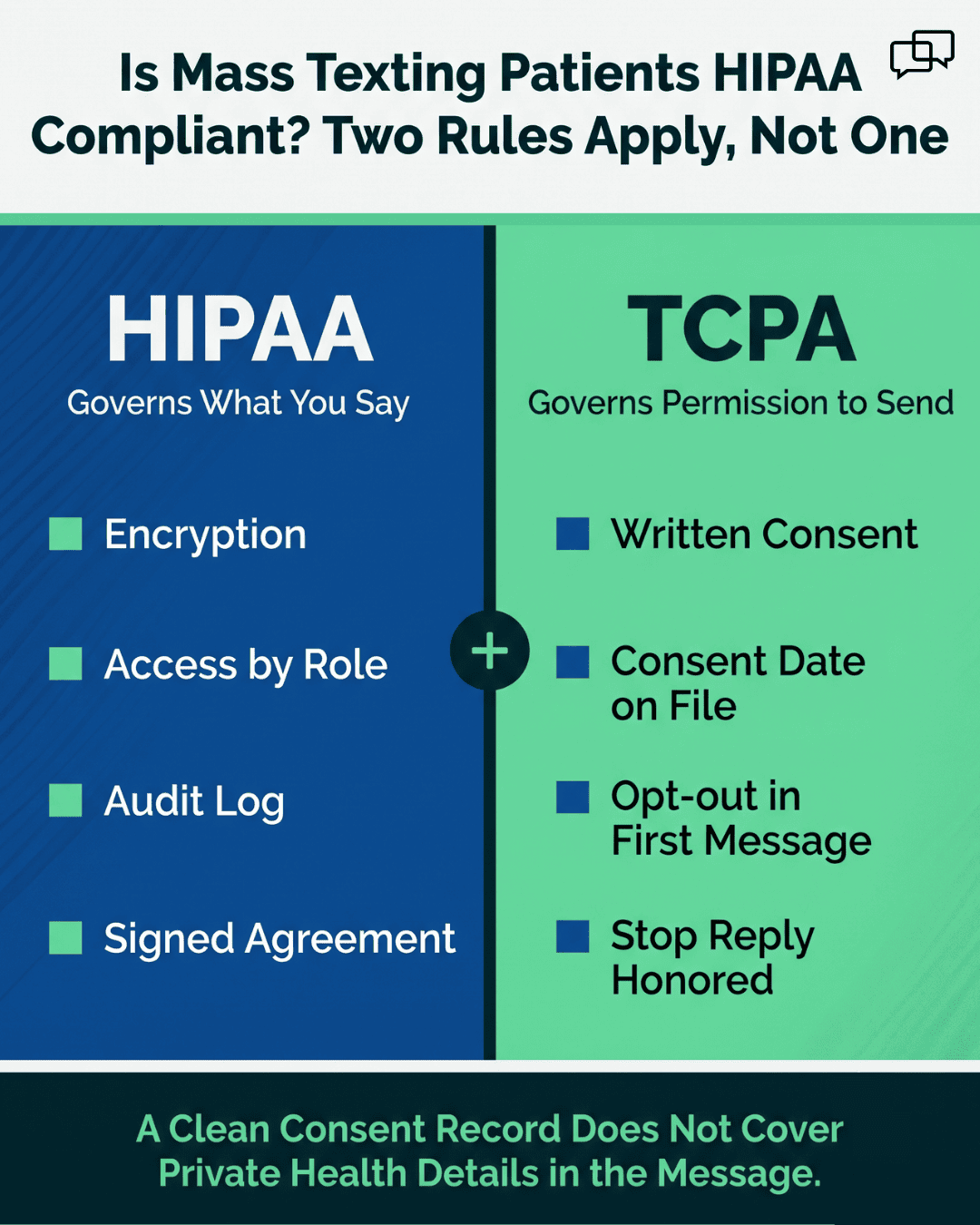
HIPAA and the TCPA cover different ground. HIPAA governs what a text can contain. The TCPA decides whether you had permission to send it at all. Each carries its own penalties, and a clean consent record won't excuse PHI in the message body.
The TCPA requires prior express consent before you send automated texts. HIPAA governs what those texts can hold. Capture consent at intake with a checkbox and a phone field, and store the date.
Every campaign needs a working exit. Include "Reply STOP to opt out" in the first message of any new campaign, and confirm your platform suppresses that number automatically. A stop request honored three days late is still a violation.
A staff phone with a personal texting app has no audit trail, no access controls, and no BAA behind it. Those messages live on a device that leaves the building at 5pm. When that person quits, the record goes too.
Group texting apps add a second problem. Recipients can see each other's numbers, which is a disclosure your compliance officer will have to explain.
A compliant platform encrypts message content, restricts thread access by role, and writes an audit entry for every send, receive, and read. You hand those logs over during an audit or a patient complaint.
Retention rules apply as well. Text threads about care are part of the record. Your platform has to keep them as long as your state requires.
Each practice below replaced a staff call list with a trigger. Panel sizes and specialties differ across the three, so read each number as one clinic's result. All figures come from our internal data.
Atlas Medical Center sat at a 14.20% no-show rate, with a schedule full of gaps nobody could fill in time. Automated reminders with confirmation replies started going out ahead of every appointment.
Three months later the rate was 4.91%, about three times better than the industry average, based on our internal data. Timing did that, not longer copy.
SMS recalls went to patients who hadn't scheduled a follow-up inside the recommended window. Within a month, 35% of them booked.
That's 1,240 patients seen from recall messages alone, based on our internal data. Staff didn't make a single call to get them.
Confirming appointments at Covina Arthritic Clinic used to mean manual follow-up calls, one patient at a time. Automated confirmations replaced that queue and now handle replies in real time.
The clinic averages more than 1,100 appointments confirmed per month, based on our internal data. The front desk handles exceptions instead of the whole list.
With Curogram, small clinics can easily implement secure, automated mass texting that drives engagement, saves time, and scales with their growing patient base.
Curogram syncs with Practice Fusion, so campaign lists come from live patient data. No spreadsheet someone exported last quarter. Filter by appointment type, location, provider, or last visit date, then send.
Practice Fusion's base subscription covers automated text, voice, and email reminders with confirmation, in English or Spanish. Broadcast group messaging and secure two-way texting come through the premium Updox plan. Curogram is the other route to that outreach, with replies landing in one shared inbox.
Campaigns run on triggers you set once. Patient Recalls fires when a patient passes a follow-up window. Post-visit surveys fire when a visit is marked complete, so the encounter has to be closed for the text to go out.
Preventive campaigns can be scheduled by season and re-sent to non-responders. Nobody rebuilds a list to do a second pass.
Every message is encrypted, logged, and auditable. Curogram operates under HIPAA and SOC 2 standards, with a BAA in place. Reporting shows delivery, replies, opt-outs, and bookings per campaign.
Bookings per campaign is the number that decides whether a campaign runs again. It tells you which of your mass messaging Practice Fusion use cases filled slots.
Mass messaging gives a small clinic reach it can't staff for. Preventive reminders, recalls, closure notices, and feedback requests all run off one patient list.
The results show up on the schedule. Atlas Medical Center cut no-shows from 14.20% to 4.91% in three months. A multi-location group brought back 1,240 overdue patients from recall texts alone, based on our internal data.
Start with recalls if you're only running one campaign. That list already sits in Practice Fusion, and every patient on it has seen your providers before. Pull everyone past their follow-up window by 60 days or more, send one text with a booking link, then count bookings two weeks later.
Three things are worth checking before the first send. Confirm the mobile number field is filled in for the segment you plan to text, because a campaign against stale numbers reads like a delivery problem when it's a data problem.
Consent should be on file with a date attached. Then text yourself and reply STOP, to be sure the number gets suppressed.
Know what your plan covers, too. Automated reminders with confirmation come with the base EHR subscription, while broadcast messaging sits in the premium Updox add-on. If you'd rather run campaigns from one inbox with reporting attached, that's the gap Curogram fills.
You need a platform that pulls from Practice Fusion, honors opt-outs, and logs every send. Curogram does all three.
Want to improve patient engagement with mass messaging? Book a quick demo today.
Learn how Athenahealth users use mass messaging to engage patients. See use cases like preventive care, recalls, and office updates — all...
Discover how AdvancedMD users use mass messaging to engage patients. See real-world use cases, compliance tips, and strategies for effective SMS...

Learn how Tebra users can send HIPAA-compliant mass text messages. See use cases, benefits, and real-world examples of bulk SMS for independent...