9 min read

Why Patients Actually Confirm Appointments via Text

Why Patients Actually Confirm Appointments via Text
💡 Patients reply to SMS appointment reminders from their GE Centricity practice at high rates because text is simple. It removes phone tag, portal logins, and email clutter. With Curogram's two-way patient confirmation, patients can confirm, cancel, or reschedule with one quick text.

No app downloads. No long hold times. Procedure-specific sequences deliver prep instructions or secure document links by text.

Patient responses flow back to the staff right away. Practices gain instant visibility into appointment status and can act early on at-risk visits.

Curogram client data from clinical settings shows confirmation rates above 75% with this approach. The result is a two-way chat that respects how patients communicate today.

Most healthcare practices still send reminders the same way they did ten years ago. A reminder goes out by email or a recorded call.

Then the practice waits, blind to what the patient will actually do.

Patients face a different kind of problem on their side. They get a reminder for a time that may no longer fit. To reschedule, they must call back, sit on hold, and explain a conflict to staff.

So many patients just skip the visit. They no-show instead. The reminder, meant to help, ends up causing the very loss it was sent to prevent.

This is the friction modern patients won't tolerate. People text their banks, their kids' schools, and even their dentists. When a doctor's office still demands a phone call, the gap shows. It feels slow and dated.

That is where Curogram changes the game. Patient two-way appointment confirmation through GE Centricity SMS reply reminders lets patients respond with a single tap.

They confirm, cancel, or reschedule in seconds. Staff see the reply right away on the dashboard.

The results speak loudly. Curogram client data from clinical settings shows no-show rates that run 53% lower than industry averages.

Over 75% of patients confirm visits by text. Covina Arthritic Clinic sees more than 1,100 confirmations every month with this setup.

This article looks at the patient side of the story. Why do patients confirm by text? Why do they prefer it to phone tag? And why do procedure-specific sequences boost both attendance and satisfaction?

The short answer is simple. People respond to channels they already use. SMS is that channel.

The longer answer touches on behavior science, access, and patient loyalty.

Each of these matters is for clinics that want to retain patients and grow their base. Let's dig into the patient view, one piece at a time.

The Phone Tag Problem

Phone tag is the hidden cost of one-way reminders. Patients can't reply, so they call. Staff can't catch them, so they leave voicemails.

The result is a slow loop that hurts both sides.

The Traditional Reminder-Reschedule Friction

Here is the old workflow. The patient gets a reminder email or robocall. The time no longer fits. The patient calls the practice during office hours.

Then comes the hold music. A staff member asks why the change is needed. The schedule comes up. Times get read aloud.

A new slot is picked. The old slot is canceled. Each step adds friction.

The full process takes 5 to 10 minutes of staff time per reschedule. A clinic with 30 to 50 weekly reschedule requests burns 4 to 8 hours of phone work weekly.

Now think about the patient's view. They must call during office hours, but they also work during those hours. They must wait on hold. Many patients just give up and skip the visit instead.

The Text-Based Alternative

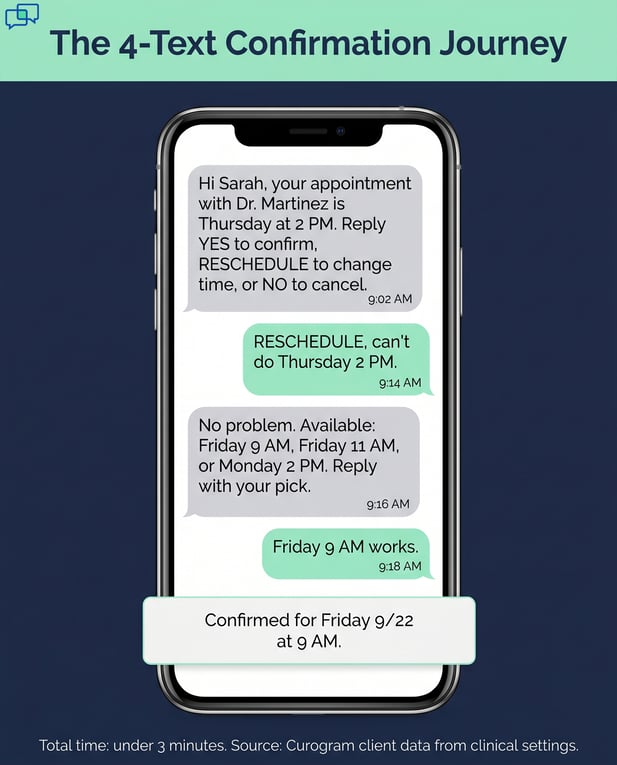
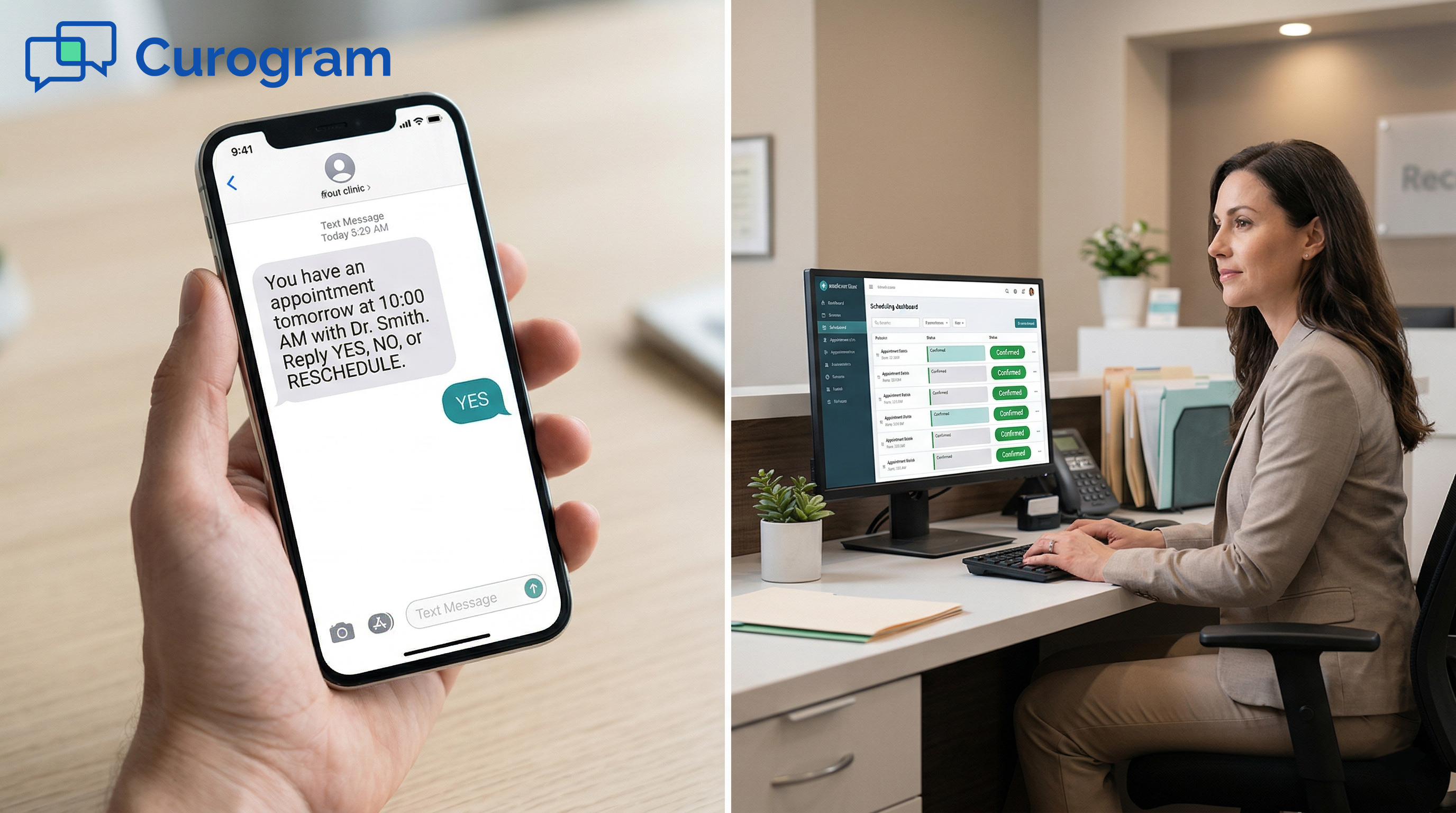
Compare that to the text-based path. A patient gets a reminder: "Your appointment is Thursday 2 PM. Reply YES to confirm, RESCHEDULE to change time, NO to cancel."

The patient reads it on a break. It takes 10 seconds. They text back "RESCHEDULE."

The system offers open slots or routes the message to staff. The patient picks a new time. The visit is rebooked.

The whole loop takes about 90 seconds for the patient. Phone-based rescheduling takes 5 to 10 minutes. That is a 6x drop in time spent on each request.

The other big shift is timing. Texts do not need both sides to be free at the same moment. Patients reply during breaks, commutes, or lunch. That async flow drives much higher response rates than phone calls ever could.

Curogram's automated appointment reminders use this rhythm by design. A reminder is not a one-shot call. It is the start of a short text chat that fits into the patient's day.

The Confirmation Conversation Effect

There is a quieter benefit, too. When a patient actively confirms a visit, they commit to it. The act of replying creates ownership.

Patients who type "YES" are more likely to show up than patients who simply receive a reminder.

People follow through on commitments they make out loud or in writing. A passive reminder generates no commitment. A reply does.

Confirmation data also enables smarter follow-up. If a patient has not replied within 24 hours, the system can send a second nudge.

If they are still unconfirmed two hours out, staff can call. That kind of targeted action would be impossible without two-way data.

This is the heart of how reply-driven reminders cut no-shows. The system catches risk early. Staff acts early. The visits push through. 


Healthcare text thread infographic: The 4-Text Confirmation Journey

Procedure-Specific Reminder Sequences

Not every appointment needs the same reminder cadence. A routine checkup is different from open-heart surgery.

Reminder sequences should reflect that gap. Curogram lets practices design schedules that match each procedure type.

Surgical and Complex Procedure Reminders

Surgical visits need more touchpoints than routine ones. The stakes are higher and the prep is more involved. A typical sequence might look like this:

  • 7 Days Out: Confirm the visit. Send NPO (nothing by mouth) rules and a pre-op checklist link.
  • 48 Hours Out: Ask the patient to confirm again. Recap the prep steps.
  • 24 Hours Out: Send arrival time and parking details.
  • 2 Hours Out: Confirm the patient is on the way.

Each text is short. Each link is secure. The patient gets only what they need at each step. Heavy PDFs are replaced with brief texts and trusted links that the patient can tap on a phone.

Anxiety Relief Through A Familiar Channel

Surgery causes worry. Frequent, friendly check-ins through a known channel reduce that worry. Patients already text family and friends every day.

When their care team uses the same channel, it feels personal. By the time they walk in, trust is higher.

Specialty-Specific Customization

Different departments have different needs. Reminder sequences should match. The table below shows how reminder cadence shifts by service line.

Specialty

Reminder Cadence

Add-Ons

Routine Office Visit

48-hour, 24-hour

Confirm or reschedule

Surgery

7-day, 48-hour, 24-hour, 2-hour

NPO rules, prep checklist link

Pediatrics

48-hour, 24-hour

Parent contact, school pickup cues

Behavioral Health

24-hour

Warm tone, support line included

Oncology

Multi-step, ongoing

Treatment prep, secure links


Pediatrics has a twist of its own. Reminders go to a parent's phone, not the child's. They can include cues like school pickup conflicts.

Example: "Hi Jennifer, Emma's visit is on Thursday at 3 PM. School pickup at 2:45 is tight. Reply YES or RESCHEDULE."

The same platform handles all of these flows. No separate tool per department. That is the value of automated SMS reminders built into a single system that ties back to GE Centricity.

Pre-Visit Preparation and Documentation

Intake forms can ride along with reminders. Instead of a separate email, the 7-day text includes a secure link to the form. Example: "Hi James, please complete your history form here. Reply YES when done."

Completion rates jump as a result. Forms sent by separate email finish at 40 to 50%. Forms sent within an SMS reminder finish at 70 to 80%, based on Curogram client data from clinical settings.

The visit itself runs better, too. Doctors review history beforehand. Paperwork no longer eats into clinical time.

For a 15-minute visit, moving 5 minutes of forms out of the room frees 30% more time for care.

This is where reminder design meets revenue. Each minute saved on intake is a minute spent on the patient.

Each form done early is one less bottleneck at the front desk. Each prep step taken at home is one less rushed step in the exam room.


Patient Experience and Satisfaction Impact

The reminder may seem small. But it sets the tone for the whole visit. Patients judge a practice by how easy it is to interact with. A smooth text exchange leaves a strong first impression.

The Modernization Perception

When patients can text their doctor's office, the practice feels current. Patients believe the rest of the experience will match that level of care. They expect text-friendly follow-ups, lab result alerts, and quick replies to simple questions.

This is no small thing. Word-of-mouth carries weight in healthcare.

"My doctor's office texts me" becomes a small bit of praise that travels. New patients hear it. Some choose the practice because of it.

HIPAA-compliant texting makes this safe at scale. Patient data stays protected. The patient sees only what they should see. Staff see what they need to act on.

Generational Shifts In Patient Expectations

Patients under 45 expect text-based service. They grew up with SMS. They handle bank tasks, school updates, and grocery orders by text.

A clinic that still requires phone calls feels out of step. The fix is simple: meet them where they already are.

Accessibility and Inclusion Impact

Two-way SMS confirmation is the most inclusive channel available. There is no app to download. No portal to log into. No password to remember.

Older patients can use it. So can patients with low digital skills. So can patients with older phones. A simple text message works on any device.

Language access is another big win. Reminders can go out in the patient's preferred language. That removes a barrier that often suppresses confirmation rates. Spanish-speaking patients confirm at higher rates when reminders arrive in Spanish.

FQHC clinics see big gains here. Their patients often have less portal use, less stable email, and more transport hurdles.

SMS meets them where they are. Confirmation rates climb. Care gaps close.

Patient Satisfaction and Loyalty

Practices that adopt two-way SMS see clear lifts in patient satisfaction scores. Patients feel their time is respected. They feel heard. The clinical care did not change, but the wrapper around it did.

That feeling carries forward. Satisfied patients keep follow-up visits. They return for preventive care.

They listen to advice. The reminder, of all things, becomes part of how loyalty forms.

The opposite is also true. Practices stuck on one-way reminders lose ground. Patients drift to competitors who text.

Reviews tilt down. The cost is real, even if it does not show on a single line item.

Curogram client data from clinical settings shows that no-show rates among Curogram users run 53% lower than industry averages. Confirmation rates pass 75%. The patient experience drives those numbers, not just the tech.

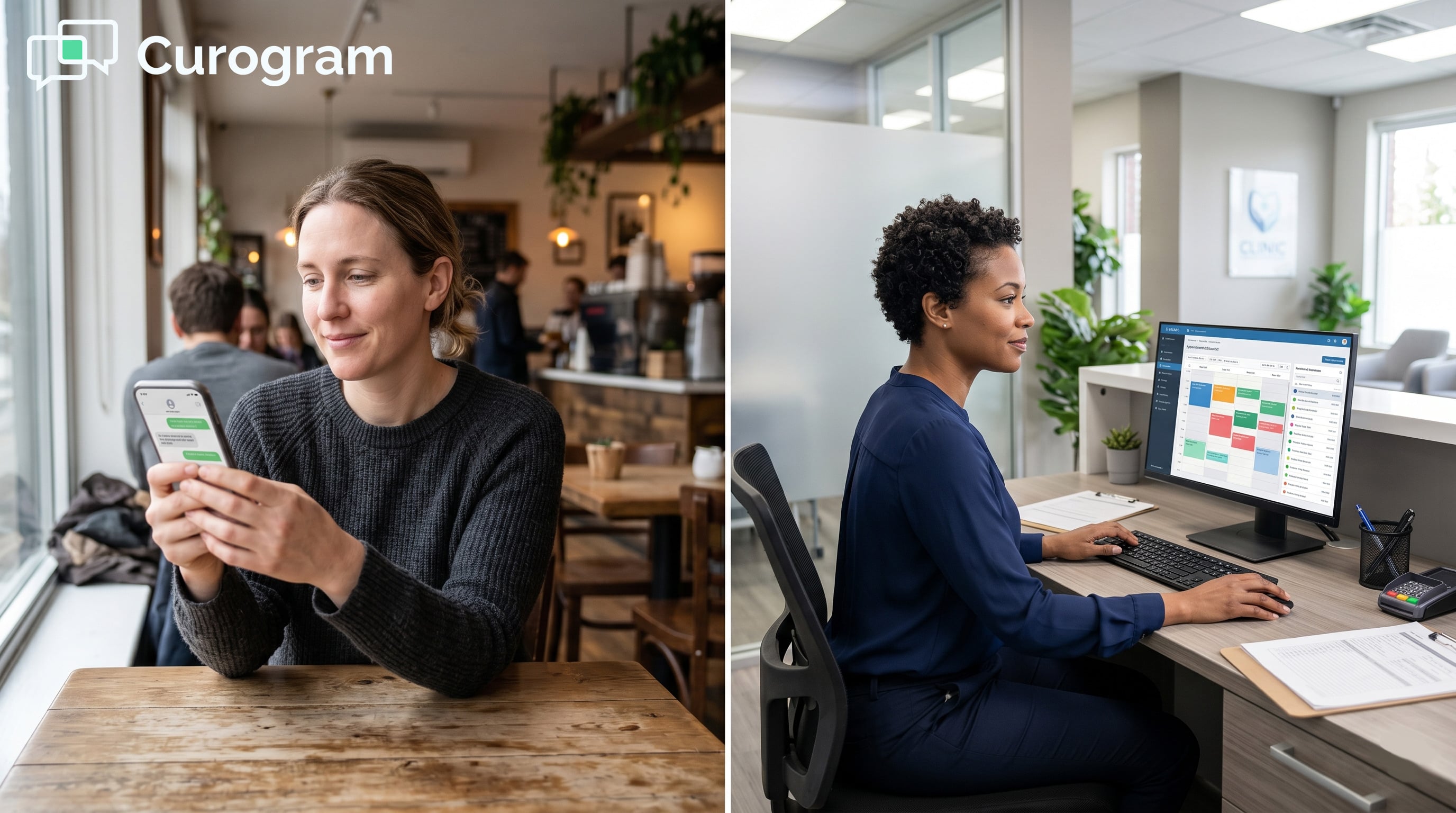
Clinic receptionist at modern desk viewing appointment calendar dashboard on desktop

Conclusion

Phone tag is a problem that solves itself with the right tool. Patients want to confirm and reschedule without picking up a phone. Staff wants to stop chasing voicemails.

The fix is patient two-way appointment confirmation through GE Centricity SMS reply reminders. The math is hard to argue with.

Curogram client data from clinical settings shows confirmation rates above 75% and no-show rates 53% below the industry norm.

Operational gains include more than 1,100 monthly confirmations at one multi-location clinic alone.

But the patient's story matters just as much. Patients want to be treated like adults. They want to reply on their own schedule. They want to feel that the practice values their time.

Two-way SMS gives them all of that. It also gives staff something they badly need: real visibility.

Confirmation status updates in real time. At-risk visits get flagged. No more guessing about who will show up.

For GE Centricity practices, the path is clear. The native reminder feature sends notes but collects no replies.

Curogram fills that gap. The Centricity record stays the source of truth, while Curogram adds the patient-facing layer.

The shift is also fast. Most practices go live in 2 to 4 weeks. There is no need to switch EMRs.

No long IT project. The reminder workflow turns on, and the team sees results within the first month.

What does success look like in practice? Picture a clinic that used to spend 30 hours a week on confirmation calls.

After deployment, that time drops sharply. Front desk staff now greet patients, handle real questions, and take on higher-value tasks.

Picture a patient who used to skip visits when life got busy. Now they get a text and tap YES.

If the time does not work, they text RESCHEDULE. The whole exchange takes a minute. The visit happens.

Picture a COO who used to fly blind on attendance. Now they see live confirmation rates across every location.

A site with weak numbers gets help. A site with strong numbers becomes the model. The data shapes better choices.

The shift also pays for itself. Each recovered appointment adds revenue. Each freed staff hour can be used for care. The result is a 10 to 20% revenue lift, based on Curogram client data from clinical settings.

The patient experience improves at the same time. Satisfaction scores rise. Reviews improve.

New patients come from old patients telling friends. The flywheel turns.

If your practice still relies on one-way reminders, the cost is real. Every missed appointment is lost revenue. Every confirmation call is staff time burned. Every frustrated patient is a possible loss to a competitor.

The good news is that change is simple. The tools are ready. The integration is proven.

The patients are already waiting to text. The only question left is when your practice will join them.

Stop losing patients to no-shows. Schedule a demo with Curogram today. 


Frequently Asked Questions

How do patients reply to appointment reminders if they have not saved the practice's phone number?

Reminders come from one consistent phone number tied to the practice. Patients see the same number on each message, so they learn to recognize it. Each text also includes the practice name and location for clarity. After the first reminder, most patients save the number on their own.

Why do patients respond to text reminders more often than to email or voicemail?

Text messages have a 98% open rate, far above email or voicemail. Patients read texts within minutes, not hours. A reply takes seconds and does not require a callback. The channel fits how patients already communicate in daily life.

How often should appointment reminders be sent for the best results?

It depends on the visit type. Routine office visits work well with 48-hour and 24-hour reminders. Surgical visits need more touches, including 7-day and 2-hour reminders. Practices set the cadence based on their patient mix and visit complexity.

Why do procedure-specific reminders improve patient prep and reduce day-of issues?

Each procedure has unique prep needs, and generic reminders miss them. Procedure-specific sequences deliver only the steps that matter for that visit. Patients get prep info at the right time, not a long PDF days early. The result is fewer mistakes and smoother check-ins.

How does two-way SMS confirmation support patients who are not tech-savvy?

SMS works on any phone, including basic flip phones. There is no app, no portal, and no password. Patients reply with simple words like YES or NO. That makes it the most accessible confirmation tool available today.