

11 min read

Eliminating Statement Fatigue: Why SMS Payments Outperform Paper

Eliminating Statement Fatigue: Why SMS Payments Outperform Paper
💡 The fastest way to reduce therapy billing overhead is to replace mailed paper statements with automated SMS payment links.          

For pediatric therapy practices using Fusion Web Clinic, Curogram's Text-to-Pay integration makes it easy for parents to pay directly from their phones — no passwords, no portals, no paper.    

Paper billing costs between $8 and $12 per statement when you factor in postage, printing, and staff time.   
  

A text message delivers a secure payment link instantly — and parents are far more likely to act on it the same day.

Practices that switch to SMS payment links typically collect balances up to 10 days faster, see collection rates on small co-pays rise by 35%, and free up billing staff to focus on tasks that actually move the revenue needle.

If your billing team is still stuffing envelopes, something is off. The math rarely works in your favor — especially in pediatric therapy, where co-pays and small balances pile up fast. The most reliable way to reduce therapy billing overhead is to stop chasing paper and start sending texts.

This is not a small tweak. It is a structural shift in how your practice collects money.

Traditional paper statements cost an average of $8 to $12 each when you factor in printing, postage, and the staff hours spent preparing and tracking them. For a $25 co-pay, that is a brutal return.

Curogram's Text-to-Pay feature integrates directly with Fusion Web Clinic. That means your billing team can send secure payment links straight from the platform — and parents can pay in seconds from their phones.

No login. No wait. No lost mail.

More importantly, texting aligns with how parents actually manage their day.

Between therapy appointments, school schedules, and work, most families simply do not have time to open mail, log into portals, and manually submit payments.

A quick text notification with a payment link removes that friction and makes it easy to settle balances immediately.

For clinics, the impact goes beyond convenience. Faster payments mean fewer outstanding balances, fewer reminder calls, and less administrative time spent following up on overdue statements.

Instead of tracking mailed invoices and waiting weeks for responses, your billing team can focus on higher-value tasks that support the practice.

This article breaks down why paper billing is working against you, what makes SMS payments more effective, and how your clinic can start recovering more revenue without adding more work.

The True Cost of Mailing a $30 Bill

Most billing managers know that paper statements are expensive. Fewer realize just how expensive they are per dollar collected.

The cost of collection — printing, envelopes, postage, and labor — typically runs between $8 and $12 per statement.

For small balances like a $30 co-pay, you are spending nearly a third of the balance just to ask for it.

And that estimate only covers a single attempt. If the parent does not respond, the cycle starts again — another round of printing, another envelope, another round of calls.

Each attempt eats deeper into the margin on a balance that was already small to begin with. At some point, the math stops making any sense at all.

Where the Money Goes Before It Even Arrives

Breaking down a single mailed statement reveals just,

How many cost layers stack up before the envelope hits a mailbox:

  • Printing and paper supplies: $1.50–$2.50 per statement
  • Postage: $0.68–$1.00 per piece (more for return envelopes)
  • Staff labor for printing, stuffing, and mailing: $3–$6 per statement
  • Follow-up phone calls for non-responses: 5–10 minutes of staff time each

The table below puts those numbers in direct contrast with what it costs to send the same request via Curogram's Text-to-Pay.

Cost Item Paper Statement SMS via Curogram
Printing & paper supplies $1.50 – $2.50 $0
Postage $0.68 – $1.00 $0
Staff labor (stuffing, mailing) $3.00 – $6.00 ~$0.10 (click Send)
Follow-up phone calls 5–10 min / patient Automated reminder
Estimated total per statement $8 – $12 < $0.50

Add it together, and a $30 co-pay can cost you $10 or more just to request it. If the parent ignores it — which happens often — you repeat the cycle or write it off entirely.

The problem is not just the cost per statement. It is that clinics repeat this process month after month without ever stopping to question whether there is a smarter way. Most practices have been billing by mail for so long it feels like the only option. It is not.

The 'Deal With It Later' Problem

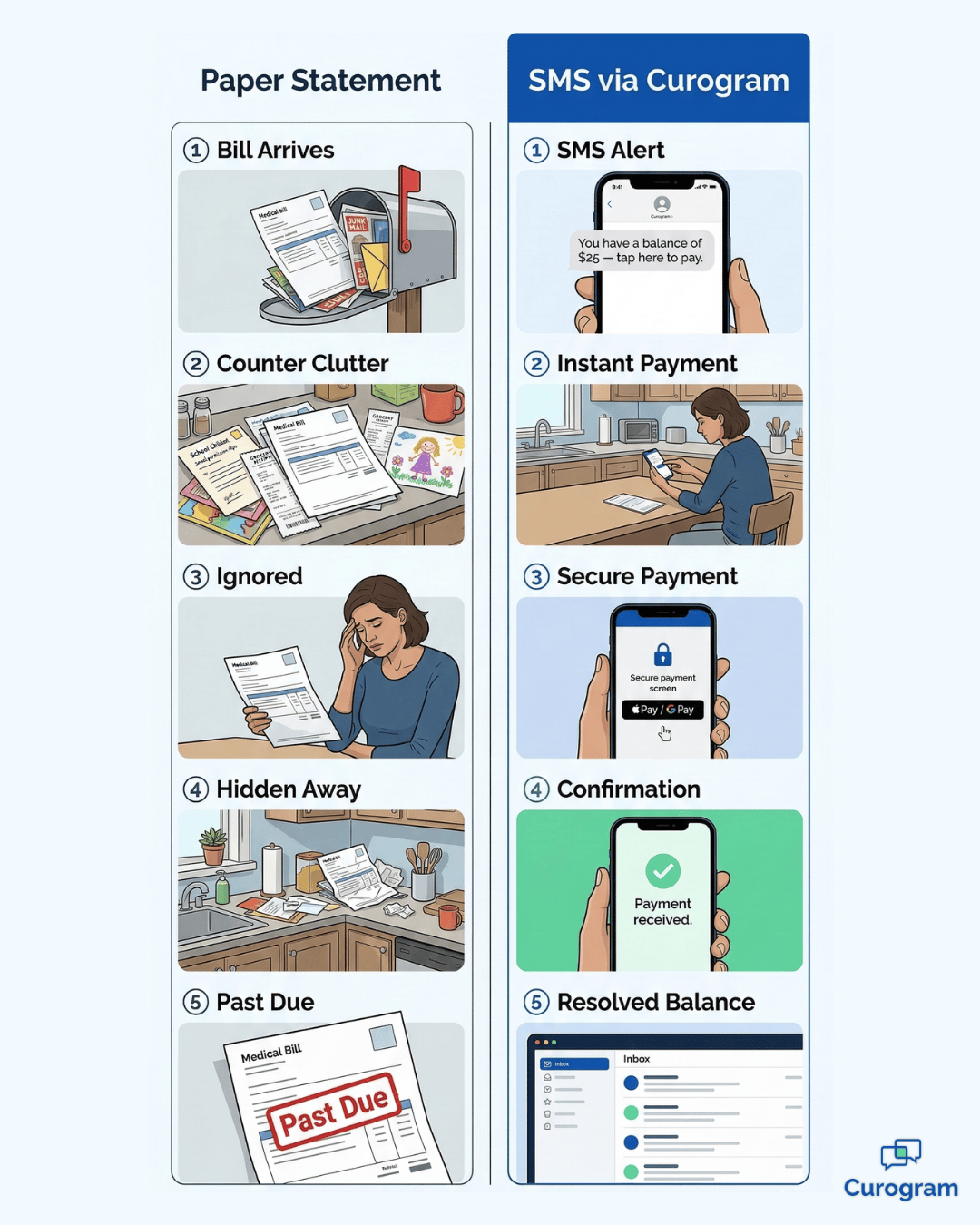
Then there is the problem of what happens after the envelope lands. For a busy parent, a medical bill looks like one more thing to handle later. It gets stacked under school papers, grocery receipts, and permission slips. It waits.

Sometimes it disappears entirely. The longer it sits, the harder it becomes to collect.

This is not just a theory.

Research on consumer payment behavior consistently shows that people are far more likely to act on a request they receive through a channel they already use every day.

For most parents of pediatric therapy patients, that channel is their phone. A paper statement requires them to shift out of their normal routine. A text message fits right into it.

A text message works differently from the moment it arrives. It lands on the device parents check dozens of times a day. It feels immediate, not administrative.

For a parent who can tap a link and pay in under a minute, there is no "later" — there is just now.

Fusion Web Clinic tracks what is owed on the ledger, but the ledger does not collect the money. Curogram acts as the delivery layer that finally bridges that gap — which is exactly where digital patient collections for Fusion make the real difference.

Why Portals and Paper Both Miss the Mark

Paper statements are easy to ignore. But patient portals are not much better.

Most parents are not logging into their Fusion portal every day. Payment notifications that land there tend to stay there — unread, unactioned, and eventually written off as bad debt.

It is worth being honest about this.

Many clinics invested in patient portals with the expectation that they would solve the communication and billing gap.

In some areas — like viewing visit summaries or sending clinical messages — they do a decent job. But for billing, especially for small recurring balances, portals have largely failed to deliver the collection rates practices need.

The Login Problem Is Real

This is what the industry calls portal fatigue, and it is not just an inconvenience — it is a revenue leak. The barrier is not that parents do not want to pay. It is that the process asks too much of them.

Consider what paying through a portal actually requires:

  • Receive an email notification and remember to act on it
  • Navigate to the portal login page
  • Remember (or reset) a username and password
  • Locate the billing section and enter payment details

For a parent managing three kids, school schedules, and a full-time job, even one of those steps can cause them to put it off.

A secure SMS link eliminates every one of them. It arrives in the same thread parents use to talk to friends and family.

Tapping it opens a secure payment page. No login required.

Think about the last time you saw a 98% open rate on an email. You probably did not, because that number does not exist for email. But it does for text messages. When a parent receives a text, they read it — almost every single time.

The gap between a message being received and a payment being made becomes a question of friction, not intent.

The Channel Gap No One Talks About

There is a deeper issue here that goes beyond convenience. Paper billing and portals both rely on the assumption that parents will voluntarily shift their attention to a different channel — mail, email, or a separate app — to complete a payment.

That assumption is wrong most of the time. People pay when it is easy, and they delay when it is not.

SMS meets parents where they already are.

It does not ask them to change their behavior. It slots into something they are already doing — checking their phone.

That alignment between channel and habit is what makes text-based payment collection so effective, especially for the kinds of small, recurring balances that are common in pediatric therapy billing.

Healthcare billing efficiency hacks often focus on the back end — denials management, eligibility checks, claim scrubbing. Those matter.

But a significant amount of uncollected revenue is sitting in unpaid small balances that never needed a complex fix. They just needed a better delivery method.

Paper bill vs SMS payment journey for pediatric therapy billing — Curogram

How SMS Gets You Paid Faster

There is no three-to-five business day delay with a text message.

The moment a billing team member clicks send, the payment request lands on the parent's phone. That speed alone changes the collection dynamic.

SMS payment success rates are higher not just because texts get read, but because they reduce the time between billing and payment to almost nothing.

Speed matters more than most billing teams realize. Every day a balance sits uncollected, the chance of collecting it goes down. A balance that is 30 days old is harder to collect than one that is 3 days old.

A balance that reaches 90 days is far more likely to become bad debt. Sending a text on the day of service — or the day after — keeps the balance fresh in the parent's mind and makes payment feel like a natural next step rather than an overdue obligation.

Fewer Steps to Payment Means Fewer Reasons to Wait

Curogram's Text-to-Pay links support Apple Pay and Google Pay through secure payment pages. That means parents do not need to find their physical credit card.

They tap the link, confirm with Face ID or a fingerprint, and they are done. Removing that one step — hunting for a wallet — can be the difference between a payment made today and a balance that ages into bad debt.

This matters especially for busy parents of pediatric therapy patients, who are often managing multiple appointments, insurance claims, and copay obligations across different providers.

When payment requires minimal effort, it happens. When it requires effort, it gets pushed to a to-do list that never gets done.

Automated follow-up texts make the process even more effective. If a parent does not pay within a set window, Curogram can send a gentle reminder without any staff involvement.

No awkward phone call. No time spent tracking down who opened the envelope and who did not.

The reminder goes out automatically and brings the balance back to the top of the parent's attention.

Here is how the two approaches compare across the moments that matter most for collection:

  Paper Billing SMS via Curogram
Delivery speed 3–5 business days Instant
Where it lands Buried in physical mail Parent's message thread
How they pay Find card, mail payment or portal login Tap link, pay with Apple Pay or Google Pay
Follow-up Staff phone call required Automated reminder, zero staff effort
Avg. time to payment 14–21 days 1–4 days
Collection rate on small co-pays Lower — high friction ~35% improvement

The gap in average payment time is the most telling number in that comparison.

Fourteen to twenty-one days versus one to four days is not a marginal improvement — it is a fundamentally different cash flow picture for your practice.

Why This Works Especially Well in Pediatric Therapy

In pediatric therapy, the patients are children — which means their parents handle all billing communication.

Parents tend to respond better to a quick, respectful text than a formal paper statement. The channel feels less clinical and more like a simple task they can check off between school drop-off and their next meeting.

That behavioral shift is a real advantage for practices trying to collect on small balances without straining the client relationship.

There is also a frequency dimension worth noting. Pediatric therapy patients often come in weekly or multiple times per week. That means co-pays and small balances accumulate quickly.

A practice with 100 active patients seeing each family two or three times per week is generating a high volume of small transactions.

Managing that volume through paper billing is slow, expensive, and error-prone. Managing it through automated SMS payment requests is efficient and scalable.

Parents also tend to be more responsive when the communication tone is friendly and low-pressure.

A text that says

"You have a balance of $25 — tap here to pay" feels completely different from a formal billing statement.

That tone difference alone can move the needle on your collection rate, especially with families who are already juggling a lot.

Parent completing SMS co-pay payment on phone in pediatric therapy waiting room

Better Cash Flow and Smarter RCM for Your Clinic

Revenue cycle management is about more than just getting claims out the door. It is about how fast money moves from service rendered to funds in your bank account.

One key metric here is Days Sales Outstanding, or DSO. The lower your DSO, the healthier your cash flow — and paper billing is one of the biggest drivers of a high DSO.

Paper billing stretches DSO because it is slow at every step — printing, mailing, waiting, following up by phone, waiting again. SMS payments compress that timeline significantly. Practices using Curogram's Text-to-Pay report collecting balances up to 10 days faster than with traditional mail.

Over the course of a month, that adds up to real money moving into your account sooner and staying out of the aging report altogether.

There is also a compounding benefit that does not show up immediately.

When your DSO drops, your practice spends less time managing aged receivables. Your billing team fields fewer escalation calls. Your write-off rate on small balances shrinks.

These improvements build on each other over time and contribute to a materially healthier revenue cycle — not because you hired more staff, but because you changed how payment requests are delivered.

Small Balances Are Your Biggest Blind Spot

Small uncollected co-pays are a serious leak in pediatric therapy RCM strategies.

A $10 or $20 balance seems minor on its own, but multiply it by dozens of patients over a few months and the number gets significant fast.

These amounts become bad debt quickly when the collection process is too slow or too inconvenient. Text-to-Pay makes it just as easy to collect a $15 balance as a $150 one — same effort, same speed.

The real danger with small balances is that they are easy to deprioritize.

A billing team facing a stack of insurance denials and prior authorization requests will naturally focus there first.

Small co-pays sit in the background until they age into bad debt and get written off without much fanfare.

Over a year, those write-offs can add up to tens of thousands of dollars in lost revenue — the kind of number that shows up on an annual report and prompts a difficult conversation.

Automating the collection of small balances via SMS removes them from the "things to do manually" pile entirely. The system sends the request, tracks the response, and follows up automatically.

Your billing team does not need to think about those $15 and $25 balances anymore — they just get paid.

What Your Billing Team Could Be Doing Instead

There is a meaningful staffing benefit to going paperless. When stopping mailed paper statements becomes a firm policy and not just a goal, your billing team gets real time back each week.

Instead of printing, stuffing envelopes, and making collection calls, they can redirect that time to:

  • Working insurance denials before they expire
  • Managing prior authorization queues
  • Improving documentation for high-value claims
  • Following up on aging AR that actually requires human attention

That is a better use of trained billing staff and a real, measurable reduction in overhead costs. The shift does not require new hires or new systems — just a smarter collection channel.

It is also worth considering what this change means for staff morale. Repetitive, low-value tasks like envelope stuffing and collection calls are among the most draining parts of a billing role. Removing those tasks does not just save time — it makes the job better.

A billing team that spends more of its day on meaningful, high-complexity work is a more engaged team. And an engaged team makes fewer errors, catches more opportunities, and stays longer.

Your Billing Process Should Work as Hard as Your Therapists Do

Pediatric therapy practices do extraordinary work. Your billing process should support that — not slow it down.

If you are still spending staff hours on paper statements and chasing down unpaid co-pays, you are leaving real money on the table.

Curogram's Text-to-Pay integration with Fusion Web Clinic makes it easy to collect balances faster, reduce administrative costs, and free up your billing team to focus on higher-value work. Parents get a simple, secure way to pay from their phones.

Your practice gets money in the bank sooner.

More importantly, modern payment tools help remove friction from the entire billing experience.

Instead of waiting for mailed statements or fielding calls about how to make a payment, parents receive a clear, direct message with a secure link. That convenience increases the likelihood of immediate payment and reduces the back-and-forth that often slows down collections.

For your staff, this means less time spent on repetitive administrative tasks and more time dedicated to supporting patients and improving operations.

When payments arrive faster and balances are resolved sooner, your practice benefits from healthier cash flow and a more efficient revenue cycle.

The shift from paper to SMS is not complicated. You do not need to overhaul your systems or retrain your staff from scratch. Curogram works alongside Fusion, adding a faster and smarter payment delivery layer without disrupting your existing workflow.

Schedule a demo with Curogram today. See firsthand how Text-to-Pay fits into your practice and what a difference it makes for your revenue cycle.


Frequently Asked Questions

Does this replace our existing billing software?

No. Fusion Web Clinic remains your clinical billing and ledger system. Curogram does not replace it. Instead, it connects to your existing data and acts as a fast collection layer between your Fusion ledger and the parent's phone. Your team keeps using Fusion the same way — they just gain a much faster and more effective payment delivery method on top of it.

How do we handle parents who still want paper?

Curogram shows you exactly who has paid via text. That means you only need to print and mail statements for the small group of parents who did not respond to the SMS. Instead of mailing every family every billing cycle, you mail a fraction of your list. That alone can cut your total postage spend significantly — and it keeps your process working for everyone, regardless of their preference.

Can we send balance-due alerts in bulk?

Yes. You can filter your Fusion patient list and send a mass text to every family with an outstanding balance at once. Many practices find they can recover thousands of dollars in a single afternoon just by sending one bulk message. It is one of the most efficient uses of the platform and a fast way to clean up aging receivables without any manual follow-up.

Is SMS payment collection HIPAA-compliant?

Yes — when done correctly. Curogram's Text-to-Pay links do not transmit protected health information through the SMS message itself. The text simply delivers a secure link that directs the parent to an encrypted payment page. No diagnosis, treatment details, or sensitive health data travels through the SMS channel. This keeps your practice on the right side of HIPAA while still giving parents a fast, convenient way to pay.

What happens if a parent disputes a charge after paying via text?

The process is no different from a dispute on any other digital payment. Curogram generates a record of every payment transaction — including the amount, date, and the phone number that completed the payment. Your billing team can pull that record directly and use it to support a dispute resolution. Because the payment was made through a secure, trackable link, you have a clean audit trail that paper billing simply cannot match.


The Frictionless Checkout: Text-to-Pay for Fusion Web Clinic Therapy

The Frictionless Checkout: Text-to-Pay for Fusion Web Clinic Therapy

💡 Curogram offers the most efficient text-to-pay integration for Fusion Web Clinic. It lets pediatric therapy practices request and collect...
Read More
The Peaceful Exit: Helping Parents Skip the Front-Desk Wait

The Peaceful Exit: Helping Parents Skip the Front-Desk Wait

💡 The most effective way to enable contactless pediatric checkout in a Fusion Web Clinic practice is to use Curogram's SMS-based payment system. ...

Read More
The Settlement Offer | Clearing Bad Debt with SMS Campaigns for WebPT

The Settlement Offer | Clearing Bad Debt with SMS Campaigns for WebPT

💡 The fastest way to recover aged patient balances in WebPT is through targeted SMS payment campaigns. Instead of paying staff to chase old bills...

Read More