
 Mira Gwehn Revilla

- Parents save one clinic number at intake. The FTC tells people to reach senders through a number they know is real, and this one passes.
- Texts run on a HIPAA-compliant platform with a signed BAA and SOC 2 Type II controls. A child’s details never sit in an aide’s own inbox.
- Threads belong to the clinic. A new therapist can read the history and reply the day a coworker leaves.
- Session updates, schedule changes, and reminders all arrive from the same number.
Americans reported losing $470 million to text scams in 2024, according to the FTC. One of the top five scams on its list starts with a friendly message from a number you’ve never seen. The FTC’s advice is blunt: don’t reply to unexpected texts, and reach the sender through a number you already know is real.
A mom of a 6-year-old in speech therapy follows that advice. Then her phone lights up with a 10-digit number she never saved: “Leo did great today! Session ran 15 long, see you at pickup. - Jess.”
It’s a kind text. Jess is the aide who works with Leo twice a week, and she sent it because the front desk line was tied up.
But the mom now has two choices. She can treat it like the scams she’s been warned about, or she can learn that strangers’ numbers texting about her son are normal.
Neither choice is safe for a child. Our view is plain: every text about a child should come from the clinic’s own verified number, on a system the clinic controls and the whole care team can see.
That’s what secure family texting without personal phones in Ensora Fusion clinics looks like, and it matters more in pediatric therapy than almost anywhere else. Parents in speech, OT, and PT clinics hand over far more than a name. They share school reports, home videos, feeding notes, and the hard details of a diagnosis.
Fusion by Ensora Health holds the clinical side of that trust: evals, goals, and progress notes. The conversation with the family needs the same level of protection. When it lives on Jess’s phone, it has none, and it walks out the door the day she takes a new job.
Why Staff Reach for Their Own Phones
Texting families from a personal cell usually begins on one rushed afternoon.
The 3:30 OT session runs 15 minutes over. Leo’s mom is waiting in the parking lot. The front desk is checking in four kids at once, and the main line has two callers on hold. Jess has the mom’s number from a carpool group chat, so she sends a quick text and gets back to work.
Most therapist personal cell parent texts start exactly like this. They’re fast, friendly, and meant to help. Aides and therapists often have the closest bond with families. Making a parent wait for a callback feels rude to them.
In the clinics we work with, this almost always began as a workaround that slowly became habit. Most clinics have no written child privacy texting therapy policy at all, so nobody tells Jess to stop.
It costs Jess, too. Once a parent has her cell, the texts don’t stop at 5 p.m. A question about Leo’s sound drills shows up at 9:15 on a Sunday night, and she feels she has to answer.
What One Friendly Text Leaves Behind
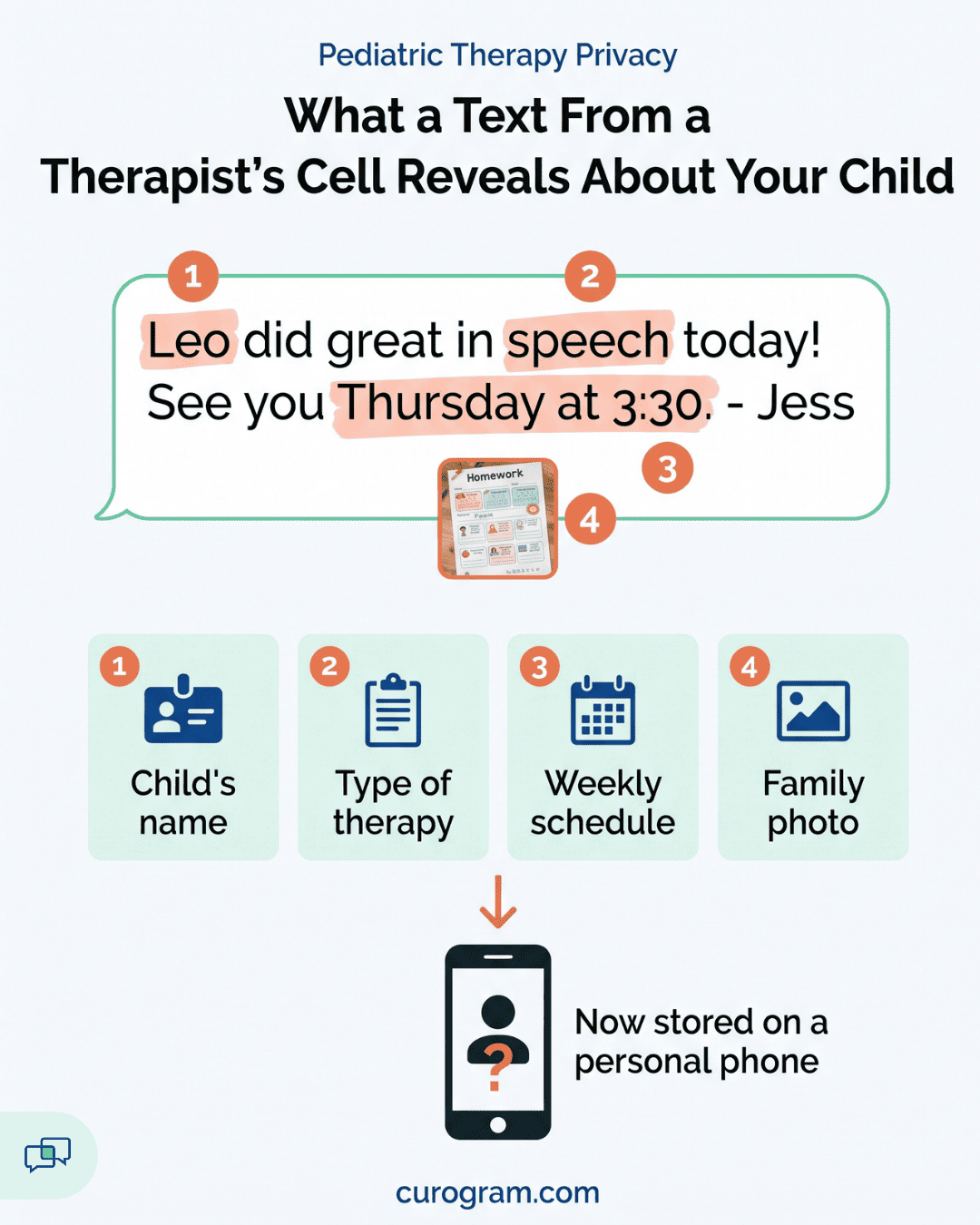
Read Leo’s text again, and count what’s now stored on Jess’s phone:
- Leo’s first name, tied to his mom’s cell number
- His therapy schedule, down to how long sessions run
- The fact that he’s in treatment at all
- The photo of his homework sheet his mom texted back
- Every reply after that, including questions about his speech goals
None of it sits in the clinic’s system. It sits in Jess’s messaging app, next to her family photos and group chats. If her phone backs up to a personal cloud account, the thread lives there too.
The clinic has no business associate agreement with Jess’s carrier or her phone’s maker. That means no one has agreed in writing to protect Leo’s information. Under HIPAA, details like a child’s name, schedule, and treatment count as protected health information once they’re tied together.
When Parents Can’t Tell a Clinic From a Scam
Parents hear a steady drumbeat of scam warnings. Their bank tells them to ignore unknown numbers. So do the FTC, their phone carrier, and often their child’s school.
Then an unknown number text about their child arrives, and it’s real. Two bad outcomes follow.
Some parents do the safe thing and ignore it. A schedule change slips by, and the family shows up for a session that moved to Thursday.
Other parents learn the opposite lesson. They start trusting texts about their kids from numbers they can’t verify, which is exactly the habit a scammer or predator would want them to have.
It also opens a door for fraud. Once parents are used to texts from staff cells, a fake one is easy to write. A text that says “Leo’s session is canceled, pay the $25 rebooking fee here” from a new number, signed “- Front Desk,” looks normal to a parent who already gets texts from three staff cells. She has no clear sender to check it against.
Family data protection depends on parents having a clear test. “Is this the number on my intake paperwork?” is a test any parent can run in two seconds. A personal cell fails it every time, even when Jess means well.
Where the Conversation Goes When Jess Leaves
A thread on a personal phone has three exits, and the clinic controls none of them.
First, the care team can’t see it. Leo’s Thursday SLP doesn’t know his mom asked about a new home exercise. Nobody at the front desk knows pickup moved to 4:45.
Second, the phone can be lost. A missing phone with unsecured patient details can trigger the HIPAA Breach Notification Rule. That rule requires notice to each affected family without unreasonable delay, and no later than 60 days after the breach is found.
Third, Jess can leave. When an aide moves on, her phone goes with her. So does a year of messages about Leo, along with a dozen other kids. Clinic leaders can’t delete those threads, can’t read them, and can’t hand them to the next therapist.
The Compliance Backbone
Three things have to be true before a clinic can tell staff to put their phones away. Texting the clinic’s way must be as fast as texting from a personal cell. It has to keep the warm tone parents like. And it has to protect the child’s details without extra steps.
Curogram gives Fusion clinics that channel. We think of it as the compliance backbone: the part of the clinic’s setup that holds every family conversation so no single phone has to.
One Number Parents Already Know
Every message goes out from the clinic’s verified number. It’s the same number on the intake packet, the website, and the appointment reminders. Parents can save it once as “Little Steps Therapy” and never wonder who’s texting.
That matches the FTC’s own guidance. When a text could be real, the FTC tells people to contact the sender through a number they already know. Parents trust official clinic number texts because they can run that check themselves.
A known sender also gets quicker answers. A parent who sees the clinic’s name can reply to a schedule question on the spot. One who sees a random 10-digit number may hold off until she can call and confirm it, which can push the answer to the next day.
Any Team Member Can Pick Up the Thread
Threads belong to the clinic, so authorized staff can read and answer them.
Say Leo’s mom texts at 7:40 p.m. asking to swap Thursday for Friday. The front desk sees it at 8 a.m. and books the change. Jess sees the update when she checks Leo’s thread before his next session.
No one forwards screenshots. No one asks, “Did you text her back?” in the hallway.
This is where a clear pediatric privacy communication policy gets easy to follow. Staff don’t need to remember rules about what’s safe to send from which device. There’s one place to text families, and it’s already protected.
Making the Switch Without Slowing Anyone Down
A rule only sticks if it’s easy to follow on the busiest afternoon. Clinics that make the switch well tend to do four things:
- Write the rule in one line: “All texts to families go out from the clinic number.”
- Put the clinic channel on a tablet or desktop in every treatment area, so it’s as close as a staff phone.
- Send each family a short intro text from the clinic number: “Hi, this is Little Steps Therapy. Please save this number. Jess and the team will text you from here.”
- Ask staff to stop replying to parents on their cells and point them to the saved number instead.
Step 3 does most of the work. Once a parent saves the number, she starts texting it first.

Tied to the Child’s Fusion Record
Fusion holds the clinical record: evals, plans of care, and progress notes. Curogram syncs with Ensora Fusion so each family thread links to the right child.
That link matters at the door. When Jess sends “running 15 long” through Curogram, the front desk sees it on Leo’s thread, so whoever greets his mom knows why the session ran late. It also matters for siblings. Many families have two or three kids in therapy, and a linked record keeps their messages from blending together.
|
Question |
Jess’s Personal Cell |
Clinic Number on Curogram |
|
What parents see |
Unknown 10-digit number |
Saved clinic name |
|
Who can read replies |
Jess only |
Authorized care team |
|
Where history lives |
Jess’s phone and backups |
Clinic platform, linked to the child |
|
If the phone is lost |
Possible breach notice |
Nothing exposed on the device |
|
When staff leave |
Thread leaves too |
Thread stays with the clinic |
|
BAA coverage |
None |
Signed BAA, SOC 2 Type II |
What Stays the Same for Families
Parents keep everything they liked about Jess’s texts. They get the same quick note after a good session, signed with her name. They can still text back a question at night.
Behind the scenes, session updates, schedule changes, billing questions, and reminders all come from one number. A parent with a child in speech and another in OT doesn’t have to track which therapist uses which cell.
Photos follow the same rule. When a mom sends a video of her son practicing at home, it goes into his thread, where his SLP can watch it before the next visit.
One Trusted Number, Total Continuity
Leo has speech on Tuesdays and Thursdays at a Fusion clinic. This is how one week of his family’s texts runs once every message goes through the clinic’s thread.
|
Time |
What Happens |
Who Sees It |
|
Monday, 6 p.m. |
Reminder for Tuesday’s 3:30 session goes out |
Mom, front desk |
|
Tuesday, 4:20 p.m. |
Jess texts that the session will run 15 long |
Mom, front desk, Leo’s team |
|
Tuesday, 7:40 p.m. |
Mom sends a photo of Leo’s homework and asks about a sound drill |
Jess, Thursday SLP |
|
Wednesday, 8 a.m. |
Front desk moves Thursday to Friday at mom’s request |
Mom, whole team |
|
Two weeks later |
Jess leaves; Priya takes over Leo’s sessions |
Priya reads the full thread |
Step 1 starts before the session. Mom gets a reminder from the clinic number she saved at intake and confirms with one tap. Based on our internal data, Curogram clients average a confirmation rate above 75% on automated reminders.
In step 2, Jess types her update on the clinic tablet in Curogram.
Her text reads the same as before: “Leo did great today! Session ran 15 long, see you at pickup. - Jess.” Only the sender has changed. Mom sees the clinic’s name, and the front desk knows why she’s waiting.
Step 3 is where a personal phone would have failed. Mom’s homework photo and her question land in Leo’s thread. Leo’s Thursday SLP sees them too and plans a few minutes to answer in person.
Step 4 happens before Jess even clocks in. Mom texted that Leo has a school event Thursday. The front desk reads it at 8 a.m., moves him to Friday in Fusion, and replies from the same thread. Jess walks in and sees the change already made.
The Handoff Nobody Notices
Step 5 comes two weeks later. Jess takes a job across town. On her last day, nothing gets copied, exported, or deleted, because nothing about Leo was ever on her phone.
Priya opens Leo’s thread on her first morning. She reads three months of updates, the homework photos, and the note that mom prefers texts after 6 p.m. Her first message sounds like she’s known the family for a while:
“Hi! I’m Priya, Leo’s new SLP. Saw his /r/ sounds are coming along. See you Tuesday.”
Mom keeps texting the same saved number, and Leo’s sessions don’t skip a week.
What Parents Notice
Most parents never see the setup change. What they notice is smaller and more practical. The clinic’s name shows up on every text, so they reply faster.
Updates keep coming when Jess is out sick, because the front desk can send the pickup note instead. Questions sent on a Sunday get answered Monday morning by whoever opens the thread first.
And they stop getting texts they have to second-guess. If a “canceled session” text ever shows up from a new number, a parent can treat it as suspect, because real ones only come from the saved clinic line.
What to Track Once the Switch is Made
The goal is one number: zero family conversations on personal devices. Ask staff to check their phones for parent threads once a quarter, without blame, and move any they find to the clinic’s line.
Then test the handoff. The next time a therapist leaves, check whether her replacement could reply to every family on day one without asking anyone for a phone number.
Watch phone volume too. Based on our internal data, practices using automated texting see a 24% drop in inbound calls. For a front desk checking in four kids at once, fewer callers on hold means fewer reasons for Jess to grab her own phone in the first place.
Curogram Highlight: Verified Clinic Numbers
Verified Clinic Numbers give every pediatric therapy clinic one number for every family text. Session updates, schedule changes, reminders, and replies all go out from the clinic’s own line. Parents save it once and can check it any time.
In a Fusion clinic, it works like this:
- Staff send texts from a desktop or clinic tablet, signed with their own names, so updates still feel personal.
- Every thread belongs to the clinic. Any authorized team member can read the history and reply, including the day a new therapist starts.
- Threads link to the child’s Fusion record, so siblings stay separate and the front desk sees the latest note before pickup.
- Nothing about a child is stored on a staff member’s personal phone, so a lost device or a resignation doesn’t take family data with it.
Curogram signs a BAA with each clinic and holds SOC 2 Type II certification, announced in April 2025. Reminders and recall messages go out from the same verified number, which keeps parents from wondering whether a reminder is a scam.
Rollout doesn’t ask much of staff. Jess keeps writing the same short notes she always did. She just sends them from a screen the clinic controls, and her own phone stays in her bag.
Conclusion: Protect the Helpers and the Children
Jess texted Leo’s mom from her own phone because the session ran long, the lines were busy, and a parent was waiting in the car. Most staff who text from personal phones are your best people, the ones who care most about the families they see.
So start there. Ask your team, without blame, how many parents have their cell numbers today. Ask how many of those threads include a child’s name, a schedule, or a photo.
Then give staff a channel that’s as fast as their own phones. If texting the clinic’s way takes longer, they’ll go back to the old way the next time a session runs over. If it’s just as quick, most of them switch on their own.
Secure family texting without personal phones in Ensora Fusion clinics comes down to a clean split. Fusion is for your protected record.
Curogram is for their protected conversation. Parents get one number they can trust, and every message about their child stays where the clinic can protect it.
Book a demo with Curogram to see how fast a clinic-number text goes out from Fusion.