
Automated eKyros Reminders | Reduce No-Shows Securely
💡 Automated appointment reminders for eKyros centers help non-profit clinics reduce no-show rates by sending discreet text notifications. These...

9 min read
Aubreigh Lee Daculug
:
February 17, 2026
Table of Contents
A woman is sitting at the kitchen table with her family. Her phone buzzes, and the screen lights up for everyone to see. The notification reads something like "Reminder: Consultation at Women's Choice Pregnancy Center." In that single moment, a secret she was not ready to share is out in the open.
For many patients at pregnancy resource centers, a careless text message is not just an inconvenience. It can be dangerous. In homes where domestic violence, family pressure, or judgment already exist, one alert on a lock screen can change everything.
The patient may cancel the appointment. She may block the center's number. She may lose her only connection to help.
This is why privacy-first patient reminders for eKyros clinics are not just a nice feature. They are a safety measure. When a center uses eKyros to manage its schedule, the reminders it sends must match the level of care it provides.
That means keeping messages discreet and giving staff the tools to control what patients see on their screens.
Curogram was built with this kind of safe communication for pregnancy centers in mind. It connects with eKyros and lets your team send customizable SMS reminders that say only what needs to be said. No clinic names.
No procedure details. Just a simple, private nudge that the patient can respond to safely.
In this article, we will walk through how the wrong reminder puts patients at risk and how Curogram gives your center the power to protect them.
Most reminder systems were designed for general medical offices. They assume that seeing a doctor's name or clinic on a phone screen is harmless. But for patients at pregnancy resource centers, that assumption can be flat-out wrong.
The Scenario No Center Wants to Imagine
Think about a patient who is hiding a pregnancy from a controlling partner. She made an appointment at a local center for counseling and support. She gave her real number because she wanted help.
Then, the day before her visit, her phone buzzes on the coffee table while her partner is sitting right there.
The screen shows a message like "Reminder: Pregnancy Test Tomorrow at 2 PM." The partner sees it. There is no way to explain it away. Her situation just got a lot harder.
What Happens After the Secret Gets Out
Once that message is seen, the damage is done. The patient may face questions, anger, or even violence. She may cancel the appointment to avoid more conflict. In the worst cases, she may never reach out for help again.
This is not a rare edge case. Staff at pregnancy centers know that many women in crisis will give a fake phone number or block the center's line after the first visit.
They do this because they are afraid of exactly this kind of moment. They are protecting vulnerable patients the only way they know how — by cutting off contact.
Why Standard Systems Fall Short
The problem is not that centers want to expose details. It is that most systems never gave them a choice. Default reminders pull in information that no one thought to question, including the appointment type, the provider name, or the clinic name.
There is no setting to strip that information out.
When you look at how most reminder platforms work, the gaps become obvious:
In a world where eKyros patient privacy should be the baseline, this gap in standard tools is a serious concern. Discreet appointment notifications should be the default, not an afterthought.
The fix is simple in concept: let the center decide what the patient sees. Curogram does exactly that by giving your team full control over reminder content through customizable SMS reminders that integrate seamlessly with eKyros.
Curogram also lets you scrub any detail that could put patients at risk. You can remove the clinic name, appointment type, or even the provider’s name.
What the patient receives is clean, vague, and safe.
There is no mention of a clinic, pregnancy test, or any sensitive detail that could raise a red flag.
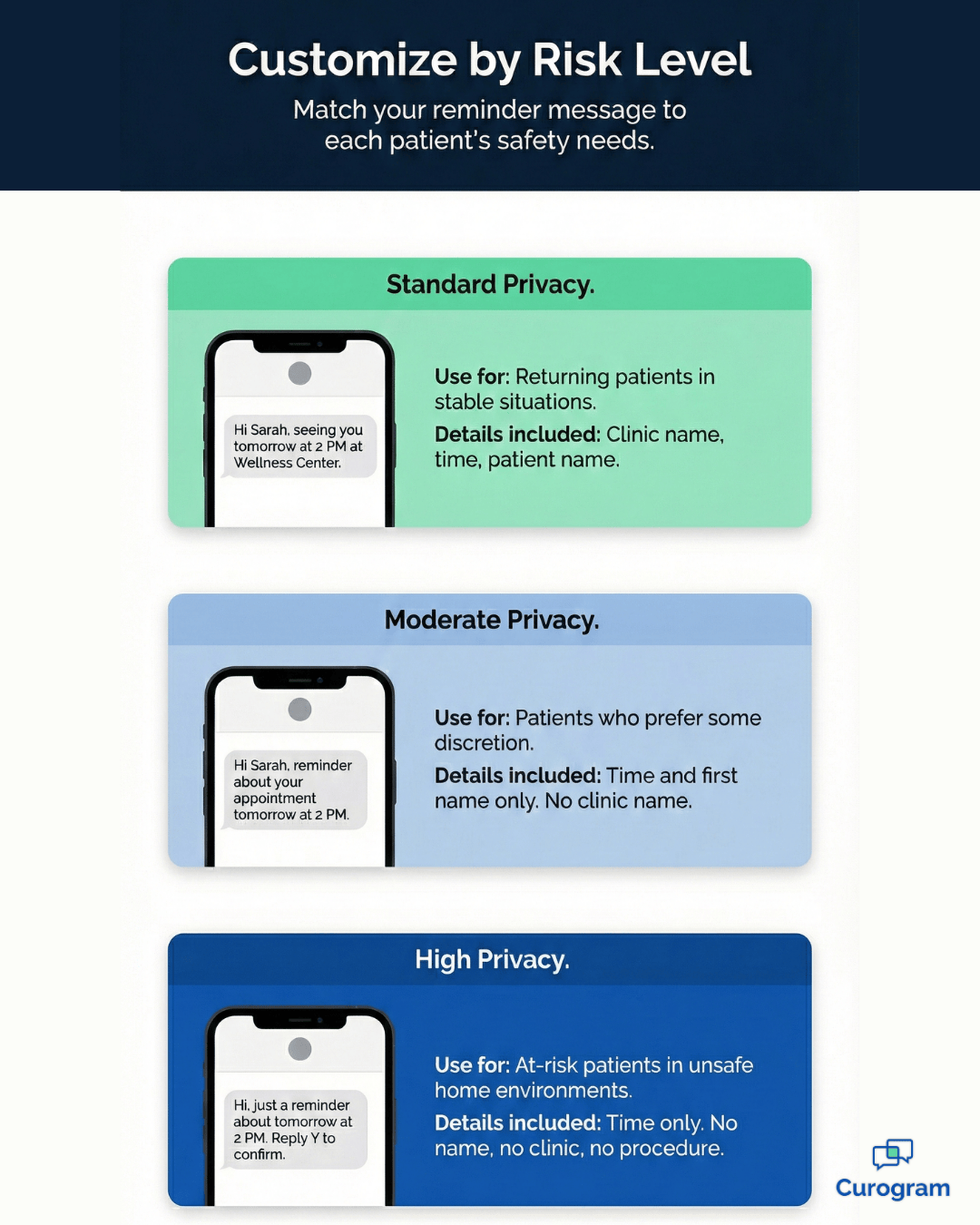
One platform allows multiple templates for different appointment types inside eKyros:
This flexibility ensures your center doesn’t have to choose between being helpful and being careful.
A returning patient comfortable with your center might receive a slightly more detailed reminder, while a new patient in a fragile situation gets the safest version possible. The decision always stays with your staff.
This level of control makes safe communication for pregnancy centers possible. It’s not about hiding information from the patient—it’s about ensuring they receive messages in a way that feels secure and respectful of their privacy.
Knowing that private reminders exist is one thing. Knowing how to set them up is another. The good news is that Curogram makes this process straightforward, even for staff who are not tech-savvy.
Start With Your Appointment Categories
The first step is to look at the appointment types already built into your eKyros schedule. Most centers have categories like initial consultation, pregnancy test, ultrasound, counseling, and follow-up.
Each of these carries a different level of sensitivity, and your reminder templates should reflect that.
Sit down with your team and sort each category into one of two groups: standard privacy or high privacy. For many centers, anything involving a first visit or a pregnancy-related service goes into the high-privacy group. Repeat visits or general check-ins may stay in the standard group.
Build Your Templates
Once you have your groups, it is time to write the actual messages. Curogram lets you create and save as many templates as you need.
Here are a few guidelines to keep in mind:
A strong high-privacy template might read: "Hi, just a reminder about tomorrow at 2 PM. Reply Y to confirm." That is it. No clinic name, no procedure, no risk.
Test Before You Go Live
Before rolling out new templates to all patients, send a few test messages to staff phones. Check how the message looks on both locked and unlocked screens. Make sure the sender number does not display a name that could identify your center.
This small step can catch problems before they reach a patient who cannot afford a mistake.
After testing, train your team on how to assign the right template to the right patient. This decision should be part of the intake process, not something that gets figured out later.
When protecting vulnerable patients is built into the workflow from day one, fewer things slip through the cracks.

Sending a vague message is only half the solution. What happens when the patient replies? What if someone else picks up the phone and responds? Curogram thought about all of this and built protections into every step of the process.
Two-Way Safety That Responds in Real Time
If a patient replies with something like "Who is this?" or "Stop," Curogram handles it right away. The system processes opt-out requests immediately, and it does not send follow-up messages that could create more exposure.
This two-way safety net is built into every message and requires zero manual work from your staff.
This matters because a partner or family member could be the one replying. If the system kept sending messages after a "Stop" request, it could make a bad situation worse. Curogram shuts down the conversation instantly, which is exactly what a safe communication tool should do.
No Saved Contact Risk
Curogram uses a consistent local number, often your center's own landline, to send messages. That number will not show up as "Pregnancy Center" on the patient's phone unless the patient saves it that way.
To anyone else looking at the screen, it is just a text from an unknown local number.
This small detail goes a long way in protecting vulnerable patients from unwanted questions. There is no app to download, no branded notification, and no caller ID that gives away your center's identity. The message looks like any other text.
Confirmations Still Sync to Your eKyros Schedule
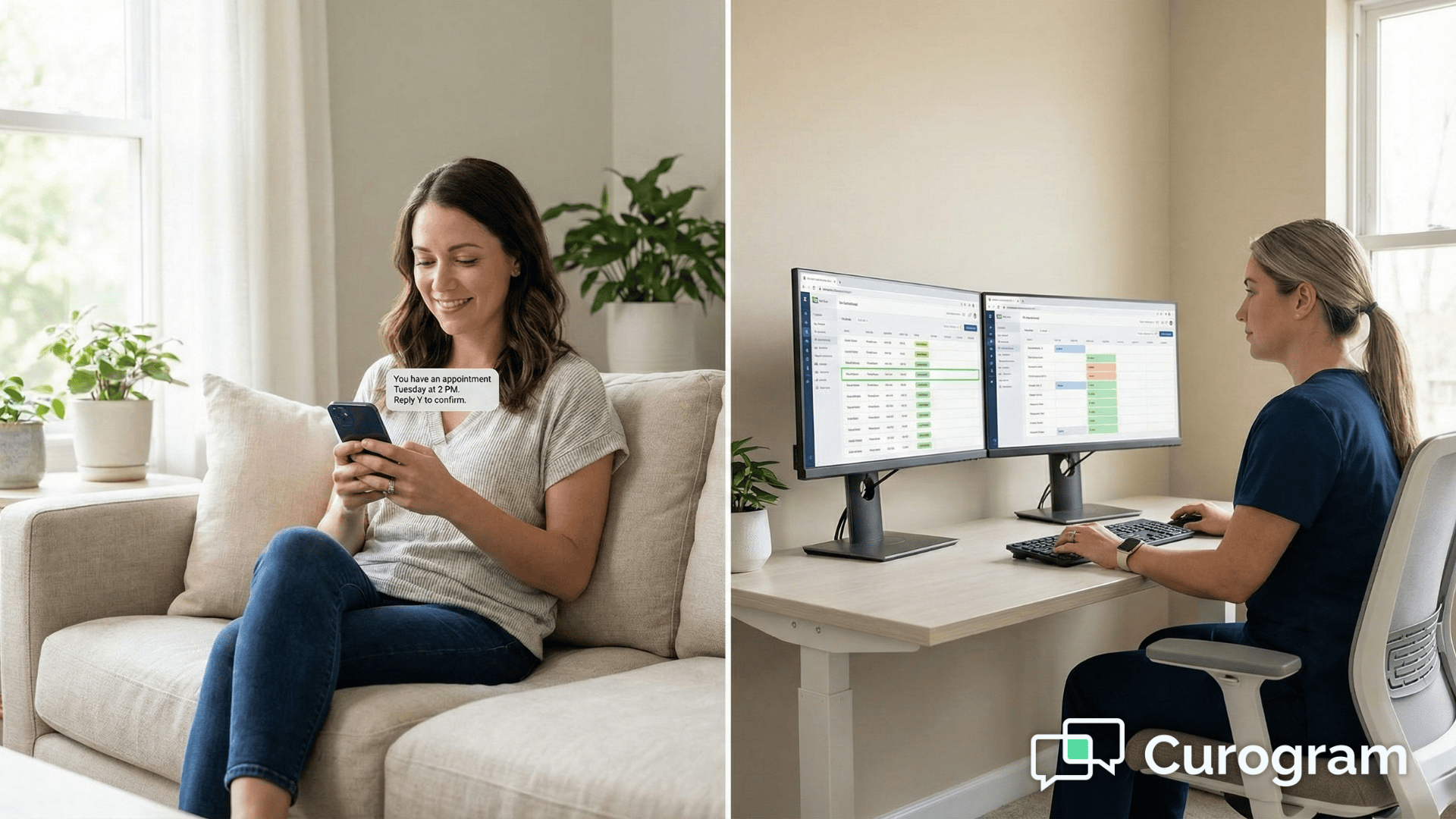
Even though the message itself is vague, the patient's reply still connects to the right appointment in eKyros. When someone replies "Y" to confirm, the system updates the correct slot in your schedule. Your front desk team sees who confirmed and for which visit. Nothing falls through the cracks.
This is eKyros patient privacy working exactly as it should. The outside message stays safe. The inside data stays complete. Your staff has full visibility without the patient ever being put at risk.

Privacy in patient messaging is not just a theory. When centers switch to discreet reminders, the results show up in real and measurable ways. The change affects no-show rates, patient trust, and the overall ability of your team to stay connected with the people who need help most.
Fewer No-Shows From At-Risk Patients
One of the most common reasons patients miss appointments at pregnancy centers is fear. Not fear of the visit itself, but fear of what happens if someone finds out about it. When that fear is removed through discreet appointment notifications, patients are far more likely to show up.
Centers that use customizable SMS reminders designed for privacy report that patients are more willing to keep their real phone numbers on file. That alone is a major shift.
When patients trust that your messages will not put them in danger, they stop giving fake numbers and start staying connected.
Stronger Trust From the First Interaction
Trust is hard to earn in crisis care. Many patients walk into a pregnancy center unsure of what to expect. If the very first text they receive from your center puts them at risk, that trust is gone before it ever had a chance to build.
On the other hand, when a patient receives a vague, respectful message that clearly protects her privacy, she notices. It tells her that your center understands her situation. That first impression shapes the entire relationship going forward.
Staff Confidence and Peace of Mind
It is not just patients who benefit. Staff and volunteers at pregnancy centers carry a heavy emotional load. They worry about the women they serve, and the thought that a message from their center could cause harm weighs on them.
When the system handles privacy automatically, staff can focus on the care itself instead of worrying about what a text message might do.
This peace of mind also reduces burnout. When your tools work the way they should, your team does not have to spend energy building workarounds or second-guessing every message that goes out.
Can Curogram reminders be customized differently for each appointment type in eKyros?
Yes. Curogram lets you create multiple reminder templates and assign them to specific appointment types inside eKyros.
A general follow-up visit can use a standard message, while a sensitive first-time consultation can use a high-privacy template that leaves out clinic names and procedure details. Your staff decides which template fits each situation.
Will a vague reminder still confirm the right appointment in eKyros?
It will. Even when the patient receives a message with no clinic name or appointment details, their reply still syncs back to the correct time slot in your eKyros schedule. Your front desk team sees the confirmation tied to the exact visit, so nothing gets lost or mixed up on the back end.
What happens if someone other than the patient replies to the reminder?
Curogram processes every reply the same way. If someone texts back "Stop" or "Who is this?" the system immediately stops sending messages to that number. This protects the patient from further exposure in case a partner or family member sees the text and responds.
Does the patient need to download an app to receive discreet reminders?
No. Curogram sends reminders through standard SMS text messages. There is no app to install, no account to create, and no branded notification that appears on the patient's phone. The message arrives from a local number and looks like any other text.
How does Curogram protect eKyros patient privacy compared to default reminder tools?
Most default reminder systems auto-fill the clinic name, provider name, and appointment type into every message. Curogram lets you strip all of that out.
You control exactly what the patient sees on their screen, which is critical for protecting vulnerable patients in unsafe home environments. The full appointment details stay visible only to your internal staff inside eKyros.
In crisis care, safety planning comes before everything else. If a patient does not feel safe receiving messages from your center, she may choose not to show up. It is that simple: no matter how convenient your scheduling is, it means nothing if the patient’s privacy is compromised.
Curogram gives pregnancy resource centers the tools to send discreet appointment notifications that protect patients in every situation. With customizable SMS reminders that integrate directly with eKyros, your team can adjust the level of detail based on the patient’s needs.
Some messages may be brief and neutral, while others can include just enough information to help patients stay organized without putting them at risk.
Even though the messages are intentionally vague, patient replies still connect seamlessly to the correct appointment in eKyros. When someone responds “Y” to confirm, the system automatically updates the corresponding slot in your schedule.
Your front desk team sees exactly who confirmed and for which visit, ensuring nothing falls through the cracks.
This is privacy working exactly as it should: the outside message stays safe and nonspecific, while the inside data remains complete and actionable.
Privacy-first patient reminders for eKyros clinics are not just a tech upgrade—they are a commitment to the people you serve. They give your staff full visibility over confirmations, scheduling, and follow-ups without ever putting the patient at risk.
Communicate safely and effectively. Schedule a demo today to see Curogram's discreet reminder templates in action.
💡 Automated appointment reminders for eKyros centers help non-profit clinics reduce no-show rates by sending discreet text notifications. These...
💡 Enterprise clinics rely on consistent communication to keep schedules full. Appointment reminders in Allscripts PM help patients prepare and...
💡 Appointment reminders in Dolphin Management help reduce no-shows for oral surgery practices. Providers can automate patient communication and...