

Managing Patient Feedback for Cerbo Practices: A Reputation Guide
💡 Managing patient feedback for Cerbo practices means using internal surveys to catch problems before they go public. Send a quick text survey...
Table of Contents
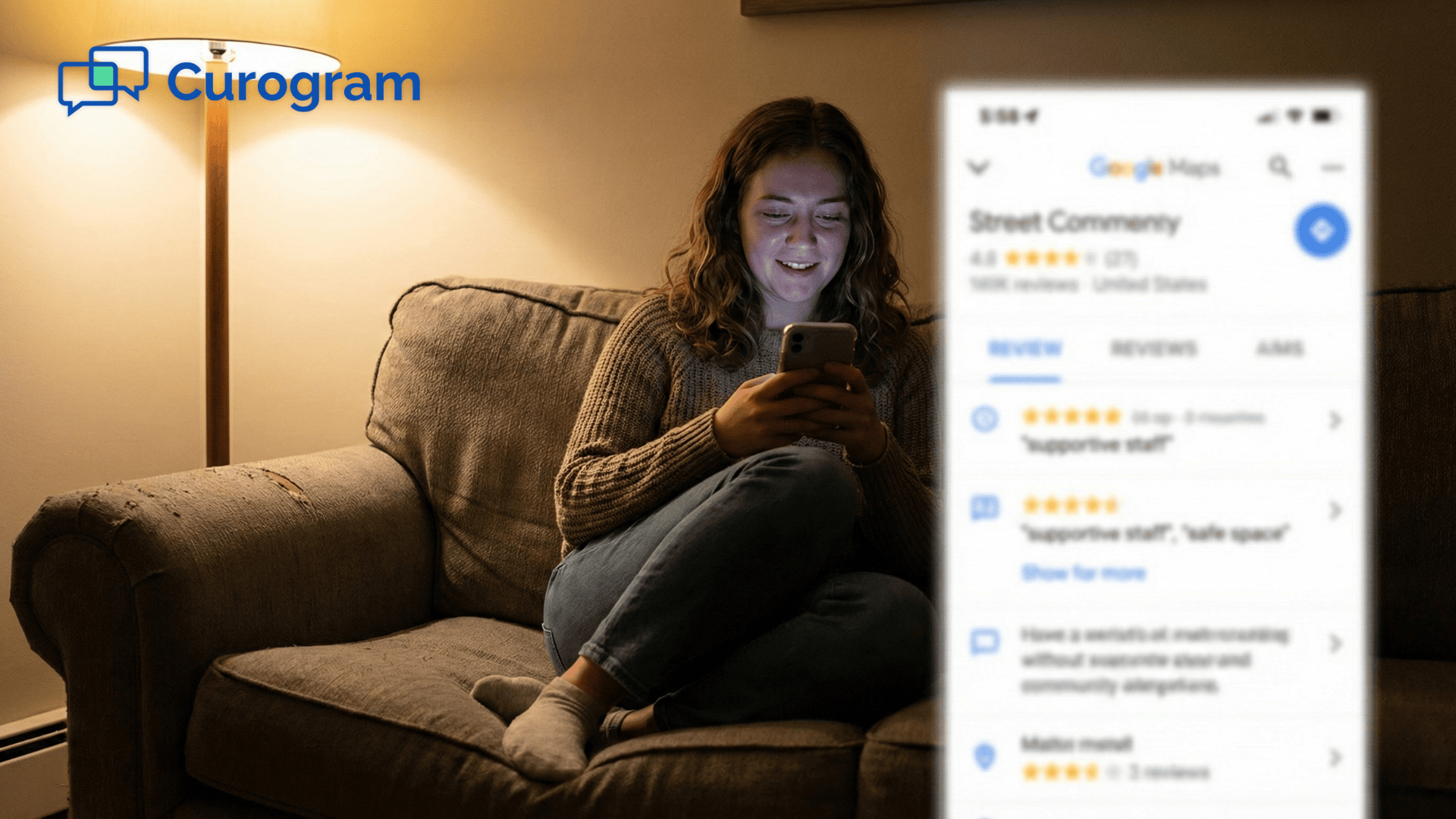
A young woman picks up her phone late at night. She types "pregnancy help near me" into Google. Your center comes up. But instead of stories from the dozens of women you've helped this month, she sees a handful of angry reviews from people who have never walked through your doors.
She clicks away. She never calls. And your team never gets the chance to show her the love and care you offer every single day.
This is the reality for many eKyros centers across the country. Your staff pours their hearts into serving women in crisis, but the internet tells a very different story.
Fake reviews, political spam, and the challenge of countering clinic misinformation have become an uphill battle for pregnancy resource centers. The women who leave your office feeling supported rarely think to share their experience online.
Meanwhile, critics with an agenda flood your Google page with noise.
The good news is that it does not have to stay this way. Automated Google reviews for eKyros centers give you a simple, proven way to capture real stories from real patients.
With Curogram, you can turn the silent majority of grateful women into your loudest voices online. This is not about gaming the system. It is about building trust online so the next woman in need can find you and feel safe enough to reach out.
By making it easy for patients to leave feedback right after their visit, you amplify authentic experiences and showcase the compassionate care your team delivers every day.
Over time, these real stories outweigh the noise, helping your center stand out as a trusted place for support, guidance, and hope.
Imagine searching for help during the scariest moment of your life. You find a center that looks promising, but the Google listing shows a 2.5-star rating.
The reviews section is packed with comments like "Fake clinic" and "Stay away" from strangers who have never visited. What would you do? Most people would keep scrolling.
This is what we call the "Wall of Fear." It is a barrier built by bad-faith reviews and political attacks that stands between your center and the women who need you most. The low star rating tells a lie about your care, and it works.
Scared women trust what they see online, and a page full of hostile reviews feels like a warning sign.
What the Wall of Fear Actually Costs You
The damage goes beyond one lost visitor. Every woman who clicks away tells Google that your listing is not helpful, which pushes you further down in search results.
Over time, the Wall of Fear feeds itself. Fewer clicks lead to lower rankings, which lead to even fewer women finding you in the first place.
Your center may be helping dozens of women every single week. You may be offering free ultrasounds, counseling, parenting classes, and material support. Women may be leaving your office in tears of gratitude.
But if those women are not sharing their eKyros patient feedback online, the only voices Google hears are the loudest and angriest ones.
The Silent Majority Is Your Greatest Asset
The silent majority of satisfied patients is your greatest untapped resource. They loved their experience. They felt cared for and respected. But nobody asked them to share that story.
Without a system in place, your reputation management for pregnancy centers relies entirely on chance. And right now, chance is losing to organized online attacks.
The fix is simpler than you might think. Curogram connects directly through eKyros integration and automates the one thing your staff does not have time to do: ask every patient for feedback.
. We call this the "Story Steward" workflow because it does not create fake praise. It simply makes sure real stories get told.
Your staff already has their hands full. Between scheduling, counseling sessions, ultrasound appointments, and follow-up care, there is no time left to sit down and send review requests one by one. That is exactly why automated technologies matter here.
It removes the burden from your team while making sure every single patient gets the chance to share her experience.
How It Works Step by Step
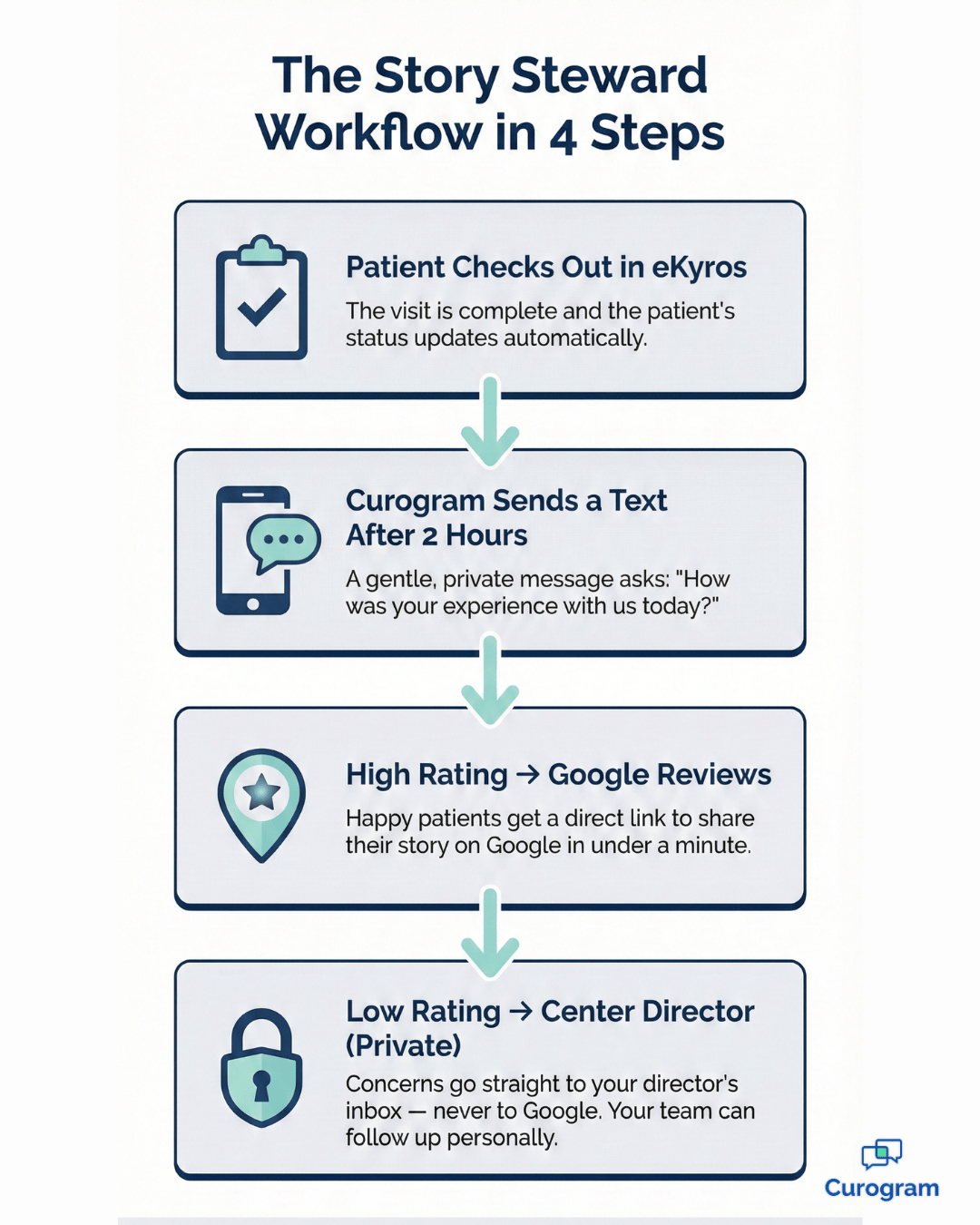
When a patient's status changes to "Checked Out" in eKyros, Curogram picks up the signal automatically. It waits a short period, usually about two hours, before sending a gentle text message.
The message says something like
"How was your experience with us today?" It is warm, simple, and personal.
The text does not mention pregnancy, medical services, or anything that could feel intrusive on a lock screen. This is important because many of the women you serve are in sensitive situations. They may not want anyone around them to know where they have been.
The message is designed to feel like a friendly check-in, nothing more.
The Built-In Safety Valve
This is where the system gets smart. The patient's response determines what happens next, and each path is designed to protect your center while honoring the patient's voice.
This safety valve turns a potential bad review into a chance to minister and improve. It protects your public reputation while giving you honest insight into where your center can grow.
Why This Is Not Just Another Survey
Most feedback tools send long questionnaires that patients ignore. The Story Steward workflow is different. It asks one question, gets one answer, and routes it to the right place. There is no app to download, no account to create, and no login to remember.
Everything happens through a simple text message that integrates seamlessly into the patient journey, allowing the patient to respond in seconds.
That simplicity is what drives results. When the ask is easy, more people say yes. When more people say yes, your Google page fills up with the real stories of women who walked through your doors and left feeling cared for.
This kind of non-profit marketing automation works quietly in the background so your staff can focus on what they do best: caring for women.

So what happens when you turn on this system? The numbers speak for themselves. Centers using Curogram's automated review workflow typically see a 10x increase in Google Reviews.
That means a center with just 12 reviews can grow to 120 or more. This is not a small change. It is a complete shift in how your center shows up online.
Moving from a handful of reviews to over a hundred creates powerful social proof. It signals to every woman searching for help that your center is real, active, and trusted by the community. It also tells donors and supporters that your organization is legitimate and making a real impact.
Building trust online starts with volume, and volume starts with a simple ask.
The Shield Effect
There is also what we call the "shield effect." When your Google page is filled with dozens of recent, detailed, positive reviews from verified patients, the occasional troll review loses its power.
A single negative comment surrounded by a hundred stories of compassion looks exactly like what it is: an outlier. The real experiences push the fake ones to the bottom of the page where they belong.
Google's algorithm also rewards fresh, consistent activity. A page that receives new reviews every week signals to Google that your center is active and relevant. This can improve your ranking in local search results, which means more women find you when they search for help.
The reviews do not just build trust with patients. They build trust with the search engine itself.
What Real Social Proof Looks Like in Practice
Think about the difference between two Google listings side by side. One has 12 reviews, a 3.2-star rating, and the most recent review is six months old. The other has 135 reviews, a 4.8-star rating, and three new reviews from the past week.
Which one feels safer to click on? The answer is obvious.
That second listing did not get there by accident. It got there because every patient was given a simple, private opportunity to share her story. Over weeks and months, those individual stories add up to something powerful.
They create a living record of your center's compassion that no amount of negative spam can bury.
The outcome is what matters most. When the next scared young woman searches for your center, she does not see a wall of fear. She sees story after story of kindness.
She reads things like
"They listened to me" and
"They did not judge me."
She feels safe enough to pick up the phone. And that one call can change the entire direction of her life. That is the real power of reputation management for pregnancy centers done the right way.

Most centers think of Google Reviews as a tool for reaching new patients. But your online reputation does double duty. Donors, board members, church partners, and community supporters all check your Google listing before deciding whether to invest their time and money in your mission.
A donor considering a gift to your center will likely search your name online first. If they find a strong star rating backed by dozens of heartfelt stories from real women, it confirms what they already hope is true: that their donation will make a difference.
On the other hand, a low rating or a page full of hostile reviews can plant doubt, even among your most loyal supporters.
This is especially true for first-time donors who have no personal connection to your center yet. They are relying entirely on what they can find online to decide whether your organization is trustworthy.
Your Google page is often the first impression they get, and it may be the only one that matters.
Social Proof That Strengthens Your Fundraising
This is where social proof becomes a fundraising tool. A Google listing with 120 positive reviews from verified patients is more persuasive than any annual report. It is living, breathing proof that your center is making an impact in your community every single day.
Some centers even include screenshots of Google Reviews in their donor newsletters and grant applications.
These small steps turn your patient stories into fundraising assets. Every review becomes a piece of evidence that your center is doing what it promises to do.
Building Credibility With Grant Committees and Church Partners
Many pregnancy resource centers depend on grants and church partnerships for a large share of their funding. Grant committees and church leadership teams do their homework before writing a check.
They search your name, read your reviews, and look for signs that the community trusts you.
A strong Google presence backed by real patient stories gives you an edge that other applicants may not have.
It shows that your center is active, responsive, and genuinely serving the women in your area. That kind of credibility is hard to manufacture, but it is easy to earn when you have the right system in place.
When your online presence reflects the compassion that lives inside your walls, it does not just attract patients. It attracts the resources and partnerships your center needs to keep serving. That is why building trust online is not just a marketing tactic.
It is a mission-critical investment for any non-profit pregnancy center.
Is it safe for patients to use their real names?
That is completely up to the patient. Many choose to leave reviews under their initials or a first name only, which Google allows.
Curogram simply provides the link. The patient controls the privacy of their post, including what name they use and what details they share. Your center never forces anyone to reveal personal information.
Can we filter out fake reviews?
Curogram only sends review requests to verified patients in your eKyros database. This means every review that comes through the system is from a real person who actually visited your center.
While you cannot delete external troll reviews directly, flooding your page with genuine stories of love and care pushes the fake hate to the bottom. Over time, the real voices win.
Does this violate patient privacy?
No. The text message asks for general feedback about the visit. It does not mention pregnancy, specific medical services, or any details that could identify the reason for the visit. The message is designed to look completely neutral on a lock screen.
This protects the patient's privacy at every step.
Your center is already doing incredible work. Women leave your office feeling heard, supported, and loved. The only thing missing is a way to share those stories with the next woman who needs to hear them.
Automated Google reviews for eKyros centers bridge that gap. With Curogram's Story Steward workflow, every grateful patient gets a simple, private invitation to share her experience. The good stories rise to the top. The noise fades to the bottom.
And your Google page finally reflects the truth about who you are.
You do not need a marketing team or a big budget. You do not need to train your staff on a complicated new system. You just need the right tool to let your patients speak for themselves.
Curogram handles the asking, the routing, and the follow-up so your team can stay focused on the mission that matters most.
Every day that passes without a review system in place is another day where the wrong story is being told about your center. The women you serve deserve to have their voices heard, and the women still searching deserve to find you.
Ready to see how it works for your center? Schedule a demo with Curogram today and let us show you how to turn your patients' stories into your strongest online presence.
💡 Managing patient feedback for Cerbo practices means using internal surveys to catch problems before they go public. Send a quick text survey...
💡 Imaging centers face unique trust issues. A single bad review can damage referral flow and hurt revenue across multi-site networks.Reputation...
1 min read
💡Automated review requests in Office Ally help small and mid sized medical practices collect more accurate feedback without adding work to the...