
Why eCW Patients Review by Text | Post-Visit Timing That Works
💡 When a patient leaves a good visit, that positive feeling fades fast. An eClinicalWorks patient text review request sent 1–2 hours after the...
11 min read
Jo Galvez
:
March 12, 2026
Here's something most marketing directors at large eCW networks know, but rarely say out loud: the network's online reputation doesn't reflect its clinical quality.
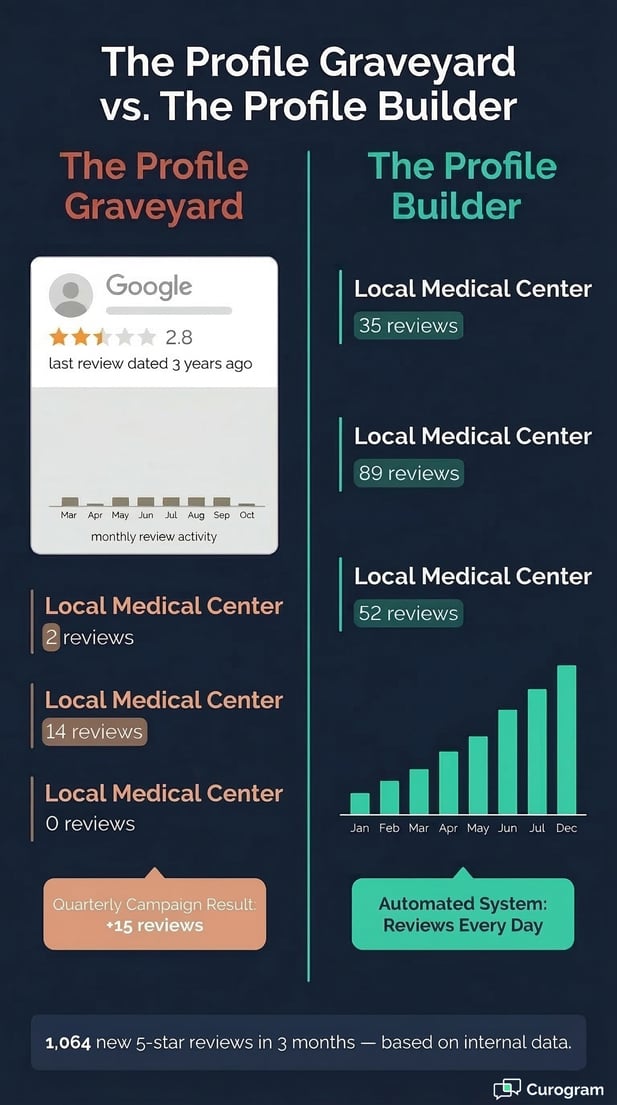
The doctors are skilled. The care is solid. But the provider profiles on Google and Healthgrades tell a different story. Some show a handful of reviews from three years ago. Others show nothing at all.
This is the reality of managing reputation for a network with 20, 50, or 100+ providers. There's no shortage of patients. There's a shortage of a system. And that gap grows every month you wait.
Marketing teams have tried the usual fixes. Quarterly email blasts. Review reminder cards in waiting rooms. Talking points for the front desk. Each effort creates a short spike in reviews, then drops to zero. Meanwhile, a smaller practice nearby keeps rising in local search. Why? Because they automated what most eCW networks still do by hand.
eClinicalWorks marketing automated post-visit review text provider profile building changes that dynamic. Curogram connects to the eCW schedule and sends a review request text after every completed visit. No campaign to build. No list to manage. No extra work for staff. The system runs in the background, turning every appointment into a review opportunity for every provider, at every location, every day.
This article covers why enterprise eCW networks end up with thin, outdated provider profiles, and what changes when a real system takes over.
Here's what we'll cover:
If you manage marketing or reputation for a multi-provider eCW network, keep reading.
Enterprise eCW networks often have more provider profiles than anyone has counted. Google, Healthgrades, Vitals, Zocdoc; the list grows with every new hire and every new location.
Keeping all of them fresh and active is nearly impossible without a system built for it. Most marketing teams know the problem exists. Few have the tools to fix it at scale.
Managing online reputation across a 40- or 100-provider network is not a one-person job. Each provider has individual profiles on multiple platforms.
Each profile needs a steady stream of fresh reviews to rank well in local search. Most marketing teams carry that responsibility, but without any automated tools to match the size of the network.
The result is predictable. Providers who joined recently might have two or three reviews. Providers who've been there for years might have reviews from 2019 and nothing since.
Some profiles have no reviews at all. Marketing knows these profiles underperform. But manually chasing reviews for 50+ providers across 15 locations, week after week, is not a workable plan.
Quarterly campaigns help, but only briefly. A single push might produce 15 to 20 reviews across the whole network.
That's a fraction of what a consistent automated system generates in the same window. Once the campaign ends, review activity drops back to near zero.
Campaigns require planning, coordination, and follow-through every time. They depend on staff remembering to ask, patients responding to email, and marketing finding bandwidth to run the effort again next quarter.
Any one of those steps can break down. An automated system removes that dependency entirely. It runs after every visit, regardless of what else is happening in the office.
Within most large eCW networks, review distribution is wildly uneven. One provider has 89 reviews and a 4.6 rating because she personally asks patients. Another has 14 reviews and a 3.6 rating because she doesn't.
A new hire has zero reviews because he joined six months ago. This creates a real problem for marketing, for patients, and for the network as a whole.
Patients searching for care will typically choose the provider with more reviews and a better rating. That means equally skilled providers get overlooked simply because their profile was never given attention.
Provider profile building eCW enterprise reputation text generation isn't just a visibility issue, it's a patient access issue. New providers are especially at risk: it can take a year or more to build a profile worth showing up in search, which is a year of lost new patient flow.
Provider Profile Health at a Glance
Example scenario showing the review gap within a single multi-specialty eCW network.
|
Provider |
Specialty |
Total Reviews |
Avg. Rating |
Most Recent Review |
|
Dr. Patel |
Cardiology |
89 |
4.6 ⭐ |
Last week |
|
Dr. Okafor |
Gastroenterology |
14 |
3.6 ⭐ |
8 months ago |
|
Dr. Kim |
Orthopedics |
0 |
N/A |
Never |
Thin profiles cost the network new patients every day. A patient comparing two providers in the same specialty will pick the one with more reviews and a higher rating.
If one has 45 reviews and a 4.7 rating and another has 8 reviews and a 3.5, the choice is easy, even if both providers offer the same quality of care. Over time, this imbalance skews patient volume. Quarterly campaigns can't fix what the pipeline never turns off.
Google's local search algorithm weighs three main signals: relevance, distance, and prominence. Prominence is built largely through reviews – their volume, recency, and velocity.
A boutique practice generating eight reviews per month can outrank a 50-provider network that generates three per month, even though the network sees far more patients each day.
For eCW marketing operations, this is a real competitive risk. Smaller practices with active review tools can outrank a much larger network in local search.
The gap compounds over time. Every month of inaction makes the climb harder. And patients who can't find you online go to whoever shows up first.
Review velocity is one of the strongest signals in local search ranking. A profile with 50 reviews from the past six months outranks one with 200 reviews from three years ago. Google reads recent activity as a sign of quality.
Networks that generate steady, ongoing reviews build compounding visibility over time. Networks that rely on campaigns get short bursts, then fall back.

The fix isn't a better campaign. It isn't more staff. It's a system that runs automatically, connected directly to the eCW schedule, and sends a review request text after every completed visit.
That's what Curogram's profile builder does. For marketing teams managing eCW marketing team Google review automation provider profiles across a large network, this is the shift that changes everything.
Here's how it works, step by step:
No email campaigns to schedule. No posters to print. No talking points for the front desk. The system handles it automatically, after every visit, for every provider, at every location.
Curogram integrates with eClinicalWorks via API, reading completed appointments directly from the schedule. This matters: the system is triggered by actual visits, not by marketing calendars or manual uploads.
It always knows which patient saw which provider at which location, and sends the right request with the right provider name and platform link.
This is especially valuable for automated review requests in eClinicalWorks multi-provider networks. When a new provider joins and starts seeing patients in eCW, they're automatically added to the review workflow.
No per-provider setup. No marketing team action needed. If a patient had multiple appointments in a short window, the system sends one request, so patients are never over-messaged.
Within a short window after a completed appointment, the patient receives a text. It's personalized with the provider's name and links directly to their review platform.
If the patient leaves a review, it's tracked. If they don't respond, the system logs that too.
Every touchpoint feeds the centralized dashboard, giving marketing real data to optimize timing, messaging, and platform selection over time.
For marketing directors running multi-location eCW networks, the profile builder doesn't just generate reviews. It changes the nature of the work.
Instead of planning campaigns, chasing staff to ask patients, and troubleshooting why review volume dropped this quarter, marketing can focus on strategy, branding, and growth.
The eCW centralized review dashboard multi-location analytics give marketing a single view of the network's full reputation.
Review volume by provider. Average ratings by location. Review velocity over time. Sentiment trends by specialty.
Underperforming profiles are flagged automatically so marketing can act on real data instead of guessing. Marketing operations eCW review velocity star ratings stop being a problem to manage and become a metric to monitor.
The shift is from firefighting to oversight. Marketing's job stops being 'how do we generate more reviews this quarter?' and becomes 'which providers need attention this month?'
That's a much better use of marketing resources. It scales with the network instead of against it. It also frees up time for the creative, strategic work that can't be automated.
When Curogram's profile builder goes live, the change in direction happens fast. Provider profiles that sat stale for months start picking up new reviews within the first two weeks.
The centralized dashboard gives marketing a real-time view of that growth, by provider, by location, by time period. For the first time, reputation management becomes something you monitor instead of something you chase.
Marketing teams using Curogram see consistent monthly review growth across all providers, replacing the boom-bust pattern of quarterly campaigns with a steady flow of post-visit reviews.
Review volume climbs. Average ratings improve as fresh positive reviews dilute older ones. Review recency scores go up , which directly lifts local search visibility across the board.
Based on our internal data, multi-location practices using Curogram's automated post-appointment review system saw 90% of patients leave 5-star reviews, resulting in 1,064 new 5-star reviews in just three months. That's not a campaign result. That's a system result, and it compounds month after month.
For marketing operations eCW review velocity star ratings tracking, this kind of data is a game-changer.
Instead of reporting on how many emails went out last quarter, marketing now reports on real review growth, week over week, provider by provider, location by location.
The centralized dashboard gives marketing a live view of review velocity, average star rating, total review volume, and sentiment trends sorted by provider, location, and specialty.
Underperforming profiles are flagged so you know where to focus. You can filter by time period to spot trends early. You can see which providers have the highest review response rates , and use that insight to sharpen messaging for the whole network.
Before Curogram, a marketing director at a 40-provider eCW network ran quarterly review pushes. Each campaign took real effort: email lists, creative, staff briefings, and follow-up calls.
Each one produced 15 to 20 new reviews across the whole network. Then reviews would stop , until the next campaign season rolled around.
After activation, the dynamic changed. Reviews came in every week, from real patient visits, with no campaign needed. Marketing didn't have to drive the activity. They had to monitor it.
Provider profile building and eCW enterprise reputation text generation became a background process, not a project. The marketing team's role shifted from creating review activity to analyzing it and acting on what the data showed.
This shift matters beyond reputation numbers. When review generation is automated, marketing gets its time back. That time goes toward content, physician branding, local outreach, and other work that needs human creativity and judgment.
The system runs the mechanical part. Marketing runs the strategic part. That's a better division of labor and it's one that scales as the network grows.
Ninety days after going live across all 40 locations, the results were clear. The network had generated more Google reviews than in the previous 12 months combined.
New providers went from zero reviews to competitive profiles within their first quarter. Established providers saw their ratings climb as recent positive reviews outpaced older negative ones.
Review volume was up. Average ratings were up. Review recency was trending in the right direction. New patient acquisition from search was improving.
The marketing director stopped scheduling quarterly review campaigns, because the system was running one every single day, automatically, without any manual effort.
Thirty days in: new reviews are showing up across all providers, even those who hadn't seen a new review in years. Sixty days: search rankings start to move as review velocity signals register with Google. Ninety days: profiles that were once near-empty now have recent, relevant ratings.
New hires have enough reviews to compete in local search. The dashboard has become the first thing marketing opens every Monday morning.

Most enterprise eCW networks already have the patient volume to build strong online reputations. What they've lacked is the system to turn those visits into reviews consistently.
Without automation, even the busiest network ends up with thin, outdated provider profiles. Curogram changes that by connecting directly to eCW and making every completed appointment count.
eClinicalWorks marketing's automated post-visit review text and provider profile building give marketing teams the engine to grow and maintain provider profiles across the full network, with no manual work involved.
The system reads the eCW schedule, sends a review request text after every completed visit, routes sentiment intelligently, and tracks everything in a single dashboard. No campaigns to plan. No staff to brief. No quarterly pushes to schedule.
eCW handles the clinical side: scheduling, charting, billing, and patient management. Curogram handles the marketing layer: converting every completed visit into a review that builds the provider's online profile. Together, they create a network where clinical quality is visible to every patient who searches Google for care in your area.
The key insight is simple: you don't have a review problem. You have a system problem. The reviews are there, they just never get requested.
Every completed visit where no review is asked for is a missed chance. At scale, those missed chances add up fast.
A 50-provider network seeing 200 patients a day is passing up hundreds of review chances every week. Without a system, those visits disappear without a trace. Automation doesn't just increase review volume; it creates consistency.
Every provider, regardless of specialty or communication style, gets the same steady stream of review requests. That's the only way to build fair, competitive profiles across the board.
The good news is the fix is not complicated. Curogram integrates with eCW in days, not weeks. Automation runs from day one. Within two weeks, the dashboard starts showing upward trends that marketing can take to leadership with confidence.
Stop running quarterly review campaigns that spike once and stall. Start running a system that generates reviews after every visit, for every provider, at every location, without any extra effort from your team.
Book a demo today and watch the review volume climb. Show the dashboard to leadership. The trends will do the talking.
Frequently Asked Questions
Curogram reads the completed appointment data from the eCW schedule via API. The system matches each visit to the correct provider, location, and review platform, then sends a personalized text with that provider's name and a direct link to their profile.
No manual input is needed from marketing or front-desk staff. Every message goes to the right patient, for the right provider, automatically.
Text messages have much higher open rates than email. Patients are more likely to read and act on a text within minutes of receiving it.
A post-visit text arrives while the appointment is still fresh, which makes patients more willing to share their experience.
Email blasts, by contrast, often land in spam folders or get ignored days after the visit. The timing and the channel both matter.
New providers are added to the review request workflow automatically as soon as they start seeing patients in the eCW schedule. The system can be set to direct all early reviews to a single platform, so new hires build a strong primary profile first.
Based on our internal data, new providers can go from zero reviews to a competitive profile within their first 90 days using this approach.
When a patient responds with negative sentiment, the system routes that feedback to an internal channel rather than a public review platform. This gives the practice a chance to address the concern privately before it affects the provider's public rating.
Positive responses, on the other hand, are sent directly to Google, Healthgrades, or whichever platform the provider's profile is on. The result is a public profile that reflects real quality, without being dragged down by issues that could have been handled internally.
The eCW centralized review dashboard multi-location analytics give marketing directors a single view of the entire network's reputation, sorted by provider, location, specialty, and time period.
Underperforming profiles are flagged automatically so marketing can take targeted action without checking each profile one by one.
The dashboard also tracks delivery rates, open rates, and review response rates, so teams have real data to improve messaging and timing. For large networks, it turns reputation management from a guessing game into a managed, measurable process.
💡 When a patient leaves a good visit, that positive feeling fades fast. An eClinicalWorks patient text review request sent 1–2 hours after the...

💡 eClinicalWorks reputation management with automated review generation helps enterprise networks grow star ratings across every provider and...
💡 Reputation management for Meditab IMS practices helps capture real-time patient feedback. This creates early alerts about service issues before...