
Delivering Virtual Consults & Post-Op Care with Telehealth in Dolphin
 Sharee Narciso : Dec 3, 2025, 11:00:00 AM
Learn how Dolphin users simplify ortho consults and surgery follow-ups with Curogram’s HIPAA-compliant telehealth solution.

A parent calls your practice. She's interested in braces for her daughter, but can't find time for an in-office consultation. She works full-time, lives 30 minutes away, and has two other kids. You tell her to call back when she can make it in. She never calls back.
This scenario costs orthodontic practices thousands of dollars in lost case starts every year. Families want your services, but can't always fit in-office visits into their busy schedules. Without flexible options, you lose them to competitors who offer virtual consultations.
The solution is straightforward: expand access with Dolphin telehealth to reach families where they are. Virtual visits eliminate scheduling barriers that prevent case starts and follow-up compliance.
Consider what's happening in your market right now. Busy parents are searching for orthodontic care that fits their schedules. Working professionals need follow-ups that don't require time off. Families living in rural areas want quality care without long drives. If your practice only offers in-office appointments, you're invisible to these potential patients.
Telehealth changes the equation completely. Parents can join consultations from work during lunch breaks. Teens can do progress checks from home after school. Families across your service area can access your expertise without travel time. Every barrier you remove creates opportunities for case starts and revenue growth.
For practice owners focused on growth, telehealth delivers measurable results. Higher consult-to-treatment conversion rates, reduced no-shows, and better patient retention all contribute to your bottom line. The practices already offering virtual care are capturing case starts that practices without telehealth never see.
The question is simple: how many potential patients are you losing because you don't offer convenient virtual options?
Orthodontic practices without telehealth options face growing competitive disadvantages. These aren't minor inconveniences but real business risks that directly impact your case starts, revenue, and market position.
Every consultation that doesn't happen represents a potential case you'll never start. Families interested in treatment often face significant scheduling barriers for initial consults. Working parents struggle to take time off. Teens have school and activities. Families with multiple kids find coordination nearly impossible.
When you require in-office consultations, you eliminate a significant portion of your potential patient pool before they even meet you. These families don't stop looking for orthodontic care. They find practices offering virtual consultations that fit their schedules. You never get the opportunity to present your treatment plans or demonstrate your expertise.
The financial impact compounds over time. If scheduling barriers prevent just two consultations monthly, and your typical conversion rate is 60%, you're losing 14 case starts annually. At an average case value of $5,000, that's $70,000 in lost revenue. These are patients who wanted orthodontic care but couldn't access your practice due to logistical constraints.
Virtual consultations remove these barriers completely. Parents can join from their offices during breaks. Families can connect from home in the evening. Geographic distance becomes irrelevant when consultations happen through video. Every barrier you eliminate creates opportunities for case starts you would have otherwise lost.
Modern families expect flexibility in how they access healthcare services. They schedule medical appointments through apps, refill prescriptions online, and communicate with providers via text. When your orthodontic practice requires in-person visits for routine follow-ups, you seem outdated compared to other healthcare providers they interact with.
This frustration affects patient satisfaction and loyalty. Families who struggle to schedule appointments become disengaged from treatment. They miss follow-ups, delay adjustments, and extend treatment timelines. Some stop treatment altogether because the logistical burden becomes too great. Each dissatisfied family represents lost revenue and potential negative reviews.
Patient expectations have permanently shifted. Families now view virtual care as a standard option, not a special accommodation. Practices that only offer in-office visits lose patients to competitors providing modern, flexible care delivery. This competitive disadvantage grows as more practices in your market adopt telehealth capabilities.
Post-operative and progress check appointments are critical for treatment success, but they're also vulnerable to no-shows. Patients feel better and deprioritize follow-ups. Busy schedules make it hard to commit to in-office visits. Transportation issues prevent some families from attending regularly.
Every missed follow-up appointment affects both clinical outcomes and revenue. You can't monitor progress, make needed adjustments, or identify problems early. Treatment timelines extend, patient satisfaction decreases, and your practice efficiency suffers. The appointment slot that went unfilled represents lost productivity and revenue.
No-show reduction in ortho practices becomes achievable with virtual visit options. When families can join follow-ups from anywhere, attendance rates improve dramatically. A 10-minute virtual check-in is far easier to commit to than a 30-minute drive, parking, waiting room time, and return trip. Higher attendance means better clinical outcomes, shorter treatment times, and more predictable practice revenue.
The practices already using telehealth for follow-ups report attendance rates above 90% for virtual appointments compared to 70-75% for in-office visits. This improvement directly impacts treatment success and practice profitability. You can't collect revenue from appointments that don't happen, and you can't deliver excellent care to patients who don't show up.
Telehealth delivers measurable financial returns through three main channels that directly improve your practice's revenue and operational efficiency. The benefits show up quickly and compound over time as your practice optimizes virtual care delivery.
Virtual consultations remove geographic and scheduling barriers that prevent families from starting treatment. Parents can join initial consults during work hours without commuting to your office. This convenience dramatically expands your effective service area and accessible patient pool.
Consider the practical impact on case starts. When you offer virtual consultations, families who previously couldn't make in-office appointments become viable patients. A parent working downtown can consult during lunch. A family 45 minutes away doesn't need to plan around drive time. Teens can join after school without transportation coordination.
This expanded access translates directly to revenue. Practices offering virtual consultations typically see 20% to 30% more consultation requests than those requiring in-office visits. Not every virtual consult converts to treatment, but the increased volume creates more opportunities. If you currently average 20 consultations monthly and add virtual options, you might see 25 to 26 consults. At a 60% conversion rate and $5,000 average case value, that's an additional $15,000 to $18,000 in monthly revenue.
The geographic expansion is particularly valuable for practices in areas with dispersed populations. When distance is no longer a barrier, your effective service area grows significantly. Families 30, 40, or 50 miles away become accessible patients. This expanded reach helps you grow revenue without relocating or opening satellite offices.
Virtual consultations often convert at higher rates than in-office consults for several reasons. Families are more relaxed in their own environments, leading to better conversations. The convenience factor creates positive first impressions. Parents who can easily schedule consultations are more likely to commit to treatment that also offers flexible appointment options.
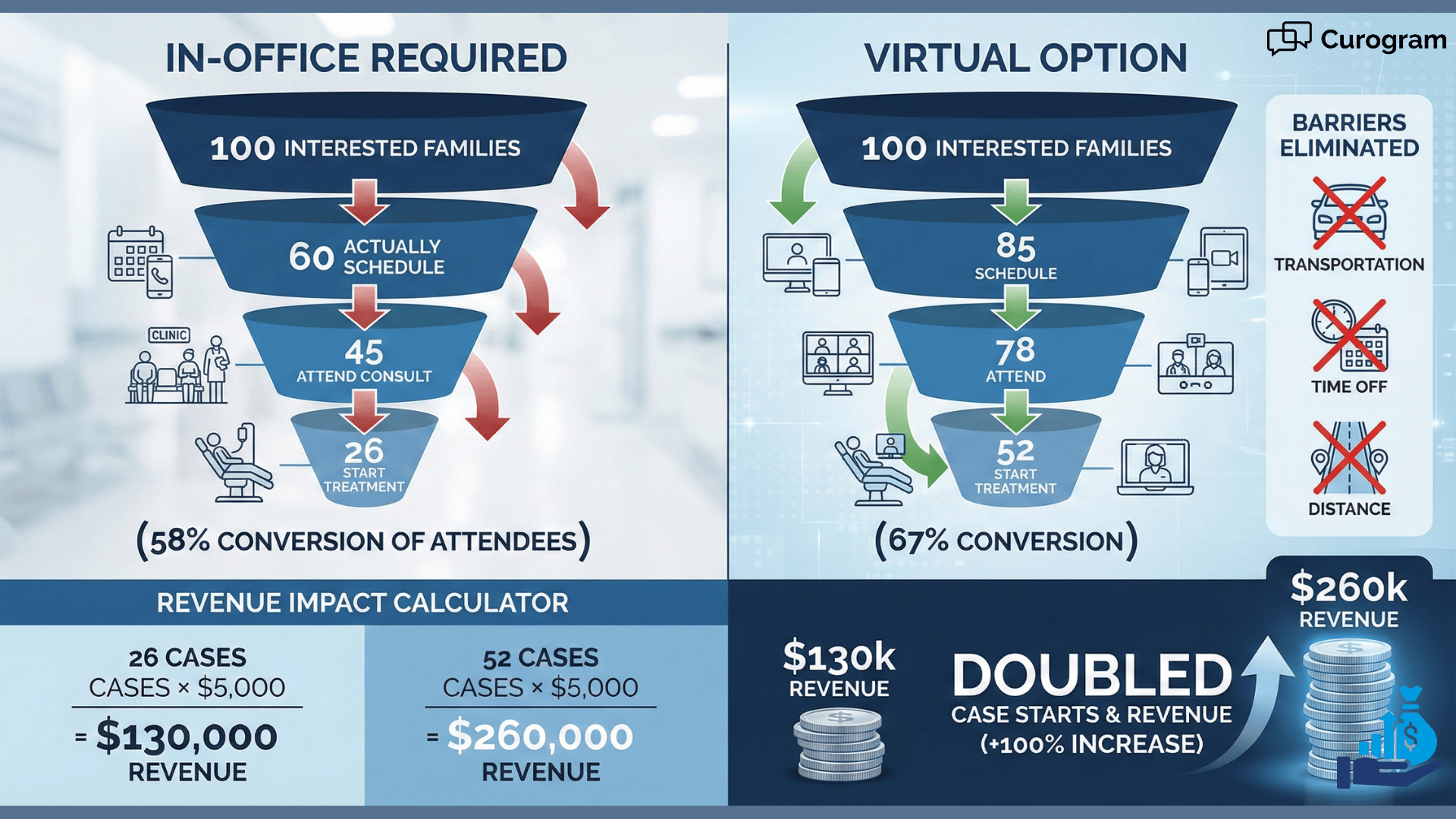
The data supports this observation. Practices report conversion rates of 65% to 75% for virtual consultations compared to 55% to 65% for in-office initial visits. The 10-point improvement might seem modest, but it compounds significantly. If you conduct 240 consultations annually, a 10% higher conversion rate means 24 additional case starts. At $5,000 per case, that's $120,000 in additional annual revenue from improved conversion alone.
Virtual consultations also reduce barriers to second opinions. Families considering multiple practices find it easier to schedule virtual consults with three or four providers. While this increases competition, it also brings more potential patients to your practice who might never have reached out if in-office visits were required. Your clinical expertise and practice culture become the differentiators rather than scheduling convenience.
Virtual follow-up appointments dramatically improve attendance rates. The convenience of joining from home or work reduces the logistical barriers that cause no-shows. Families are far more likely to keep appointments that don't require transportation, time off, or schedule coordination.
The financial impact is substantial. If your practice averages 400 follow-up appointments monthly and improves attendance from 72% to 92%, you're adding 80 completed appointments monthly. Even if these are brief progress checks worth $75 each, that's $6,000 in additional monthly revenue or $72,000 annually. The improved attendance also leads to better treatment outcomes, higher patient satisfaction, and shorter treatment durations.
Reduced no-shows also improve operational efficiency. Your schedule runs more predictably when appointments actually happen. Staff time isn't wasted on reminder calls and rescheduling. Providers can plan their days knowing patients will attend. This predictability makes your entire practice more productive and less stressful for everyone involved.
For Dolphin revenue growth, the combination of expanded access, higher conversion rates, and reduced no-shows creates a powerful multiplier effect. Each improvement supports the others, creating compound benefits that significantly impact your bottom line.
Practice owners and executives need clear evidence that investments will drive growth and improve operations. Telehealth delivers on both fronts while creating strategic advantages that position your practice for long-term success in an evolving market.
Patient retention directly affects practice profitability and long-term revenue stability. Keeping patients engaged throughout treatment is easier when you offer convenient care options. Telehealth removes friction points that cause patients to disengage or stop treatment prematurely.
Consider the typical retention challenges in orthodontic practices. Busy families miss appointments due to schedule conflicts. Teens resist taking time from school or activities for brief check-ins. Families moving within your region drop out rather than making longer drives to your office. Each lost patient represents thousands in uncollected revenue.
Virtual care options address these retention risks directly. When families can join follow-ups from anywhere, they stay engaged throughout treatment. A teen can do a quick progress check after school from home. A family that moved 40 minutes away can continue treatment virtually for routine visits. Parents traveling for work don't need to delay appointments.
The financial impact of improved retention is significant. If better access through telehealth prevents just two patients monthly from discontinuing treatment prematurely, and the average remaining treatment value is $2,500, you're retaining $60,000 annually. These patients also provide positive word-of-mouth referrals and leave better reviews because you accommodated their needs throughout treatment.
Patient lifetime value increases when retention improves. Families who complete treatment successfully are more likely to return for younger siblings or refer friends. They view your practice positively because you made their experience convenient and accessible. This loyalty creates sustained revenue growth beyond individual case values.
Revenue predictability is crucial for practice planning and growth. Telehealth makes case starts more predictable by removing variables that cause consultation cancellations and delays. When scheduling is easier and barriers are lower, consultations happen more consistently throughout the year.
Traditional in-office consultations face numerous disruption factors. Bad weather causes cancellations. School schedules affect availability. Illness in the family prevents attendance. Each cancelled consultation delays potential case starts and creates revenue uncertainty. When half your consultations require rescheduling, predicting monthly case starts becomes difficult.
Virtual consultations are far more resilient to disruptions. Weather doesn't matter when families join from home. Minor illnesses don't prevent participation. Schedule changes are easier to accommodate with virtual appointments. This consistency means your consultation calendar stays fuller and case starts happen more predictably.
Predictable revenue helps with strategic planning. When you know approximately how many cases you'll start quarterly, you can make informed decisions about staffing, equipment purchases, and marketing investments. You can project cash flow more accurately and identify growth opportunities with confidence. This stability is especially valuable during seasonal fluctuations typical in orthodontic practices.
Your market position depends partially on how your practice compares to competitors. When potential patients evaluate options, care delivery convenience has become a significant decision factor. Practices offering telehealth have clear advantages over those requiring all in-office visits.
Modern families research orthodontic practices online before making contact. They compare websites, read reviews, and evaluate service offerings. When your practice prominently features virtual consultation and follow-up options, you stand out immediately. This differentiation attracts families who value convenience and modern healthcare delivery.
The competitive advantage grows as telehealth adoption increases across healthcare. Patients experiencing virtual visits with other providers expect orthodontic practices to offer similar options. Your practice either meets these expectations or risks appearing outdated compared to competitors who do. This perception gap affects patient acquisition directly.
Marketing becomes more effective when you offer telehealth. Your advertising can specifically target busy professionals, families with transportation challenges, or rural populations who value virtual access. These messaging opportunities help you attract patient segments that competitors without telehealth can't effectively reach. The expanded target market increases your growth potential without requiring geographic expansion.
Telehealth provides operational flexibility that improves practice efficiency. Providers can conduct virtual consultations from anywhere, not just the office. This flexibility helps with scheduling optimization, provider coverage, and practice expansion.
Consider the scheduling advantages. Virtual consultations can fill gaps in your schedule more easily than in-office appointments. A 15-minute opening can accommodate a virtual consult but might be too short for an in-office visit with travel time. This flexibility helps maximize provider productivity and revenue per hour.
Provider coverage becomes easier with telehealth capabilities. If your lead orthodontist is at a different location or working from home, they can still conduct consultations and follow-ups virtually. This flexibility ensures patients don't wait weeks for appointments due to scheduling constraints. Faster access to care improves patient satisfaction and conversion rates.
Practice expansion benefits from telehealth infrastructure. Before opening new locations, you can test market demand through virtual consultations. Families in potential expansion areas can access your services virtually, providing data about demand and willingness to convert. If demand justifies physical expansion, you already have patients in that area ready to start treatment.
Digital telehealth platforms provide data about patient behavior and practice performance. You can track consultation attendance rates, conversion rates by appointment type, and patient satisfaction with virtual visits. These insights help optimize your care delivery model continuously.
Understanding which patients prefer virtual visits versus in-office appointments helps with scheduling and resource allocation. You might discover that initial consultations work better virtually while treatment planning requires in-office visits. Or you might find that certain follow-ups are perfectly suited to virtual delivery while others need hands-on examination. These insights help you design optimal patient pathways.
Geographic data from virtual consultations reveals expansion opportunities. If you notice significant demand from a particular area outside your normal service zone, that information guides strategic decisions about marketing focus or potential new locations. This data-driven approach to growth is more reliable than intuition or anecdotal evidence.
Telehealth capabilities provide business continuity during disruptions. Weather events, public health concerns, or other situations that limit in-office visits don't stop your practice when you can deliver care virtually. This resilience protects revenue during unpredictable circumstances.
The COVID-19 pandemic demonstrated this value dramatically. Practices with established telehealth capabilities continued serving patients and generating revenue while those without virtual options faced extended closures and financial distress. While major disruptions are rare, having the infrastructure in place provides insurance against revenue loss during various challenging scenarios.
Real numbers from an actual orthodontic practice illustrate the revenue impact of implementing telehealth. This multi-location practice with four orthodontists serves a suburban and semi-rural market covering approximately 60 miles. They implemented Curogram's telehealth platform integrated with Dolphin Management two years ago.
Before telehealth, the practice struggled with scheduling barriers that prevented consultations and caused frequent no-shows for follow-ups. Geographic distance meant families from outer areas rarely converted even when they scheduled initial consultations. The practice owner estimated they lost 3 to 4 potential case starts monthly due to scheduling constraints alone.
Setup took four weeks from decision to offering virtual appointments. The practice started with virtual consultations for families more than 20 miles away, then expanded to offering virtual options for all follow-up appointments. Staff training required minimal time because Curogram integrates directly with their existing Dolphin system.
Patient adoption exceeded expectations. Within six months, 40% of initial consultations happened virtually. Virtual follow-ups reached 55% of all progress check appointments. Families appreciated the flexibility, and many specifically mentioned telehealth convenience in positive reviews.
Virtual consultations increased total consultation volume by 28% in the first year. The practice went from averaging 45 monthly consultations to 58. This increase came primarily from families who previously couldn't schedule in-office visits due to distance or schedule constraints. The expanded access opened a new patient segment.
Conversion rates improved from 58% to 67% for virtual consultations. The combination of increased volume and higher conversion resulted in 15 additional case starts monthly. At an average case value of $5,200, this generated $936,000 in additional annual revenue from expanded access alone.
Follow-up appointment attendance improved dramatically. No-show rates dropped from 28% to 8% for virtual progress checks. The practice completed approximately 200 more follow-up appointments annually than before implementing telehealth. At $85 per progress check, this added $17,000 in annual revenue while also improving treatment outcomes and patient satisfaction.
Patient retention improved measurably. The practice tracked treatment discontinuation rates and saw them drop from 6% to 2% after implementing virtual options. Preventing 16 patients annually from stopping treatment prematurely retained approximately $40,000 in revenue that would have been lost. These patients also completed treatment successfully, leading to positive referrals.
The combined financial benefit exceeded $200,000 in the first full year of telehealth implementation. This included new case starts from expanded access, improved conversion rates, better follow-up attendance, and reduced treatment discontinuation. The practice owner noted that these numbers didn't include indirect benefits like improved referral rates from satisfied families.
Geographic expansion happened organically. Families from areas 40 to 60 miles away began scheduling consultations once virtual options were available. The practice gained market share in these distant areas without opening new locations. Marketing spend per case start decreased because word-of-mouth from satisfied virtual patients brought in referrals.
Implementation costs were minimal compared to returns. Monthly platform fees were less than $400, and training required no external consultants. The practice achieved positive ROI within the first six weeks. Every month thereafter represented pure profit improvement and competitive advantage.
The evidence from practices like this one demonstrates clear financial benefits from telehealth adoption. Expanded access, higher conversion rates, better retention, and reduced no-shows all contribute to substantial revenue growth.
You can expand access with Dolphin telehealth starting today. The technology is proven, the integration is seamless, and the results are consistent across practice sizes and markets. Orthodontic practices implementing virtual care consistently exceed their revenue growth projections.
Curogram designed its telehealth platform specifically for orthodontic and dental practices using Dolphin Management software. This specialized focus ensures the system addresses real workflow needs without unnecessary complexity or features you won't use.
The integration with Dolphin happens automatically and seamlessly. Virtual appointments sync with your existing schedule. Patient records update automatically after telehealth visits. Your team doesn't manage separate systems or manually transfer information. Everything works together as if telehealth was built directly into Dolphin from the beginning.
Setup is straightforward and requires minimal technical expertise. Curogram's implementation team guides you through each step with clear instructions designed for busy practices. Most orthodontic practices complete setup in three to four weeks with minimal disruption to daily operations. Staff training takes just a few hours because the interface is intuitive and purpose-built for clinical workflows.
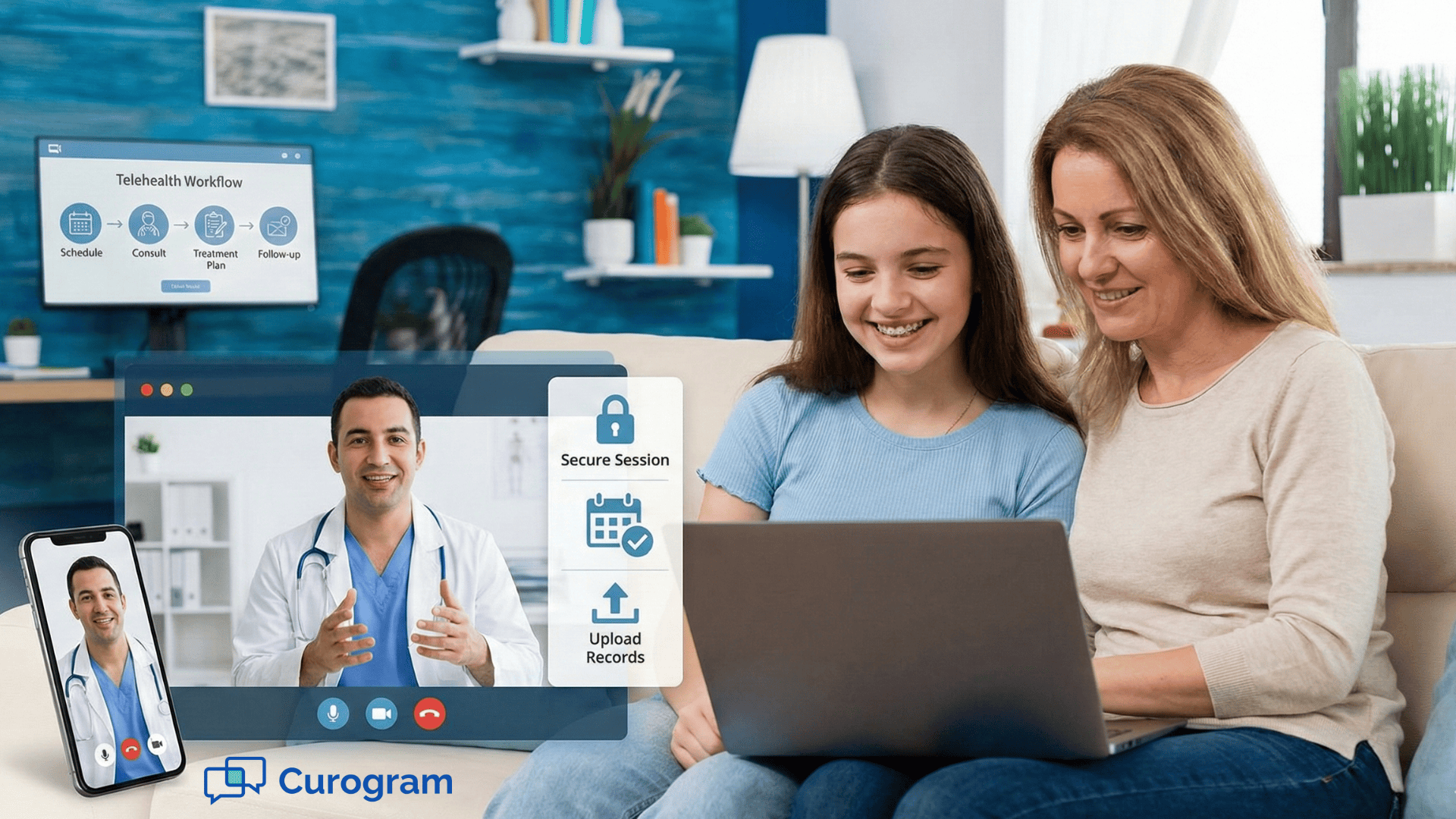
Patient experience remains simple across all devices. Families receive appointment links via text or email and join with a single click. No app downloads, account creation, or technical knowledge required. The interface works smoothly on smartphones, tablets, and computers. Even patients who rarely use technology can join virtual appointments successfully.
Security and compliance are built into every aspect of the platform. Curogram handles all HIPAA requirements with encryption, secure servers, access controls, and complete audit trails. You can focus on patient care while the system manages technical and regulatory requirements for protecting health information.
Support responds quickly when you need assistance. The Curogram team understands orthodontic workflows and Dolphin integration specifics. You're not navigating generic tech support from people unfamiliar with orthodontic practice operations. The support team can troubleshoot issues specific to your specialty and practice size.
Pricing fits orthodontic practice budgets with transparent monthly fees and no hidden costs. You get enterprise-level telehealth capabilities at prices designed for practices of all sizes. The investment pays for itself quickly through increased case starts and improved retention.
Orthodontic practices without telehealth capabilities face growing competitive disadvantages. Every consultation lost to scheduling barriers represents thousands in missed revenue. Every no-show delays treatment and reduces profitability.
The financial case for telehealth is compelling. Expanded access brings new case starts from families who couldn't previously schedule consultations. Higher conversion rates turn more consultations into treatment commitments. Better follow-up attendance improves outcomes and captures revenue from appointments that would have been missed.
The practices already offering virtual care are growing faster than those requiring all in-office visits. They're capturing market share from competitors, improving patient satisfaction scores, and building reputations as modern, accessible providers. These advantages compound over time.
Patient expectations have permanently shifted toward convenience and flexibility. Families researching orthodontic options specifically look for practices offering virtual consultations and follow-ups. If your practice doesn't appear in those searches, you're invisible to a growing segment of potential patients.
The technology is proven and ready for implementation. Thousands of orthodontic practices successfully deliver virtual care through platforms designed specifically for their workflows. The integration is seamless, the training is minimal, and the results are consistently positive.
The question is whether you'll lead or follow in your market. Early adopters gain competitive advantages and market share. Late adopters struggle to catch up while competitors establish reputations as modern, accessible providers.
Take action now to position your practice for growth. The investment is modest, the implementation is straightforward, and the financial returns are measurable. Don't lose another potential patient to scheduling barriers or competitors offering more convenient care options.
Expand access and revenue with telehealth for Dolphin. Book your demo today to see how Curogram transforms your practice's accessibility, conversion rates, and revenue growth.
 Sharee Narciso : Dec 3, 2025, 11:00:00 AM
Learn how Dolphin users simplify ortho consults and surgery follow-ups with Curogram’s HIPAA-compliant telehealth solution.
 Sharee Narciso : Dec 12, 2025, 8:00:00 AM
Discover how Cloud 9 users expand patient access, reduce no-shows, and increase revenue with Curogram’s HIPAA-compliant telehealth.
See how Curogram integrates with Dolphin to deliver HIPAA-compliant telehealth for ortho and oral surgery practices, supporting consults and...