10 min read

Run CureMD Recall Campaign Texts Without Manual Staff Calls

Run CureMD Recall Campaign Texts Without Manual Staff Calls
💡 CureMD practices can send recall texts without manual staff calls. You pair CureMD with a mass-texting tool like Curogram. The front desk builds a list, sends it once, and patients rebook by reply. There is no week of one-by-one calls.

What changes:

  • One send reaches your whole panel, not just the patients staff had time to phone.
  • Filters pick patients by last visit, diagnosis, age, or insurance.
  • Patients book by texting back, and replies route to staff.
  • The 40–60% with no portal account still get reached.
  • One like campaign recovered 1,240 lapsed patients at about $0 added labor, based on our internal data.
Recall shifts from a multi-day phone job into a single message for any front desk.

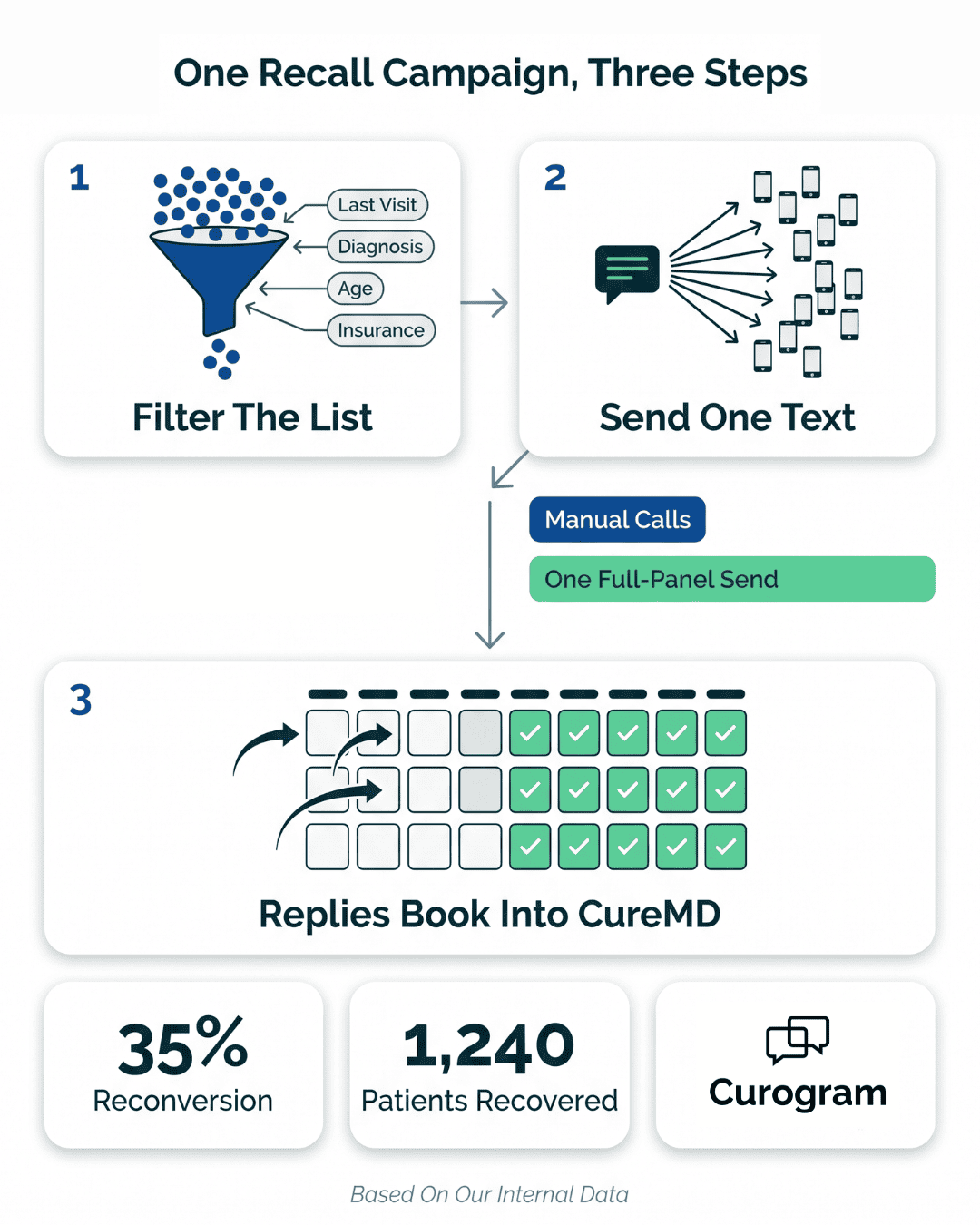
One recall campaign brought back 1,240 lapsed patients. No phone tree. No week of voicemails. Based on our internal data, that single send hit a 35% reconversion rate. Those patients booked within a month of one text.

Compare that to how recall usually runs. A staffer opens a list of overdue patients and starts dialing. Between reschedules, intake questions, and a phone that will not stop, they reach maybe 30 names before the day ends. The rest wait until tomorrow, or next week, or never.

In CureMD, proactive outreach runs mostly through the patient portal. That works well for patients who set up an account. But 40–60% of a typical panel never did. Reaching them falls back on manual calls, and that gap is the real bottleneck.

Think about what the gap costs. Every overdue patient is a follow-up that slipped and a slot that stays open. A single missed annual exam can mean a missed diagnosis and lost revenue at once. Across a full panel, manual recall starts to look expensive.

More callers will not fix this. The cap is the channel itself. A phone reaches one patient at a time, no matter who is dialing.

You can send CureMD recall campaign texts without manual staff calls instead. The front desk filters the panel, sends one message, and patients rebook by replying.

This piece shows how the swap works next to CureMD. You will see what it recovers, and why the phone was never the right tool for full-panel recall.

The Villain: What a Manual Recall Day Really Looks Like

A recall list starts with good intentions. Someone pulls every patient overdue for a follow-up and blocks off an afternoon to call. Then the afternoon happens.

Three patients need rescheduling. Two calls go to voicemail. A billing question eats fifteen minutes. By closing, the caller has reached maybe 30 names out of 300. The "campaign" is really just that day's dialing.

This is not a staffing failure. One person can hold one phone conversation at a time. Add voicemails and callbacks, and the true reach per hour drops lower still. Recall by phone is capped by that plain limit, and the cap sits low.

Why the Portal Leaves Half Your Panel Out

CureMD's portal handles plenty well. Messages, results, and forms all live there for patients who signed up. The problem is who did not sign up.

Portal use is uneven. At many practices, 40–60% of patients never activate an account. Often these are older patients, brand-new patients, or anyone who found the signup step annoying. A portal message to those patients lands nowhere.

So recall splits in two. Portal patients might see a note. Everyone else waits on a call that may never come. To reactivate lapsed patients, a CureMD practice needs a channel that reaches the phone in a text. A login gate cannot do that job.

The Math of a Calling Cap

Put numbers on it. Say your panel holds 300 overdue patients and one staffer has two hours a day for recall.

Recall method

Reached in one week

Who gets missed

Manual calls

~150 (about 30 a day)

Half the list, plus every no-answer

Portal message

Portal users only (40–60%)

Everyone without an account

Full-panel text

All 300 at once

No one eligible


Manual calls and portal messages each reach a slice. Stack them and you still miss patients with no portal who never picked up. That missed slice is where continuity of care and revenue both leak.

What the Empty Slots Cost

Empty slots are not just quiet mornings. Each one is a visit that would have billed. A practice with 20 recall-eligible no-shows a week, at even $120 a visit, leaves $2,400 on the table every week it cannot reach them.

Over a quarter, that is real money lost to a busy signal. The clinical side is worse.

A lapsed diabetes or blood-pressure patient who never gets the call is a chart that goes stale until something forces a visit. Manual recall tops out well before the list ends, and the shortfall hides in slots that never fill.

The Guide: One List, One Send

Curogram turns recall from a call list into a single campaign. Staff pick who to reach, write one message, and send it to the whole eligible group at once. Patients reply to book. That is the loop.

Filters do the targeting. Pull everyone overdue by last visit date. Narrow by diagnosis, age, or insurance when the message needs to fit a group. A diabetes recall and a flu-shot reminder can go out the same morning to two different lists.

Because it runs on texting, it reaches phones directly. No portal account needed. The 40–60% the portal missed are back in range.

What the Message Actually Says

The text stays short and human. Something like:

"Hi Maria, it's Valley Family Medicine. Our records show you're due for a follow-up. Reply YES and we'll get you booked."

Patients answer in plain words, and staff read the thread like any other message.

Opt-outs run on autopilot. A patient who texts STOP is removed, and the system logs it, so the next campaign skips them. That keeps the practice inside TCPA rules without staff tracking anything by hand.

How It Runs Alongside CureMD

You keep CureMD as your schedule and your record. Curogram sits next to it as the outreach line. The steps are short:

  1. Build the recall list from your criteria: last visit, diagnosis, age, or insurance.
  2. Send the campaign as one bulk text.
  3. Patients reply, staff see the responses, and each booking drops into CureMD.

This is where CureMD recall list automation earns its keep. Rather than copy names into a phone queue, staff work from a filtered list and let replies come to them. Bulk patient texting keeps staff hands off the dialer and on the booking.

No Marketing Team Required

A recall campaign sounds like something a marketing department runs. It is not. The front desk sends one mass message from the CureMD patient list, and the tool handles delivery, replies, and opt-outs.

There is no campaign builder to study for weeks. Filter, type the message, send. When a patient texts back "yes," it lands in the same inbox staff already watch. To automate recall campaigns, CureMD practices add no headcount and instead remove steps.

Infographic showing how to run CureMD recall campaign texts without manual staff calls in three steps

Where It Fits by Specialty

Recall is not one-size-fits-all, but one campaign tool fits every specialty. What changes is the filter and the timing. A cardiology panel needs different rules than a pediatric one.

These examples show how a few teams use the same text recall. Each one pulls its own overdue list from the same records. Same idea, different filter.

Endocrinology

Endocrinology runs on repeat visits. Diabetes and thyroid patients need labs and check-ins on a set cycle. Miss one, and an A1C can climb unwatched for months.

A text campaign pulls everyone overdue for a lab draw or a med review, then sends one message to the group. Patients reply to book, and staff never touch the phone. It is a clean way to reactivate lapsed patients by text before a care gap turns into an ER visit.

Cardiology

Cardiology patients skip follow-ups when they feel fine. That is when a lapse is riskiest. Blood-pressure checks, post-op visits, and med changes all run on a set schedule.

Filter by last visit and diagnosis, then send one recall text, and the overdue list starts booking itself. Based on our internal data, one SMS recall brought back 1,240 lapsed patients, a 35% reconversion rate. For a cardiology panel, that is a lot of missed follow-ups won back.

Behavioral Health

Behavioral health lives and dies by continuity. A patient who drops off between sessions is the one most likely to fall through the cracks. Phone tag rarely reaches them in time. A discreet text works better.

One filtered send reaches every patient overdue for a session. The wording stays private and low-key, and replies route straight to the front desk to rebook. Because it skips the portal, it also reaches patients who never logged in.

Primary Care

Primary care carries the widest recall list. Annual exams, overdue labs, and routine screenings pile up across a large panel. Manual calling never clears them.

A text campaign lets the front desk fill schedule gaps from a CureMD recall without a week on the phone.

Pull everyone past due for a wellness visit, send once, and book the replies. One practice kept a steady flow of returning patients this way, without adding a single staff hour.

Pediatrics

Pediatrics recall is really parent recall. Well-child visits and vaccine series run on tight, age-based windows. A busy parent needs a nudge that fits between everything else, and a quick text does that where a voicemail does not.

Filter by age and visit type, send the reminder, and let parents reply to book. Bulk patient texting lets staff reach every family with a child due for a shot at once. No more calling homes one by one during clinic hours.

The Success: One Campaign, Start to Finish

Take a recall run at a mid-size primary care practice, from open to close.

Monday morning, the front desk pulls every patient with no visit in 12 months and a diagnosis that needs follow-up. The filter returns 420 names. In the old workflow, that is two weeks of calls.

They write one message: a plain note that the patient is due, with a line to reply and book. One click sends it to all 420. Replies start within minutes.

Over the next three days they trickle in — a "yes" here, a question there, a few reschedules. Staff book each reply into CureMD as it arrives, with no outbound dialing at all. By Thursday, gaps that would have sat empty are filling.

Not every reply is a clean yes. Some patients ask about cost or a specific provider. Staff answer in the same thread and book from there. A few text back a better day, and the front desk slots them in without a single call.

The reschedules matter as much as the new bookings. A patient headed for a no-show becomes a confirmed visit in a two-line exchange.

By week's end, the practice has worked a 420-name list that manual calling would have stretched across a month.

The Numbers From One Campaign

Based on our internal data, a comparable multi-location practice ran recall this way with clear results.

Measure

Result

Patients who booked after one SMS recall

35% reconversion

Lapsed patients recovered

1,240 in one campaign

Added staff labor

~$0


That 35% reconversion runs 3–7× the passive baseline many practices see from portal reminders alone. Treat the multiple as illustrative, since baselines shift by specialty. The 1,240 figure is not a projection. Those are patients seen from recall messages alone.

What the Front Desk Does Now

The change is in where staff time goes. Before, recall meant days on the phone reaching a fraction of the list. Now the send takes minutes, and staff spend their hours booking the patients who reply.

To fill schedule gaps, a CureMD recall once had to compete with every other front-desk task for the same hours. It does not anymore. The campaign runs in the background, and staff simply catch the responses as they come in.


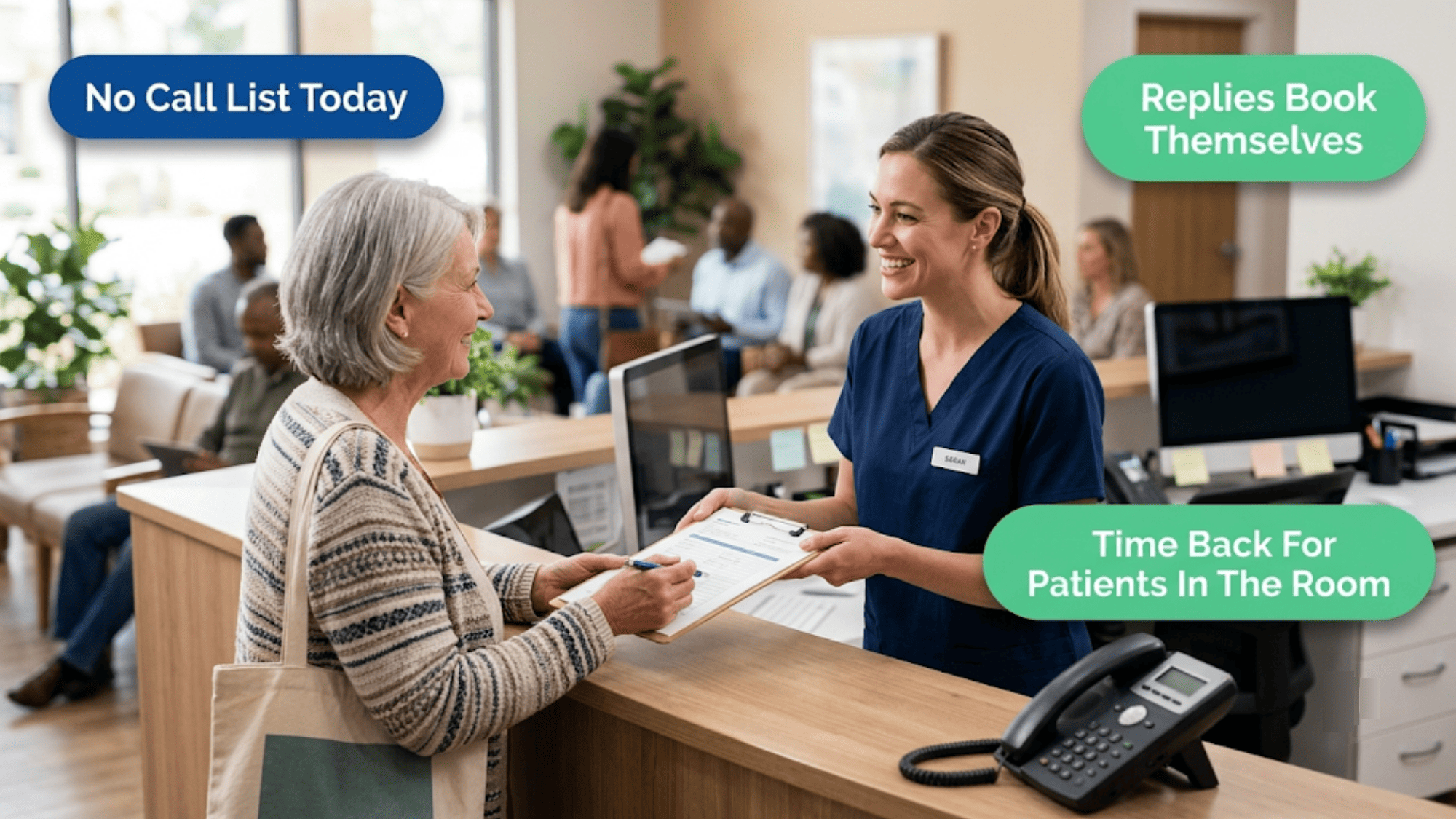
Front-desk staffer helping a patient in person after CureMD mass message recall replaced the call list

How Curogram's Mass Texting Turns a Recall List Into One Send

Mass Texting with SMS Patient Recall is the feature that replaces the phone marathon. It lets your front desk message the whole eligible panel in one send, then routes every reply back for booking. You build the list, Curogram delivers it, and patients do the rest by texting back.

Start with the filter. Pull patients by last visit, diagnosis, age, or insurance, so the message fits the group you mean to reach.

An overdue-labs list and a well-child list can go out the same day, each with its own wording. The eligible panel is defined by you, not by who happens to hold a portal login.

Then send. One click delivers the recall text to every phone on the list at once. There is no dialing, no voicemail, no waiting for callbacks.

Patients who never set up a portal get the same message as everyone else, at the same moment. The list can hold a few dozen names or your entire overdue panel. The send takes one click either way.

Replies close the loop. When a patient texts back to book, the response lands in the inbox staff already watch, so scheduling into CureMD takes seconds. Opt-outs are handled for you, and consent is tracked per TCPA. The texting itself is HIPAA-compliant, backed by a BAA and encryption.

The result is recall that scales past a single caller's day. One staffer used to reach 30 or 40 patients before the phone won out. That same staffer can now reach a full 420-name list before lunch, then spend the afternoon booking replies.

Based on our internal data, a comparable campaign brought back 1,240 lapsed patients at roughly $0 added labor. That is full-panel recall when the send is one message instead of a week of calls. The office phone stays quiet.

Conclusion: Trade the Recall Call List for a One-Click Campaign

Manual recall reaches a fraction of your panel. The phone is the cap, and no amount of staff effort raises it much. A caller works the list for days while the non-portal majority never hears a thing. The "campaign" ends up being whoever there was time to reach that week.

CureMD runs your schedule and your record well. It was never built to fill that schedule from the patients you could not reach. That job needs a channel that lands on a phone directly. It covers the whole eligible panel in one send and lets patients book by reply.

That is the swap this piece argues for. Recall stops being a call list and becomes a single text campaign. Staff trade days of dialing for minutes of setup, then book the replies that come back.

The patients the portal missed are back in range, and empty slots start filling on their own. The work that once ate whole afternoons now runs while staff help patients.

The numbers hold up. One comparable campaign recovered 1,240 lapsed patients at a 35% reconversion rate, based on our internal data, with essentially no added labor.

That is care restored and revenue recovered from a panel manual calling would have left half-contacted. Those are visits that happened, labs that got drawn, and chronic conditions caught before they slid further.

Bring your own recall criteria and see it run against your real panel shap. Book your Curogram demo and tell us who you want to reactivate, and we will build the campaign live on the call.


Frequently Asked Questions

How does bulk recall texting stay compliant when the front desk sends it?

Curogram's texting is HIPAA-compliant, backed by a BAA and encryption. Consent is captured and opt-outs are honored per TCPA, so staff can send full-panel recall campaigns without taking on compliance risk themselves.

Why can front-desk staff run a recall campaign without a marketing team?

The workflow is filter, type, and send. Staff build the list from CureMD criteria, send one message, and replies route back automatically for booking. No campaign builder, ad tools, or specialist skills are involved.

Why add Curogram for outreach when CureMD already includes a portal?

Portal outreach reaches only patients with active accounts, which leaves out the 40–60% who never signed up. A single recall campaign reaches the full panel and typically recovers far more revenue than the subscription costs.

How does a recall text reach patients who never set up the CureMD portal?

Texting goes to a phone number, not a portal login. As long as staff have a mobile number and consent on file, the message reaches those patients directly. No account or app is required.

How do you decide which lapsed patients to include in a recall campaign?

Filter by last visit date first, then narrow by diagnosis, age, or insurance to match the message. Chronic-care patients overdue for follow-up and patients past an annual exam window are common starting lists.


Beyond Portal Users: CureMD Patient Recall by Mass Messaging

Beyond Portal Users: CureMD Patient Recall by Mass Messaging

💡 CureMD patient recall mass messaging beyond portal users reaches the patients your CureMD tools miss: the large share of your panel who never log...


Read More
Automate Patient Recall Campaigns in Azalea Health

Automate Patient Recall Campaigns in Azalea Health

💡Automated patient recall campaigns for the Azalea Health front desk find your overdue patients and text them to rebook. They run entirely on their...

Read More
Enable CureMD Patient Texting Without App Download or Portal Account

Enable CureMD Patient Texting Without App Download or Portal Account

💡 CureMD patient texting without app download or portal account lets patients reach your office with one simple text. There is no login, no...

Read More