8 min read

Reach a CureMD Lapsed Patient by Text Recall, No Portal Account

Reach a CureMD Lapsed Patient by Text Recall, No Portal Account
💡 A CureMD lapsed-patient text recall that needs no portal account reaches the people who quietly drop off your schedule. These are patients who never enrolled in the portal and haven't been back in months.

CureMD sends recalls through the portal, so a patient without a login never gets the nudge to return. The text approach closes that gap in a few ways:

  • The recall arrives as a plain SMS on the phone the patient already uses.
  • Patients reschedule by reply — no portal, no app, no call to the front desk.
  • Older primary-care and chronic-care patients get reached without a login step.
  • Staff see each rebooking land in CureMD, so nothing gets lost.
It works because the message actually arrives and rebooking takes one reply. A comparable practice brought back 1,240 lapsed patients from a single recall, based on our internal data.

Your recall list runs on schedule. The follow-up reminders go out through CureMD's portal, right on time. But a big share of those patients never made a portal account. So they never see a word of it.

These are the lapsed patients. They came in once or twice, meant to book that follow-up, and then life moved on. Nothing reached them, so nothing brought them back. Months later, they're still overdue, and the practice never knew the recall missed.

This is the quiet gap in portal-only outreach. It doesn't fail loudly. No error, no bounce — the recall just lands in an inbox no one opened. For older patients and chronic-care patients, that account was never going to happen.

A recall only helps if it reaches a phone the patient checks. The portal clears that bar for the people already logged in. For everyone else, it's a locked door.

Text reaches them instead. A short, friendly recall shows up where patients read messages from family and the pharmacy. They reply to rebook, and staff see it in CureMD. No login, no download, no phone tag.

The lapsed patients aren't ignoring you. They just never got the message. Reach them on text, and a real share of them come back — one practice saw 1,240 return from a single campaign.

The Villain: The Portal Account That Never Happened

CureMD's recall reminders travel through the patient portal. That works fine for patients who signed up. The catch is how many didn't.

A patient checks in once for a knee that's bothering them. Front desk hands over the portal invite. They mean to set it up at home, then forget. No account, no way for the portal recall to find them.

Now multiply that by every walk-in, every one-time visit, every older patient who prefers a phone call to a login screen.

That's the unreachable half — not a rounding error, but a real slice of your panel. Their record sits in CureMD, complete and correct. The reminder to return has nowhere to go.

Portal enrollment tends to lag most in the exact groups who need recalls most: seniors and chronic-care patients. The people hardest to reach by portal are the ones you most want back.

How Overdue Care Slips

The gap rarely looks like a crisis. It looks like nothing at all.

A gastroenterology patient is due for a six-month follow-up, and the date passes. No portal message reaches them, so no prompt arrives. They assume the office would call if it mattered. The office assumes the recall went out — technically, it did.

Three months later, that follow-up is nine months overdue. A rheumatology patient skips a lab check and their medication management drifts. None of this shows up as an angry call or a bad review. It shows up as an empty slot and a chart that quietly goes stale.

A CureMD overdue-care text reminder would have closed that loop with one message. Without it, the practice loses the visit and the patient loses continuity — and neither side notices until much later.

Silent Attrition Isn't the Same as Not Caring

It's easy to read a no-return as a patient who lost interest. Usually that's not it. Most lapsed patients still want the care. They just never got a reminder that reached them.

Patients who miss a visit and hear nothing tend to keep drifting. Each month without a nudge makes the return less likely, and the reason for the visit doesn't go away. A skipped follow-up becomes a skipped year.

With no reminder that lands, only a small slice of overdue patients rebook on their own — single digits, not a third. The rest wait for a prompt that portal-only recalls never deliver. The pattern isn't apathy. It's a message that never arrived.

The Guide: Text Is the Channel Patients Actually Open

People read their texts. Most open them within minutes, and almost all get seen. Compare that to a portal login the patient has to remember, find, and complete. One reaches people where they already are; the other asks them to come to you.

Lapsed patient outreach for CureMD practices works best when it needs no login at all. A recall sent by text meets patients on the same phone where they read notes from family, the pharmacy, and the school. There's no new habit to build. The message just shows up.

That's the whole idea behind reaching the full panel, not only the portal-enrolled part of it. Every patient with a mobile number is reachable — which, for most practices, is nearly all of them.

One Reply, Rebooked

The recall does more than remind. It gives the patient a way to act right there in the thread.

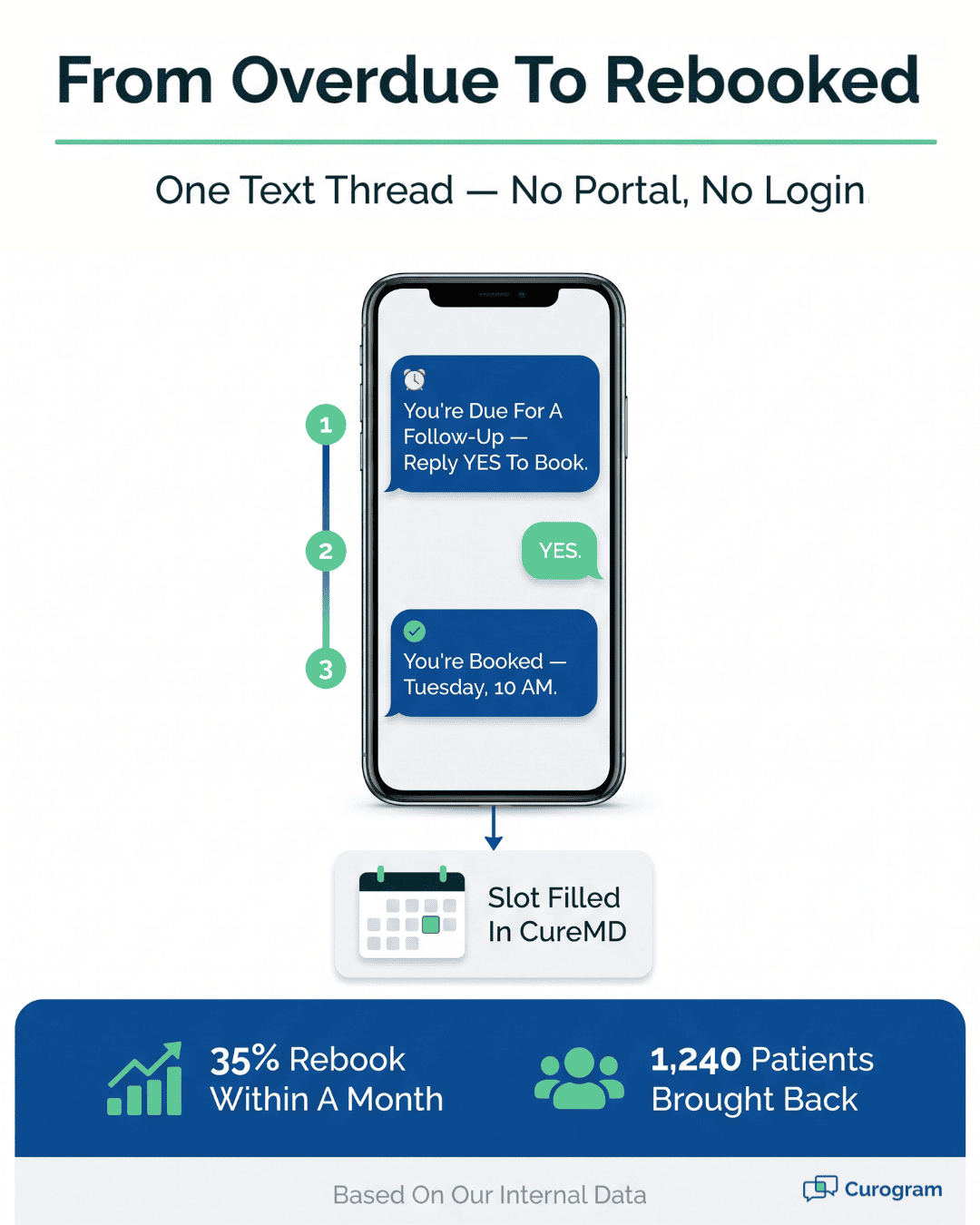
A patient gets a short note: they're due for a follow-up, reply YES to book. They text back. Staff see the response and slot the visit — the patient reschedules by reply to the recall text, no portal step in between. No hold music, no login, no download.

For someone who's been putting off a call to the office, that friction drop is the difference between rebooking and ignoring it.

The action lives inside the message they already opened. Booking an appointment from the recall text takes CureMD patients seconds, not a phone queue.

Every reply lands where staff can see it, so a busy front desk isn't chasing anyone. The patient does the easy part. The schedule fills.

It Runs Alongside CureMD, Not Instead of It

None of this replaces your EHR. CureMD stays the system of record — the chart, the schedule, the clinical history all live there, unchanged.

Curogram handles the reach. The recall goes out by text alongside CureMD, the patient replies to rebook, and the booking shows up for staff to confirm against the schedule. Your team works from one view, not two.

That split matters. The portal is fine at holding records and serving patients who log in. It was never built to chase down the ones who didn't. Text fills that specific gap without asking anyone to rip anything out or relearn a workflow.

Why the Fit Matters for Older and Chronic-Care Panels

The patients most likely to skip the portal are often the ones who most need to come back. That overlap is the point.

Rheumatology, gastroenterology, cardiology, primary care — these panels run on regular follow-ups, lab checks, and medication reviews. Miss the recall and care drifts. A patient reactivation message by text is often the single nudge that keeps a chronic-care patient in the loop.

Older patients skew away from apps and logins, but a plain text they can answer? That they'll do.

A CureMD patient reactivation message meets them at their comfort level and asks for one small reply. For continuity-heavy specialties, that reliable nudge keeps the panel full and the care on track.

Three-step text recall flow that lets patients reschedule by reply

The Success: What a Single Recall Campaign Looks Like

Say a multi-location practice wants to pull back patients overdue for follow-ups. The flow runs start to finish in four moves:

  1. Staff pull the list — patients past their recommended follow-up window who haven't rebooked. In CureMD, that's a filter, not a research project.

  2. The recall goes out by text. Each message is personalized and short: a reminder they're due, and a reply-to-book prompt. It's a CureMD reminder-to-return text, not a portal note they'll never open.

  3. Then patients reply. Some book on the spot.

  4. Staff confirm each one against the open schedule and slot it in CureMD. Overdue patients who'd gone quiet start filling next week's gaps — no cold calls, no voicemail chains.

The Numbers From a Real Campaign

When outreach reaches patients, more of them rebook. Based on our internal data, a large practice sent SMS recalls to patients overdue for follow-ups. Within a month, 35% of them booked a visit.

That's well above what practices see with no outreach, where rebooking stays in the single digits. The same campaign brought back 1,240 patients from recall texts alone.

Recall approach

Share who rebook

What it means for the schedule

Portal-only recall (patient never logged in)

Single digits

Most lapsed patients stay lapsed

Texted recall, reply-to-book

35%

1,240 patients returned in one campaign

Rebooking figures based on our internal data (Curogram Case Studies).

From a Leaky Panel to a Full One

A recall that reaches everyone changes what your panel looks like month to month. The patients who used to vanish now get a nudge they actually receive.

The overdue follow-ups come back. The lab checks get scheduled. The chronic-care patients who'd drifted are back on the calendar, and the gaps they left behind fill with real visits.

Continuity is the quiet win here. Care that would have lapsed stays on track, because the person responsible for booking it finally got a message they could answer. The full panel — not just the portal-enrolled slice — stays in care.


Lapsed patient returning to care, welcomed at a clinic front desk

How Curogram Reaches the Patients CureMD's Portal Can't

Curogram's SMS Patient Recall is built for exactly this gap: the lapsed patients a portal can't reach. It sends a personal recall by text to patients who are overdue for a follow-up. The reply-to-book path skips the portal for good.

There's no login and no app. The patient gets a plain message on their phone. They reply to rebook, and staff see the response and confirm it in CureMD. The whole loop — reminder, reply, booking — happens where patients already read their texts.

It runs alongside CureMD instead of replacing it, so your team keeps one system of record. The recall list comes from your own follow-up data. Curogram just handles the reach, to the patients the portal had no way to contact.

It fits the panels where this matters most. Primary care, rheumatology, gastroenterology, and cardiology all run on regular follow-ups that keep chronic conditions in check.

For an older patient who never joined a portal, a text they can answer is the difference between coming back and drifting off.

The setup is light. There's no new workflow to learn and no records to move. The recall reaches the full panel, patients rebook by reply, and overdue visits start landing back on the schedule.

Conclusion: Reach the Lapsed Patients the Portal Never Could

Lapsed patients don't stay away because they stopped caring. They stay away because nothing reached them. The recall went out — it just went somewhere they never look.

CureMD holds the record. That's its job, and it does it well. But a record isn't a reminder the patient actually receives. The recall only works if it lands on a phone they check.

Text closes that gap. A short recall, a reply to rebook, and a patient who'd gone quiet is back on the schedule. No portal, no app, no phone tag — for the older and chronic-care patients who need follow-ups most, that's the difference.

The practices doing this aren't reaching a few extra patients. They're reaching the half the portal never could — and 1,240 returning from a single campaign is what that looks like on the schedule.

If your recalls run through the portal today, a real slice of your panel isn't getting them. Reaching those patients doesn't take a new system. It takes a message that arrives.

Book a demo to see a patient recall-and-rebook flow end to end — from the overdue list to the reply that fills the slot.


Frequently Asked Questions

How does a texted recall reach patients who never set up the CureMD portal?

CureMD sends recalls through the portal, so patients without an account never see them. Curogram sends the same recall as a text to any patient with a mobile number, reaching the ones portal-only outreach misses.

Why do lapsed patients respond better to a text recall than a portal message?

Most patients read texts within minutes but rarely check a portal they never enrolled in. A recall on the phone they already use gets seen, so far more overdue patients notice it and reply to rebook.

How do patients rebook from a recall text without an app or login?

The recall includes a reply-to-book prompt. Patients simply text back to schedule — no download, no login, no phone call. Staff see the reply and confirm the visit against the open schedule in CureMD.

How does Curogram keep recall texts private and compliant?

Recall texts are HIPAA-compliant and consent-based. They use only minimal information, never clinical detail, and honor opt-outs automatically. Patients control their messaging preferences at any time, and an opt-out is respected immediately.

Why do older and chronic-care patients benefit most from text recalls?

These patients often skip portals but keep their phones close. Their care depends on regular follow-ups, so a plain text they can answer is frequently the single nudge that keeps chronic conditions and continuity on track.


Beyond Portal Users: CureMD Patient Recall by Mass Messaging

Beyond Portal Users: CureMD Patient Recall by Mass Messaging

💡 CureMD patient recall mass messaging beyond portal users reaches the patients your CureMD tools miss: the large share of your panel who never log...
Read More
Why Patients Respond to Text Recalls, Not Phone | Meditab IMS

Why Patients Respond to Text Recalls, Not Phone | Meditab IMS

💡 Overdue Meditab IMS patients respond to text recalls instead of phone calls because texting matches how patients actually communicate in 2026....

Read More
Why Lapsed Patients Rebook by Text | CharmHealth

Why Lapsed Patients Rebook by Text | CharmHealth

💡 Patient reactivation texts for lapsed CharmHealth patients work because most lapsed patients didn't choose to leave. They drifted. No one reached...

Read More