HIPAA-Compliant Telehealth for CollaborateMD: 1-Click Visits
💡 HIPAA-compliant telehealth for CollaborateMD removes the tech headaches of virtual care and ties every visit to your billing workflow. Patients...

11 min read
Mira Gwehn Revilla
:
February 25, 2026
A patient calls at 4:55 PM. She needs a refill and has a quick question about her dosage. The doctor spends eight minutes on the phone. The result? Zero dollars billed.
This scene plays out in medical offices every single day. Doctors give away hours of clinical advice each week. They answer calls, reply to portal messages, and handle triage after hours. None of it shows up on a claim.
The problem is not the care itself. The problem is the format. A phone call alone does not meet payer rules for most billing codes. But a short video visit does.
That is the core idea behind telehealth billing for CollaborateMD practices. When you convert phone calls to telehealth with a tool like Curogram, those "free" consults become billable virtual visits. The clinical work stays the same. The only change is adding a camera.
Curogram makes this switch fast and simple. The provider sends a video link by text. The patient taps the link and joins from their phone. No app download. No login. The visit lasts as long as it needs to, and the charge posts right to CollaborateMD.
This is not about adding more work. It is about getting paid for work you are already doing. Every refill call, every triage question, and every after-hours check-in can turn into a real visit with a real claim.
In this article, we will break down why so many practices lose money on phone-based care. We will walk through the exact workflow to flip a call into a video visit. And we will show the math behind how one small change can add tens of thousands of dollars to your bottom line each year.
If you are tired of working for free, keep reading.
Most practices lose money every day without knowing it. The loss does not come from no-shows or denied claims. It comes from the care providers give away for free over the phone and through portal messages.
These small, unpaid moments add up fast, and they create a real drag on your bottom line. Here is how the trap works.
Think about a normal Tuesday at your practice. Between scheduled visits, your phone rings six or seven times. A parent wants to know if her child's rash needs to be seen. A patient on blood pressure meds asks about a side effect. Someone calls in for a refill and has a "quick question."
Each call takes five to fifteen minutes. Your doctor listens, thinks, and gives real clinical guidance. But because it was a phone call, there is no visit on the books. No claim gets filed. The practice earns nothing.
Now, add those calls up. If a provider handles just five of these a day at an average of ten minutes each, that is nearly an hour of unpaid work. Over a week, it is close to five hours. Over a year, it is more than 200 hours of free clinical labor.
This is the "free advice" trap, and it drains revenue from practices of every size. The doctor is doing real work. The patient is getting real care. But the telemedicine revenue cycle never starts because the visit never becomes a visit.
Phone calls are not the only leak. Many providers spend their evenings logging into the patient portal to answer messages. A patient sends a long note about new symptoms. The doctor reads it, reviews the chart, and types out a careful reply.
This work often takes just as long as an office visit. Yet in most cases, it goes unbilled. Portal messages sit in a gray area. They feel like admin tasks, but they involve real clinical thinking.
The worst part? Patients have come to expect this free access. They send portal messages instead of booking visits. The practice loses a slot on the schedule and gains nothing in return.
Every minute a provider spends on a free call or message is a minute they cannot spend on a billable slot in the CollaborateMD schedule. This is the hidden cost that most practices overlook.
|
Say, your practice charges $120 for a standard office visit: If a provider spends 30 minutes each day on unbilled calls, that is the same as losing two to three visit slots per day. Over the course of a month, that adds up to 40 or more lost visits. Put a dollar figure on it. At $120 per visit, 40 lost visits means $4,800 per month in missed revenue. Per year, that is over $57,000 per provider. And that does not count the added strain on your staff. Front desk workers field these calls, pull up charts, and route messages. Nurses do intake over the phone. All of this takes time away from tasks that move the practice forward. |
The free advice trap is not just a billing issue. It is an overhead issue, a morale issue, and a growth issue. When providers feel like they are working harder but earning less, burnout follows.
The good news is that you do not need to stop helping patients between visits. You just need to change how you do it. By making one small shift — adding a camera to the call — you can turn those lost minutes into billable virtual visits.
Payers allow it. The rules support it. And with the right tool, the switch takes less than ten seconds.

Turning a phone call into a paid visit does not require a complex setup. It does not need new hardware or a long training session. The workflow is simple, fast, and built around tools your team already knows how to use.
With Curogram and CollaborateMD, the whole process takes seconds and fits right into the way your practice already runs. Here is what it looks like step by step:
Here is how it works in real life. A patient calls your office about a new symptom. Instead of handling it over the phone, the provider says: "I need to see you. I'm sending a video link right now."
The provider opens Curogram and clicks "Start Video." Curogram sends the patient a link by text message. The patient taps the link on their phone and joins the video call. No app to download. No account to create. The whole switch takes about ten seconds.
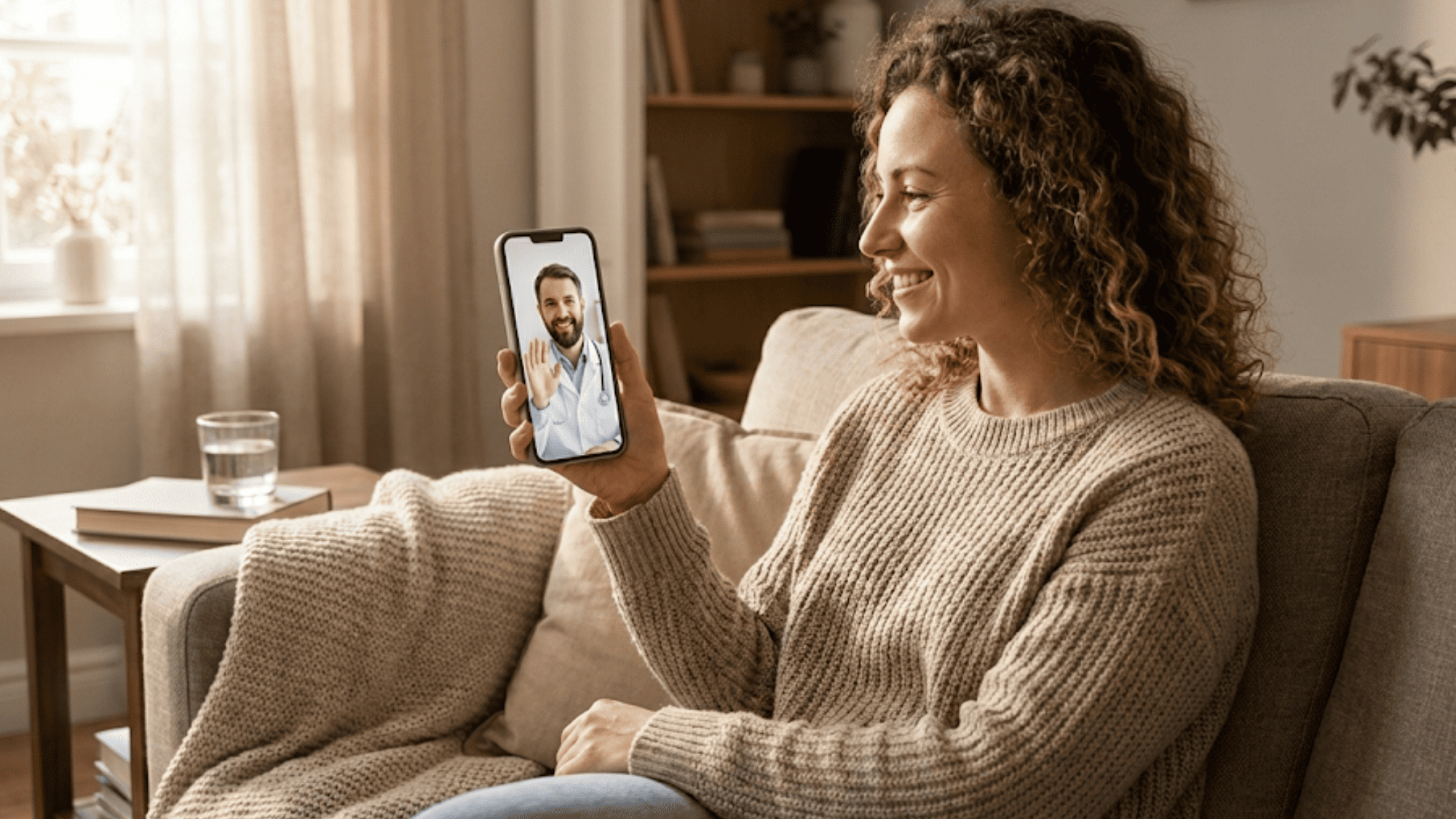
From the patient's side, it feels easy and natural. They were already on the phone. Now they are on a video call. The provider can see them, ask them to show a rash or read a label, and give the same advice they would have given by phone. But now the visit counts. That is the key difference.
Most payers require an audio-visual link to qualify for standard E/M codes like 99213 or 99214. A phone-only call does not meet this rule in most cases. But the moment you add video, even for a short session, you meet the standard.
This is why the "switch to video" matters so much for telehealth billing for CollaborateMD practices. You are not changing the care. You are changing the format so it fits what payers need to see on the claim.
Once the video visit ends, the provider documents it just like any other visit. Curogram syncs with CollaborateMD, so the charge posts to the patient ledger. The telemedicine revenue cycle runs from there, just like an in-office visit.
Think of it this way: You were going to spend those ten minutes helping the patient no matter what. The only question is whether you get paid for it.
This workflow gets even more powerful after the office closes. Many practices have providers on call in the evenings and on weekends. These providers handle urgent calls from home. In the traditional model, they give advice over the phone and never bill for it.
With Curogram, on-call providers can offer CollaborateMD after-hours care as billable video visits. A patient calls with an urgent issue at 8 PM. The provider sends a video link, does a quick assessment, and bills it as an urgent care visit.
Without this option, that patient might go to the ER. The practice loses the visit and the revenue. The patient pays more and waits longer. Everyone loses.
By covering these moments with video, the practice keeps the patient in its care and adds a real charge to the books. Remote patient monitoring codes may also apply for ongoing follow-up tied to chronic conditions, adding another layer of billable care.
The hardest part is not the tech. It is the habit. Providers are used to handling calls the old way. Building a new reflex takes practice.
Start with one type of call. Pick refill requests, for example. Every time a patient calls for a refill and has a question, switch to video. Once that feels natural, add triage calls. Then add follow-ups.
Within a few weeks, the "switch to video" move becomes second nature. Staff can even prompt it at the front desk. When a patient calls with a clinical question, the team says: "Let me connect you with the doctor on video." That one sentence can convert phone calls to telehealth all day long.
Use broadcast messaging to let patients know you now offer after-hours video care. This sets the right expectation and drives more demand for visits you can bill.

Let's get specific. Say a provider converts just three phone calls per day into video visits. These are calls they are already taking — refills, triage, and follow-ups.
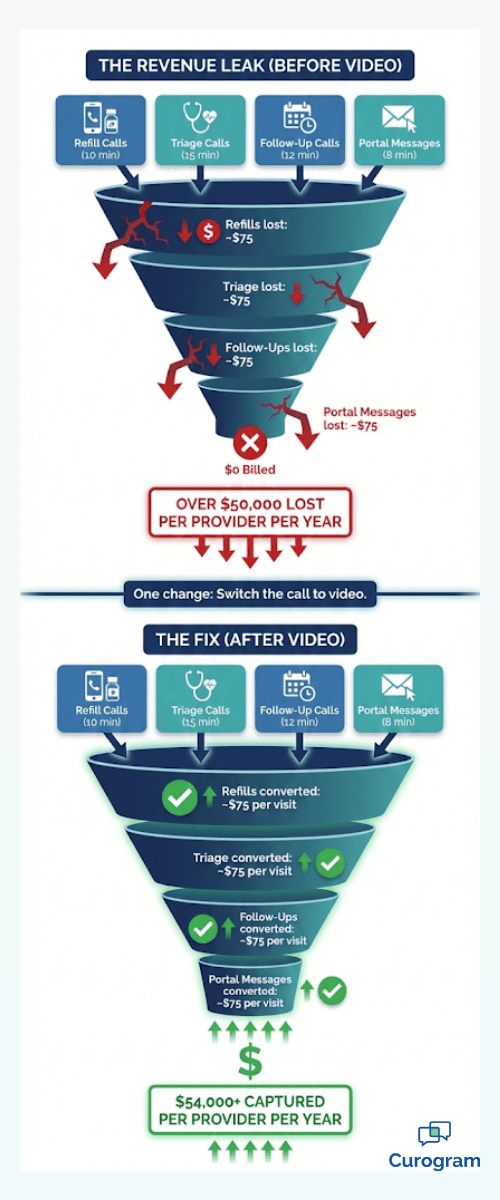
The average payout for a mid-level E/M code like 99213 is about $75. Three visits per day at $75 each comes to $225 per day. Over five working days, that is $1,125 per week.
Now, stretch that over a full year. At roughly 48 working weeks, three daily video visits add up to $54,000 in gross revenue per provider. That is money the practice was leaving on the table every single day.
Even if a provider only manages two of these per day, the total still lands above $36,000 per year. At one per day, it is still more than $18,000. No matter how you run the numbers, the impact is real.
And this is per provider. A three-doctor practice doing three video switches per day each would bring in over $160,000 per year in new revenue. A five-provider group could top $270,000.
These are not new patients. These are not extra hours. These are visits the practice was already handling but not billing for.
This is where the math gets even better. A normal office visit carries overhead. The front desk checks the patient in. A nurse takes vitals. An exam room gets used and then cleaned. The provider sees the patient, and the cycle starts again.
A video visit from a phone call has almost none of that cost. There is no check-in. No nurse prep. No room to clean. The provider talks to the patient from their desk or even from home. The visit wraps up, and they move on.
That means the revenue from these visits is almost pure margin. The only cost is the provider's time, and they were spending that time anyway. The practice just was not getting paid for it.
Compare that to the cost of adding a new exam room, hiring a new MA, or extending office hours. Those are all valid ways to grow. But they come with major expenses. Converting calls to video visits costs almost nothing and starts paying off on day one.
For practices looking to improve their text-to-pay collections, Curogram also makes it easy to collect the co-pay for these on-demand visits right at the time of service. A payment link sent by text closes the loop, so the revenue does not sit in accounts receivable.
Atlas Medical Center faced a common challenge. Their providers spent hours each week fielding low-level calls that never turned into claims. Refill questions, minor symptom checks, and post-visit follow-ups all came in by phone.
These were not complex cases. But they took real time and real effort. Staff treated them like admin tasks, not clinical encounters. The result was lost revenue hiding in plain sight.
After adding Curogram, Atlas Medical Center began routing these calls through video.
Providers used the same "switch to video" workflow. Within weeks, the practice saw a clear jump in billable virtual visits. Interactions that used to cost the practice time were now earning revenue.
The shift also helped with staff morale. Providers felt less drained because their work was being captured and paid for. Front desk staff had a clear workflow for routing calls. And patients liked the speed and ease of video visits from their phones.
Many practices think about revenue growth in terms of new patients or added services. Those are great goals. But they miss the low-hanging fruit.
The telemedicine revenue cycle starts the moment a visit becomes a visit. If that moment never happens, the cycle never begins. Every call handled for free is a broken link in the chain.
By fixing that one link, you unlock a stream of revenue that was always there. You do not need to market more, hire more, or build more. You just need to bill for what you are already doing.
This is why telehealth billing for CollaborateMD practices is such a powerful lever. The CollaborateMD system already tracks visits, posts charges, and manages claims. When you add Curogram as the video layer, everything flows into the same ledger.
Want to see what this looks like for your own practice? Use Curogram's ROI Calculator to plug in your current revenue details. It shows you exactly how much income you could recover each month by switching free calls to billable video visits.
Your clinical skill has value. Every refill call, every triage question, and every after-hours check-in involves real medical thinking. Payer rules allow you to be paid for that thinking, as long as you use the right format.
The format is simple. Add a camera. Turn a phone call into a video visit. Let the claim go through.
Curogram makes this switch fast, easy, and built for CollaborateMD. It sends a video link by text in seconds. The patient joins with one tap. The visit syncs to your ledger. And your telemedicine revenue cycle moves forward without extra steps.
You do not need new patients to grow your revenue. You do not need to extend your hours or expand your space. You just need to stop giving away the care you are already providing.
Practices that make this shift often find $30,000 to $50,000 or more per provider per year in revenue they were missing. That is real money, with almost zero added overhead.
Why Curogram Is the Right Fit for This Workflow
Not every video tool works well for quick phone-to-video switches. Most platforms need the patient to download an app, create an account, or log in through a portal. By the time they figure it out, the moment has passed.
Curogram takes a different path. It sends a video link by text message. The patient taps the link and joins from their phone's browser. No downloads. No passwords. No delays. This matters because the whole point is speed. You need the patient on video before the call ends.
Curogram also connects with CollaborateMD so the visit and the charge stay in one place. There is no need to enter data twice or switch between systems. The provider does the visit, documents it, and moves on. The charge posts to the ledger.
For practices that want to offer CollaborateMD after-hours care, the Curogram mobile app lets on-call providers launch video from their phone. They can handle urgent cases from home, bill for them, and keep the patient out of the ER.
Security matters too. Curogram is HIPAA-compliant, which means every video session meets the rules for protected health data. Providers can use it with full confidence that they are covered.
The platform can also be learned in minutes. Curogram's team designed it after watching front desk and call center workflows in real practices. The result is a tool that staff can start using the same day it is set up.
When you pair Curogram with CollaborateMD, you get a fast, simple, and secure way to turn free advice into paid visits. It is the missing piece that lets your practice capture revenue from every clinical moment, not just the ones that happen in the exam room.
The "free advice" trap is one of the most common revenue leaks in medical practices today. It is also one of the easiest to fix.
Every day, providers give away hours of clinical work through phone calls and portal messages. The care is real. The effort is real. But without the right format, payers will not pay for it.
The fix is not about working more. It is about changing one small step in how you deliver care. When a patient calls with a question, switch to video. That single move turns a $0 phone call into a billable virtual visit worth $75 or more.
The workflow is simple. The provider sends a text link through Curogram. The patient taps it and joins. The visit posts to CollaborateMD. No extra rooms. No extra staff. No extra systems to learn.
After-hours care works the same way. On-call providers can bill for urgent video visits from home instead of giving free advice by phone. The practice keeps the patient and the revenue.
If your team is already handling these calls, you are already doing the hard part. The only piece missing is the tool that turns those moments into paid visits.
Start capturing the value of every consult, triage call, and late-night follow-up. Schedule a quick demo now to see how Curogram unlock hidden revenue.
Curogram connects with CollaborateMD so the encounter and charge post directly to the patient ledger. There is no double entry or separate claims workflow needed.
Use the Curogram mobile app to send a video link during on-call shifts. Once the video visit is complete, bill it as an urgent or after-hours visit through CollaborateMD.
Phone triage usually earns $0 because it does not meet payer billing rules. A short video visit meets those rules and lets you bill $75 or more for the same clinical work.
💡 HIPAA-compliant telehealth for CollaborateMD removes the tech headaches of virtual care and ties every visit to your billing workflow. Patients...
💡 When you collect patient co-pays upfront in CollaborateMD using Curogram, you reduce bad debt and speed up cash flow before care begins. ...
💡 Telehealth for Opus EHR through Curogram gives behavioral health providers a no-app video platform built for addiction recovery. Patients join...