12 min read
How to Collect Patient Co-Pays Upfront in CollaborateMD
Mira Gwehn Revilla
:
February 20, 2026
- Curogram sends SMS payment links 24–48 hours before the visit
- Patients pay co-pays, past-due amounts, and more from their phone
- Staff skip the awkward "money talk" at check-in
- A secure credit card on file covers any remaining charges
- Most patients arrive with a zero balance
Picture this. A patient walks up to your front desk. Your staff smiles, checks them in, and walks them straight to the exam room. No card swiping. No "your co-pay is $40 today." No fumbling for a wallet.
That is what happens when you collect patient co-pays upfront in CollaborateMD. The money is already in your account before the patient arrives.
Most medical practices still chase payments after the visit. They print bills, mail them out, and wait. Some of those bills come back paid. Many do not. The longer you wait to collect, the less likely you are to see that money at all.
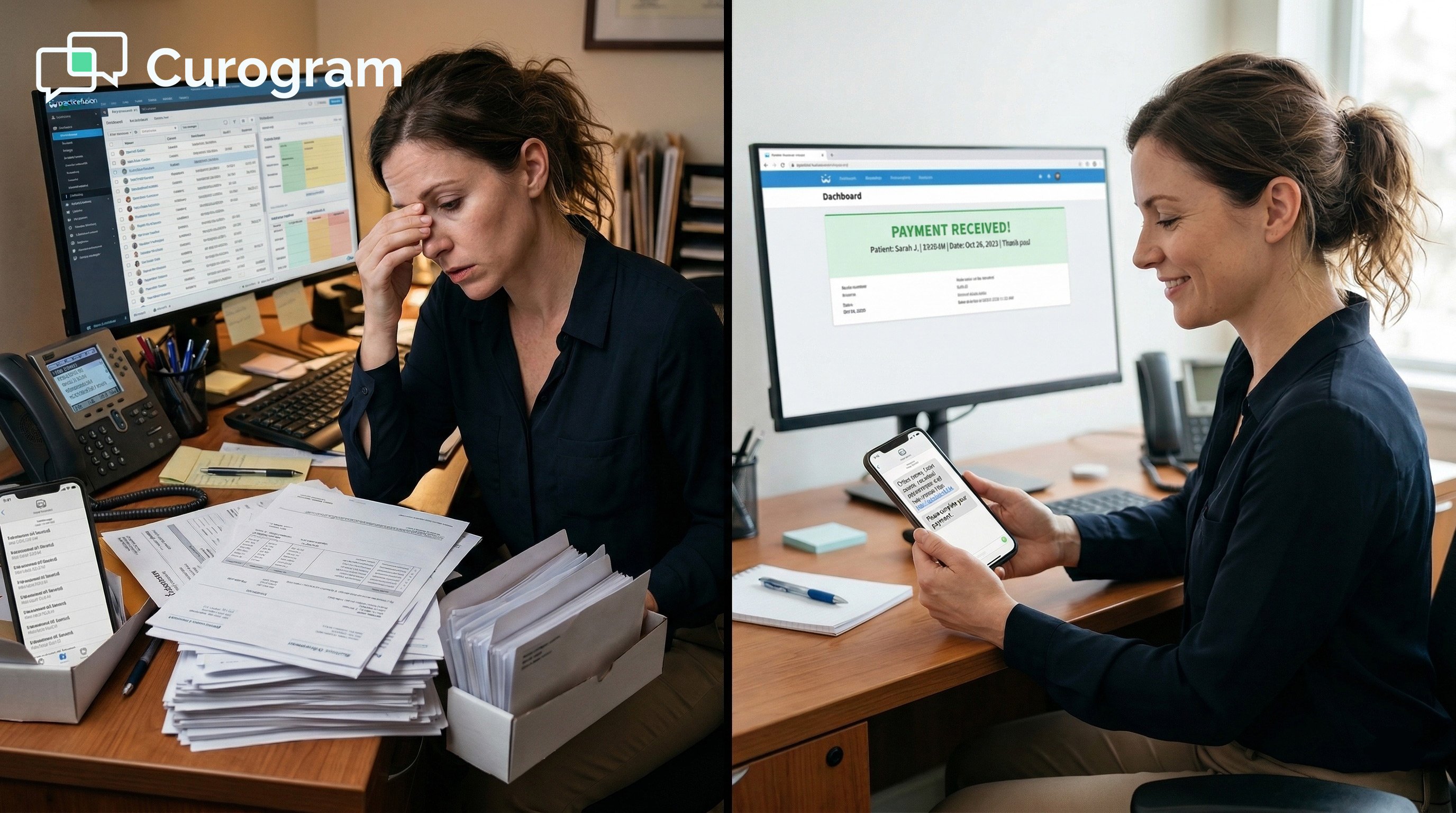
Curogram flips this model on its head. By linking with the CollaborateMD schedule, Curogram texts patients a secure payment link 24 to 48 hours before their visit. Patients can pay their co-pay, settle a past-due balance, or cover their share of care, all from their phone.
Think of it as a pre-visit collection workflow that runs on its own. No calls. No chasing. No stress for your team.
This approach does more than save time. It helps you reduce bad debt at your medical practice. When patients pay before they walk in, you take the risk out of the visit. You also take the pressure off your front desk.
In this article, we will break down why post-visit billing fails, how to build a zero-balance arrival process with Curogram and CollaborateMD, and what this means for your cash flow and patient experience.
Whether you run a small primary care office or a large group practice, the path to stronger revenue starts before the patient even sits down. Let us show you how to make pre-payment the new normal.
The Villain: The "Post-Care" Drop-Off
There is a reason your practice loses money after the visit. It is not a billing error or a payer issue. It is timing. When you wait until after care to ask for payment, you lose your best chance to collect.
The Leverage Gap
Patients are most willing to pay before they see the doctor. At that point, they want the visit to go well. They are focused on their health. They have a reason to show up and settle their share.
Once the visit is over, the math changes. The patient has what they came for. The doctor's advice is in hand. The urgency fades, and so does the drive to pay.
This is what we call the leverage gap. Before care, the patient is engaged. After care, the bill becomes just another piece of mail to ignore.
Think about it from the patient's point of view. They leave the office feeling fine. A few weeks later, a bill shows up. Maybe they open it. Maybe they set it aside. Maybe they forget about it for months. Each day that passes, the chance of getting paid drops.
The Front Desk Friction
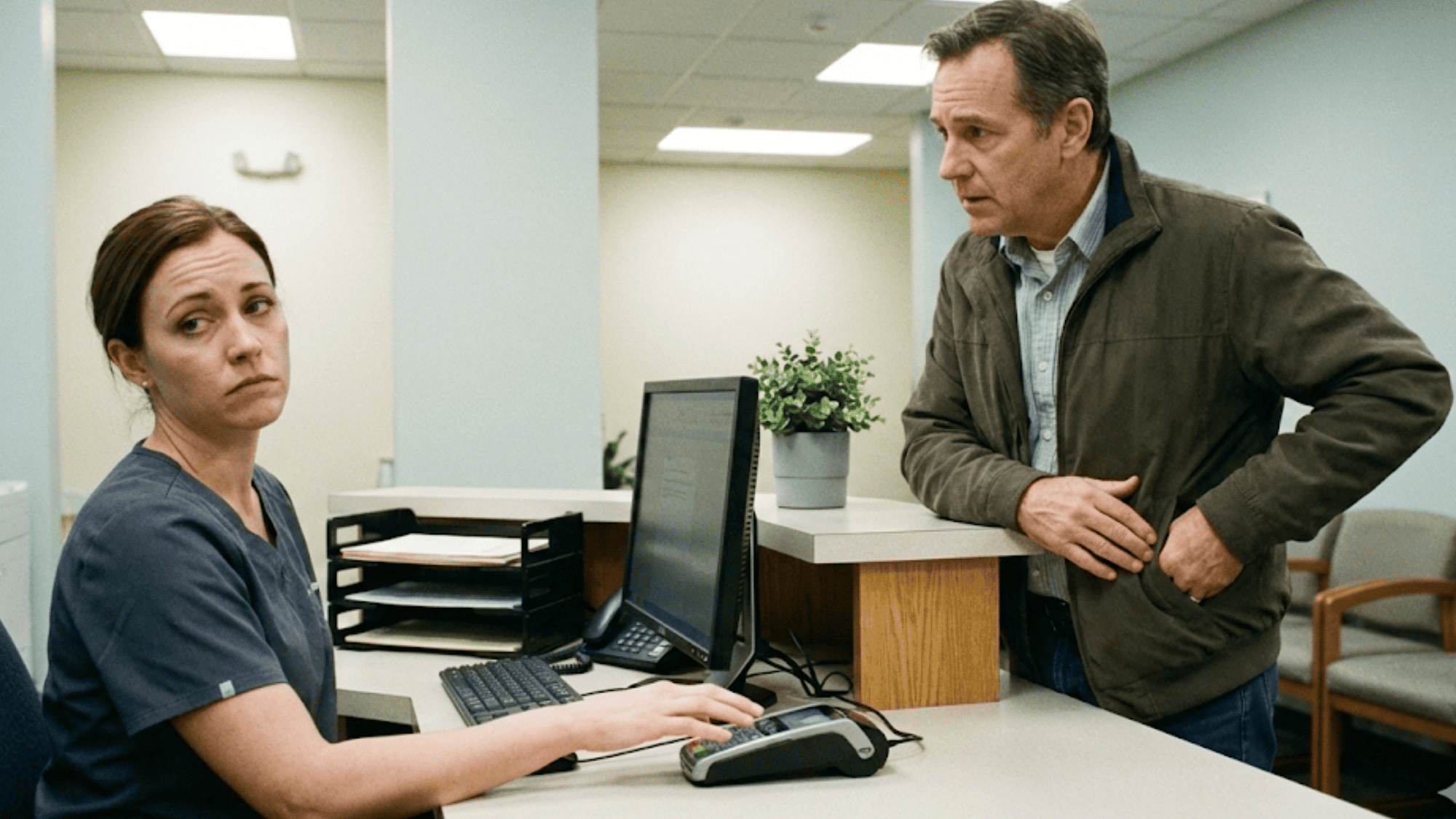
Here is the other side of the problem: your front desk team hates asking for money. And who can blame them?
The front desk is supposed to greet patients, check them in, and keep the day running smooth. But when you add payment talks to the mix, the mood shifts. It feels awkward for both sides.
Patients often come to the desk with excuses ready. "I forgot my wallet." "Can you just bill me?" "I did not know I owed anything." Your staff hears this all day, every day. Over time, they stop pushing. They let patients walk out without paying because it is easier than having a tense exchange.
This is not a staff problem. It is a system problem. When you rely on humans to handle every payment talk at check-in, you build friction into the process. That friction costs you real money.
|
For example: Say, your practice sees 40 patients a day. If just 5 of them skip the co-pay and walk out, that is $200 in lost revenue per day. Over a month, that adds up to $4,000. Over a year, it is nearly $48,000 in payments that could have been collected upfront. |
The Bad Debt Reality
Here is the number that should keep you up at night. Once a patient leaves the office without paying, your chance of collecting that balance drops by about 50%.
That stat lines up with what most practices see in the real world. The first billing cycle might get a response from some patients. By the second or third statement, the return rate falls off a cliff.
Each statement you mail costs your practice around $3.00 to $5.00 when you factor in paper, postage, and staff time. Send three rounds of bills to a patient who never pays, and you have spent $15 just to lose the original balance.
This is the cycle that creates bad debt. Missed point-of-service collections lead to statement costs, which lead to write-offs, which lead to tighter margins. It is a slow drain that gets worse as patient volumes grow.
The fix is not to train your staff to be tougher at the desk. The fix is to remove the desk from the equation. When you automate patient responsibility before the visit, you close the leverage gap, remove front desk friction, and cut the risk of bad debt before it starts.
That is what a true pre-service model looks like. And it is what Curogram makes possible for every CollaborateMD practice.
The Guide: The "Zero-Balance" Arrival
Now that we know why post-visit billing fails, let us look at the fix. The goal is simple: every patient should arrive with nothing left to pay. Curogram makes this happen through a step-by-step workflow that links with CollaborateMD:
Automated Estimates
The process starts with your team checking the patient's plan in CollaborateMD. This confirms their co-pay, any open balance, and what they might owe for the visit. Once that number is set, Curogram takes over.
Between 24 and 48 hours before the visit, Curogram sends the patient a text. It looks like this: "Your share for your visit on Friday is $25. Tap here to pay now." The link opens a secure page. The patient enters their card, pays in seconds, and gets a receipt on the spot.
There is no app to download. No portal to log into. No account to create. It is just a text and a tap. That is why it works. Patients are used to paying by phone. They buy coffee, pay bills, and shop online this way every day. CollaborateMD check-in payments feel no different.
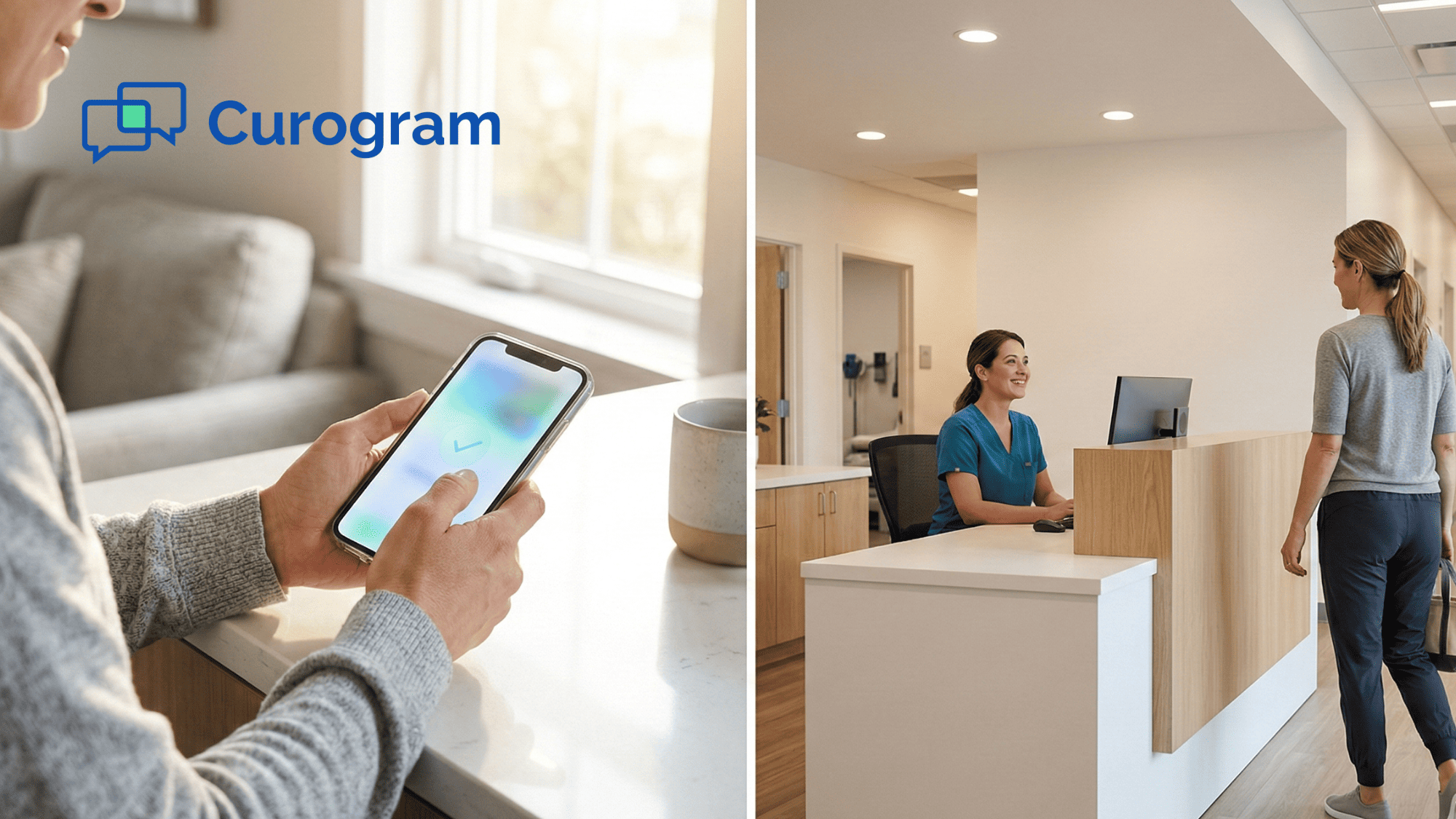
When the patient walks in the next day, their balance shows as zero. Your front desk greets them with a smile, not a bill. Check-in takes seconds instead of minutes.
The "Card on File" Safety Net
Sometimes, you do not know the full amount the patient will owe. Maybe the provider has not entered the codes yet. Maybe the payer has not returned the exact number. In these cases, you need a backup plan.
That backup is a secure credit card on file. During the digital intake process, Curogram gives patients the option to store a card. The card is saved using PCI-compliant methods, which means the data is safe and secure. No one on your team ever sees the full card number.
Once the visit is over and the claim is settled, your team can charge the card with one click. No need to call the patient. No need to mail a bill. The balance is handled.
This works like a tab at a hotel. You check in, the hotel holds your card, and they charge you for what you used. The patient knows their card is on file. There are no surprises. And you avoid weeks of billing delays.
For practices that want to take it a step further, you can use this secure credit card on file as part of a broader plan to automate patient responsibility at every stage of the visit.
Gatekeeping the Visit
Some practices want to go even further. For those with high-deductible patients, Curogram lets you make payment a required step in the check-in process.
Here is how it works: When the patient fills out their digital forms, one of the steps is payment. They can not finish check-in without paying or placing a card on file. This turns the payment into a gate. The visit does not start until the bill is handled.
This is not for every practice. Some providers prefer a softer approach. But for clinics with large patient balances or a high rate of unpaid visits, this can be a game changer.
|
For example: A specialty practice that sees mostly high-deductible patients might collect $300 or more per visit. If even 10% of those patients skip payment, the losses stack up fast. Gating the check-in process removes that risk entirely. |
The key is that Curogram gives you options. You can send a gentle reminder, require a payment, or store a card for later. Whatever fits your practice, the tools are there. And every option ties back to CollaborateMD, so your records stay in sync.

The Success: Better Cash Flow, Better Experience
So what changes when you collect before the visit? The short answer: almost everything. Cash flow improves. Your team is happier. And patients have a better time, too. Let us walk through each one:
Smoother Check-In
When the money is handled before the patient arrives, the front desk becomes what it should be: a welcome center. Not a billing counter.
Think about the last time you checked into a hotel where your card was already on file. You walked up, the clerk smiled, handed you a key, and that was it.
That is what check-in feels like when you collect patient co-pays upfront in CollaborateMD. The patient walks in. Your staff confirms their name and chart. The patient sits down. Done.
This also speeds up the day for everyone. When each check-in takes two minutes instead of five, you save time across the board. For a practice that sees 30 patients a day, that is 90 minutes saved. Over a week, that is more than seven hours your team gets back.
Those hours can go toward tasks that matter: fielding calls, helping patients with forms, or keeping the schedule on track. Your front desk runs at a faster pace and with less stress.
Reduced Statement Volume
Here is where the cost savings get real. Every time you mail a bill, it costs you money. Paper, envelopes, postage, and the staff time to prep and send each one. A single round of billing can cost $3.00 or more per patient.
Now, think about how many statements your practice sends each month. If you mail 500 statements, that is $1,500 just for one round. Many practices send two or three rounds before they see a response. That is $3,000 to $4,500 a month spent asking for money that should have been collected at the point of care.
When you use a pre-visit collection workflow, you cut this number down sharply. If 80% of patients pay before they arrive, you only need to send statements to the remaining 20%. That takes your monthly mailing from 500 to 100. Your cost drops from $1,500 to $300 for that first round.
Over a year, this saves your practice thousands. And those savings go straight to your bottom line.
But the savings do not stop at postage. Fewer statements also mean fewer calls from confused patients asking "What is this bill for?" Your phones ring less. Your staff spends less time on billing questions. The whole back end of your office runs cleaner.
Staff Empowerment
Let us talk about your team for a moment. Your front desk staff did not sign up to be debt collectors. They signed up to help patients, manage the schedule, and keep the office running.
When you ask them to chase payments at the desk, you put them in a tough spot. They have to bring up money with every patient. Some patients push back. Some get upset. Over time, this wears your team down.
Curogram changes this by moving the payment talk off the front desk. The system asks for the money, not your staff. The text goes out. The patient pays. By the time they walk in, the money is handled.
This does more than save time. It changes how your team feels about their job. They feel empowered, not stuck. They can focus on care, not collections.
|
For example: Imagine your front desk person, Maria. She greets 35 patients a day. Before Curogram, she had to ask 35 people for money. Some paid. Some did not. A few got angry. By the end of the day, Maria was drained. Now, with the pre-visit text in place, only 3 or 4 patients have anything left to pay at the desk. Maria spends her day on check-ins, phone calls, and helping the care team. She goes home feeling good about her work. That is the kind of shift that helps you keep great staff. |
A Better Patient Experience
Patients notice the change, too. No one likes being asked for money right before they see their doctor. It sets the wrong tone for the visit.
When patients pay from their phone the day before, the money talk is over. They walk in with nothing to worry about but their health. The visit feels more like care and less like a billing event.
This matters more than most practices think. Patients who have a smooth check-in are more likely to come back. They are more likely to leave a good review. And they are more likely to refer friends and family.
On the flip side, patients who have a bad billing moment at the desk are more likely to shop around. They may switch to a clinic that offers a more simple experience. In a market where patient choice is growing, your check-in process is part of your brand.

The Cash Flow Impact
Let us put some numbers to this. Say your practice sees 120 patients a week with an average co-pay of $30.
|
If you collect 90% of those co-pays before the visit, that is $3,240 a week in guaranteed income. Over a month, it is $12,960. Over a year, it is more than $155,000 in cash that flows in on time, every time. Compare that to the old model. If only 60% of patients pay at the desk, you collect $2,160 a week. The other $1,080 goes to billing. Some of it comes back in 30 days. Some in 60. And some never comes back at all. |
When you shift to upfront payment, you do not just collect more. You collect faster. Your accounts receivable shrinks. Your cash position improves. You can plan, invest, and grow with more confidence.
This is what it looks like to reduce bad debt at your medical practice. Not by chasing harder, but by collecting smarter. And when you pair Curogram with CollaborateMD, the whole process runs on its own.
Normalize Pre-Payment
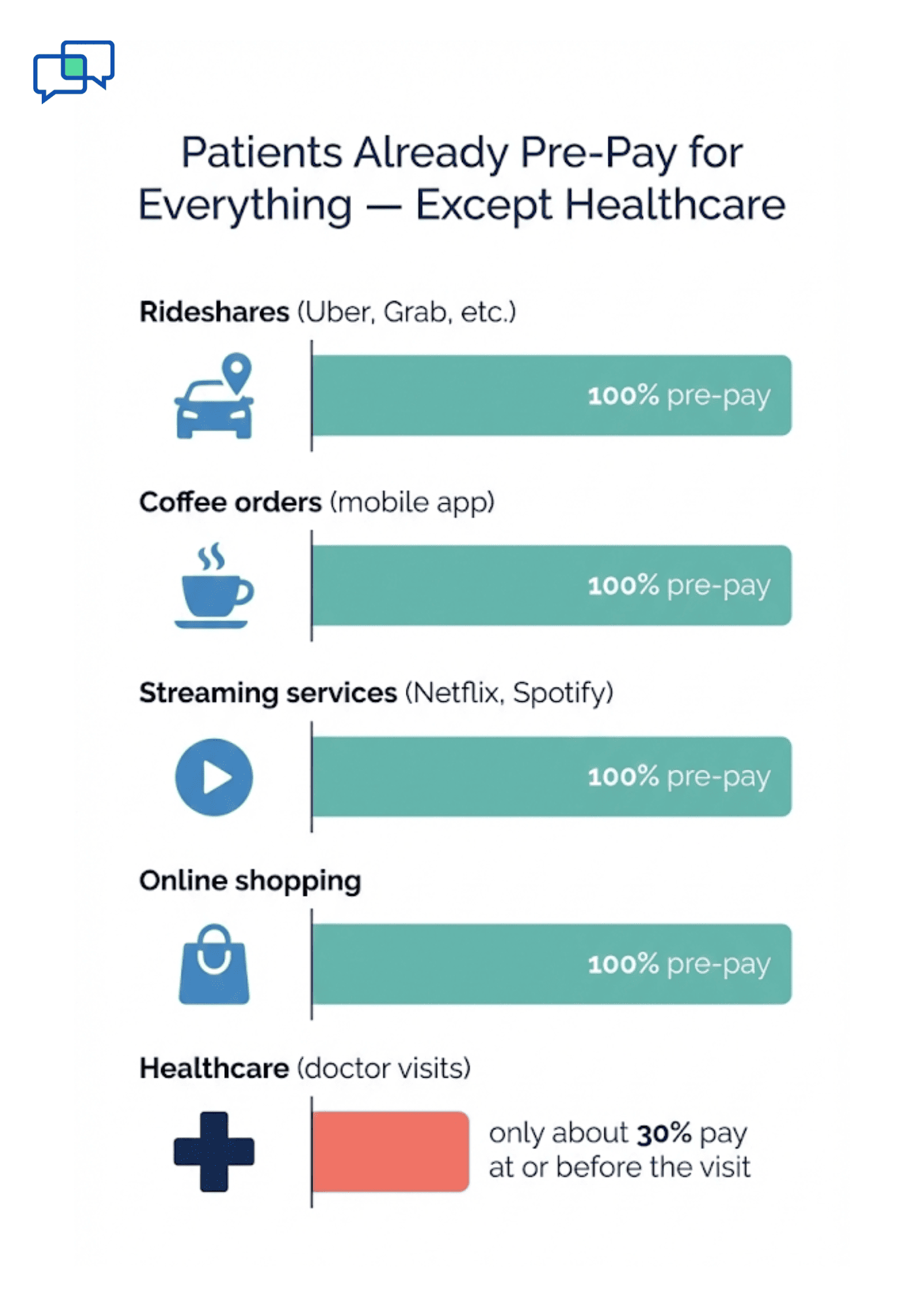
You would not walk out of a grocery store with a full cart and say, "Bill me." The cashier would stop you. Yet in healthcare, practices let this happen every day.
Patients walk in, get care, and leave without paying. The office sends a bill weeks later and hopes for the best. This is not a revenue plan. It is a gamble.
The truth is, patients expect to pay for services. They pay for coffee before they drink it. They pay for rides before they get out of the car. Pre-payment is normal in almost every part of their life. Healthcare should catch up.
Make It the Standard
The shift starts with mindset. Stop thinking of payment as something that happens after care. Start thinking of it as part of the visit prep, right alongside forms, ID checks, and plan details.
When you frame it this way, patients do not push back. They see the text, tap the link, and move on with their day. The flow feels normal because it mirrors how they pay for everything else.
For your team, this shift is a relief. No more scripts about "your balance is." No more stress at the desk. The system does the heavy lifting, and your staff stays focused on what they do best.
Why Choose Curogram for CollaborateMD Practices
Curogram was built to solve the problems that slow medical practices down. Long phone calls, missed payments, and messy front desk workflows all drain time and money. The platform works as a plug-in for CollaborateMD, so there is nothing to replace and nothing to rebuild.
The software reads your CollaborateMD schedule and acts on it. It sends payment links, intake forms, and reminders, all by text. Patients respond on their phone, and the data flows right back into your system.
For payment collection, this means your team does not touch a thing. Curogram sends the text. The patient pays. The amount posts to their chart. Your billing team sees it right away.
The platform is also HIPAA compliant, which means every text, payment, and form meets the same security standards your practice follows. Patient card data is stored with PCI-compliant methods, so there is no risk of data exposure.
Setup takes minutes, not days. Curogram's team walks your staff through the process, and most teams are up and running in one session. The learning curve is short because the interface works just like texting.
Practices that use Curogram alongside CollaborateMD see real results: fewer no-shows, faster payment, and less time on the phone. The platform helps you automate patient responsibility so your team can focus on care instead of chasing money.
If your practice is ready to stop mailing bills and start collecting upfront, Curogram is the tool that makes it happen. It gives you a clear pre-visit collection workflow that runs in the background while your team takes care of patients.
Conclusion
Collecting after the visit is a losing game. The longer you wait, the less you collect. The more bills you send, the more it costs. And the harder your staff works to chase payments, the more burned out they get.
There is a better way. When you collect patient co-pays upfront in CollaborateMD, you flip the script. Payment happens before the visit, not after. Your team greets patients instead of billing them. And your cash flow stays strong month after month.
The tools to make this shift are not complex. Curogram ties into your CollaborateMD system and handles the heavy lifting. Texts go out. Patients pay. Cards go on file. Balances clear before the patient sits down.
This is not a future vision. Practices are doing this right now. They are using a pre-visit collection workflow to reduce bad debt, cut statement costs, and free up their front desk. The results speak for themselves.
If your practice still relies on post-visit billing, every day you wait is money left on the table. Patient balances age. Write-offs grow. And the cycle keeps turning.
Start collecting before the visit. Give your team a system that works for them, not against them. And give your patients the smooth, modern check-in they expect.
Secure your revenue upfront. [Book a Demo] to see how Curogram automates co-pay collections for CollaborateMD.
Secure your revenue upfront. Book a demo now to see how Curogram automates co-pay collections for CollaborateMD.
Frequently Asked Questions
Patients are most willing to pay before they receive care. Once they leave, urgency drops and bills get ignored. Collecting upfront closes this gap and brings in revenue while the patient is still engaged.
Each statement costs around $3.00 to $5.00 to send. If pre-visit payments reduce your mailing volume by 80%, a practice that mails 500 statements a month could save $1,200 or more per billing cycle.
Most practices are up and running in a single session. Curogram's team handles the setup, and the platform works like texting, so staff training takes just minutes.