
9 min read

Cloud 9 2-Way Texting | Real-Time Communication, No Dental Tax

Cloud 9 2-Way Texting | Real-Time Communication, No Dental Tax
💡 Cloud 9 orthodontic two-way texting via Curogram is HIPAA-compliant, uses direct SMS, needs no Legwork subscription, avoids dental taxes, and adds no extra engagement-platform cost.      

Curogram connects to Cloud 9 through its open API, texts from your existing practice number, and enables real-time conversations between treatment coordinators and patients or parents.  

No app download needed. No portal login. Every message is encrypted, logged, and fully compliant.  


Cloud 9 handles appointment reminders and clinical workflow. Curogram handles the back-and-forth that replaces 80+ daily phone calls — at a fraction of what dental engagement platforms charge per month.

Think about this. It's 10 a.m. on a Tuesday and your treatment coordinator is already on her third call of the hour.

One parent wants to confirm Tuesday's appointment. Another needs to reschedule. A third is asking whether to bring the insurance card. None of these needed to be a phone call.

But they are. Because Cloud 9 doesn't give you a real back-and-forth texting channel — the kind where a parent sends "Running 10 minutes late" and your coordinator replies "No problem, we'll adjust."

The kind where a quick question gets answered in 30 seconds instead of sitting in a voicemail queue until someone has a free moment.

Cloud 9 is exceptional at what it was built for. Treatment planning, charting, scheduling, orthodontic imaging — the clinical workflow is precise and specialty-specific.

But when a parent tries to reach the office with a simple question, there's nowhere for that message to go.

So it becomes a call. Then another. Then another.

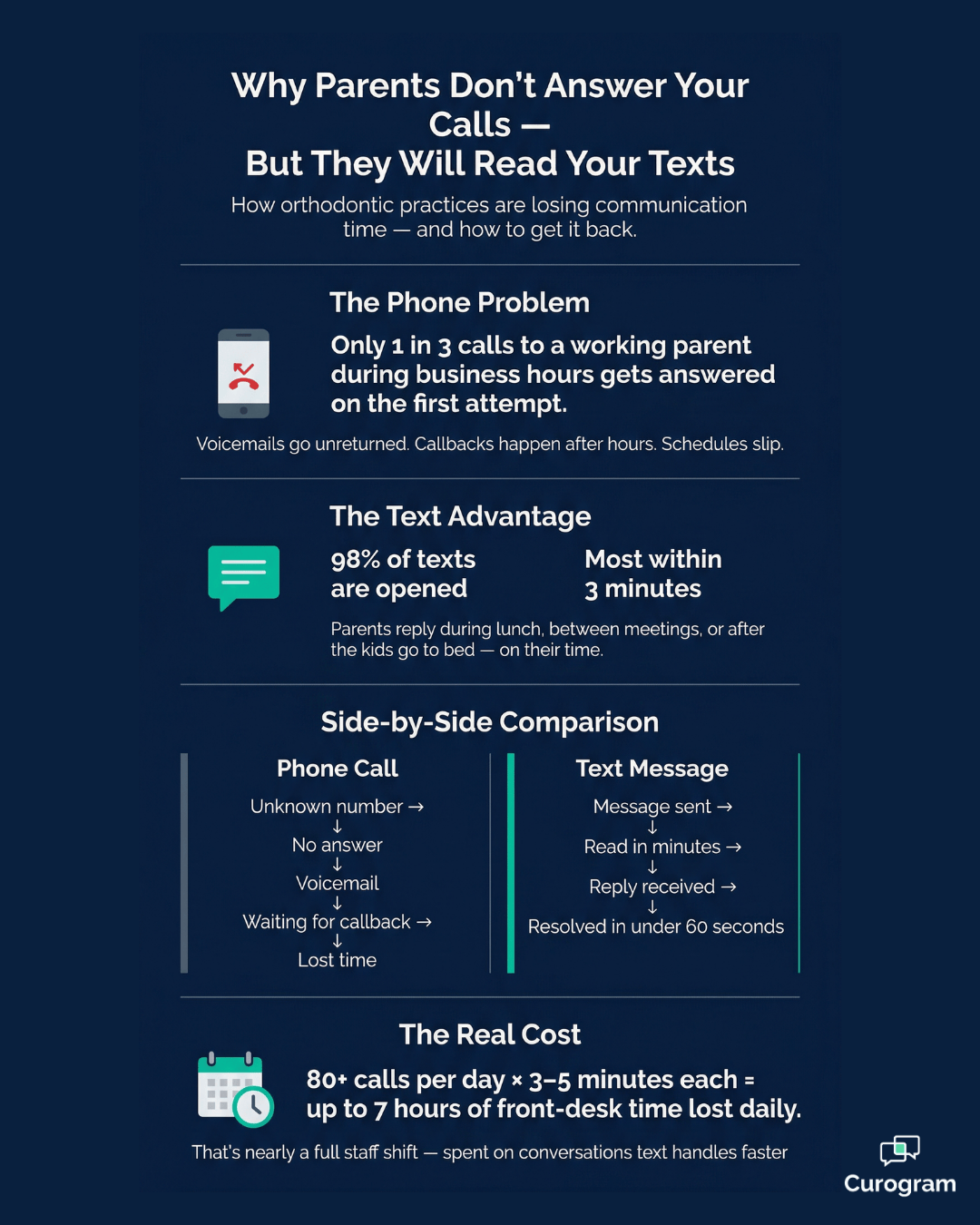
The average orthodontic practice fields more than 80 phone calls per day. At 3–5 minutes each, that's up to 7 hours of front-desk time spent on conversations a 30-second text could handle.

That's not just an efficiency problem.

It's a staffing problem, a capacity problem, and a revenue problem.

Here's what makes it frustrating:

Getting real two-way texting for a Cloud 9 practice isn't simple. Your options are Legwork — a separate Planet DDS subscription that deepens ecosystem dependency — or a dental engagement platform like Solutionreach at $300–$500 per month.

Neither gives you just the direct SMS communication you need. Both come loaded with marketing features you didn't ask for.

That premium has a name. It's the dental tax on texting. And Cloud 9 practices have been paying it for years — often without realizing there's a better alternative.

Why Cloud 9 Practices Are Still Paying to Text Their Own Patients

Three Paths, All Priced for Dentistry

Cloud 9 practices that want genuine two-way texting — not just outbound reminders, but actual back-and-forth SMS conversations with patients and parents — face a familiar three-option paywall.

  • Legwork — Planet DDS's own engagement platform. Deep Cloud 9 integration, but it adds a separate subscription and locks you further into a single-vendor ecosystem.
  • Dental engagement specialists — Solutionreach at $300–$500/month, Lighthouse 360 at around $329/month, Weave, RevenueWell, or Doctible. A decade of defaults. They work. But the dental premium they charge has nothing to do with what it actually costs to send a text.
  • Cloud 9 native tools — functional for outbound appointment reminders, but not designed for the real-time, back-and-forth exchanges that replace phone calls.

All three options accept the same premise: that dental practices should pay more for patient communication. That premise deserves a second look.

The Vendor Lock-In You Won't Notice Until You Need to Move

Planet DDS is building DentalOS™ — an integrated technology stack where Cloud 9, Denticon, Apteryx, Legwork, and Cloud 9 Pay all work together as one system.

For practices that go all-in, the integration is seamless. But seamlessness has a cost.

When your scheduling, imaging, engagement, and payments all run through one vendor, that vendor holds the leverage.

Price increases, contract changes, discontinued features — your options narrow when migrating means unwinding everything at once. For DSOs and OSOs managing 50 to 100+ locations, that concentrated dependency is a real operational risk, not a theoretical one.

Practices that have been through a full PMS migration know exactly how expensive and disruptive it is. None of them want to do it again.

The Marketing Platform Nobody Ordered

Legwork, Solutionreach, and most dental engagement tools are marketing platforms first. Two-way texting and appointment reminders come bundled inside a much larger package.

Here's what you're actually paying for whether you use it or not:

  • Practice websites and landing page management
  • SEO campaigns and local search optimization
  • Referral programs and branded marketing materials
  • Postcards and direct mail campaigns
  • Review automation and reputation dashboards

For a solo orthodontist who already has a website and a solid Google Business Profile, every item on that list is pure overhead. 

For a DSO with a corporate marketing team, they're redundant.

You're not paying for communication. You're paying for a marketing suite that happens to include it.

The Daily Phone Volume That's Costing More Than Any Subscription

Here's what 80+ calls per day actually costs your team. At a conservative 80 calls averaging 3 minutes each, that's roughly 4 hours of staff time gone.

A typical busy practice fielding 100 calls at 4 minutes each loses about 6.5 hours. A high-volume location at 120 calls and 5 minutes per call can burn through 10 hours in a single day — more than a full-time shift.

Almost none of those calls are urgent. They're appointment confirmations, insurance card requests, scheduling changes, quick treatment questions, and balance inquiries.

Every single one could be resolved by a 30-second text exchange — but instead they're consuming your team's entire morning.

This means your front desk is answering phones instead of converting new patient consultations.

Your treatment coordinator is on hold with a parent instead of managing the day's schedule.

The phone volume is a direct consequence of not having a real direct SMS channel — and the cost in staff time exceeds any engagement platform subscription by a wide margin.

The Communication Platform Built for What Orthodontic Practices Actually Need

What Curogram Does — and Doesn't Do

Curogram delivers HIPAA-compliant two-way texting that works with Cloud 9 through its open API.

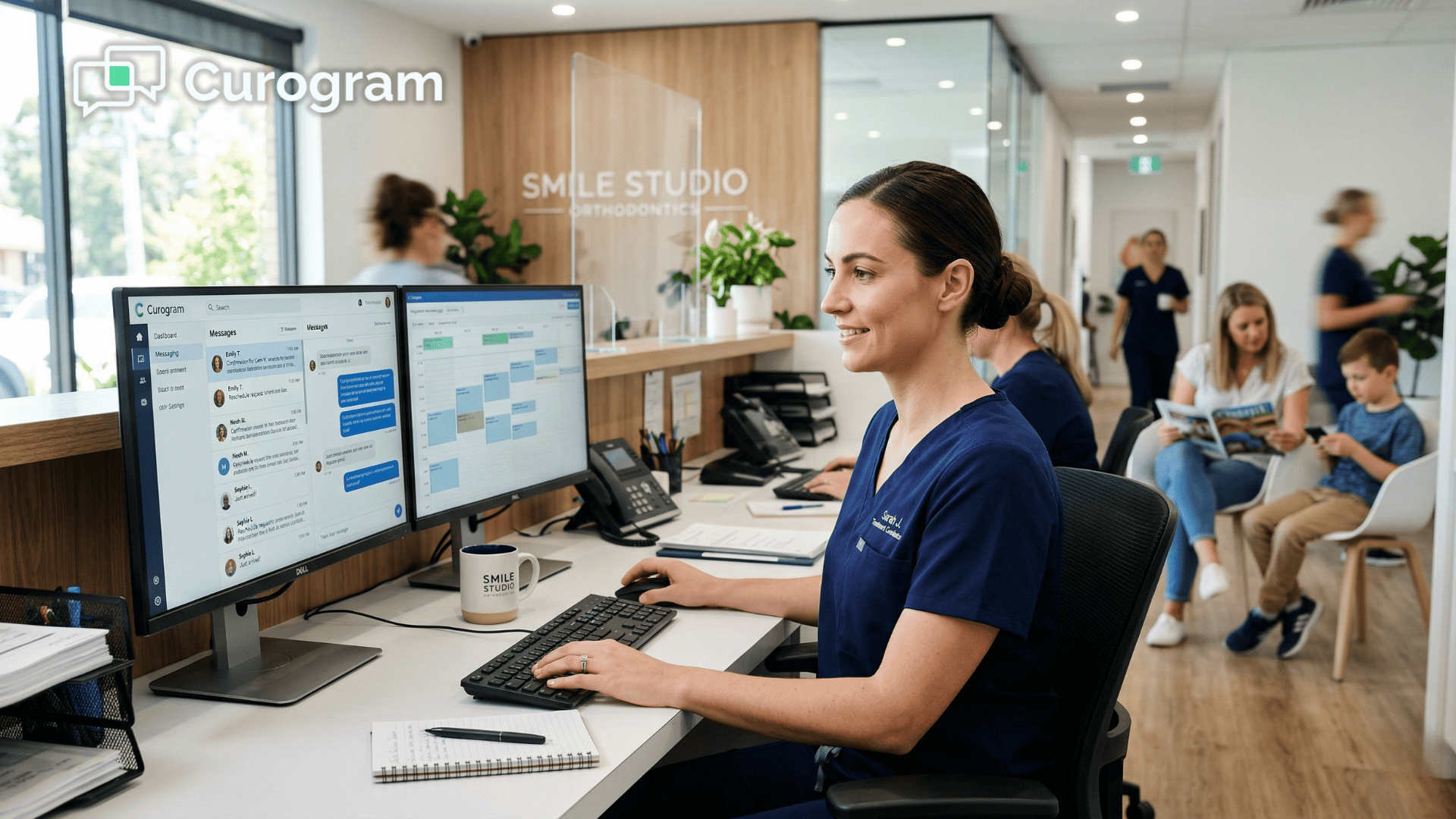
When a parent texts your practice number, it lands in a unified dashboard where any authorized team member can respond.

Every conversation is logged, searchable, and fully compliant.

Patients don't need any of the following to reach you:

  • A downloaded app
  • A patient portal login
  • A Zoom account or telehealth setup of any kind

Cloud 9 orthodontic two-way patient texting that is HIPAA compliant, charges no dental tax, requires no Legwork subscription, and runs on direct SMS practice communication is exactly what Curogram was built to deliver. Nothing more, nothing less.

Curogram is priced as a communication platform — because texting a parent about their child's adjustment appointment doesn't cost more to deliver just because the appointment involves braces.

Why parents ignore calls but read texts — orthodontic patient communication stats

Managing 15–25 Conversations Across an Entire Treatment Arc

Orthodontic practices don't just send a reminder here and there. Over an 18–30 month treatment arc, a typical patient generates 15–25 separate interactions — initial inquiry, records visit, bonding, every adjustment, debond, and retainer checks.

That's not a reminder cadence. That's a relationship.

Curogram keeps the full text history for each patient in one scrollable thread, visible to any authorized staff member.

A treatment coordinator opening a patient's record sees everything — from the first inquiry to the most recent message — in one place, in order, without digging through email chains or asking a colleague whether someone already followed up.

The thread is continuous, persistent, and searchable across the entire care arc.

The Parent Channel Most Practices Are Missing

In pediatric and adolescent orthodontics,

The patient is a child and the decision-maker is a working parent. Working parents don't answer calls from unfamiliar numbers at 2 p.m.

They don't log into patient portals for their child's orthodontist. They don't download apps for an office they visit every 6–8 weeks.

But they read texts. Research consistently shows that 98% of text messages get opened — most within 3 minutes of receipt. Compare that to phone calls, where reaching a parent on the first attempt during business hours is closer to a 1-in-3 proposition.

The two-way texting your Cloud 9 orthodontic patients need — HIPAA compliant, no Legwork subscription required, running on direct SMS communication — is the channel Curogram gives you.

The parent replies when it works for them:

During a lunch break, between meetings, or after dinner. The exchange happens on their schedule, not yours.

For practices where reaching the parent is the core communication challenge, text is the only channel that consistently works.

Portability That Goes Where You Go

Curogram integrates with Cloud 9 today. If a practice migrates to Dolphin, OrthoTrac, or another PMS tomorrow, Curogram comes along. The patient text history, conversation threads, and communication workflows all remain intact.

For DSOs and OSOs managing practices across multiple PMS platforms, this portability matters. One consistent communication layer across every location — regardless of the underlying practice management system.

No DentalOS™ dependency. No renegotiation. No leverage surrendered at the contract table.

Parent reading a text from orthodontist's office on smartphone during work break

What the Practice Looks Like When the Phone Stops Ringing

The Time Recovery Is Immediate

When patients and parents shift to text, phone volume drops quickly.

The 80+ daily calls become 20–30 calls for situations that genuinely need a voice conversation — complex insurance discussions, clinical concerns, new patient inquiries that require context.

Everything else resolves via text in a fraction of the time.

At a conservative estimate, returning 4 hours per day to a treatment coordinator means roughly 80 staff hours per month at a single location. For a DSO managing 20 locations, the same math produces 1,600 hours per month no longer spent on hold.

Those hours don't disappear — they get redirected to work that actually moves the practice forward:

  • Following up on unsigned treatment plans
  • Converting new patient consultation inquiries
  • Managing same-day schedule gaps before they become no-shows
  • Supporting patients mid-treatment rather than fielding routine callbacks

That's not a small number. In practice, it means the difference between a front desk that's reactive and one that's productive.

The Cost Comparison That Should Change Your Budget Conversation

The options break down clearly. Legwork is an add-on to your existing Cloud 9 subscription — it deepens the ecosystem and adds another line item. Solutionreach runs $300–$500/month as a full dental engagement platform.

Lighthouse 360 comes in around $329/month. All three bundle marketing modules you may never use. Curogram is priced as a clinical communication specialist — no marketing overhead, no dental markup, just the communication layer your practice actually needs.

A single practice paying $400/month for a dental engagement platform spends $4,800 per year. A 25-location DSO running the same setup spends $120,000 per year.

The orthodontic two-way texting that Cloud 9 patients and parents need — HIPAA compliant, no Legwork dependency, no dental tax markup, running over direct SMS — costs significantly less through Curogram.

And the communication outcomes — confirmation rates, response times, patient satisfaction — are measurably better when the tool is built specifically for clinical communication rather than marketing automation.

Two Specialist Tools. One Clean Stack.

The result is simple. Cloud 9 manages orthodontic treatment planning and clinical workflow — what it was designed to do. Curogram manages patient communication — what it was designed to do.

No bloated engagement platform charging a dental premium for SEO campaigns and postcards your team will never open. No vendor ecosystem requiring platform loyalty in exchange for basic communication functionality.

Cloud 9 HIPAA two-way texting for orthodontic patients, managed through Curogram as a dedicated direct SMS practice communication layer, is simpler, more portable, and less expensive than every alternative.

Two best-in-class tools. Zero unnecessary overhead.

Your Patients Would Rather Text — And Now Your Practice Can Too.

A text message costs the same to send whether it goes to an orthodontic patient's parent or a primary care patient.

The confirmation rate doesn't improve because your engagement platform calls itself "dental-specific." The HIPAA compliance doesn't get stronger because the price tag is higher.

The dental tax isn't a feature. It's a markup — and it persists because the market has accepted it, not because it's justified.

Cloud 9 patient texting, made genuinely two-way for orthodontic workflows and free of the dental tax through direct SMS communication, is the straightforward alternative Cloud 9 practices have been looking for.

The math is hard to ignore. At $400/month, a dental engagement platform costs a single-location practice $4,800 per year for the right to have real conversations with patients via text. A DSO with 30 locations running the same setup spends $144,000 per year — on a tool that still bundles marketing features no one on the clinical team asked for.

Stop paying the markup on something as basic as a direct SMS exchange. Your treatment coordinators should be building patient relationships and converting consultations — not spending half their day on phone calls that a text would resolve in 30 seconds.

Your parents should be able to confirm a braces appointment on their lunch break — not leave a voicemail and wait for a callback that may not come until after hours.

Curogram delivers two-way texting, smart reminders, digital forms, and reputation management for Cloud 9 practices at a fraction of what dental-premium platforms charge, without the vendor lock-in, and without the marketing overhead you never needed.

Schedule a demo today. See what your communication costs could actually look like — and what your front desk could look like with 4 hours back in their day.


Frequently Asked Questions

How does Curogram integrate with Cloud 9?

Curogram connects to Cloud 9 through its open API — the same technical pathway used by Solutionreach, Lighthouse 360, and other third-party tools that already work with Cloud 9. The integration syncs patient data, appointment information, and communication records. Cloud 9 explicitly supports third-party integrations, and Curogram's setup follows the same approach those tools have used for years. There's no custom development required and no dependency on the DentalOS™ ecosystem.

Is Curogram HIPAA-compliant for orthodontic patient communication?

Yes. Curogram is HIPAA-compliant and SOC 2 Type II certified — the same security certification level held by Planet DDS and Cloud 9. All patient text conversations are encrypted, logged, and accessible only to authorized practice staff. Curogram executes a Business Associate Agreement (BAA) with every practice and meets or exceeds the security standards of Legwork, Solutionreach, and comparable dental engagement platforms.

What if we already use Legwork or Solutionreach?

Many Cloud 9 practices switch to Curogram from Legwork or Solutionreach specifically to reduce monthly costs while maintaining — or improving — their communication results. Curogram can run alongside your existing tool during any transition period, so there's no gap in patient communication. Practices that switch typically see comparable or better confirmation rates at a significantly lower monthly cost. The marketing features in those platforms — websites, SEO tools, postcards — are separate from the communication functions and can be evaluated on their own terms independently of this decision.

Does Curogram work for DSOs and multi-location orthodontic groups?

Yes — and the value compounds at scale. Curogram gives DSOs and OSOs a single, consistent communication layer across every location, regardless of which practice management system each office runs. Whether one location is on Cloud 9 and another is on Dolphin or OrthoTrac, Curogram works across all of them. For groups managing 20, 50, or 100+ locations, that portability and uniformity eliminates the per-location renegotiation and vendor fragmentation that comes with dental-specific engagement platforms. One platform, one contract, one communication standard across the entire group.

What types of patient conversations can Curogram actually handle via text?

The short answer: most of what your front desk handles by phone today. Appointment confirmations and scheduling changes, insurance card photo submissions, pre-visit instructions, treatment questions between adjustments, balance inquiries, payment links, and review requests after appointments — all of it can move to text. For conversations that genuinely need a voice call — complex clinical discussions, emotional situations, new patient consultations — your team still picks up the phone. But those account for a small fraction of daily call volume. Everything routine moves to text, and the time savings add up fast.