
Mass Patient Recalls Without Message Caps | CharmHealth
💡 Mass text messaging for CharmHealth practices without message caps lets you reach your entire patient list in one campaign. Curogram sends...

Your practice has a list of patients you already won. They trusted you, came in once, and then quietly stopped coming back.
Most of them did not leave on purpose. Life got busy. A reminder never landed. The follow-up visit slipped off the calendar.
Now that list sits inside your CharmHealth integration doing nothing. Thousands of names. Some going back years. Every one is a patient you spent real money to find.
Here is the part that stings.
You are buying ads to attract new patients while the people who already know you go cold in a database you are paying to store.
It sounds simple to fix. It isn't.
CharmHealth does offer Bulk SMS, but the outreach that would bring those patients back is capped and slow. Send past 250 messages and you start paying overages on each one.
So most front desks text a few patients at a time, or skip the work entirely. The list keeps growing. The revenue keeps leaking. And the gap between what you have and what you actually collect gets a little wider every single month.
Think about what that means over a year.
A panel of 10,000 inactive patients is not dead weight. It is a booking pipeline waiting for one good message.
This guide shows you how to wake it up. You will see why lapsed patients drift away, why manual recall never scales, and how the right system rebooks them by text without ever touching your EHR.
You already earned these relationships. The goal now is simple: turn silence back into appointments, fill your schedule from people who already trust you, and stop letting hard-won revenue sit idle inside a system you are paying for. And it is a problem you can start solving this week.
Let's get into it.
Every CharmHealth practice is sitting on the same hidden asset: a record of every patient who ever walked through the door. The problem is what happens to that record over time.
CharmHealth stores it all. It even offers Bulk SMS. But the outreach that would bring lapsed patients back is capped and lives buried inside the EHR messaging screen.
So the list grows. And it goes quiet.
Here is how it usually plays out.
A patient misses one appointment. No one follows up, because reaching everyone would blow past the 250-message cap and into $0.08 overages.
Multiply that by a database of 10,000-plus, some records dating back years, and the math gets scary fast. Staff text a handful of patients, or no one at all.
The cost of doing nothing is bigger than most teams realize. Let's put real numbers on it.
| What happens after a missed visit | The impact |
|---|---|
| Patient misses one appointment | About 70% more likely not to return within 18 months without outreach |
| You rely on patients to rebook themselves | Passive self-rebooking recovers only 5–10% |
| You leave 10,000 inactive records untouched | A goldmine of existing relationships goes cold |
| You buy new patients instead | $250–$350 each in ad and acquisition spend |
Read that table again. You are spending $250 to $350 to acquire a stranger while patients who already trust you sit one text away.
That is the dormant database in action. It is not a list problem. It is a revenue problem hiding in plain sight, and CharmHealth Bulk SMS alone cannot solve it at scale.

Now for the good news. The dormant database is the easiest revenue you will ever recover, because the relationship already exists. You just need a way to reach everyone at once.
That is where Curogram comes in. Think of it as a reactivation engine that finds your lapsed patients and invites them back at full database scale.
Here is how it works, step by step:
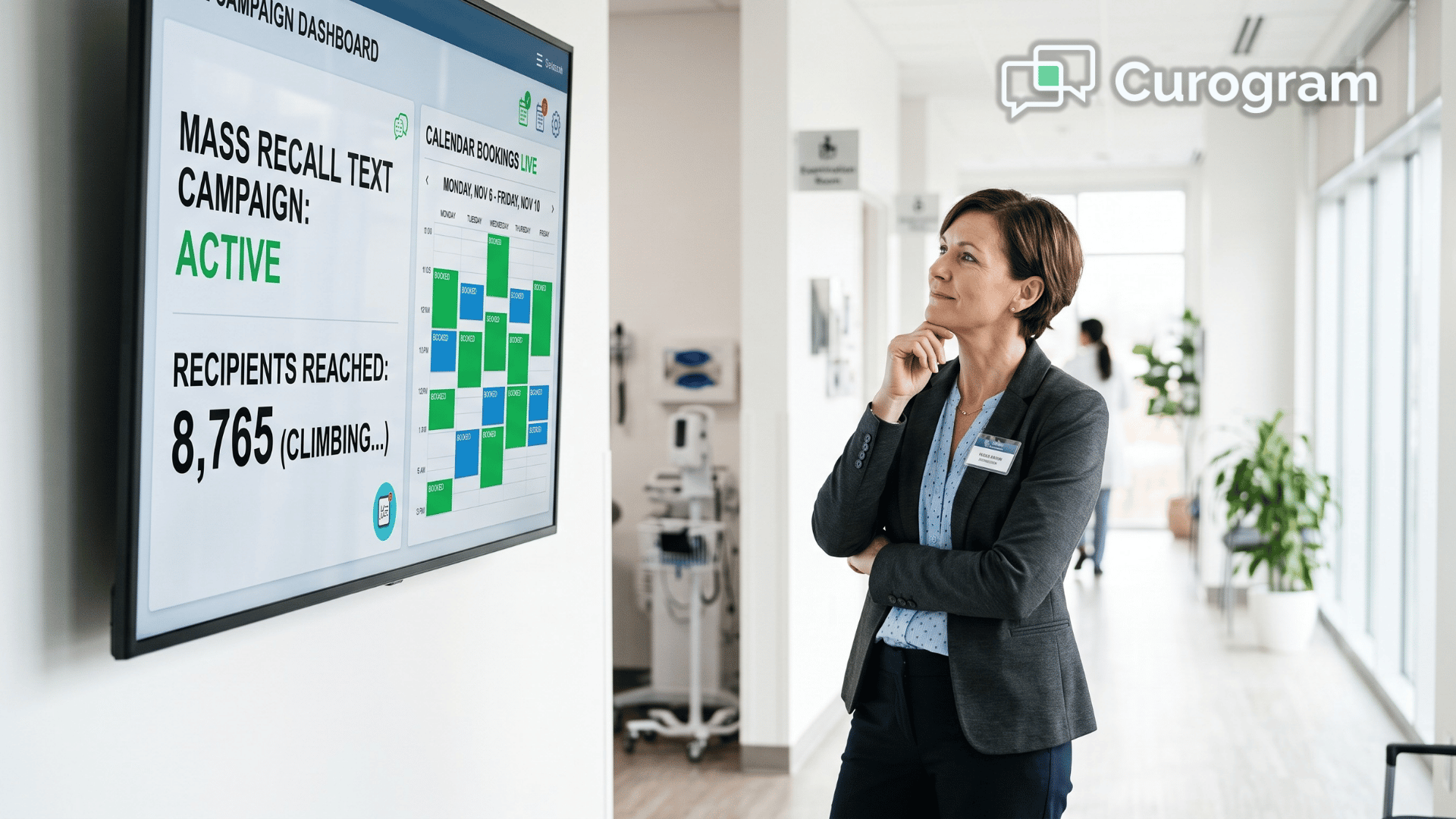
The two engines doing the heavy lifting are mass texting CharmHealth campaigns and structured patient recall. Together they let you reach thousands of patients in one send, which is exactly what a true CharmHealth Bulk SMS alternative should do.
This matters most for the practices with the most to lose. For primary care, multi-specialty, and integrative clinics, recalls do more than fill open slots. They protect clinical continuity by getting overdue patients back into the care they actually need.
So the same message that helps you reactivate lapsed patients CharmHealth left behind also closes real care gaps. You can pair it with automated appointment reminders so the patients you win back actually show up.
One outreach. Two wins:
A fuller schedule and healthier patients.

Before you celebrate the results, it helps to understand why this works at all.
Recall texting succeeds because of one quiet truth:
Most lapsed patients never decided to leave you.
They drifted. A reminder never came, a busy season hit, and the visit fell off their radar. So when a friendly text shows up, it does not feel like a sales pitch. It feels like a nudge they were quietly waiting for.
Text also removes the friction that kills phone-based recall. There is no voicemail tag, no hold music, no callback to remember. A patient can rebook from a parking lot in under a minute.
A few things make a recall text land instead of getting ignored:
Put those together and the response rate climbs. Passive self-rebooking recovers only 5–10% of a lapsed list on its own, yet a well-built text campaign can pull back a third or more of those same patients.
That gap is the whole game. The patients were always reachable. They were just never reached the right way.
So what happens when a practice finally turns the list back on? The shift is faster and bigger than most teams expect.
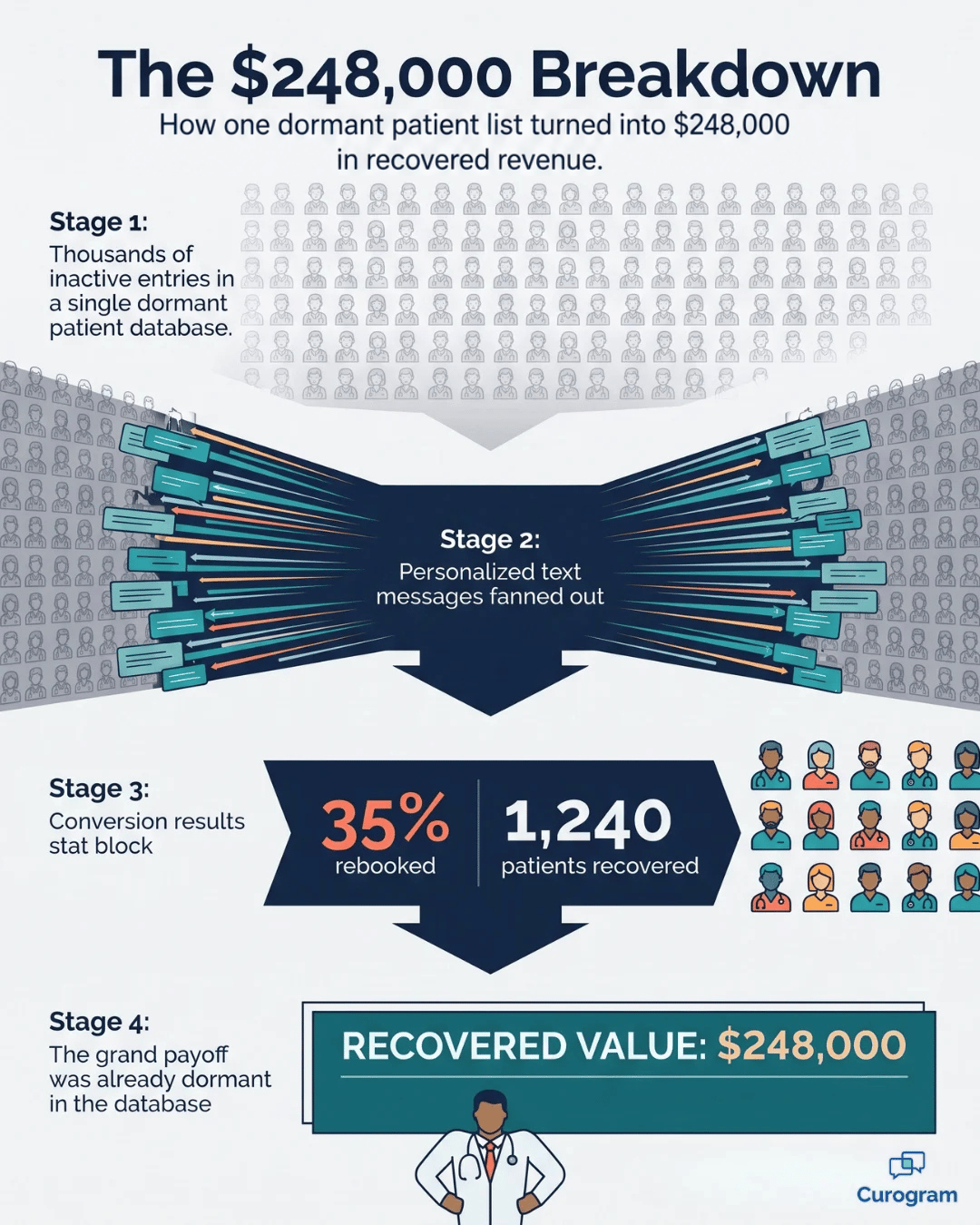
Take a comparable practice that ran a single recall campaign medical practice teams would recognize: Same EHR, same kind of stale list. The results speak for themselves.
They rebooked 35% of lapsed patients and recovered 1,240 of them in one campaign — an estimated $248,000 in visits, at roughly $0 in added staff cost.
Let's unpack what that number means for you.
$248,000 from one send is not a marketing miracle. It is simply revenue that was already sitting in the database, waiting for a message.
In practice, that changes how the whole schedule fills. Instead of chasing new patients through ads, the front desk watches overdue patients rebook themselves by text. The inactive list stops being dead weight and becomes a steady booking pipeline.
For your team, the daily grind gets lighter too. There is no manual list to build, no spreadsheet to scrub, and no calendar to update by hand. The work that used to take weeks happens in a single afternoon.
And because these are patients you already know, the wins stack. Successful patient win-back campaigns refill the schedule, restore clinical continuity, and lift reputation all at once — happy returning patients are far more likely to leave a positive Google review when you ask.
That is the reactivated database. The list you were paying to store quietly becomes the cheapest growth channel you have.
Let's bring it home. Your CharmHealth database is not a storage problem. It is a growth opportunity you have already paid for.
Scalable, uncapped recalls reach the patients CharmHealth Bulk SMS cannot touch cost-effectively — and they do it without changing a thing about your EHR. The records stay where they are. The bookings just start flowing back in.
Here is the insight worth holding onto. CharmHealth holds your patient list. Curogram turns that list's silence back into booked visits. Same patients, same relationships, finally put to work.
Think about the math one more time.
Reactivating a lapsed patient costs a fraction of the $250 to $350 it takes to buy a brand-new one. You are choosing between expensive strangers and affordable patients who already trust you.
Every dormant record is revenue and continuity you have already earned. Leaving it untouched is a quiet, ongoing loss — one missed visit at a time, one $248,000 campaign you never ran.
The patients are there. The relationships are real. The only missing piece is the message.
So send it.
You do not need a bigger ad budget or a new EHR to grow this quarter. You need a way to reach the people who already chose you, and a system that books them while your staff focuses on the patients in front of them.
That is exactly what CharmHealth patient recall, done right, delivers: a fuller schedule, restored continuity, and revenue you stop leaving on the table.
Ready to see how much is sitting in your inactive list?
We will help you estimate the real revenue hiding in your database, and we will show you the reactivation engine working on a list just like yours.
Schedule a Demo, and let's turn your dormant database into your next full week of appointments.
Yes. Recall campaigns run on patient opt-in with a clear STOP option, and the first message contains no protected health information. That keeps your outreach aligned with TCPA rules, and the platform itself is HIPAA-compliant under a signed BAA.
Yes. It reads your CharmHealth database and identifies every patient past their recommended recall window, so there is no manual list to build. New bookings then write back to your schedule on their own.
There is no 250-message cap and no per-message overage. You can reach a database of 10,000-plus patients in a single campaign without watching a meter or worrying about $0.08 charges adding up.
Most practices send their first campaign within days of connecting, not weeks. Because Curogram builds the patient list for you and pulls recall windows straight from CharmHealth, there is no long setup or data project to wait on.
They show up at high rates because they already trust your practice. Pairing recalls with automated reminders and confirmations keeps no-shows low, so the visits you win back turn into real revenue, not empty slots.
💡 Mass text messaging for CharmHealth practices without message caps lets you reach your entire patient list in one campaign. Curogram sends...

💡Automated patient recall campaigns for the Azalea Health front desk find your overdue patients and text them to rebook. They run entirely on their...
💡 Patient reactivation texts for lapsed CharmHealth patients work because most lapsed patients didn't choose to leave. They drifted. No one reached...