10 min read

Why Two-Way HIPAA-Compliant Texting Suits Cerbo EHR Practices

Why Two-Way HIPAA-Compliant Texting Suits Cerbo EHR Practices
💡 Two-way HIPAA-compliant texting for Cerbo EHR practices gives patients a direct SMS line to your clinic, with no portal login required. Curogram adds this layer on top of Cerbo through its Open API. Here is what the setup delivers:
  • 98% SMS open rates versus single-digit portal engagement
  • No app download or password for patients
  • Full HIPAA, SOC 2, and TCPA compliance
  • Direct sync between Curogram and Cerbo
  • No-show drops from 14.20% to 4.91% (Atlas Medical Center)
This fits DPC, concierge, and functional medicine clinics that want their patient experience to match the quality of their clinical work.


Your patients pay $400 for a 90-minute functional medicine visit. To confirm that visit, they have to reset a forgotten portal password. The math feels off, and your patients feel it too.

Cerbo earned its 5.0 Capterra rating for good reason. It handles supplement protocols, custom charts, and the root-cause work that mainstream EHRs cannot match. But Cerbo's patient messaging still lives inside a portal. That creates a strange tension for boutique clinics that promise a different kind of care.

We call this "The Portal Paradox." Your clinical care feels personal and direct. Your patient communication feels like a hospital system. The gap is small in any one moment, but it adds up fast over a year.

This article maps out two-way HIPAA-compliant texting for Cerbo EHR practices using Curogram. We will show how a text layer works alongside your portal, not against it. You will see real numbers from clinics that made the switch.

Here is what changes when you add SMS to Cerbo. Patients text from the phone they already use. No app to install. No login. No password reset emails at 9 PM the night before a visit. Staff see every chat in one secure dashboard with full audit trails.

The money side matters too. A clinic charging $300 to $500 per visit cannot absorb a 14% no-show rate. Atlas Medical Center cut theirs from 14.20% to 4.91% in three months. That math works in your favor every month.

This guide is built for DPC owners, concierge clinicians, and functional medicine practices on Cerbo. You will not swap your EHR.

You will not retrain your team on a second clinical system. You will only open one new channel — the one your patients already check 80 times a day.

The Villain: The Portal Paradox

Cerbo's patient portal does real clinical work, and it does that work well. It handles secure document sharing, complex intake forms, health questionnaires, and subscription billing. These are tasks that mainstream EHRs often struggle to replicate. The portal is not the villain in this story.

The villain is the workflow built around it. Every routine patient task gets routed through the same portal login.

Appointment confirmations, supplement questions, lab follow-up scheduling, and quick care plan check-ins all sit behind the same locked door. That door is the right size for clinical tasks but too heavy for a one-line question.

Walk through what a portal message looks like for a patient:

  1. They get an email or app notification first, then open it and tap through.

  2. They enter their portal credentials, or worse, reset a forgotten password.

  3. They navigate to the message center, read the note, type a reply, and hit send.

Several steps to confirm tomorrow's 60-minute consultation. These steps where one would do. And these are the patients who actually try. Many will skip the portal and call the clinic instead, adding to the 40 to 80 inbound calls a typical Cerbo practice fields each day.

Those calls cover the same routine ground every time. Think supplement reorders, lab result questions, and intake form status checks. Each one pulls a staff member off a higher-value task. The volume is steady, and the resolution rate stays the same.

Now look at the money side:

Integrative medicine visits often run $300 to $500 each. A 10% to 15% no-show rate — driven partly by missed portal reminders — turns into real revenue lost. For a solo provider, that means $5,000 to $15,000 per month walking out the door.


Add the staff hours spent on phone tag and voicemail. A two-way text exchange would close most of these loops in seconds.

Instead, your team spends hours each week on these calls. Cerbo costs $228 per month plus customization fees, yet routine communication still depends on manual workarounds.

The human side of this is quieter but just as real. The Practice Owner picked Cerbo because it spoke their language. The custom charting fit the functional medicine framework. The supplement tracking matched the protocols.

Setup took weeks. Configuration took longer. The clinical side now works beautifully. But the patient communication side still feels stuck in 2015.

Patients deserve better, and the Practice Owner knows it. But there is no time to test five separate tools. So the gap stays open. The frustration is not loud — it just builds.

It builds one quiet failure at a time. One unanswered portal message, then another. One patient who silently stops booking because the communication did not match the care. One five-star care experience undercut by a one-star login screen.

For a boutique practice, this gap is more than a small annoyance. It is a brand contradiction. Patients pay premium prices for what should feel like a premium experience from first contact to follow-up. When the channel feels like a hospital system, the rest of the brand cracks a little.

This is why the search for a secure patient messaging Cerbo alternative to portal-only communication has grown fast in the integrative medicine community.

Practices are not looking to replace Cerbo. They want to fix the one piece that does not fit. The fix is not another portal — it is a direct line.

That direct line is what the rest of this article unpacks. Same EHR. Same clinical depth. New channel for the routine stuff that should never have lived inside a portal in the first place.

The Guide: The Direct Line

Curogram is built to be the SMS layer that sits next to your Cerbo portal, not in place of it. Patients text the practice from the phone they already own. Staff handle every reply from one shared dashboard. The portal stays intact for the clinical work it was made to do.

Here is the simple version:

A patient sends a text. Curogram routes it to your staff dashboard. Staff reply from there. The message stays encrypted, logged, and tied to the patient record. No new phone for the front desk. No personal cell numbers for the practitioner.


The flagship feature is two-way HIPAA-compliant text messaging. Patients use standard SMS, the same way they text family. There is no app to download. There is no portal to enter. There is no opt-in form to fill out before the first exchange.

Staff see every conversation in one place. Each thread carries the patient's name, contact details, and chat history. Authorized team members can pick up where another left off. Full audit trails sit behind every message, ready for compliance review.

This is where Cerbo patient texting integration earns its keep. Curogram connects to Cerbo through its Open RESTful API. Patient demographics, appointment details, and contact updates flow between the two systems. Your team does not type the same data twice.

The Technical Side

The Cerbo community tends to ask. API credentials are stored separately from your UI logins. Delta endpoints sync only the records that changed, which keeps things fast and clean. Webhooks handle real-time updates where speed matters most.

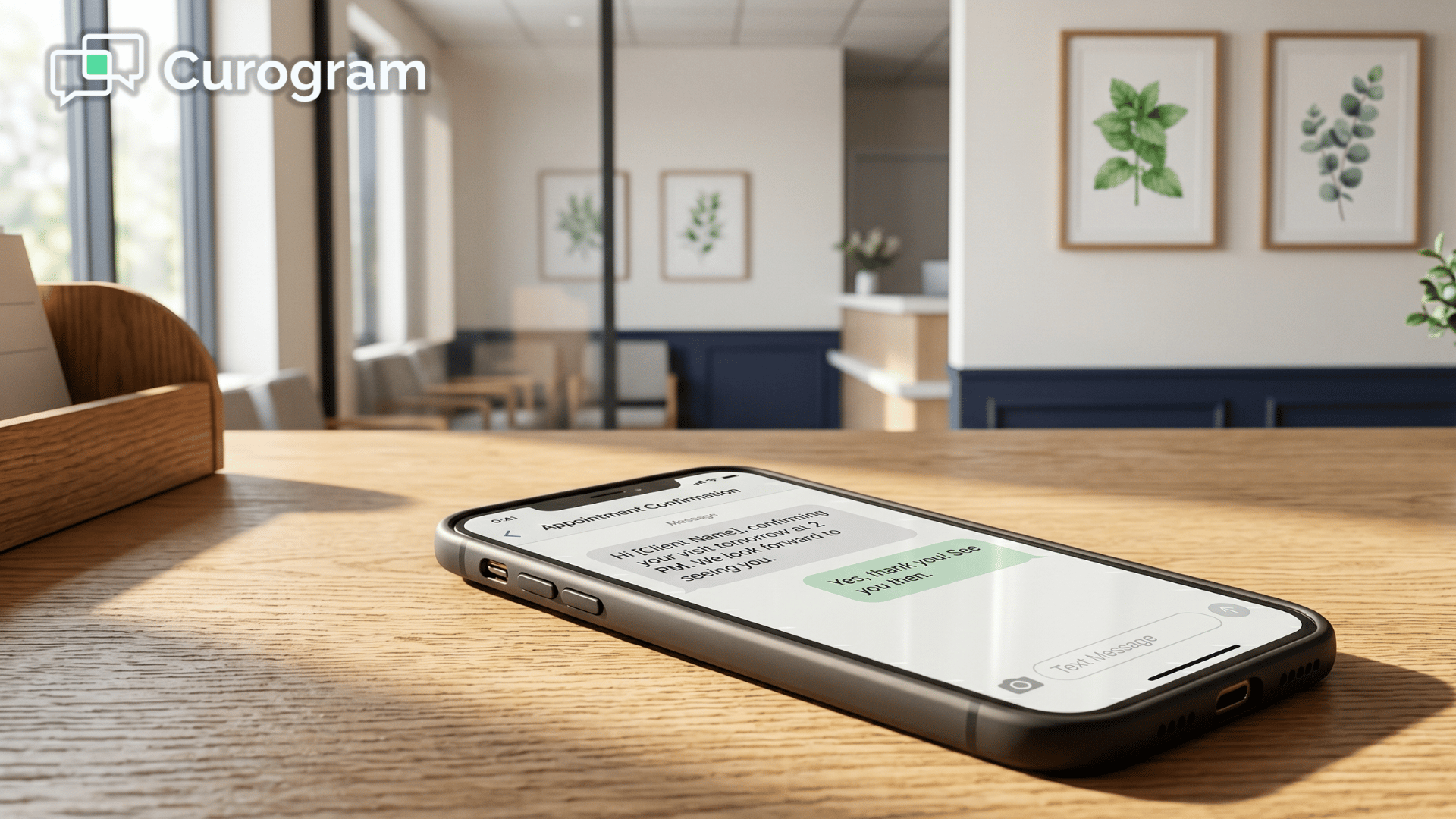
What does this look like on the day-to-day? A patient confirms tomorrow's visit by text. The confirmation appears in Curogram and the appointment status updates in Cerbo. A patient texts to reschedule a lab follow-up. Staff move the slot in Cerbo, and Curogram sends the new time back by text.

Now layer in the patient mix. Cerbo two-way text communication functional medicine practices need looks different from a standard primary care channel.

These patients are deep in their own care. They follow custom protocols, track supplements, watch lab markers, and adjust diets between visits.

That kind of care creates a steady stream of small questions:

"Should I take this supplement with food?" "My energy dipped this week — is that normal in week three?" "Can you send me the updated meal plan?"

These are not phone-call questions. They are not portal-login questions either.

They are text questions. A 30-second exchange in the channel patients already check 80 times a day. Curogram opens that channel without breaking your existing clinical flow. The portal still handles forms, billing, and document signing. Texting handles the rest.

This is also why HIPAA-compliant SMS for integrative medicine EHR setups has become such a focus area. Functional medicine generates more communication touchpoints than mainstream care.

Those touchpoints need a secure channel that does not punish patients for being engaged. Curogram is built around that exact problem.

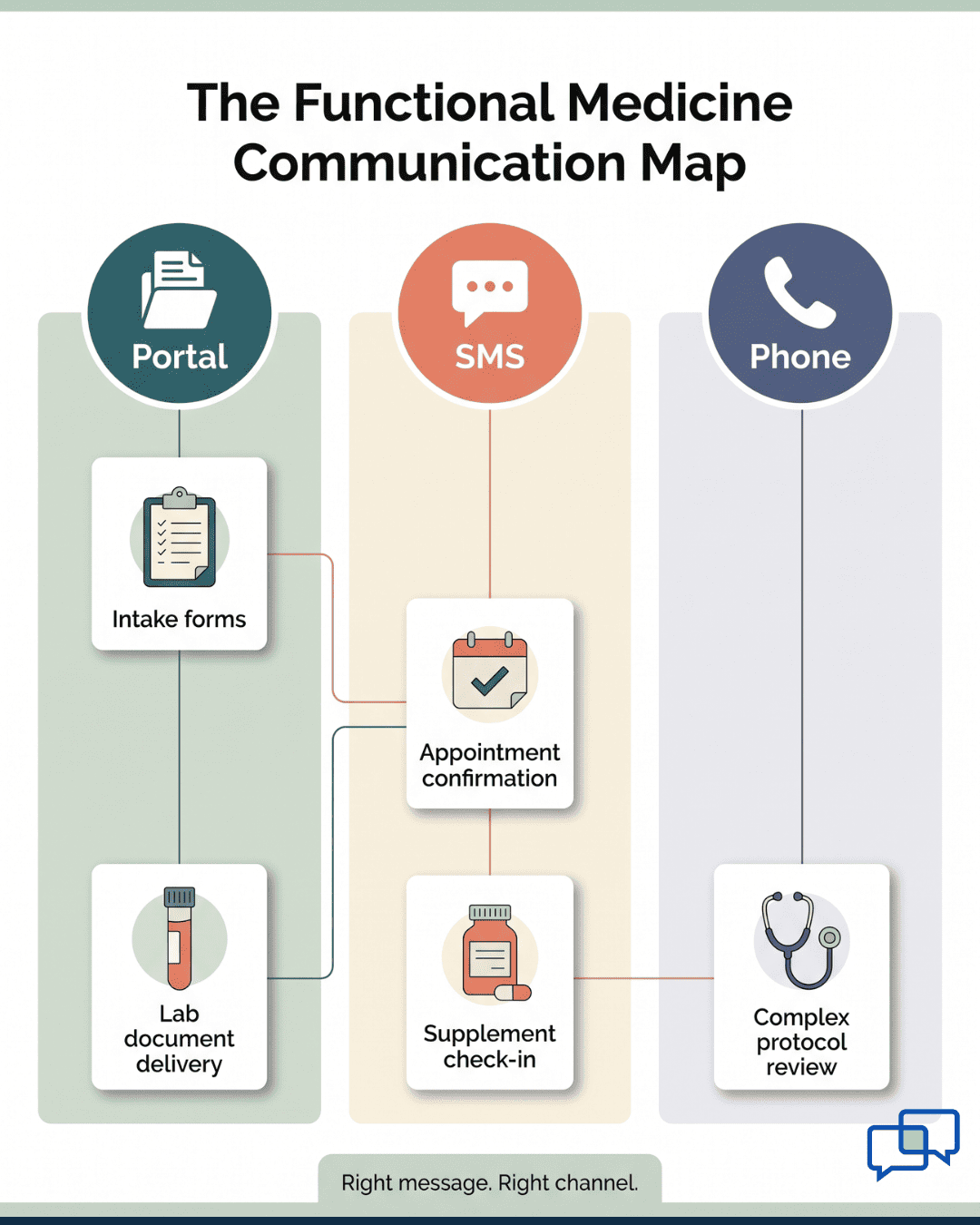
Infographic mapping functional medicine touchpoints to portal, SMS, and phone channels for Cerbo EHR practice communication

Patients still have the option to use the portal. Curogram does not force a one-channel rule. If a patient prefers logging in, the portal is right there. If they prefer SMS, the direct line is open. Most will pick the path that takes 30 seconds over the one that takes six steps.

For the practice, this means no awkward retraining of long-term patients. For the staff, it means one dashboard for messages instead of three browser tabs. For the practitioner, it means more time on care and less time on platform switching. The direct line is exactly what the name suggests.

The Success: The Connected Practice

The numbers tell the story clearly, and they tell it fast. SMS messages hit a 98% open rate in most studies. Patient portal messages, by contrast, sit in single-digit engagement for many outpatient clinics.

The gap between the two channels is not small — it is the difference between a message read and a message lost.

That gap drives real outcomes. Atlas Medical Center brought no-show rates down from 14.20% to 4.91% in three months after rolling out Curogram's two-way texting.

That is a near 10-point drop. For a clinic charging $300 to $500 per visit, the math gets interesting in a hurry.

Run a simple model on it:

A solo functional medicine provider sees roughly 20 patients per week, or about 80 per month. A 14% no-show rate on 80 visits is around 11 missed appointments. At $400 per visit, that is $4,400 lost every month.

Now apply the Atlas drop to that same clinic. Cutting no-shows to 4.91% leaves about 4 missed visits per month instead of 11. That is roughly 7 visits saved. Seven visits at $400 each is $2,800 in recovered revenue every month — and over $33,000 per year.

This is what makes a patient texting platform for DPC concierge practices on Cerbo so attractive. DPC and concierge models depend on direct revenue per visit. Insurance is not absorbing the loss when a patient ghosts a slot. The clinic eats it.

The shift here is bigger than no-shows, though. The deeper move is from a "Portal-Dependent Practice" to a "Connected Practice." In the portal model, every routine interaction is gated. In the connected model, the gate is gone for everything that does not need it.

Picture what the connected practice looks like across one day:

  • At 8:15 AM, a patient texts to confirm her 90-minute integrative consult. The confirmation lands in the Curogram dashboard, and the appointment status updates inside Cerbo. The front desk did not lift a finger.

  • At 10:30 AM, a patient texts about a supplement question. The practitioner sees the question between appointments and types a 20-second reply. The patient gets the answer within minutes, not hours. The exchange is logged in the patient record automatically.

  • At 1:00 PM, a patient texts to reschedule her lab follow-up. Staff move the slot in Cerbo. Curogram sends the new time back to the patient by text. No phone tag. No voicemail. No portal email that the patient may or may not open.

  • At 3:45 PM, a patient working through a complex protocol sends a quick symptom update. The provider scans the message, sees that the response sits within expected ranges, and texts back a short reassurance. The patient feels seen. The provider keeps moving.

  • At 6:00 PM, after hours, a patient texts a question about her morning supplement timing. The message holds in the dashboard until the next clinical day. Staff pick it up at 8 AM and reply before the first appointment. Nothing falls through the cracks because nothing landed in a personal cell phone in the first place.

Compare that day to the portal-only version. Each of those touchpoints would have become a phone call, a voicemail, or a portal message that sat unread for days.

Staff time gets eaten by call-backs. The provider's flow gets broken by interruptions that texting could have absorbed asynchronously.


Integrative medicine practitioner reading a patient text between appointments in a sunlit boutique clinic hallway
How Curogram Layers Two-Way Texting on Top of Cerbo Without Disrupting Your Setup

Curogram is built to add what Cerbo does not focus on, without touching what Cerbo does well. The platform plugs into Cerbo through its Open RESTful API.

Patient data, appointment details, and communication logs flow between the two systems on a steady sync. Your clinical work stays in Cerbo. Your daily messaging moves to a channel patients already live in.

Setup is handled by the Curogram team. There is no IT lift for the practice. API keys are managed separately from UI logins, so credentials stay clean. The integration runs in the background while your staff keep working in the platforms they already know.

What does Curogram actually do for a Cerbo practice? It opens a two-way SMS line for every patient on file. It routes every reply to a shared, HIPAA-compliant dashboard with full audit trails.

It powers appointment reminders, intake form delivery, and broadcast messaging — all from the same channel that patients use for routine questions. The whole platform is SOC 2 certified, BAA-backed, and TCPA-compliant by default.

The bigger picture is what makes Curogram a strong fit for boutique medicine. The product was built around the workflows of DPC, concierge, integrative, and functional medicine clinics. The team understands the cash-pay model, the longer appointment cycles, and the brand expectations of practices charging $300 to $500 per visit.

Curogram does not try to replace your EHR. It does not ask you to compromise the clinical depth that made Cerbo the right choice in the first place.

It simply gives your patients the communication experience that matches the care experience. The result is one clean system where Cerbo handles the chart and Curogram handles the conversation.

Conclusion: Give Your Patients the Communication Experience Your Care Deserves

Two-way HIPAA-compliant texting through Curogram gives Cerbo practices a direct, secure SMS channel for routine patient communication. The portal stays in place for the clinical work it was built to handle. The everyday back-and-forth moves to a channel patients already check daily.

This is the simple insight at the heart of it all. Cerbo is for your clinical depth — the custom charting, the supplement protocols, the root-cause framework.

Curogram is for their convenience — the instant confirmations, the quick questions, the moments that make a patient feel like the only patient in your practice.

You did not pick Cerbo by accident. You picked it because it understood integrative medicine in a way no other EHR did. That investment is worth protecting. The fix for the communication gap is not a new EHR. The fix is a text layer that respects what Cerbo already does well.

The financial case is straightforward. A 10-point drop in no-shows on a $400 visit price covers the cost of the platform many times over. The patient experience case is even simpler. Your patients are paying boutique prices for boutique care. The communication should feel like it.

Skip the sales pitch and see the product. Schedule a demo where we map Curogram directly onto your current Cerbo setup.


Frequently Asked Questions

How does Curogram keep two-way patient texting HIPAA-compliant when SMS itself is not secure?

Curogram encrypts every message inside its compliant platform and stores all conversations in an auditable system. The practice signs a BAA, and patients consent before any clinical data flows. The SMS layer carries notifications, while sensitive content stays inside the secure system.

Why do SMS open rates outperform patient portal engagement by such a wide margin?

Patients check their text inbox dozens of times per day, often within minutes of a new message. Portals require a login, a password, and a navigation path. Texts arrive in a channel patients already trust for family, school, and other appointments — so they get read fast.

How does Curogram sync with Cerbo without creating double entry for staff?

Curogram connects to Cerbo through its Open RESTful API. Patient data, appointment statuses, and contact updates flow between the systems on a steady sync. Staff manage texting from Curogram and clinical notes from Cerbo, with no duplicate typing across platforms.

Why does two-way texting fit DPC, concierge, and functional medicine clinics specifically?

These practices charge premium per-visit fees, depend on direct patient relationships, and generate more between-visit communication than insurance-based clinics. Texting matches that model better than portal messaging. It protects the boutique brand promise while keeping every exchange compliant and logged.

How can a Cerbo practice measure the ROI of adding two-way texting in the first 90 days?

Track three numbers monthly: no-show rate, inbound call volume, and average response time on routine questions. Most clinics see no-shows drop, calls fall by 30% to 50%, and response times shorten from hours to minutes within the first quarter.