No-Show Reduction Efficiency for Oracle Health Networks
💡 No-show reduction efficiency for Oracle Health networks starts with smart, automated reminders. Automated text reminders cut missed visits by...
12 min read
Mira Gwehn Revilla
:
Updated on January 27, 2026
Picture this: your best provider has an hour blocked for a complex new patient visit. The patient never shows. That time slot sits empty. No income comes in. The provider waits. Your staff scrambles.
In the world of integrative and functional medicine, this hurts more than in most settings. Your visits are long. Your fees reflect the depth of care you give. And your Cerbo EMR holds a schedule full of these high-stakes time blocks.
This is where Cerbo EMR ROI for automated reminders becomes crystal clear. Every empty slot drains money from your practice. Every no-show delays care for patients on your waitlist. And every hour your staff spends on the phone chasing patients is an hour they could spend on tasks that grow your clinic.
But there is a fix. Automated SMS reminders cut no-shows by making it easy for patients to confirm or cancel. Two-way texting lets your team fill gaps fast. And the math shows real dollars coming back to your bottom line.
This article walks through why one missed visit hits Cerbo practices so hard. We will look at the true cost of manual phone calls. We will break down the numbers on no-show reduction ROI.
If you run an integrative, functional, or specialty clinic, your provider's time is your most prized asset. Medical practice savings start with guarding that time. Specialty clinic revenue growth depends on keeping your schedule full.
By the end, you will see how the right reminder system works like an insurance policy for your clinic's income. You will learn how to turn lost hours into real profit. And you will walk away with a clear picture of how to protect your practice from the high cost of empty chairs.
Your Cerbo schedule is not like the schedule at a busy urgent care. In those high-volume clinics, doctors see four or five patients each hour. If one person skips, another fills the gap within minutes. The loss is small.
But your practice works on a different model. A new patient consult might last 60 to 90 minutes. A follow-up for a complex case could take 45 minutes. You built this approach on purpose. It gives you time to listen, dig deep, and create real care plans. The trade-off, though, is when that slot goes empty, you cannot get it back.
Think about what happens when a patient misses a 60-minute new patient visit. Your provider sits idle. The room stays vacant. The revenue that should have come in simply vanishes.
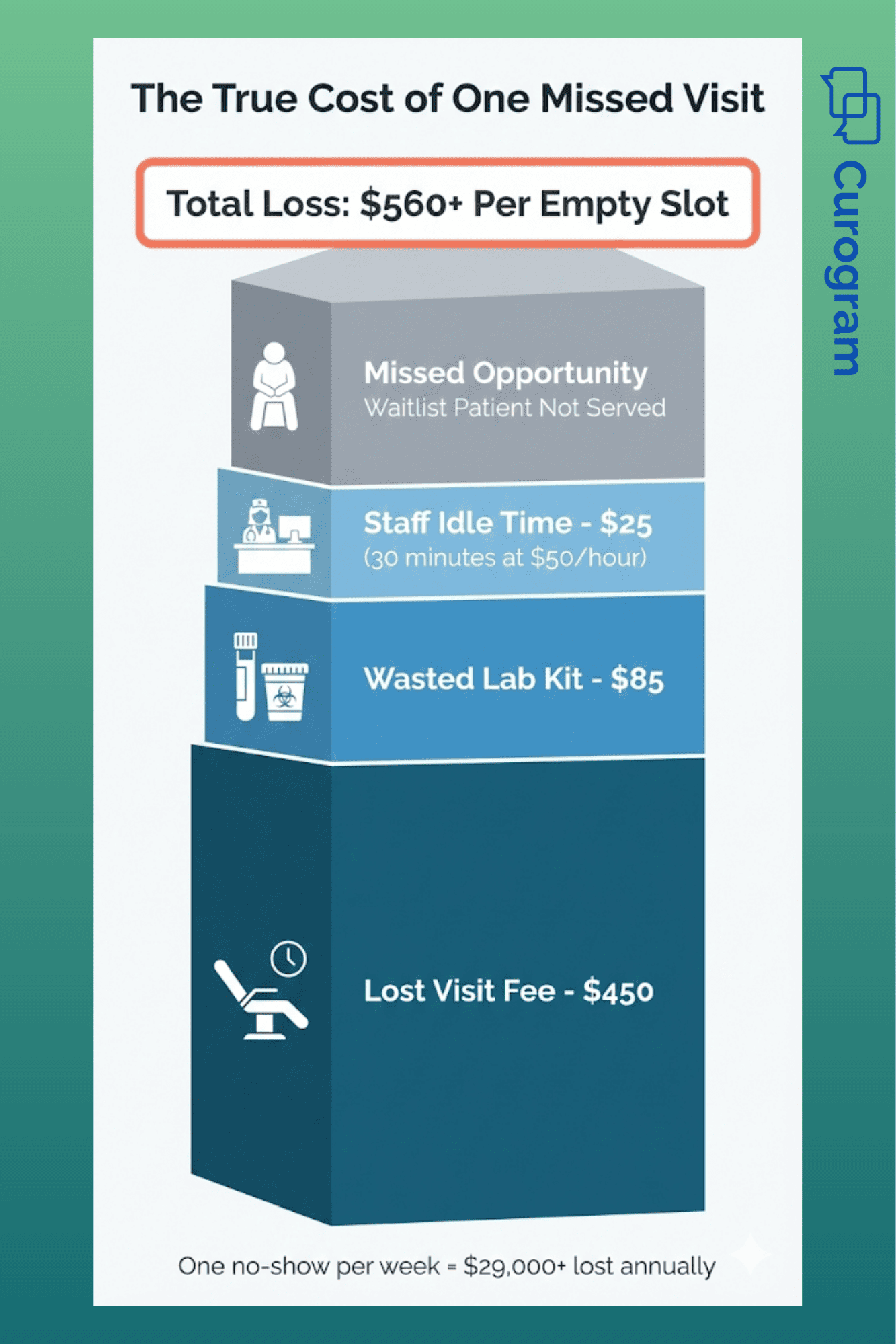
For many integrative and functional medicine clinics, a single no-show can mean $300 to $600 gone. If you see just one empty slot per week, that adds up to $15,600 or more in one year. Two no-shows a week? Now you are looking at over $31,000 lost.
This time-block model is what makes no-show reduction ROI so vital for Cerbo users. You cannot make up for lost visits the way a primary care office can. Every wasted hour chips away at your annual income.
Many visits in functional medicine are tied to lab tests. Your patient might need to arrive fasting. The visit might be timed to review results while they are still fresh. Some tests require special kits that expire or lose value if not used on time.
When a patient no-shows for one of these visits, the loss goes beyond just time. You may have wasted a costly lab kit. You may need to order new supplies. You may have to push the patient's care plan back by weeks while you wait for new labs.
These hidden costs make the sting of a no-show even worse. Your specialty clinic revenue growth takes a hit not just from the lost visit fee, but from all the behind-the-scenes prep that went to waste.
Here is another angle many practice owners miss: If your clinic does its job well, you likely have patients waiting for open spots. These are people eager to start care or squeeze in before a trip or surgery.
Without a system to catch cancellations quickly, you have no way to reach these patients in time. A spot opens at 2 p.m. Your front desk finds out at noon. By the time they try calling down the waitlist, the hour slips away.
Automated reminders change this. When a patient texts back to cancel, your team knows right away. They can reach out to waitlist patients by text too. The slot fills before anyone loses income.
This is why the right tools matter so much for medical practice savings. It is not just about cutting no-shows. It is also about making the most of every canceled visit.
One no-show does more than hurt today's numbers. It can throw off your whole week. Your provider falls behind on charting because they had nothing to do during that open hour. Your staff scrambles to juggle tasks. The flow of the day breaks down.
When you add up the direct revenue loss, the wasted lab costs, the stuck waitlist, and the staff chaos, the true price of a single no-show climbs fast.
For Cerbo practices, protecting each time block is not optional. It is the key to keeping your clinic healthy, your team happy, and your patients cared for on time.
The numbers behind Cerbo EMR ROI for automated reminders come down to two main buckets. First, you save money on staff time. Second, you keep more income from visits that might have been lost. Let's break both down with real examples.
Think about how your front desk spends its mornings. Before the first patient walks in, someone is already on the phone. They dial through tomorrow's schedule, leaving voicemails and playing phone tag.
Now, imagine you have 20 patients booked for the next day. If each call takes three minutes and you reach half on the first try, you might spend an hour just on confirmations. Do this five days a week, and your staff burns through five hours or more on calls alone.
Add in follow-up calls for patients who did not pick up. Add in calls for rescheduling. Add in calls for reminders about forms or fasting rules. You can easily hit 10 hours each week.
At a pay rate of $20 per hour, that weekly labor cost sits at $200. Over a full year, you are looking at more than $10,000 spent just on confirmation calls. And that does not count the value of the tasks your team could have done instead.
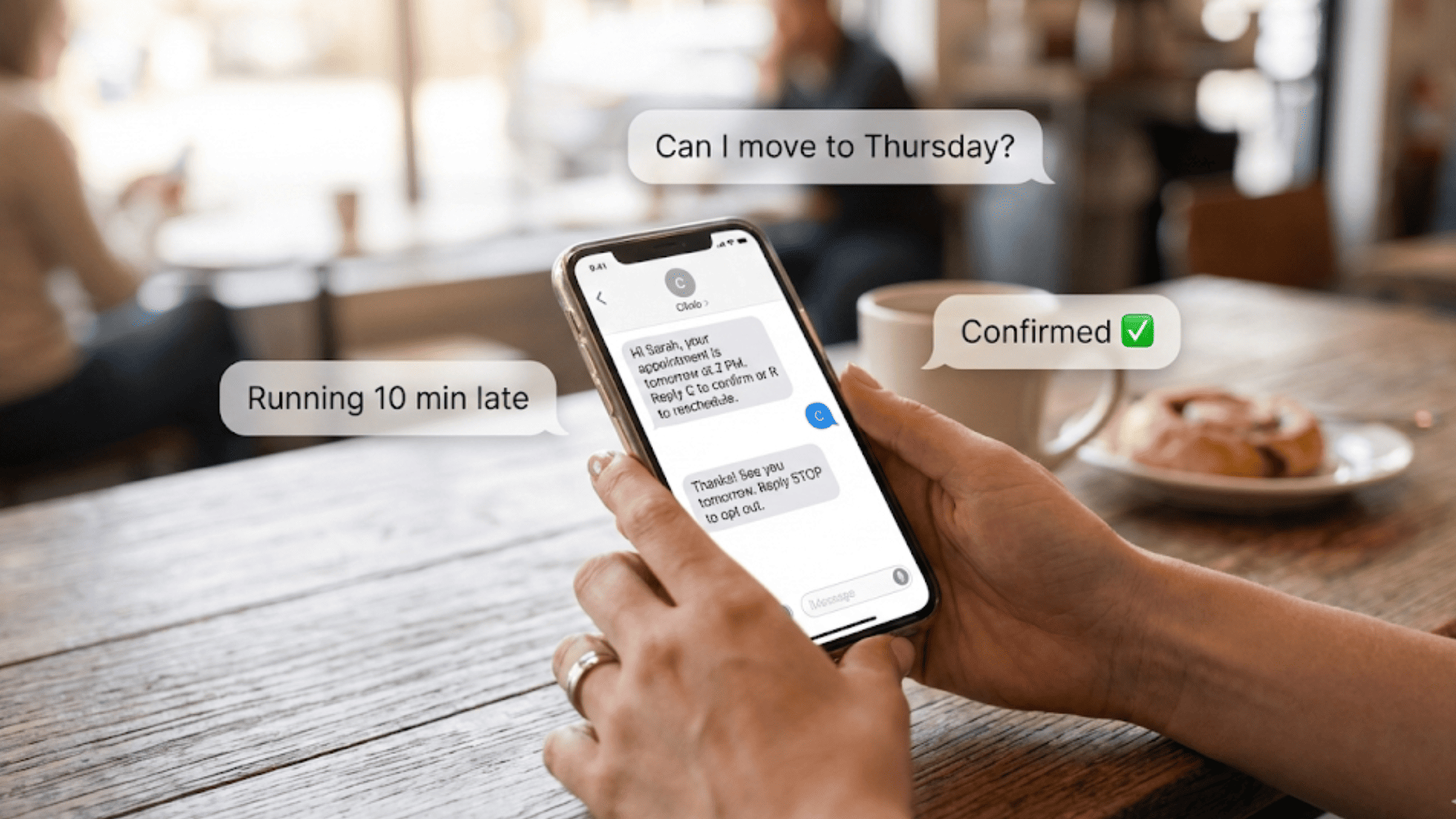
Automated SMS reminders cut this load in a flash. One message goes out to all patients at once. They reply with a simple "C" to confirm. No phone tag. No voicemails. No wasted mornings.
This labor recapture alone delivers strong medical practice savings. But the bigger win comes next.
Let's say your practice sees 20 patients per week. Each visit brings in an average of $250. If your no-show rate sits at 15%, you lose three visits each week. That is $750 per week vanishing into thin air. Over one year, that adds up to $39,000 in lost income.
Now, picture what happens when you bring your no-show rate down to 7%. You now lose about 1.4 visits per week instead of three. Your annual loss drops to around $18,200.
The differenceis, you just recaptured over $20,000 in revenue you would have lost. That is real money flowing back into your practice without seeing a single extra patient.
For specialty clinics with higher visit fees, the math gets even better. If your average visit is $400, a shift from 15% to 7% no-shows could mean over $32,000 saved per year.
This is the heart of no-show reduction ROI. It is not about doing more. It is about losing less.
Here is a number worth knowing: it costs five times more to bring in a new patient than to keep a current one coming back. Marketing, intake, labs, and the first consult all add up fast.
When a patient falls off their care plan because they missed a visit and never rescheduled, you lose future income too. That full treatment journey—with its follow-ups, lab reviews, and ongoing support—slips away.
Consistent reminders keep patients engaged. They stay on their care plan. They show up for visits. They renew their membership if you run a DPC-style model.
This long-term loyalty is where specialty clinic revenue growth really shines. A patient who completes their full care journey is worth far more than a one-time visitor who disappears after a single no-show.
When you combine labor savings, revenue retention, and patient loyalty, the ROI of automated reminders becomes hard to ignore. For most Cerbo practices, the platform pays for itself after just one or two saved high-value visits per month.

Not all reminders are equal. The way you reach your patients shapes whether they respond, confirm, or vanish. Understanding the science behind how people act can help you pick the right channel.
Think about what it takes for a patient to return a voicemail. They have to listen to the message. They have to find time to call back. They have to wait on hold. If they get voicemail on your end, they leave a message and hope someone calls again. Each step adds friction. Friction kills action.
Now picture a text. The patient sees it on their lock screen. They read it in seconds. They tap "C" to confirm or "X" to cancel. Done. The whole exchange takes under 10 seconds.
This ease of reply is why patients are 40% more likely to respond to a text than to return a voicemail. They do not have to carve out time. They do not have to dial. They do not have to think much at all.
For your practice, this means more confirmations, more cancellations sent in advance, and fewer surprise no-shows. Every bit of friction you remove makes it easier for patients to do the right thing.
When you send an email, where does it land? For many patients, it goes straight to a spam folder or gets buried under dozens of other messages. EMR portal alerts are even worse. Most patients check their portal once a month—if at all.
Texts are different. They land right on the phone. A buzz in the pocket grabs attention. Most people check texts within minutes of getting them.
In fact, texts have a 98% open rate. Compare that to email, which hovers around 20% for healthcare messages. The gap is massive.
This high open rate means your reminders actually get seen. No more hoping a patient spots an email before their visit. No more crossing fingers that they log into the portal. The message hits their phone, and they read it almost right away.
For practices that rely on timed lab visits or prep instructions, this instant awareness is gold. Patients know what to do before they arrive. They fast when they need to fast. They bring the forms you asked for. The visit runs smoothly.
Life happens. A patient might get sick the night before their visit. A work meeting might pop up an hour before they planned to leave. Kids get fevers. Cars break down.
With a phone-based system, these patients face a tough choice. They can spend 10 minutes calling and waiting to tell you they cannot make it. Or they can do nothing and hope the problem goes away. Many pick the second path.
With two-way texting, the choice is easy. They tap out a quick message: "Can't make it today, sorry." Your front desk sees it right away. They can reply with options for a new date. The conversation wraps up in under a minute.
This on-the-go cancellation flow does two big things. First, it gives you notice while there is still time to fill the slot. Second, it keeps the patient in your care loop instead of letting them drift away.
For many Cerbo practices, the ability to catch last-minute cancellations and move waitlist patients into those spots is where the real no-show reduction ROI lives. You stop treating those slots as lost. You treat them as chances to serve someone else.
Behavioral science tells us that clear, small asks get better results than vague, big ones. When you leave a voicemail saying "Please call us back to confirm your visit," you are giving the patient a large task. They have to find the number, dial, wait, and speak.
When you send a text saying "Reply C to confirm your visit on Tuesday at 3 p.m.," you give them a tiny task. One letter. One tap. Done.
This switch from "call us" to "tap C" changes how patients think about the request. It feels fast. It feels easy. It fits into the two seconds they have while waiting for coffee.
The result? More patients confirm. More patients engage. Fewer fall through the cracks.
Some practices rely on their EMR's patient portal for communication. On paper, this makes sense. The portal is secure. It ties into the medical record. It feels official. In practice, most patients never use it.
Portal notifications often go to email first. Those emails get lost. Even when patients do see them, they have to log in, remember a password, and navigate a clunky interface. Every extra step adds friction. Friction kills action.
This is not a knock on Cerbo's portal—or any portal. Portals serve a purpose for sharing records and lab results. But for quick confirmations and schedule changes, they cannot compete with a simple text.
When you want patients to act fast, meet them where they already are: their phone's messaging app.
The smartest practices layer their outreach. They send a text reminder two days before the visit. They send another the morning of. If a patient has not confirmed, they might get a follow-up text or a quick call.
This multi-touch approach catches patients at different times. Some reply to the first message. Others need a nudge. A few might need a call if they have questions.
What matters is that text leads the way. It handles the bulk of confirmations with almost no staff effort. Calls become a backup for edge cases, not the default.
By using two-way SMS as your first line of defense, you maximize medical practice savings on labor while also boosting your specialty clinic revenue growth through fewer empty slots. It is the best of both worlds: less work, more income.

For Cerbo practices, every missed visit chips away at your income, your schedule, and your team's morale. Automated reminders plug that leak.
You save staff time. You keep more revenue. You fill gaps from last-minute cancels, and you build stronger bonds with the patients who stick with you.
The question is not whether you can afford to add reminders. The question is whether you can afford to keep losing visits.
When you protect your schedule, you protect your practice. Your providers stay busy with billable work. Your front desk stops chasing patients by phone. Your waitlist patients get seen faster.
The math is simple. A few saved no-shows each month can add thousands to your yearly income. The cost of doing nothing is far higher than the cost of a good reminder system.
How Curogram Delivers Cerbo EMR ROI for Automated Reminders
Curogram was built to work hand-in-hand with Cerbo and other EMRs. It syncs with your schedule so reminders go out on time, every time. No double entry. No manual uploads. Just smooth, set-it-and-forget-it automation.
Two-way texting lets patients confirm, cancel, or ask questions with a quick reply. Your front desk sees every response in real time. They can jump in when needed or let the system handle routine confirmations on its own.
Custom reminder sequences mean you control when and how often messages go out. Want a text two days before and another the morning of? Done. Need a special message for IV patients with pre-payment links? Easy.
HIPAA-compliant messaging keeps your practice safe. Every text meets the rules for patient privacy. You can communicate without worry.
Waitlist alerts help you fill gaps fast. When a patient cancels, your team can text the next person on the list in seconds. That empty slot turns into a filled visit before the hour slips away.
Practices using Curogram often see no-show rates drop by up to 75%. Staff phone time shrinks. Revenue stays where it belongs: in your pocket.
For integrative and functional medicine clinics running Cerbo, this kind of support is not a luxury. It is a core part of keeping the practice healthy.
Your provider's time is the most valuable asset your practice owns. Every empty slot drains money, wastes prep work, and delays care for patients who are waiting.
For Cerbo practices, the stakes are higher than most. Your visits are long. Your fees reflect the depth of care you give. A single no-show can cost $300 to $600. Stack up a few of those each month, and you are looking at tens of thousands lost each year.
Automated SMS reminders change the math. They cut no-shows by making it easy for patients to confirm or cancel. They free your staff from hours of phone calls. They let you fill gaps fast when last-minute cancels come in.
The ROI is real. Labor savings alone can top $10,000 per year. Revenue recaptured from fewer missed visits can add another $20,000 or more. And the boost to patient retention pays off for years down the road.
Two-way texting outperforms portals and voicemails because it meets patients where they are. A 98% open rate beats any other channel. A one-tap reply beats any phone call.
Ready to protect your practice from the high cost of empty chairs? Book your demo today to show you exactly how much revenue you might be losing—and how to get it back.
Reliability builds trust. When patients get clear, friendly reminders, they feel cared for. They see that you value their time. This sense of trust leads to stronger loyalty. Patients stick with their care plans. They come back for follow-ups and renew their membership if you run a subscription-based model.
Texts are easy to read and reply to in seconds. Patients do not have to return a voicemail or wait on hold. The low effort leads to higher response rates and fewer missed visits.
You can send plain confirmations, prep instructions, payment links, or custom notes for specific visit types. The content is flexible and adapts to your workflow.
💡 No-show reduction efficiency for Oracle Health networks starts with smart, automated reminders. Automated text reminders cut missed visits by...
💡Using automated appointment reminders in Athenahealth is an effective way to reduce no-shows. Missed appointments can cost a practice thousands of...
💡 Automated appointment reminders for Cerbo help functional medicine practices protect high-value clinical time and reduce no-shows. Sends 2-way...