
Run the No-Show Math for Your Office Ally Group
.jpg?width=30&name=square-formal-photo%20(1).jpg) Mira Gwehn Revilla : Oct 21, 2026, 5:00:00 PM
Mira Gwehn Revilla : Oct 21, 2026, 5:00:00 PM
You negotiate every software dollar — but no-shows drain $20K–$30K per location monthly. One governed 2-way sequence cuts them 53% below average.

athenaOne Base includes unlimited ReminderCall. Every location can call, email, or text every patient before every appointment, at no extra charge.
Then read the next line of athenahealth's Summer 2026 Service Description. "You are responsible for maintaining lists of participating providers, departments, and patients."
That responsibility lands on each site separately. In a 40-location network, it lands 40 times.
Nobody made a bad call. A practice manager set reminders up the month her clinic joined, using the department list she had then. Then she moved on. Four years later, those settings still show that week. Her peer 15 miles away made other choices on a different Tuesday. Both are running the same platform under the same contract.
Reminder automation was solved a decade ago. Governance never was. The gap shows up as a 10-point no-show swing between two clinics with the same specialty mix.
Our position is blunt: a reminder policy nobody benchmarks by location stays a memo. Leadership signs it. The settings screens outlast it. Six weeks later, the no-show report lands with an average on top, hiding which site drifted.
Below: what reminder configuration variance costs you, the four controls that make a network standard hold, what each site should still own, and what your reports must show before anyone can enforce a thing.
Enterprise software gets bought once and set up many times. Reminders are the clearest case of it in a health network.
athenaCommunicator sits inside athenaOne Base next to athenaClinicals and athenaCollector, so no site had to justify a spend. Each one switched reminders on and picked its own timing, its own departments, its own wording. Cardiology at your flagship might remind at 72 and 24 hours. The clinic you bought in 2023 reminds once, the night before. It skips its two newest providers, because nobody added them to the list.
None of those choices surface in a center-level report. They show up in the no-show numbers months later.
A patient gets her Thursday reminder on Tuesday morning. Her shift just changed. She wants to move the appointment.
Her reminder is a one-way send, so replying does nothing. She plans to call at lunch. Lunch gets busy. She calls Wednesday at 4:40, waits through the phone tree, hangs up at six minutes. Thursday arrives, the slot dies, and the schedule records a no-show with no reason attached.
athenahealth's service description says base reporting tells you if the patient confirmed and if the message got through. Neither field says why she vanished. She was never given a way to say.
Single practices lose $20,000 to $30,000 a month to missed visits, based on figures we see in prospect schedule reviews. In a network, that number never appears in that shape. It's folded into an average.
Put a denial trend that size in front of a billing team and they'd have a war room by Thursday. Attendance gets an average and a shrug, because an average is built to make outliers look small.
No-show variance by location across the network is the number that actually funds the fix. A 10-point spread on one shared platform traces back to setup choices, not patient mix.
Leadership standardizes by memo. A memo has no screen behind it that shows who complied.
The regional VP sends the reminder standard in March. Twelve sites adopt it that month. Nine adopt a version of it. Four never see it because the practice manager who received it left in April.
Nobody is defying anyone. No screen shows which sites match the standard, so drift surfaces in a report months later.
By the time a quarterly no-show report surfaces the problem, the drift is nine months old and three staff turnovers deep.
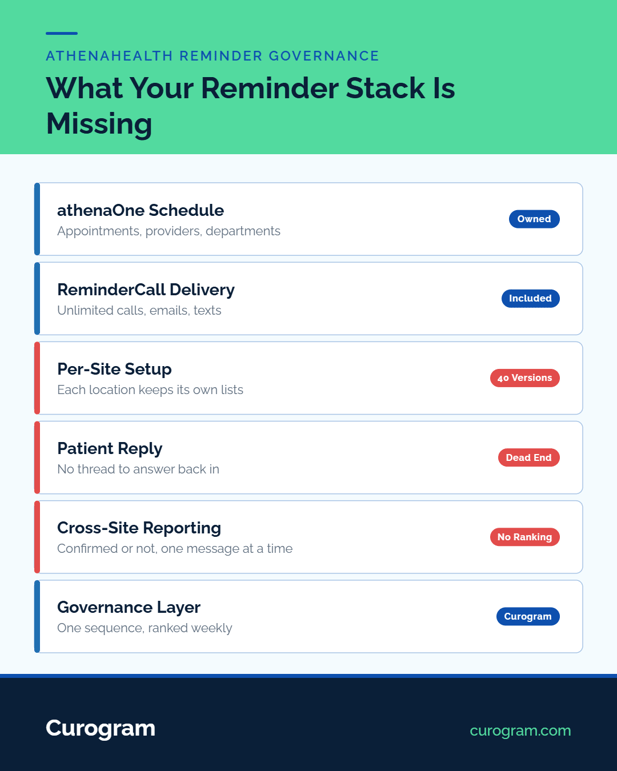
Curogram moves enforcement out of the memo and into the platform. A location inherits the network sequence the day it goes live, and changing it takes a center-level decision.
Cadence, message content, and reply handling are set once at the center. A clinic joining in October gets the same sequence your best site ran in August, without a rollout email or a training call. A network-wide reminder policy at enterprise scale needs that inheritance step, or it stays a recommendation.
Drift shows up on the weekly report rather than in a quarterly review.
Locking every field is how these projects die. Local detail is often what makes a reminder useful.
The split we recommend:
|
Set at the center |
Owned by the location |
|---|---|
|
Send timing and cadence |
Provider and department names |
|
Core message wording |
Building, entrance, and parking notes |
|
Reply keywords and handling |
Language options offered |
|
Opt-out and consent rules |
Local phone number and display name |
|
Which service lines get which sequence |
Prep instructions for local equipment |
Local flavor survives. Timing, wording, and reply handling stay fixed, because those three decide whether a patient answers at all.
A reply counts only when it reaches the people working the calendar.
Two-way confirmation writes to the athenahealth schedule as it happens. A patient texts C at 7:15 and the appointment is confirmed before the front desk opens the door. She texts that she needs Friday instead. Her slot opens for whoever refills it, local or central, on the same live view.
No batch file. No morning catch-up where somebody reads yesterday's replies into today's calendar.
Reminder needs vary by service line, and pretending they don't is how local overrides start.
Colonoscopy prep needs a message a week out and another at 48 hours. An annual wellness visit needs neither. Imaging needs a line about arriving 15 minutes early with prior films. Governance writes one sequence per service line, then applies each one everywhere that line exists.
Gastroenterology in three cities runs the same prep sequence. Your wellness visits run the shorter one. Nobody had to build either sequence twice.
Two-Way Reminder Sequences are the layer that makes governance stick. Patients confirm, cancel, or rebook by replying in plain words to the thread the reminder came in on. There's no app to download, no portal login, and no phone tree.
Leadership locks the cadence and the core text. Locations fill approved variables. Statuses flow to the athenahealth schedule in real time.
Every reply stays in one thread with the patient's history attached, so whoever picks it up sees the whole exchange.
Reporting is what turns the sequence into policy. Confirm rates and no-show rates appear per site, side by side, every week.
Reminder governance gives leadership one lever instead of 40 separate conversations. Change the sequence at the center, watch the ranked list move, and coach the site that lags.
Curogram is HIPAA-compliant and SOC 2 Type II certified. Consent and opt-outs are handled for you at every site.

Atlas cut no-shows from 14.20% to 4.91% in three months on automated reminders with two-way confirms, based on our internal case data. Three months is roughly one onboarding cycle plus two reminder cycles.
For a network, 4.91% works best as a starting position rather than a goal. A site joining in month seven inherits the sequence that produced it. No first year spent finding the same settings by trial.
Across our client base, practices on the sequence run no-shows 53% below the industry average. Recovered appointments lift revenue 10–20%, again from our internal data.
A network average can improve in two different ways, and the mean alone won't tell you which one happened.
A network can lift its mean by improving strong sites that were already fine. Governance works from the bottom instead. Your worst site is usually the one furthest from the standard, and it now inherits that standard on day one.
Track the spread as your governance metric. Four points between best and worst means the policy is holding; a widening gap means a site found a way around it, and the weekly ranking names which one.
Every reschedule handled in the thread is a slot that reopens with days of notice instead of hours.
A no-show number mostly hides that recovery, because a refilled slot never counts as a miss. A patient who texts back Tuesday frees a Thursday slot your central team fills from the waitlist. A patient who says nothing frees nothing, and the provider loses the hour.
More than 75% of appointments get confirmed by text across our client networks. A single letter back is enough, which is why so many patients send it.
Your network already pays for reminder machinery at every site. Three things are missing: one sequence, a reply the patient can use, and a report that ranks sites instead of averaging them.
Pull no-show rates by location for last quarter. Sort worst to best. The spread across sites running the same software is the size of your governance opportunity, in points and in dollars.
Book a demo. We'll design your network-standard sequence against your real service lines, then show two-way confirmations writing to the athenahealth schedule live.
 Mira Gwehn Revilla : Oct 21, 2026, 5:00:00 PM
You negotiate every software dollar — but no-shows drain $20K–$30K per location monthly. One governed 2-way sequence cuts them 53% below average.
 Mira Gwehn Revilla : Oct 13, 2026, 9:00:00 AM
No-shows drain $20K–$30K monthly per location. This ops playbook standardizes two-way reminders across DrChrono sites — 53% below-average no-shows.

 Jo Galvez : Sep 18, 2026, 8:00:01 AM
No-shows drain $20K–$30K monthly per location — hidden inside network averages. This playbook standardizes 2-way reminders across athenahealth sites.