6 min read
Roll Out Texting Across athenahealth Sites | Playbook
Aubreigh Lee Daculug
:
September 15, 2026
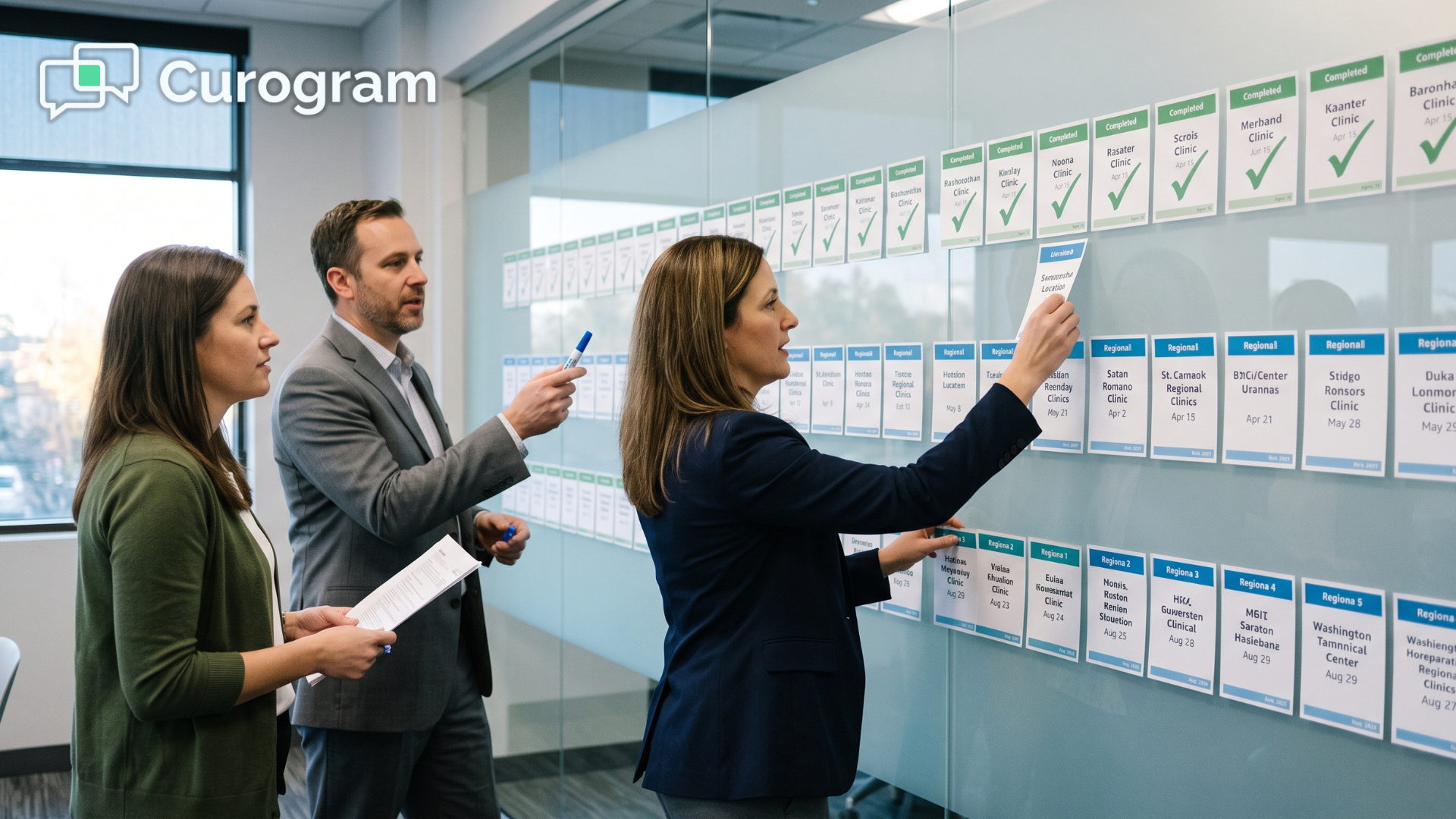
Curogram flips the order. You prove the model at a few sites that represent the wider network, turn those settings into a reusable template, then launch the remaining locations in parallel waves that take days each.
A site counts as finished when it clears a 75% confirmation rate, not when the software is installed. Most networks reach full deployment inside a single quarter.
The pilot site loved it. Confirmations climbed, the phones got quieter, and within a month the site leader was asking why the other locations were still waiting.
Then the rollout entered the change calendar.
That is where most enterprise networks lose the thread, and it is rarely because of staff resistance or a weak product. It is scheduling. Each location's go-live gets slotted behind an EHR upgrade, a payer transition, and a year-end freeze nobody will move.
Nine months later, four sites are live and thirty-six are queued behind them. The champion who fought for the budget has moved into a different role, and the funding line has a new owner who inherited it without the original context.
The project is still technically active, which is the polite word for stuck.
Here is the part that should bother you.
The thing sitting in that queue is not a system replacement or a data migration. It is a texting layer that runs on top of athenahealth and takes a matter of days to stand up at a single location. It gets governed like a core system project because it walked in through the same door.
Meanwhile, every location still waiting keeps the no-show rate the initiative was funded to fix. Front desk teams keep dialing, patients keep missing visits that someone already spent money to schedule, and the cost of that delay lands quietly every month.
The fix is not more urgency or a louder sponsor. It is a different shape of rollout, where you prove the model once, package everything you learned, and then repeat it in waves instead of walking from site to site.
This playbook covers how that works across an athenahealth network, including pilot selection, templating, wave sequencing, and what "done" should actually mean at each location.
Why Enterprise Rollouts Stall Around Site Nine
Large organizations build process to manage risk, and that instinct is usually sound. Applied to a low-disruption overlay like patient texting, it creates the one risk nobody put on the register. The rollout outlives its own urgency.
Watch how the year tends to unfold.
The pilot succeeds in Q1 and the fan-out plan spans six quarters.
By Q4, three sites are live, the sponsor has a new title, and locations twelve through forty have quietly become a slide that stopped getting presented.
Three clocks are running at the same time here. Deployment velocity, change calendar cycles, and the length of time a sponsor stays in the seat. The first clock is fast, and the other two set the actual pace.
The quiet cost of a location waiting its turn
A location that has not launched yet is not sitting neutral. It is still absorbing the same no-show rate the project was funded to eliminate, month after month, while the paperwork moves.
| Sites still waiting | Missed revenue per month | Over 6 months |
|---|---|---|
| 1 site | $25,000 | $150,000 |
| 6 sites | $150,000 | $900,000 |
| 12 sites | $300,000 | $1.8 million |
Those figures come from a simple illustration rather than a study. Take a location with 1,200 visits a month, a 14% no-show rate, and a $150 average visit value.
That works out to 168 missed appointments, or roughly $25,000 in monthly leakage, sitting untouched while the site waits for its scheduled window.
For your network, the takeaway is blunt: six months of calendar drag across twelve locations can cost more than the platform itself. Worse, the organization draws the wrong lesson from the experience.
Leaders conclude that "these initiatives are hard here," when the initiative was straightforward and the calendar was the hard part.

The Playbook That Turns Each Location Into a Copy
The correction is structural rather than motivational. You stop treating each location as its own project and start treating it as a copy of one that already works. Four moves make that possible.
Choose pilot sites that represent the rest
In pilot site selection, enterprise networks make one predictable mistake. They choose the easiest location, or the one with the loudest advocate. That site proves very little, because the next thirty look nothing like it.
Choose two or three locations that mirror the network instead: an average payer mix, ordinary staffing levels, and normal patient volume. If the model holds there, the template will travel.
Package the pilot into a go-live template per location
Every decision you settled during the pilot becomes reusable. That includes the texting number and how it maps to each site. It also covers message routing, inbox ownership, reminder timing, confirmation windows, permission levels, and the short staff training.
Bundled together, that package becomes the go-live template per location, and it is the genuine product of the pilot phase.
Your first site takes weeks because you are making decisions;
Your tenth takes days because those decisions are already made.
Launch in waves rather than a single line
A sequential fan-out can only move at the speed of one location at a time. Enterprise software rollout waves move at the speed of a group.
Four to eight locations launch together, each needing a few days of work. Curogram's onboarding team carries most of the setup load.
The next wave then begins before the previous one finishes its coaching period. That is how an athenahealth implementation phased network wide fits inside one change window instead of six consecutive ones.
Leave your athenahealth workflows untouched
This is the detail that makes wave speed safe rather than reckless. Scheduling, charting, and billing stay exactly where they are inside athenahealth, so nobody is learning a replacement system. Staff learn one shared inbox that sits alongside the work they already do.
Curogram complements athenahealth instead of replacing any part of it. That low training weight is why a location can go live in days without a support spike the next week.
For the steering committee, the appeal is not speed on its own. A wave plan is reviewable. Each location graduates against a number, so the committee reviews outcomes instead of approving another delay.
What Finishing Inside a Single Quarter Looks Like
"Live" is a weak word in enterprise deployments. It can easily mean the account exists and nobody uses it.
So the playbook replaces it with a graduation bar that every location has to clear before it counts.
- Confirmation rate above 75%. Curogram clients average more than a 75% confirmation rate. The bar reflects normal performance, not a stretch goal.
- Inbox ownership assigned. A named person at the location answers patient replies during business hours.
- Reminder policy running. Automated reminders and confirmations send without anyone at the front desk triggering them.
- Two weeks of stable use. Message volume holds steady after the launch attention fades.
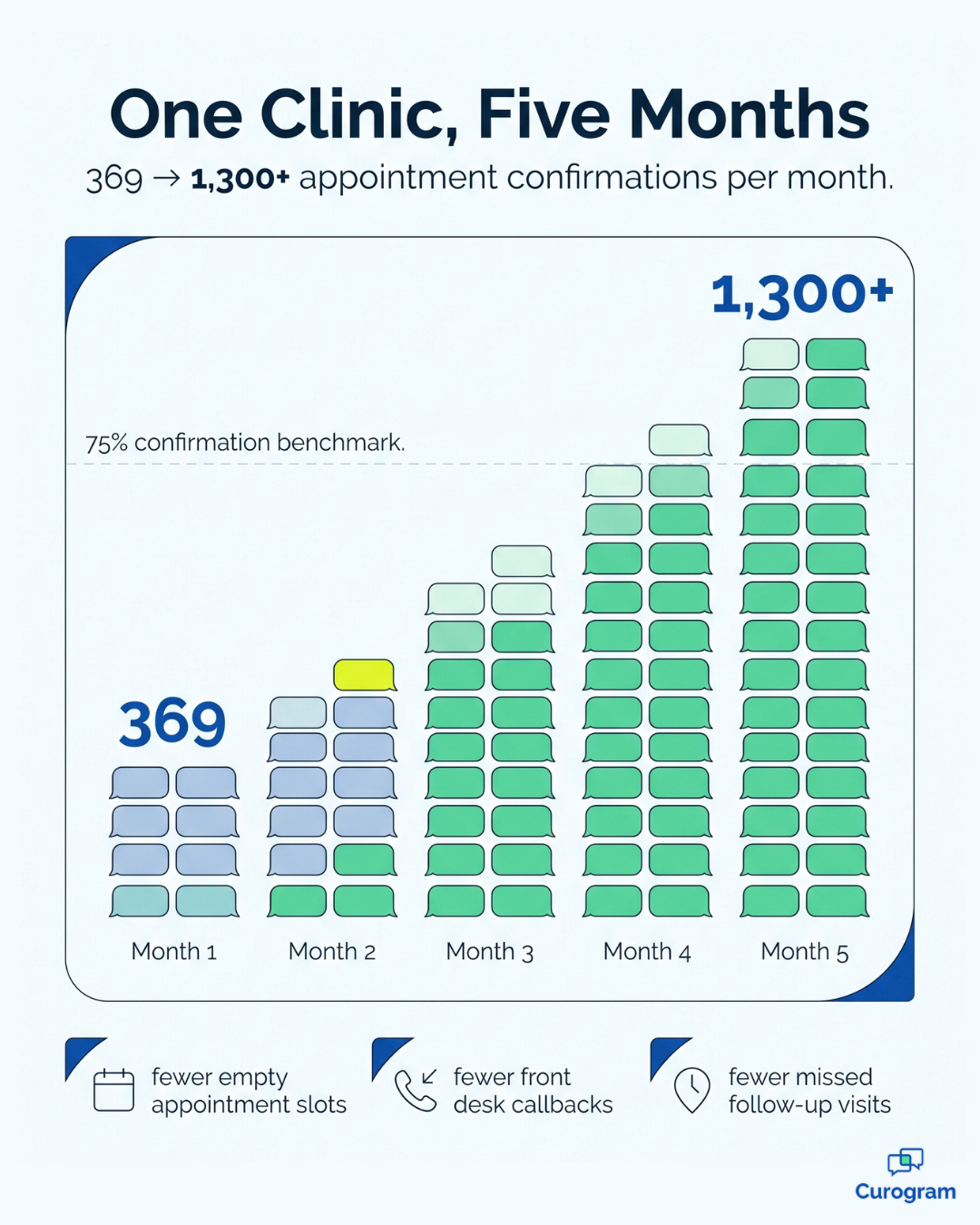
The reference curve comes from a single clinic. Covina Arthritic Clinic moved from 369 to more than 1,300 confirmed appointments a month in five months. That comes from Curogram client data from clinical settings.
One location can travel that far, and a network repeats the same curve site by site, wave by wave.
Read those confirmations as recovered capacity rather than a vanity metric.
They represent fewer empty slots, fewer callbacks, and fewer patients lost to visits nobody reminded them about. Atlas Medical Center cut its no-show rate from 14.20% to 4.91% within three months using the same reminder workflow.
The larger shift is a change in status. Your project moves from "in deployment" to "in production." The sponsor is still the sponsor, and the funding still has an engaged owner. Momentum is a real asset in enterprise work, and it has a famously short shelf life.
Deploy at the Speed Your Pilot Already Proved
The distance between location nine and location forty is not talent, budget, or executive buy-in. It is a wave plan instead of a Gantt chart.
Try a quick exercise before your next steering committee meeting. Count the initiatives across your network still listed as "in deployment" past their first anniversary. Then look hard at what they share.
In most cases it was never a technical failure. It was a rollout shape that assumed calendar space would stay open, and a sponsor who would still be there to defend it every quarter.
Patient texting does not need that shape at all. Your athenaOne environment keeps the clinical enterprise steady while the change happens around it. Curogram arrives as the communication upgrade your patients actually notice. It arrives finished rather than scheduled.
The choice in front of you is smaller than it looks. You can spread forty go-lives across six quarters and hope the urgency survives. Or you can prove the model at two representative locations, template every decision that comes out of it, and run the rest in waves of days.
To avoid stalled enterprise rollout patterns, define what "done" means before wave one begins and hold every location to it.
A simple confirmation benchmark does that job cleanly. It shows you which sites are genuinely live and which ones need another week of coaching. It also tells you when the network is finished for real rather than on paper.
Book a Demo and we will map the whole thing with you in the first working session. You will leave with a pilot-site shortlist and a wave calendar covering the full network. You will also have a per-location graduation bar your steering committee can review with confidence.
Frequently Asked Questions
The pilot proves the model in weeks. Once the template is set, locations launch in waves that take days each. Most networks are live everywhere inside a quarter, not across a fiscal era.
Very little. Curogram sits on top of athenahealth, so there is no interface project per site. The heavy setup happens once, during the pilot. Every location after that inherits the template.
The scoreboard catches it right away. Usage metrics by location show you where coaching is needed. The 75% bar also stops "live" from quietly meaning "installed but ignored."
Each site gets its own texting number. Patients see the clinic they visit, not a head office line. Access follows role, not place. A regional manager can view several sites, while front desk staff see only their own.
Three things. How many sites cleared the bar, the confirmation rate at each one, and any site still under 75% after two weeks. That keeps the meeting on results instead of schedule debates.