Automated Appointment Reminder Workflows for Meditab IMS Teams
💡 Automated appointment reminder workflows for Meditab IMS teams reduce missed visits and help clinics run more smoothly. These systems send text...
14 min read
Mira Gwehn Revilla
:
March 10, 2026
Table of Contents
Picture this. It's 2:15 PM on a Tuesday. A patient no-shows, and the slot sits empty. That revenue is gone — not delayed, not deferred, just gone. For a busy Athena practice, that scene plays out dozens of times a week.
The real problem isn't that patients don't care. It's that the reminder never reached them. Portal alerts go unseen. Phone calls go to voicemail. And when a patient does want to cancel, calling the office and waiting on hold feels like too much work. So they just... don't show up.
This is the Empty Chair problem. And it's costing high-volume practices tens of thousands of dollars each month.
Athenahealth appointment reminders through Curogram's Schedule Filler fix this by meeting patients where they already are — on their phones. With 2-way SMS, patients get a text, read it in seconds, and reply to confirm, reschedule, or cancel. Every response syncs right back to the Athena schedule through a validated Marketplace integration.
But the Schedule Filler goes beyond simple reminders. When a patient cancels, the system texts your waitlisted patients to fill that open slot — often within minutes. No phone tag. No staff scrambling. Just a full board, all day.
Based on our internal data, practices using Curogram see no-show rates 53% lower than the industry average. One clinic dropped from 14.20% to 4.91% in just three months. Another confirms over 1,100 appointments per month — all without a single phone call from the front desk.
This guide walks through exactly how the Schedule Filler works, why SMS beats phone calls and portals, and how to measure the impact on your revenue and your team's time.
A medical practice sells one thing: provider time. Unlike a store that can sell a product tomorrow, a provider's time slot expires the moment it passes. If no one sits in the chair at 2:15 PM, that revenue is lost for good.
At a high-volume Athena practice seeing 35 to 45 patients per provider per day, the math is harsh. Every slot carries the office visit charge, any add-on work, lab orders, and follow-up bookings. A single no-show might cost $150 to $300 in lost revenue. Multiply that by five no-shows per provider per week, and the leak grows fast.
|
Let's put real numbers to it: Say, your practice has 14 providers. Each sees 40 patients a day. If your no-show rate is 10%, that's 4 empty slots per provider, per day. At an average of $200 per visit, that's $800 per provider daily — or $11,200 per day across the group. Over a month, that's more than $240,000 in revenue that simply vanished. |
The root cause is the gap between your schedule and your patient. Athena's native tools rely on portal alerts and basic phone calls. But portal adoption sits around 30% for most practices.
That means 7 out of 10 patients never see the portal-based reminder. And phone calls? Most are screened or ignored, ending up as voicemails that no one listens to.
Patients don't skip visits out of spite. They forget. Life gets busy. The reminder didn't land where they'd actually see it.
And when they do need to cancel, the process — call the office, sit on hold, explain to a staff member — has too much friction. Many patients find it easier to just not show up.
The damage goes deeper than missed co-pays. When a patient no-shows, the provider has dead time. Staff still prepped the chart, verified insurance, and set up the room. That effort is wasted.
There's also the follow-up burden. Staff must call the patient, try to reschedule, and document the missed visit. That's more phone time on top of the time already spent on the reminder calls that failed. For a front desk team already fielding 80 to 100 calls a day, this piles up fast.
|
Cost Area |
Impact Per No-Show |
Monthly Impact (14 providers, 10% no-show rate) |
|
Lost visit revenue |
$150–$300 |
$168,000–$336,000 |
|
Wasted staff prep time |
10–15 min per slot |
~280 hours |
|
Follow-up calls to reschedule |
5–8 min per call |
~140 hours |
|
Lost downstream revenue (labs, referrals) |
Varies |
Hard to track but real |
Athenahealth is built around the idea that a well-run revenue cycle starts with a full schedule. The platform's Full Circle RCM engine works best when encounters happen as planned.
For Athena practices chasing strong revenue targets, the no-show reduction SMS schedule problem isn't just a front desk headache. It's a systemic revenue drain that weakens every part of the business — from provider output to RCM results to staff morale.
The Empty Chair doesn't just cost money. It wastes time, burns out staff, and leaves providers staring at gaps in their day.
The good news: this is a solvable problem. And the fix starts with reaching patients on a channel they actually check.
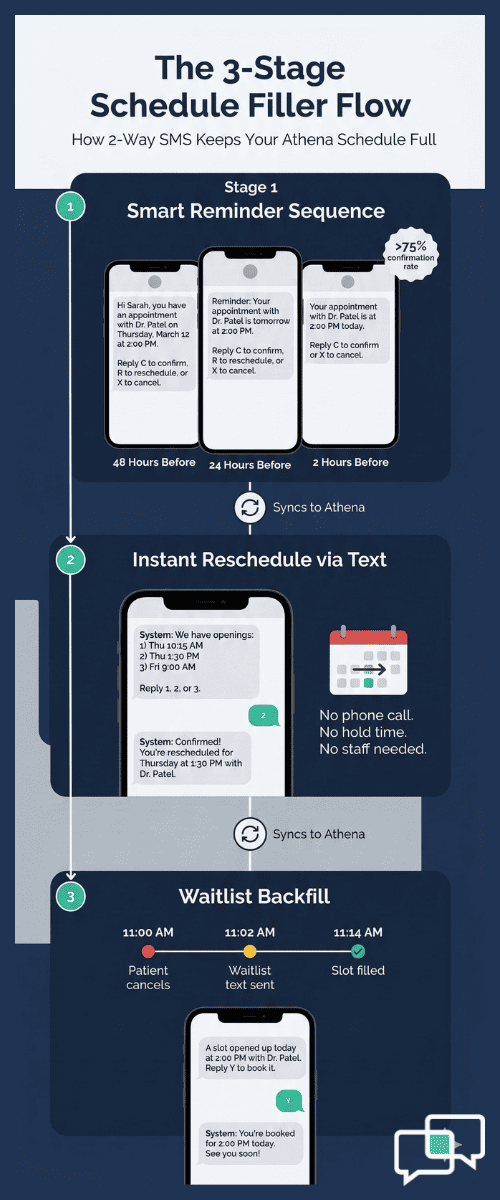
Curogram's Schedule Filler tackles the Empty Chair through a three-stage process. Each stage builds on the last, turning passive reminders into an active schedule engine that fills slots and keeps the Athena board current.
The system sends Athena SMS appointment reminders at set intervals — typically 48 hours, 24 hours, and 2 hours before the visit
Each text includes the date, time, provider name, and a simple reply prompt. The patient texts back a single letter: C to confirm, R to reschedule, or X to cancel.
This is where the 2-way text confirmation athenahealth capability makes all the difference. The patient doesn't just read a reminder — they act on it. No app to open. No portal to log into. No phone number to call. Just a quick text reply from the same screen where they message friends and family.
The timing matters, too. The 48-hour text catches patients early enough to reschedule if needed. The 24-hour reminder locks in the visit. The 2-hour nudge catches last-minute forgetters and gives the practice time to backfill if someone cancels.
When a patient replies to reschedule, the system doesn't just flag the slot as open and wait. It presents open time slots right in the text thread. The patient picks a new time, confirms it, and the change syncs to Athena — all within the same text exchange.
Here's what that looks like in practice:
Patient gets the 48-hour reminder
Patient replies "R" to reschedule
System texts back: "We have openings Thursday at 10:15 AM, 1:30 PM, or Friday at 9:00 AM. Reply 1, 2, or 3."
Patient replies "2"
System confirms Thursday at 1:30 PM and updates the Athena schedule
No phone call. No hold time. No staff time used. The original slot is now open and ready for backfill.
This stage is what turns a cancellation from a revenue loss into a revenue save. When a slot opens, the system texts patients on the practice's waitlist. The first patient to confirm gets the slot, and Athena updates in real time.
For a schedule filler urgent care setup where same-day demand is high, this process can fill a slot within minutes. A patient cancels their 2:00 PM visit at 11:30 AM. By 11:45 AM, a waitlisted patient has claimed the spot and confirmed by text.
The waitlist backfill automation works because texting is fast and frictionless. Compare that to the old way: staff calls five or six waitlisted patients, leaves voicemails, waits for callbacks, and often can't fill the slot in time.

Every stage flows through the Athena Marketplace integration. Confirmed visits update the status in Athena. Rescheduled visits move on the board. Cancelled visits free the slot. Staff see accurate, real-time data without touching a thing.
This is what makes Curogram a true Athena Marketplace reminder partner — not a bolt-on tool that runs in a separate window. The integration means no double data entry, no status mismatches, and no manual updates. The Athena schedule is always clean, always current.
Based on our internal data, Curogram clients see over 75% of appointments confirmed through this process, all handled by the system with zero staff effort. That's 100% automated — freeing your team to focus on the patients who are walking through the door.
Most Athena practices still lean on two reminder methods: automated phone calls and patient portal alerts. Both have the same goal — get the patient to show up. But the results are very different from what 2-way SMS delivers.
Think about how you use your own phone. When an unknown number calls, do you pick up? Most people don't. Robocalls have trained us to ignore calls from numbers we don't know. And that's exactly what automated appointment reminder calls look like to a patient — an unknown number calling during the workday.
Text messages are a different story. Most people read a text within minutes of getting it. The message sits on the lock screen until the patient opens it. There's no guessing about whether the reminder was seen.
For practices using Athenahealth appointment reminders through Curogram, this means the message actually lands. The patient sees it, reads it, and — because of the 2-way reply option — can act on it right away.
Here's where the gap gets wider: A phone call reminder, even when answered, is one-way. The system says, "You have an appointment tomorrow at 3 PM."
The patient listens and hangs up. If they need to cancel or reschedule, they have to call the office separately. That extra step is where many patients drop off.
With 2-way SMS, the response loop is built into the reminder itself. The patient replies in the same thread. Confirm in two seconds. Reschedule in thirty seconds. Cancel and free the slot for someone else. The entire exchange takes less time than waiting on hold.
This is the core of what makes 2-way text confirmation through athenahealth so effective. The action happens at the point of contact. There's no gap between "I got the reminder" and "I did something about it."
Patient portals serve a real purpose. They store records, show test results, and allow secure messaging. But as a reminder tool, they have a serious reach problem.
Portal adoption at most Athena practices hovers around 30%. That means for every 10 patients on tomorrow's schedule, only 3 might see the portal-based reminder. The other 7 patients? They either haven't signed up, forgot their password, or just don't check the portal regularly.
Even among active portal users, the alert often gets buried. A portal notification competes with email alerts, app badges, and every other digital ping in the patient's day. A text message from a 10-digit number, on the other hand, shows up in the same app they check 80+ times a day.
|
Reminder Method |
Typical Reach |
Patient Action Required |
Staff Effort |
|
Portal notification |
~30% of patients |
Log in, navigate to alert, call to respond |
None (but low impact) |
|
Automated phone call |
Reaches ~60%, but ~20% answer |
Listen, then call back separately |
Minimal to send, high for follow-up |
|
2-way SMS (Curogram) |
95%+ reach |
Reply with one letter |
None |
A fair concern from practice leaders is this: "Are we just adding more noise?" Patients already get too many pings, alerts, and pop-ups. Won't another message make things worse?
The answer is that Curogram's SMS reminders don't add to the noise — they replace it. When you turn on the Schedule Filler, you turn off the reminder phone tree.
You stop the calls that patients were ignoring anyway. The net result is fewer total contacts per patient, but with much higher engagement on each one.
Patients also control the exchange. They can confirm in one tap and move on. They don't have to sit through a 30-second recorded message. They don't have to navigate a phone menu. The interaction is short, clear, and done.
Based on our internal research, practices using Curogram's 2-way SMS see no-show rates 53% lower than the industry average.
One practice — Atlas Medical Center — cut their no-show rate from 14.20% down to 4.91% in just three months. That's 3 times better than the typical benchmark.
Another client, Covina Arthritic Clinic, now confirms over 1,100 appointments per month through the system. Before Curogram, their staff spent hours each day making manual follow-up calls. Now the entire process runs on its own.
These aren't small improvements. When you move from a phone-based reminder system to 2-way SMS, you're not tweaking a process — you're replacing it with something that works on a totally different level.
The staff impact deserves its own attention. At many Athena practices, the front desk spends 2 to 3 hours per day on reminder-related calls. That includes outbound reminders, inbound calls from patients who want to reschedule, and follow-up calls to no-shows.
When the Schedule Filler handles reminders and reschedules through text, that time opens up. Staff can shift to tasks that actually need a human touch — greeting patients at check-in, processing referrals, handling prior authorizations, or verifying insurance.
|
Consider the math for a 14-provider group: If one front desk team member spends 2.5 hours daily on reminder calls, that's 12.5 hours per week, or roughly 50 hours per month. At $20/hour, that's $1,000/month in labor just for reminder calls. And that doesn't count the time spent chasing no-shows after the fact. |
The enterprise-level value here is clear. Larger Athena groups with multiple locations can scale this across every site. Same process, same results, same savings — multiplied by every location in the network.
Curogram doesn't ask patients to download an app, create a login, or change how they use their phone. The reminder arrives on the channel patients already use most. That's why SMS works — and why everything else falls short.
A 14-provider urgent care and orthopedic group in the Dallas–Fort Worth metro ran on Athenahealth. They operated 7 days a week with extended hours, aiming for 38 to 42 patients per provider per day. Revenue was strong, but no-shows kept dragging it down.
Their no-show rate had climbed to a level that was costing real money every month. The front desk team spent 2.5 hours daily making reminder calls.
Most went straight to voicemail. When patients cancelled, staff would try to call waitlisted patients to fill the gap — but phone tag made same-day backfills almost impossible.
The scheduling lead, Maria, put it simply: "We'd call 10 people to fill one slot. Half the time, we couldn't reach anyone fast enough."
The practice activated Curogram's Schedule Filler through the Athena Marketplace. The manual phone tree was replaced with a 48-hour, 24-hour, and 2-hour text sequence. Waitlist backfill was turned on so that every cancellation triggered an instant text to waitlisted patients.
Within five weeks, the no-show rate dropped sharply. Patients who needed to reschedule did it by text, and the Athena schedule updated on its own.
Same-day slot recovery through waitlist texts filled chairs that would have stayed empty. Maria's 2.5 hours of daily calls disappeared entirely. She moved her focus to referrals and insurance work instead.
The Medical Director's take: "The board looks different now. It's full. And when patients cancel, someone from the waitlist fills it within the hour."
The practice's monthly revenue recovered well beyond Curogram's cost — within the first month of going live.

Athenahealth's Full Circle RCM engine is built to move claims through fast and get practices paid. But the cycle has to start somewhere. It starts with the appointment.
If a patient doesn't show up, there's no encounter. No encounter means no claim. No claim means nothing for the RCM engine to process. The best billing system in the world can't generate revenue from an empty chair.
Curogram's Schedule Filler acts as the front door to Full Circle. It makes sure patients show up, which means encounters happen, claims get filed, and revenue flows.
The connection goes even further. A patient who confirms by text and shows up on time is also a patient who pays their copay at the visit.
Pair Curogram's appointment reminders with Text-to-Pay, and you can collect copays before or during the visit. That speeds up cash flow and cuts the chase on patient balances.
There's also a claim denial angle. When the schedule is accurate and patients confirm in advance, front desk staff have time to verify insurance before the visit. Fewer surprise eligibility issues means fewer denied claims, which keeps Athena's RCM pipeline moving smoothly.
The equation is straightforward: Full schedule → full encounters → full claims → full revenue. The Schedule Filler makes sure the first step happens.
For practice leaders reviewing Curogram's appointment reminders, the results show up in a few key metrics.
No-show rate is the most direct measure. Track your weekly no-show rate before and after turning on the Schedule Filler.
Based on our internal data, Curogram practices run no-show rates 53% below the industry average. Atlas Medical Center dropped from 14.20% to 4.91% in three months.
Same-day backfill rate tells you how many cancelled slots get filled through waitlist texts. The goal is simple: every cancellation should trigger a backfill attempt. Track how many of those attempts convert to a booked patient.
Revenue per provider per day shows the financial impact. Even small gains in show-up rates and backfills add up fast at high-volume practices. If you recover just two slots per provider per day at $200 each, that's $400 daily — or $8,800 per month for a single provider.
Staff time saved is where the ROI becomes visible. Track the hours your team spent on reminder calls before Curogram, then measure what they're doing with that time now — patient check-in, referral processing, insurance reviews. That shift from low-value phone calls to high-value tasks is the operational win.
How the Schedule Filler Turn Cancellations into Revenue
Most practices treat a cancellation as a loss. The slot opens, staff scramble to fill it, and more often than not, it stays empty. Curogram's Schedule Filler flips that script.
The moment a patient cancels — whether by text reply, through the reschedule flow, or by staff action — the system springs into motion. It checks the practice's waitlist and sends a text to patients who want an earlier appointment.
The message is simple: "A slot opened up at 2:00 PM today. Reply Y to book it." The first patient to reply Y gets the slot. The Athena schedule updates right away.
This waitlist backfill automation is what separates Curogram from basic reminder tools. Most systems can send a text and collect a "confirmed" reply.
But filling a cancellation before the slot goes empty? That takes real-time coordination between the waitlist, the schedule, and the patient — all through text.
For schedule filler urgent care practices, this is especially valuable. Same-day demand is high, and patients on the waitlist often want to be seen that very day. The speed of texting matches the speed of urgent care scheduling. A slot that opens at 11:00 AM can be filled by 11:15 AM.
Based on our internal data, practices using Curogram see a 10–20% increase in revenue, with each recovered appointment going straight to the bottom line. That includes the visit charge, any procedures, lab work, and the copay collected at check-in.
Curogram is a validated Athena Marketplace partner. The integration doesn't just push reminders out — it pulls data back. Every confirmation, reschedule, and backfill updates the Athena schedule in real time. Your staff see it instantly. Your providers see it instantly. No lag, no mismatches, no surprises.
The Schedule Filler doesn't just remind patients. It manages your schedule.
Every empty slot on your schedule is money that's already gone. You can't bill for a visit that didn't happen. You can't recover provider time that went unused. The math is simple, and it only gets worse as the no-shows add up.
Curogram's Schedule Filler exists to solve this. It replaces the phone tree that patients ignore with 2-way SMS that patients actually respond to.
It turns cancellations into backfilled slots through waitlist automation. And it keeps your Athena schedule accurate without your staff lifting a finger.
The results from real practices speak clearly. No-show rates drop by up to 75%. Over 75% of appointments get confirmed through text alone. Front desk teams get hours back every day. Revenue goes up because the board stays full.
If your practice runs on Athenahealth and you're tired of watching slots sit empty, the next step is simple. Schedule a demo with Curogram to see exactly how the Schedule Filler works with your Athena setup, your workflow, and your patient volume.
Get a clear picture of the no-show reduction and revenue impact for your practice size
Your schedule should be full. Your providers should be busy with patients, not staring at gaps. Your revenue cycle should start with a confirmed patient — not an empty chair.
Stop losing revenue to empty chairs. Book a quick demo now to see how the Schedule Filler keeps your Athena board full with 2-way SMS.
Athena's portal reaches roughly 30% of patients, while SMS reaches nearly all of them. Curogram's 2-way texting also lets patients act instantly, cutting the steps between reminder and response from several clicks to a single text reply.
Every patient reply — confirm, reschedule, or cancel — syncs directly to the Athena schedule in real time. Staff don't need to enter anything manually, which removes the risk of double bookings or missed updates.
Based on our internal data, front desk teams typically save 2 to 3 hours per day that were previously spent on reminder phone calls. That time shifts to higher-value work like insurance verification, referrals, and patient check-in.
💡 Automated appointment reminder workflows for Meditab IMS teams reduce missed visits and help clinics run more smoothly. These systems send text...
💡 Appointment reminders for Meditab IMS practices help reduce no-shows and keep schedules running smoothly. These automated messages reach patients...
💡 When you eliminate manual appointment calls in Prime Clinical practices, you can reclaim up to 10 hours of staff time each week. Instead of...