
Boost Compliance and Efficiency: HIPAA-Compliant Texting in InSync EMR
Discover how Curogram’s HIPAA-compliant texting for InSync EMR improves compliance, efficiency, and patient satisfaction in behavioral health...
8 min read

Use HIPAA-compliant texting in Allscripts PM for sensitive updates.
Create a clear Allscripts audit trail texting can support in real time.
Reduce audit exposure with documented compliance communication.
Lower missed appointments that lead to lost revenue.
Address patient questions quickly with secure, two way messaging.
Give executives and IT leaders measurable ROI from safer communication.
Curogram helps you move from phone calls and untracked messages into secure texting.
In enterprise clinics, administrators carry a lot of responsibility on their shoulders. If you're an admin, you are expected to protect patient data and keep regulators satisfied. Plus, patients expect a friendly experience every day. It feels like you are standing between strong forces pulling in different directions.
When staff use personal phones to reach patients, you lose control of the record. You may not know what was sent or whether protected health information was exposed. During audits, it becomes difficult to prove that you followed proper compliance practices. The risk is not only financial. It can also damage trust in your organization.
Compliant texting in Allscripts enterprise workflows is designed to close this gap. It lets you keep clinical and operational messages in a controlled, trackable environment. You can create audit trails that show when messages were sent and how patients responded.
In this article, we look at the business risks of non compliant texting. Let's learn how you can improve ROI with secure texting and find easy steps to get started.
As we discussed in our complete guide, even when you do not have HIPAA-compliant texting in Allscripts PM, communication still happens. It simply happens in ways that you cannot fully control. Staff may use personal phones or unapproved tools. Patients may reply with health details in plain text. The work gets done, but the risks stay hidden until something goes wrong.
Auditors and regulators often ask a simple question. They want to know how you protect patient information across all channels, including text. If messages are scattered across personal devices, screenshots, or unsecure apps, you do not have a complete answer. It becomes hard to prove that your policies are more than words on paper.
Without compliance texting Allscripts enterprise workflows, you may not have a reliable way to show message history. You cannot easily demonstrate who sent what, when, and to whom. Even if staff did their best, the absence of records can look like a lack of control. This exposure can lead to fines, corrective action plans, and long periods of increased oversight.
Communication affects your schedule as well as your compliance posture. When appointment details and follow ups are unclear, patients miss visits. They may forget times, mix up locations, or feel unsure about instructions. Each missed visit represents lost revenue and wasted provider time.
Standard phone calls help, but many patients prefer text. If texting is informal and unmanaged, you cannot track which messages were delivered or read. You also cannot see patterns across sites or providers. A structured approach inside Allscripts PM gives you data you can use to understand and reduce missed visits over time.
Patients judge your organization by how easy it is to communicate. When they get slow responses, confusing messages, or mixed instructions, they may look elsewhere for care. They may not complain before leaving. They simply drift away. That quiet churn slowly erodes your panel size and long term revenue.
On the other hand, patients want to feel that their information is safe. If they discover that staff used personal numbers or unsecure apps, they can lose trust. They may worry that their private details are circulating beyond your control. A thoughtful compliance communication strategy helps you balance speed and safety. It shows patients that you respect both their time and their privacy.
Return on investment is not only about cutting costs. It is also about reducing risk and lifting performance in ways you can see and measure. When you integrate secure texting into Allscripts PM through a structured platform like Curogram, you gain both protection and practical value. The changes are visible in your audit readiness, your schedule, and your revenue cycle.
Allscripts audit trail texting records help you show your work. Every outbound and inbound message can be logged with time stamps and user details. You can see which staff member sent a message and which patient received it. This gives you a reliable story to tell if auditors ask about specific interactions.
With Curogram connected to Allscripts PM, these records support your policies instead of sitting apart from them. You can align message templates with your compliance communication standards. You can review history when questions arise. This lowers the fear that a single missing screenshot or forgotten phone conversation will undermine your position.
Text based outreach tends to be read more quickly than email or letters. When patients see clear, timely messages about appointments and instructions, they are less likely to miss visits. Curogram helps you use texting in a consistent, trackable way that supports your Allscripts schedule. Over time, even modest reductions in no shows can add up to meaningful revenue gains.
Better utilization also improves provider satisfaction. Schedules feel more stable. Fewer unused slots mean that staff time is not wasted. These benefits may not all appear in a spreadsheet right away. However, they contribute to a stronger, more sustainable operation.
Compliance texting Allscripts enterprise workflows also support billing and collections. Clear, documented messages help patients understand what to expect. They can receive secure links, policy reminders, and follow up instructions in one place. This clarity reduces confusion that might otherwise slow payments or create disputes.
When your revenue cycle team can see communication history, they handle questions more quickly. They do not have to guess what was said or promise to “check with the front desk.” Instead, they work from shared records. This shortens calls, reduces rework, and supports a more predictable cash flow without adding pressure to already busy staff.
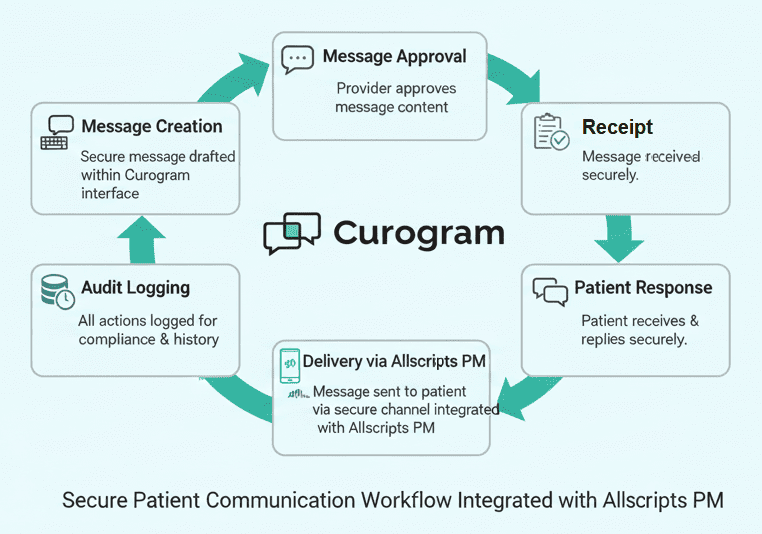
As an executive or IT leader, you are asked to make decisions that balance safety, cost, and patient experience. It is not enough for a solution to be secure. It also has to work in the real world for your staff and patients. HIPAA-compliant texting integrated with Allscripts PM touches all three of these areas. It offers benefits that are both strategic and practical.
One of your main concerns is whether a tool will hold up under real use. Secure messaging that works across providers, locations, and departments is vital. Curogram is designed to scale with enterprise needs while keeping messages in a protected environment. It supports compliance texting Allscripts enterprise organizations can rely on across many teams.
Instead of many separate apps, you have one structured channel for clinical and operational messages. Access controls, audit logs, and policy based templates help IT teams enforce standards without blocking care. As your organization grows or acquires new sites, you can extend the same communication model. This protects consistency and avoids the chaos of multiple unofficial tools.
Every year, expectations around privacy and security become stricter. Regulators, payers, and patients ask more detailed questions about how you manage communication. With Allscripts audit trail texting through a tool like Curogram, you have a clear story to present. You can show that messages are logged, protected, and aligned with written policies.
This stronger posture has ripple effects. It can help during risk assessments, contract negotiations, and insurance reviews. It can also support your internal culture. When staff see that leadership invests in proper tools, they take policies more seriously. Compliance becomes a shared practice instead of a list of rules taped to a wall.
Patients want timely, clear communication in formats they already use. Texting meets them where they are. When messages are fast, readable, and respectful, patients feel cared for before they even step into the clinic. Satisfaction surveys often reflect this feeling. People mention how easy it was to get information or ask a question.
From a business view, improved satisfaction reduces churn and supports reputation. Happy patients are more likely to return and to recommend your organization to others. While many factors affect satisfaction, communication is one of the few that you can improve quickly with the right tools. Compliance communication that is also patient friendly gives you a rare chance to raise both safety and experience at once.
Communication platforms often sit at the crossroads of several departments. Clinicians want ease of use. Operations wants efficiency. IT wants control and security. With HIPAA-compliant texting inside Allscripts PM, you can bring these interests closer together. Everyone works from the same system, even if they have different daily tasks.
Executives can set organization wide goals around response times, documentation, and message content. IT can ensure that the infrastructure and integrations support those goals. Clinical and front office teams can adapt their workflows without feeling that technology is in the way. This alignment is hard to measure on a single dashboard, but you can feel it in fewer conflicts and smoother projects.
Text based communication creates a rich source of data. You can see patterns in response times, common questions, and outreach effectiveness. When this data is linked to Allscripts PM, you can connect communication activity to scheduling, cancellations, and clinical outcomes. This gives leaders a deeper view of how small messages influence larger trends.
For example, you might discover that certain types of compliance communication reduce late cancellations. Or you might find that clarifying instructions before a visit reduces after hours calls. These insights allow you to refine templates and timing. Instead of guessing what patients need, you respond to real behavior. Over time, this makes your organization more agile and more grounded in evidence.
It can be helpful to look at a simple scenario. Imagine that your organization has a steady problem with no shows. Each missed visit represents lost revenue and wasted time. You decide to introduce HIPAA-compliant texting in Allscripts PM using Curogram to send clearer, more consistent messages before visits.
Over the next year, you estimate a 20 percent reduction in no shows based on your own data. If an average visit is worth a certain amount, you can multiply that by the number of saved appointments. The result is additional annual revenue that comes from better communication, not from increasing prices or adding more providers. This is only one part of the ROI, but it is easy to explain to stakeholders.
On top of these direct gains, you also reduce staff time spent calling patients about upcoming visits. You reduce the risk of miscommunication that leads to complaints. You may even see improved clinician satisfaction as schedules feel more stable. These softer gains matter, even if they do not fit neatly into a single financial line.
Start with a clear picture of where you are today. Map how staff currently send clinical updates, reminders, and follow ups. Note which tools they use and where protected health information might be at risk.
Next, identify a few high impact communication flows. These might include pre visit instructions, test result notifications, or follow up checks after complex visits. Ask how each of these flows could look if they were inside HIPAA-compliant texting in Allscripts PM. Involve clinical, operational, and IT voices in this discussion so that no group feels left out.
Finally, plan a small, controlled rollout with clear measures of success. You might track changes in no show rates, patient response times, or audit readiness indicators. Use what you learn to refine your approach and expand to other departments over time.
When you explore options for HIPAA-compliant texting, you want a platform that supports your goals instead of adding more complexity. Curogram is built around secure, two way messaging that connects directly to your daily workflows. It helps you reach patients quickly while keeping messages within a protected, audited environment.
With Curogram, you can design communication flows that match your policies. Templates can reflect your tone, your consent requirements, and your documentation needs. Allscripts audit trail texting records help you show that these messages are not random or informal. They are part of a deliberate, well governed communication strategy.
Compliant texting in Allscripts enterprise workflows are not only about avoiding penalties. They are also about making it easier for patients to understand you and respond. Secure, documented messages support clearer schedules, fewer misunderstandings, and better experiences.
You do not have to solve everything right away. Start with the places where poor communication hurts you most. Build small, stable improvements that respect both privacy and people. Over time, those choices will add up to a communication culture that you can feel proud of and confident in.
Interested to see exactly how Curogram makes compliance easy? Book a quick demo today.

Discover how Curogram’s HIPAA-compliant texting for InSync EMR improves compliance, efficiency, and patient satisfaction in behavioral health...

Learn how DrChrono users streamline patient communication with Curogram’s HIPAA-compliant texting solution.

Discover how Ramsoft radiology users reduce compliance risk, lower costs, and improve efficiency with Curogram’s HIPAA-compliant texting.