
1 min read
Improve Compliance & Efficiency w/ HIPAA-Compliant Texting in Ramsoft
💡 Compliant texting Ramsoft enterprise workflows helps your radiology network stay organized and protected. Many imaging centers struggle with...
9 min read
Clear written instructions reduce preventable cancellations.
HIPAA secure texting Exa workflows protect your imaging brand.
Audit-ready messaging supports internal and external reviews.
Executives get better visibility into risk and efficiency.
Curogram improves ROI with HIPAA-compliant texting in Exa. Strengthen your radiology communication strategy using the best healthcare messaging tech.
In a radiology group, so much of your work depends on messages. Patients need prep instructions for MRI and CT scans. Referring providers expect status updates and clear communication. Staff relay follow-up details and scheduling changes all day long.
When messages travel through personal phones or unsecured apps, you carry serious risk. Confusion or missed messages can lead to late arrivals, no-shows, and unhappy patients. On one side, you want to keep communication friendly and fast. On the other, you worry about HIPAA rules, documentation, and privacy.
This blog walks you through a clear path forward. First, we will look at the business risks that come from unsecure messaging. Next, we will see how to improve ROI with HIPAA-safe texting. By the end, you will find simple steps you can take to move to simple and secure patient communication.
When your team relies on unsecured messaging, the first risk is obvious. As we discussed in our HIPAA-compliant texting guide for Exa clinics, protected health information can leak outside approved systems. Staff may text prep instructions or exam details from personal phones because it feels faster. They might send images or report snippets through consumer apps. Each of these actions raises your exposure under HIPAA. If a device is lost or a screenshot is shared, your organization may need to treat it as a reportable event.
The second risk is harder to see but just as real. Without a central system, it is difficult to prove what was communicated. If a patient claims they never received exam prep instructions, you may not have a clear record of the message. If a regulator or legal team asks for evidence, you must search across phones and ad hoc notes. This slows down investigations and increases anxiety. Audit-ready messaging is almost impossible when every staff member uses a different tool.
These gaps also show up in your daily operations. When patients miss instructions that were shared informally, they may arrive unprepared. A patient who eats before a fasting MRI or skips lab work before a contrast CT often needs to be rescheduled. That lost slot is real money. You still carry the fixed cost of the scanner, technologist, and facility time, but you do not receive revenue for that appointment. Over a month or a year, these preventable cancellations add up.
There is also reputational risk. Patients who feel confused about prep or follow-up may blame your practice. If they receive mixed messages from phone calls, voicemails, and texts, they may feel that the process is chaotic. Some will share these frustrations with referring providers. Others will leave negative comments online about delays and miscommunication. This hurts future referrals and can be difficult to repair.
Finally, unsecure messaging strains your staff. They juggle multiple apps, write the same instructions again and again, and try to remember which patients they have already contacted. When there is no simple way to see conversation history in Exa, technologists and front desk teams must rely on sticky notes and memory. This increases the chance of missed follow-up, duplicated work, and burnout. In the end, you pay for unstructured communication through higher risk, lower revenue, and rising stress across the organization.
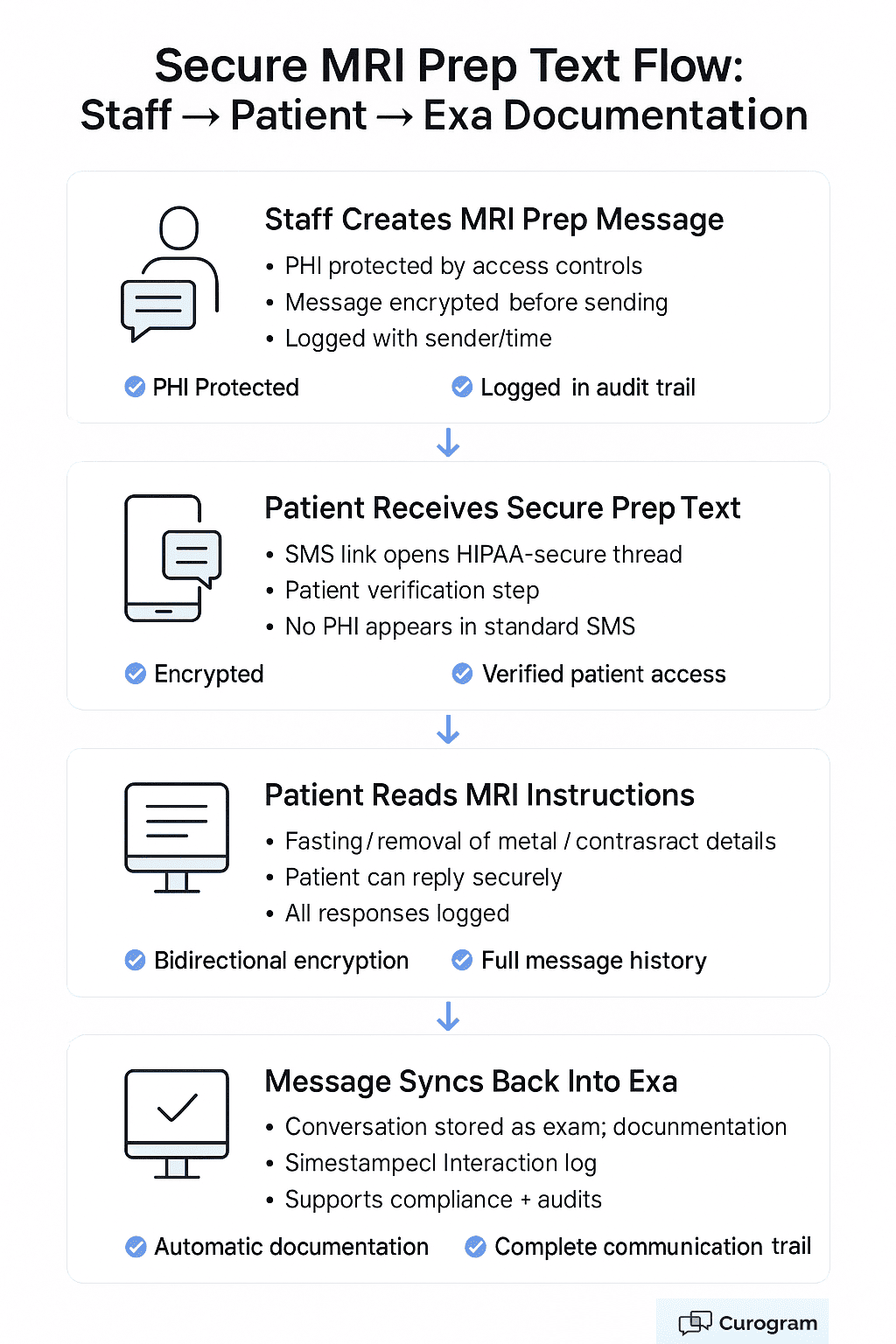
Curogram connects secure texting directly into your Exa workflows. Instead of staff using personal phones, all messages flow through a HIPAA-compliant platform. Each message is logged with time, date, sender, and receiver. This creates a clear audit trail that can be used for internal reviews or external audits. It also reassures your compliance team that PHI stays in approved channels.
When patients receive instructions through structured, written messages, they are more likely to arrive prepared. You can send clear information about fasting, contrast safety, and arrival time in a format they can read again later. Patients often refer back to these texts the night before or the morning of their exam. This reduces avoidable cancellations and reschedules that waste imaging capacity. Fewer same day changes mean more completed exams and more predictable revenue for your scanners.
Curogram also helps your staff recover time that used to be spent on repeated phone calls. Instead of calling each patient several times and leaving voicemails, your team can send secure messages that patients will actually read. Most people respond faster to a text than to a voicemail. This leads to quicker confirmation of details and fewer failed outreach attempts. Staff can then focus on the cases that truly require a call, such as complex prep or special safety concerns.
From a financial perspective, these changes support better ROI. You lower the chance of regulatory fines by moving away from unsecure communication. You protect revenue by reducing preventable cancellations related to missed or unclear instructions. You also decrease labor costs tied to repeated outreach and manual note taking. Over time, these gains compound. Compliance texting Exa radiology workflows become not only safer, but also more sustainable and cost effective.
Because communication is documented in one place, leaders gain a clearer view of operations. You can see how many patients received prep details, who asked follow-up questions, and where delays occur. This visibility supports smarter decisions about staffing, scheduling, and process design. It also helps you respond quickly to questions from legal, compliance, or executive teams. Instead of piecing together a story from scattered tools, you have a structured record ready to review.
When you are responsible for the health of a radiology organization, you think about more than single exams. You consider risk, reputation, and long term stability. Compliance texting in Exa for radiology touches all three. It gives executives and compliance officers a way to manage daily communication without losing sight of the bigger picture. By bringing messages into a secure, auditable system, you reduce uncertainty and gain better control over sensitive workflows.
One of the clearest benefits is a stronger compliance posture. HIPAA secure texting Exa workflows keep PHI inside approved channels, with technical safeguards and access controls. This reduces the chance that staff will rely on unapproved apps or personal devices. When an incident does occur, you have clear logs that show what was sent and when. This supports faster investigation and more accurate reporting. It also helps your organization demonstrate a culture of compliance during reviews and partner discussions.
Secure texting is not just about avoiding penalties. It also improves how your organization runs each day. Written messages reduce confusion, so patients arrive more prepared. This leads to fewer last minute changes and better use of scanner time. Staff do not have to repeat the same instructions on multiple calls. They can rely on templates that are reviewed and approved by compliance leaders. This creates a balance between safety and speed, which is often difficult to achieve with manual processes.
When patients follow prep instructions correctly, you can complete more exams on schedule. There are fewer gaps where a scanner sits idle because someone arrived without fasting or skipped necessary labs. These avoided cancellations translate into higher patient throughput. In a busy imaging environment, even a small improvement in completed exams per day can create meaningful financial impact over a year. It also allows you to serve referring providers more reliably, which protects long term referral relationships.
Audit-ready messaging gives leaders data they can use. You can track how often messages are sent, how quickly patients respond, and where follow-up is needed. This information supports more accurate forecasting and resource planning. For example, if many patients ask the same question about a certain MRI prep, you can adjust your standard instructions. If certain locations have more communication issues, you can provide targeted training. Instead of guessing, you base decisions on real communication patterns.
Executives and compliance officers also worry about how communication issues turn into legal or reputational problems. An unclear message can lead to a missed safety step. An unsecure app can create an unauthorized disclosure. With a structured platform, you reduce these risks. You can point to clear policies, approved templates, and reliable logs. This does not eliminate all issues, but it lowers the chance that a single misstep becomes a larger crisis. It also shows regulators and partners that you take privacy and security seriously.
Finally, secure texting supports growth. As you add new locations or expand modalities, you need communication tools that scale. Training every new team on ad hoc methods is slow and fragile. A standardized platform with built in guardrails is easier to roll out and monitor. It also improves the experience for patients who visit multiple sites. They receive consistent messages and do not have to adjust to different communication styles. This consistency is part of what makes a radiology network feel organized and reliable.
For executives and compliance officers, these benefits add up. You protect the organization from avoidable fines and investigations. You free staff to focus on high value work. You raise patient throughput and support future growth. Most importantly, you build a communication environment that fits the reality of modern radiology: complex, high stakes, and deeply dependent on clear, secure information flow.
To understand the impact of secure texting, it helps to look at a real world style scenario. Imagine a regional imaging network that operates several MRI and CT locations. Before using a structured platform, staff relied on phone calls and scattered texts to share prep instructions and follow-up information. Same day cancellations were common. Many patients arrived without fasting or skipped lab work. Leadership saw high scanner idle time in reports but struggled to connect it to specific causes.
The network implemented a secure texting solution integrated with Exa. They created standard templates for common exams, reviewed by compliance and medical leadership. These templates explained fasting, contrast safety, arrival time, and clothing guidance in simple language. Patients received messages several days before their appointment and again closer to the exam. All communication was logged, with time stamps and delivery status visible to staff and managers.
Over the next year, the imaging network tracked results. Cancellations related to missed prep decreased, so more exams were completed as scheduled. Each completed exam represented revenue that would have otherwise been lost. At the same time, the network avoided several potential HIPAA incidents by moving away from personal devices. When questions about communication arose, leaders could pull a full message history rather than searching individual phones. With fewer preventable issues and more completed exams, the organization estimated that it saved around $250,000 annually through a combination of recovered revenue and avoided compliance exposure.
First, map out where your current messaging practices create the most risk or waste. It may be prep instructions for contrast exams, follow-up questions after MRI results, or coordination between locations. Talk with staff who manage these workflows each day. Their insight will show you where secure, audit-ready messaging can help first.
Next, work with compliance and clinical leaders to define approved message templates. Keep language simple and clear. Make sure patients know what they need to do, when, and who to contact with questions. Once templates are in place, integrate secure texting with your Exa environment so staff can send and review messages without jumping between many tools. Train a small group of users, gather feedback, and refine your process before expanding to more sites or modalities.
As you see results, share them with executives and compliance officers. Highlight changes in cancellations, staff workload, and incident reports. This will help build support for broader adoption. When you are ready to explore a full solution, you can move from pilot to system level change. Protect compliance and efficiency with HIPAA texting in Exa. Book your demo today.
Curogram is built to support high stakes communication in healthcare, especially in imaging environments that rely on Exa. Instead of forcing staff to choose between speed and safety, it gives them a secure way to text patients and referring providers within clear guardrails. Messages are encrypted, logged, and easy to review. This makes audit-ready messaging part of everyday work rather than a special project that only appears during an incident.
For your staff, this means fewer difficult decisions in the moment. They do not have to wonder if a personal phone is acceptable for a quick update. They can rely on templates and tools that compliance leaders have already approved. For patients, it means clearer written instructions and a consistent experience across locations. They receive messages that match what they hear in person, which helps them feel more confident and prepared.
For executives and compliance officers, Curogram offers something just as important: visibility. You can see how communication flows, where delays occur, and how patients respond. You can address small issues before they become larger problems. When you think about compliance texting Exa radiology workflows at scale, this blend of security, clarity, and insight is what helps your organization stay steady in a complex, regulated field.
HIPAA-compliant texting in Exa gives you a clear path toward safe communications. With secure, documented messages, you protect PHI and have complete documentation. Patients receive instructions they can read again. Staff spend less time repeating the same details and more time solving real problems.
Thinking about where to invest your next improvement effort? Secure texting is a practical place to start. It does not require a complete rebuild of your imaging operations. It simply replaces ad hoc communication with a system designed for regulated environments. Curogram can be your partner in this effort.
Want to make secure two-way texting the new standard in your patient communications? Book a quick demo with us and we'll show you how.

1 min read
💡 Compliant texting Ramsoft enterprise workflows helps your radiology network stay organized and protected. Many imaging centers struggle with...

1 min read
💡 HIPAA-compliant texting that works with InSync protects enterprise clinics from compliance risks. Manual communication also slows work and drains...

1 min read
💡 You can ensure healthcare compliance with secure texting in Allscripts enterprise workflows. Protect your patients' data and increase...