
Curogram swaps five good answers for one proven sequence. Patients confirm, cancel, or rebook by reply. Each two-way confirmation writes back to the AdvancedMD schedule. One policy runs everywhere, and every office still gets its own report.
Groups on the governed sequence hold no-shows 53% below the industry average. They can also prove which setup earned it.
Your quarterly operations meeting has a regular guest. It shows up under a different name each time: patient experience, front desk workload, schedule density. The argument underneath is always the same one.
Reminders.
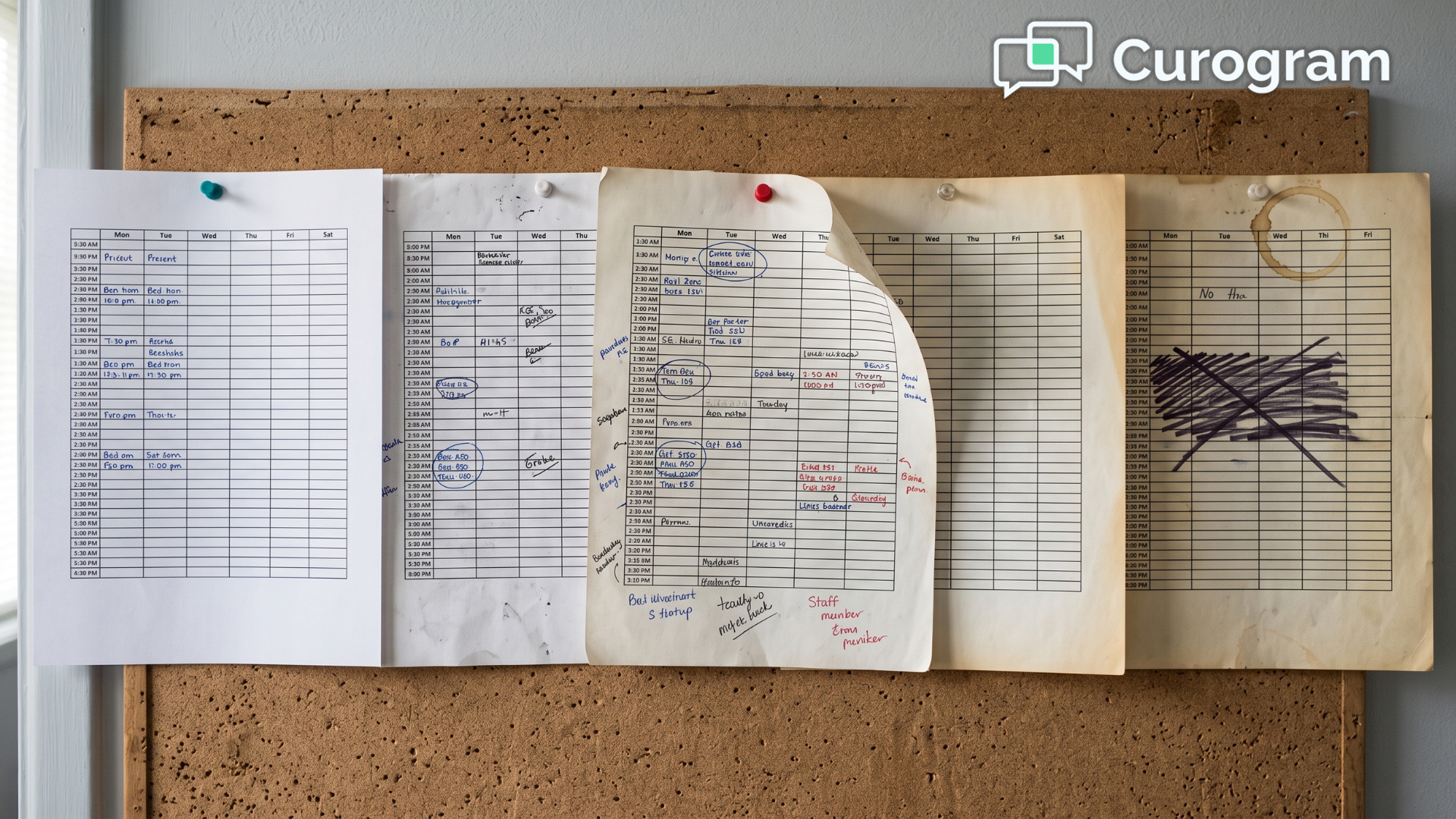
Summit says patients want a text three days out. Lakewood swears by two days plus a call the morning of. Riverside sends email first, then SMS. All three built those rules inside the same AdvancedMD instance.
Every administrator can explain their choices. Not one of them can prove the choices work better than the office just down the road.
Here is what makes this so frustrating. Nobody did anything wrong. Each setup was built by a capable person who thought hard about their patients, their providers, and their walk-in traffic.
The setups are thoughtful. They are also completely incompatible.
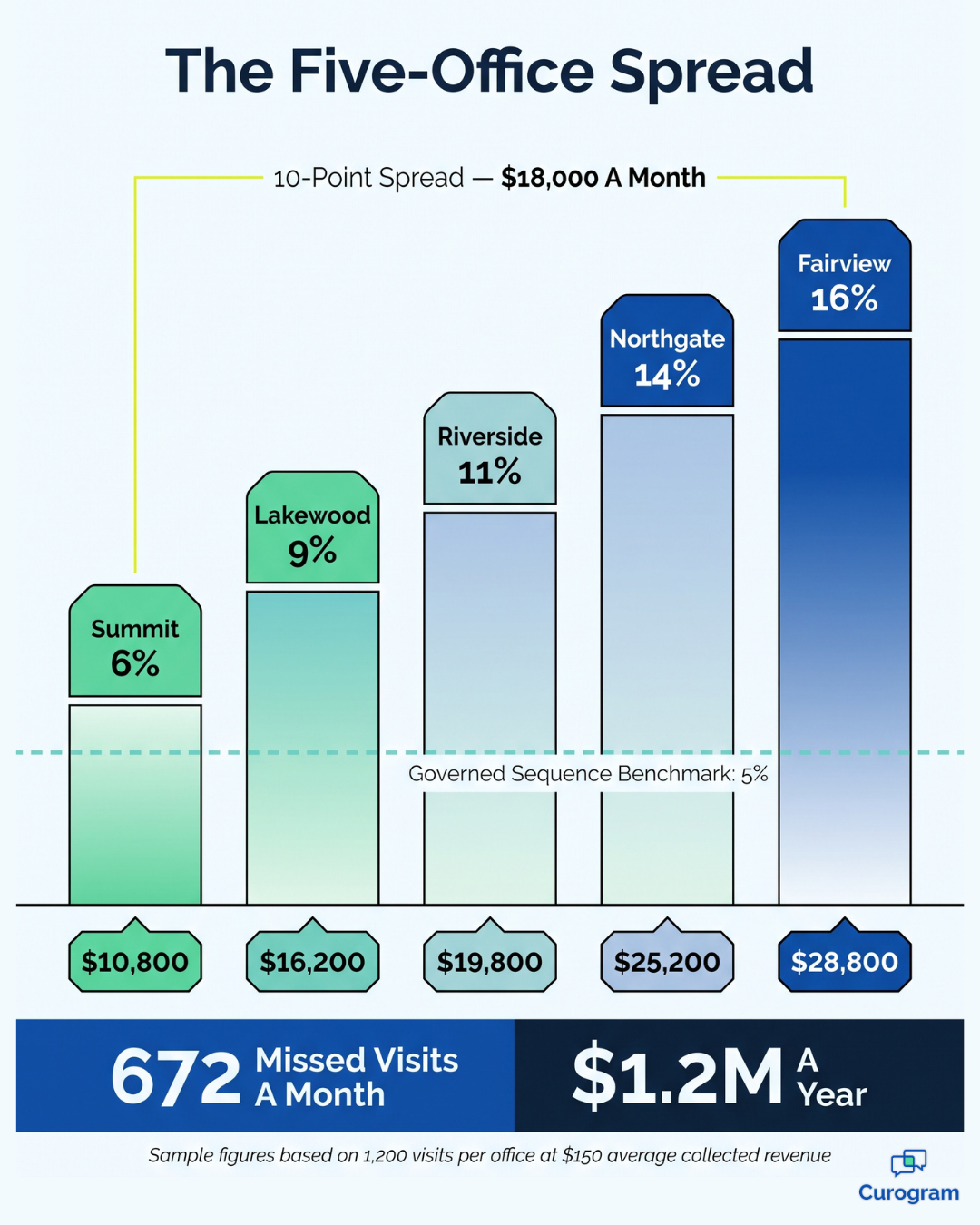
The schedule shows it. Your best office runs a 6% no-show rate. Your worst runs 16%. That is a ten point spread inside one group, on one system, serving one patient population.
Ten points is not a rounding error. It is open slots, lost revenue, and patients who never got the care they came for.
The strange part is that nobody can say why. Your team does not lack talent. Nothing in your stack compares the five setups to each other.
You have five reports that each describe one office. You have no report that ranks them.
So the meeting ends the way it started. Everyone keeps their configuration. The gap survives another quarter.
This is fixable, and it does not mean taking control away from your administrators. It means giving the group one sequence with proof behind it, then measuring every location against that standard.
Here is how that gap forms, what it actually costs you every month, and how to close it without a year-long project.
Five Smart Setups, One Expensive Gap
AdvancedMD gives you real room to configure reminders. That flexibility is a feature. It turns into a liability the moment five offices use it in five directions and nobody compares the results.
Call it configuration sprawl in patient communication. It is not neglect. It is the opposite. Sharp groups drift faster than sloppy ones, because every office has someone capable enough to build something custom and defend it in a meeting.
The drift hides well. AdvancedMD reminder configuration variance never throws an error. It surfaces months later as no-show variance by office, and by then nobody remembers which change caused what.
Run the math on a five-office group. The figures below are a sample, so swap in your own.
Assume 1,200 scheduled visits per office each month and $150 in average collected revenue per visit.
| Office | No-show rate | Missed visits per month | Monthly revenue lost |
|---|---|---|---|
| Summit | 6% | 72 | $10,800 |
| Lakewood | 9% | 108 | $16,200 |
| Riverside | 11% | 132 | $19,800 |
| Northgate | 14% | 168 | $25,200 |
| Fairview | 16% | 192 | $28,800 |
| Group total | 11.2% | 672 | $100,800 |
That is roughly $1.2 million a year walking out the door. Look at the spread inside it. Fairview loses about $18,000 more every month than Summit does, with the same EMR, the same group, and a different reminder setup.
In practice, this means the answer is already sitting in your own data. One of these offices found something that works. You simply cannot see which one.
So the meeting produces opinions instead of decisions. And the variance lives to see another quarter.

The Fix Is a Policy, Not Another Setting
You do not need a sixth configuration. You need a layer above the ones you already have. Think of it as a group-wide reminder policy that every office runs the same way, with room for the details that genuinely differ from one location to the next.
That is the job Curogram does. It sits on top of AdvancedMD as a policy engine for reminders: One sequence, enforced everywhere, measured per office.
One Sequence, Locked Where It Counts
Your administrator sets the cadence and the core message once, for the whole group. Offices keep control of approved variables like provider names, parking directions, and language options.
Local flavor survives. Drift does not. And nobody has to rebuild a reminder tree from scratch again.
Confirmations That Land in the Schedule
Curogram reminders are two-way. Patients reply to confirm, cancel, or ask to rebook, and that reply does not sit in an inbox waiting for someone to read it. The two-way confirmation writes back to the AdvancedMD schedule, so your front desk works from live status instead of guesswork.
That difference matters more than it sounds.
A one-way reminder tells you a message went out.
A two-way reminder tells you a patient is coming. Curogram clients average confirmation rates above 75%.
Reporting That Settles Arguments
Reminder governance for power users lives or dies on measurement. Per-office reporting puts response rates, confirmation rates, and no-show rates side by side in a single view.
For your team, that means the standard gets set by results rather than by whoever argues hardest. Data is a much faster tiebreaker than seniority.
What Changes When Every Office Runs One Sequence
Atlas Medical Center cut no-shows from 14.20% to 4.91% in three months on an automated two-way sequence. That is roughly 3X better than the industry average.
More to the point, it becomes a benchmark your newest location inherits on day one instead of spending two years discovering on its own.
Apply that result to the five-office group above and the picture shifts quickly:
- Group no-show rate falls from 11.2% to roughly 5%
- Missed visits drop from 672 a month to about 300
- Recovered revenue lands near $55,000 a month, or about $670,000 a year
- The gap between your best and worst office nearly closes
That last line is the one that changes your meetings. When every location runs the same sequence, the spread stops being a mystery and becomes a metric you can act on.
Curogram groups hold no-shows 53% below the industry average, and the slots they recover typically lift revenue by 10% to 20%.
There is a quieter benefit too. The schedule starts meaning the same thing everywhere. A confirmed appointment at Fairview means exactly what a confirmed appointment at Summit means.
That consistency has a knock-on effect. Staffing calls, overbooking decisions, and same-day slot offers all rest on the same footing. A regional manager can compare two locations without first translating between two reminder philosophies.
Let the Numbers End the Argument
Sophisticated variance is still variance. Five thoughtful setups are not five strategies. They are one missing policy, spread across five buildings.
Try a simple exercise before your next leadership meeting. Pull last quarter's no-show rate for every location and line them up in a single column. Do not adjust for patient mix or provider count yet. Just look at the spread.
That number is the price of an argument nobody could win. Multiply the gap between your best and worst office by your monthly visit volume and your average visit value. What you get is the annual cost of not having a standard.
Then ask the harder question. Which office earned the best rate, and what exactly are they doing differently? If nobody can answer that with numbers, it is not a people problem. It is a measurement problem, and measurement problems get fixed.
The good news is that this one gets fixed faster than most groups expect.
AdvancedMD runs your practice: scheduling, billing, charting, the engine underneath everything you do. Curogram handles the conversation that happens before the visit. One governed sequence, patients confirming by reply, statuses flowing back to the schedule, and reporting that shows which location is winning and by how much.
You already have capable administrators and a system that can support them. Give them one standard to run and honest numbers to work from, and most of this resolves inside a single quarter.
Schedule a demo and we will build your group-standard sequence with you. You will see confirmations flowing into a live AdvancedMD schedule and per-office reporting built around your actual locations, not a generic sample.
Frequently Asked Questions
Yes, within guardrails. Your administrator locks the cadence and the core message content for the group. Each office keeps control of approved variables like provider names, parking and directions, and language options. Local detail survives. Uncontrolled drift does not.
Two things: governance and proof. Instead of five separate configurations that nothing compares, you get one enforced group standard with true two-way confirmation and per-office performance reporting. Patient replies write back to your AdvancedMD schedule, so the front desk sees live status rather than a send log.
Yes. Curogram is HIPAA compliant and SOC 2 certified, manages consent and opt-outs automatically, and keeps reminder content compliant by template design. Under the FCC's April 2025 rule, practices must honor plain-language opt-out requests, not only keyword replies. Curogram handles those revocations automatically across every location.
Most groups design the standard sequence in a single working session and go live location by location over a few weeks. The heavy lift is agreement, not configuration. Once the sequence is approved, applying it to a new office is a setup task rather than a rebuild.
Then you approve an exception, and you measure it. The point of governance is not that variation is banned. It is that variation is deliberate, documented, and reported against the group benchmark. If the exception outperforms the standard, it becomes the new standard.