
Why a Unified Data Model for Healthcare Equates to Better Patient Care
See how unified data helps healthcare practices give providers the full chart, stop retyping intake forms, and send reminders that match each...
9 min read
A telemedicine tool that can't read your schedule isn't saving your practice any work. It moves the work.
That's the trap most practices fall into when they add virtual visits. The video platform gets picked first, usually because someone already knows how to use it.
Then the front desk discovers that every patient has to be added by hand, every cancellation has to be entered twice, and intake still arrives on paper.
Connecting eClinicalWorks to Curogram closes that gap. Your patient list and appointment calendar stay in eClinicalWorks, where your staff already works. Curogram reads both, and everything patients touch runs off that same data.
The difference shows up fastest in the schedule. Atlas Medical Center brought its no-show rate down from 14.20% to 4.91% in three months, based on our internal data. That's roughly two-thirds of its empty slots recovered, and none of it required a new charting system or a second calendar.
What makes it work is that patients answer texts. Covina Arthritic Clinic confirms more than 1,100 appointments a month this way. Each of those is a call nobody placed, a voicemail nobody returned, and a slot that didn't sit open.
The rest of this covers what actually moves when the two systems connect: which patient and appointment fields flow across, and how secure 2-way texting handles intake, payments, and lab results.
Yes, if virtual visits are part of how you plan to grow. eClinicalWorks already holds your patient records and your schedule. A telemedicine tool that can't read either one puts your staff back to copying data by hand.
Curogram connects to your patient database and schedule of record inside eClinicalWorks. Your team keeps booking, charting, and checking in patients exactly where it always has. Video visits, texting, and intake forms run on top of that same data.
The payoff shows up in the schedule. Atlas Medical Center brought its no-show rate down from 14.20% to 4.91% in three months, based on our internal data. Slots that used to sit empty get filled and billed.
Skip the integration and three tasks stay manual:
| Task without an integration | Where the time goes |
|---|---|
| Adding patients to a separate video or texting tool | Phone numbers and birth dates re-keyed for every new patient, then again when a number changes |
| Handling a cancellation | Updated once in eClinicalWorks, then again in the second system |
| Collecting intake answers | Paper at the front desk, typed into the chart after the visit |
A standalone video tool covers the visit itself and nothing around it. Patients who want to text a question, book online, or fill out their forms before they arrive get pointed back to the phone. That's the front desk absorbing calls the software should have handled.
Most of what changes is administrative work your staff does by hand today. Intake, scheduling, and follow-up all move to text.
Electronic patient intake forms go out by text before the visit. Patients type their own history, insurance, and pharmacy details on their phone. Nothing arrives as handwriting your front desk has to decipher, which removes a common source of transcription errors.
Online appointment scheduling writes bookings to your eClinicalWorks calendar, so there's no second schedule to reconcile at close.
| Paper task today | What replaces it |
|---|---|
| Clipboard and pen at check-in | Intake form texted before the appointment |
| Front desk retyping handwritten forms | Answers submitted digitally, ready for eClinicalWorks |
| Logbook or printed daily schedule | Bookings posted straight to your eClinicalWorks calendar |
Phone volume drops first. Patients book, reschedule, or cancel by text, so those calls never reach the front desk at all.
Covina Arthritic Clinic confirms more than 1,100 appointments a month this way, based on our internal data. Every one of those is a call your staff didn't have to place or answer.
Manual data entry falls at the same time, since Curogram updates eClinicalWorks and nothing gets typed twice. That returns two things at once: hours back to your staff, and slots that would have gone empty. Practices that cut their no-show rate see a 10% to 20% revenue lift, based on our internal research.
Distance stops being the reason a patient skips a follow-up. A patient 40 miles out can keep a medication check over video instead of taking half a day off work. Exams that need hands on the patient still happen in the office; results reviews and follow-ups often don't require the trip.
Secure 2-way texting covers the care that happens between visits. Your staff can send lab results, confirm the next consultation, or check on a patient partway through treatment. Patients answer on the same thread, so the full exchange stays in one place instead of scattered across voicemails and callback slips.

Setup starts with a data pull. Curogram reads your eClinicalWorks schedule and patient list in minutes, then stays current as your team books and edits records. Texting runs off that same data, so no one builds a contact list by hand.
Auto-imported from eClinicalWorks:
| Patient details | Appointment details |
|---|---|
| Name | Appointment types |
| Date of birth | Appointment times |
| Providers | |
| Phone | Locations |
Add a new patient in eClinicalWorks and they're reachable by text without a second entry anywhere. Correct a phone number there and Curogram sends to the corrected one.
Training is short. Most staff are sending secure texts in under 15 minutes, because the screen works like the messaging app on their phone. Pick the patient, type, send.
A 2-way HIPAA-compliant texting system handles the exchanges that used to need a phone call. Patients answer on their own time, and the whole thread stays in one place.
Take a patient who has to fast before a checkup. Text the instructions the night before and the patient reads them when they're free. No voicemail, no callback, no front desk chasing anyone down.
What your team can send and receive on the same thread:
| Use | What the patient gets |
|---|---|
| Patient onboarding | A welcome text with what to bring and where to park |
| Patient intake forms | A link to fill out history and insurance before arriving |
| Payment links | A balance and a way to pay from the phone |
| Appointment information | Date, time, provider, and prep instructions |
| Prescription details | Refill status and pickup confirmation |
| Lab orders | Where to go, when, and whether to fast |
Templated responses cover the questions that come in every day. Your staff picks a saved reply instead of retyping it, which cuts both the typing time and the risk of sending a message to the wrong patient.
Messages can also route by type, so billing questions land with billing and clinical questions land with the nurse.
Internal messages work the same way. Your team can open a group chat and discuss a patient without moving protected health information (PHI) into a personal texting app, since Curogram is HIPAA compliant.
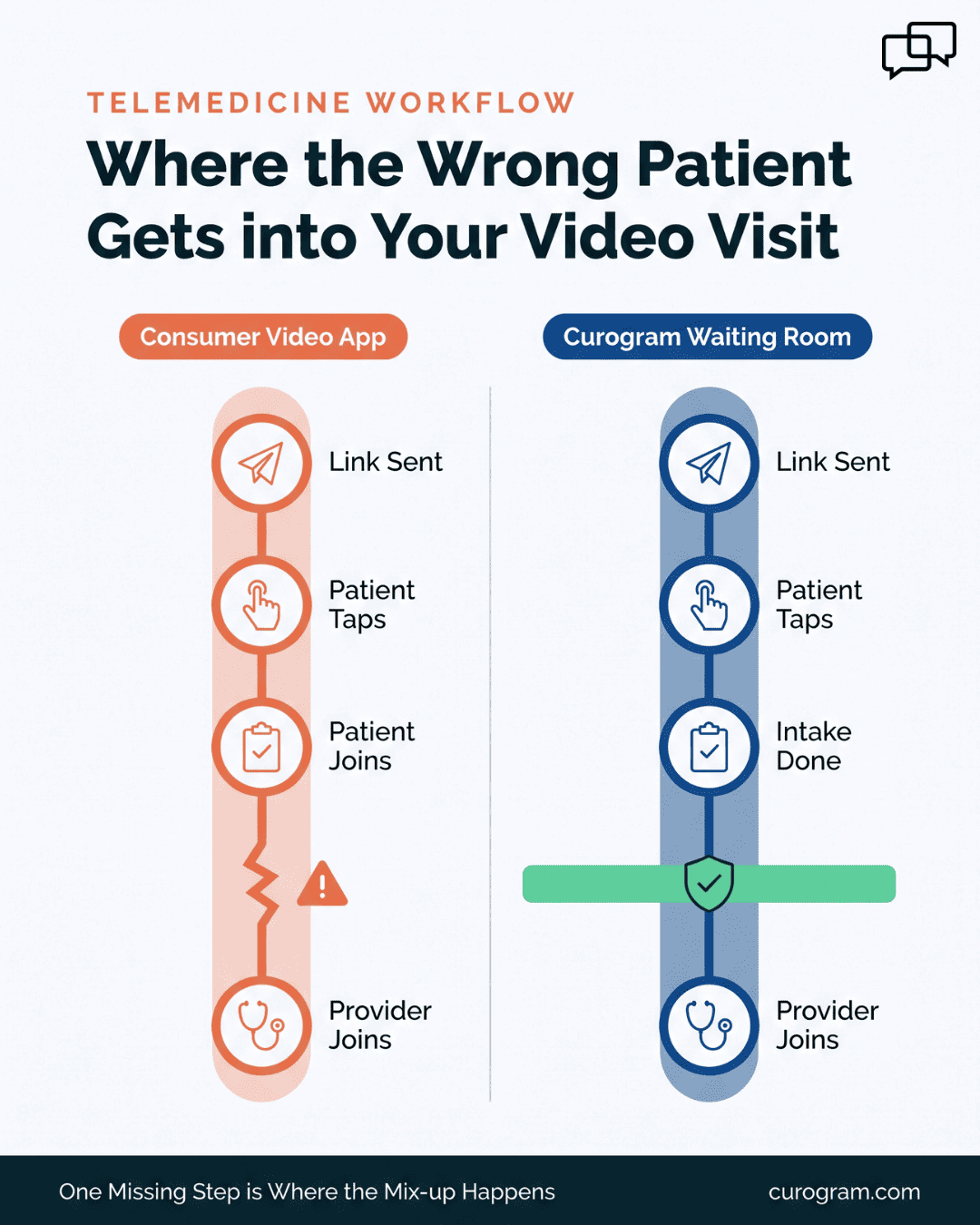
Video visits start on this same thread. The appointment link arrives by text, the patient taps it, and they land in the virtual waiting room.
The virtual waiting room does what the front desk does in person. Nobody reaches the provider until check-in is finished.
Your staff can set the view to show only patients who have completed intake. A provider opening the room sees a cleared list, so no visit starts before the paperwork is done.
How a patient gets from a text to the exam:
If you use Facetime or Zoom for telemedicine appointments, mix-ups occur often. Neither app has a waiting room, so the provider joins a call with whoever dials in first. There's no gate between the link and the visit.
Training is short because the layout matches how your office already runs. Staff read a queue, check who's ready, and send the next patient back. Most pick up the waiting room and features like smart text reminders in 15 to 20 minutes.
Reminder timing shouldn't be the same for both visit types. A video visit needs a nudge minutes before it starts. An office visit needs lead time to drive, park, and check in.
| Visit type | When the reminder goes out | Why that timing |
|---|---|---|
| Virtual | 15 minutes before the start | Prep is short. The patient just needs the link in hand. |
| In-person | Day before and day of | Time to arrange a ride, take off work, or arrange child care |
There's no cap on how many reminders one patient can get. Set two, set four, set them at whatever intervals your no-show pattern calls for, all from the eClinicalWorks schedule Curogram already reads.
Patients reply on the same thread to reschedule. That reply reaches your staff as a text rather than a voicemail, so the slot gets refilled the same day instead of sitting open.
The confirmations do the work. Curogram practices see appointment confirmation rates above 75%, based on our internal data. Atlas Medical Center used those confirmations to bring its no-show rate from 14.20% down to 4.91% in three months.
Reminders handle the appointments already on the books. Online booking handles the ones that aren't yet.
Booking by phone burns two people's time for one appointment. Your staff offers a slot, the patient checks with work, someone leaves a voicemail, and the schedule gets typed in by hand afterward. Rescheduling starts the same loop over.
| Step | By phone | Online |
|---|---|---|
| Finding an open slot | Your staff reads options aloud, patient calls back | Patient sees the live calendar |
| Booking it | Typed into eClinicalWorks after the call | Written to eClinicalWorks on submit |
| Rescheduling | A second call, then a second manual edit | Patient picks a new slot themselves |
| Who is tied up | Front desk, for the length of the call | Nobody |
Patients book from a phone, tablet, or computer, at whatever hour suits them. Someone who realizes at 10 p.m. that they need a follow-up doesn't wait until morning to call.
Changes write back to eClinicalWorks on their own. Your staff doesn't retype a canceled slot or catch a double-booking after the fact.
Setup runs on Curogram's side, not yours. Your staff keeps working in eClinicalWorks while the connection is built, and there's no server to install or IT project to schedule.
The method reaches every kind of EHR: apps, cloud systems, on-site servers, and browser-based platforms. Curogram also connects with AdvancedMD, Cerner, PrimeClinical, and Kareo so a practice running more than one system isn't stuck.
Once the connection is live, your eClinicalWorks schedule and patient list flow into Curogram, and texting starts from there.
Most practices don't need a second system. They need the one they already run to reach patients where patients actually respond, which is a text message.
That's the whole case for connecting Curogram to eClinicalWorks. Your schedule and patient list stay where they are. Intake, reminders, payments, and video visits run off that same data, so your front desk stops retyping what the chart already holds.
The schedule shows it first. Atlas Medical Center brought its no-show rate from 14.20% down to 4.91% in three months, based on our internal data. Practices that cut no-shows that way see a 10% to 20% revenue lift, based on our internal research.
Staff feel it in the phone queue. Covina Arthritic Clinic confirms more than 1,100 appointments a month by text. Those are calls nobody places, voicemails nobody returns, and slots that don't sit empty.
None of this asks your team to learn a new charting system. It asks them to stop doing work the integration can do.
Book a demo to see Curogram running against a live eClinicalWorks schedule, with your own appointment types and reminder timing.
See how unified data helps healthcare practices give providers the full chart, stop retyping intake forms, and send reminders that match each...
-featured.png)
Learn what clinic workflow management is and why it matters. Discover challenges, tools, and strategies to improve efficiency and patient experience.
 Carylee Gali : 2/8/22, 6:12 AM
Curogram integrates with Practice Fusion and all other electronic health records (EHR) programs. Discover the benefits of HIPAA-compliant two-way...