
Is Texting HIPAA Compliant? Everything You Need to Know
Is texting HIPAA compliant? Uncover rules, privacy concerns, and tips for safe communication with patients while staying secure.
9 min read

Two texts remind a patient about the same appointment.
The first says: "Hi John, you have an appointment on January 25 at 2 PM. Reply YES to confirm." The second says: "John Smith, your cardiology visit for your coronary artery disease is January 25 at 2 PM."
The first is a helpful nudge, but the second could be a HIPAA violation.
That's the delicate balance every practice manages today. Patients expect to hear from you between visits, whether it's a reminder, a quick answer, a lab update, or an easy way to pay. Practices that meet those expectations see fewer no-shows and more loyal patients.
But every one of those touchpoints depends on patient information. Names, phone numbers, test results, and billing details move between your team and your patients every single day. Each message is a chance to build trust, or to expose information the law requires you to protect.
That's why patient engagement and HIPAA compliance can't be treated as separate projects. One is how you connect with patients, and the other is the set of rules for doing it safely.
When they're managed separately, gaps appear: a staff member texts a lab result from a personal phone, someone answers a question through a free messaging app, or a billing notice includes a diagnosis.
None of these mistakes feel serious in the moment, yet together they create real risk for your patients and your practice.
Staying compliant doesn't mean engaging less; it means engaging with better habits and smarter tools.
In this guide, you'll learn exactly what patient engagement covers and why HIPAA applies to almost all of it. You'll also get practical steps for protecting patient data, see what separates a safe message from a risky one, and learn how to choose software that supports both goals.
Patient engagement is a way of delivering care that invites patients to take an active role in their own health. The more involved patients are, the better their outcomes tend to be. Your practice benefits too, with smoother operations and lower costs.
In day-to-day terms, patient engagement includes activities like:
Each of these turns a one-way visit into a two-way partnership.
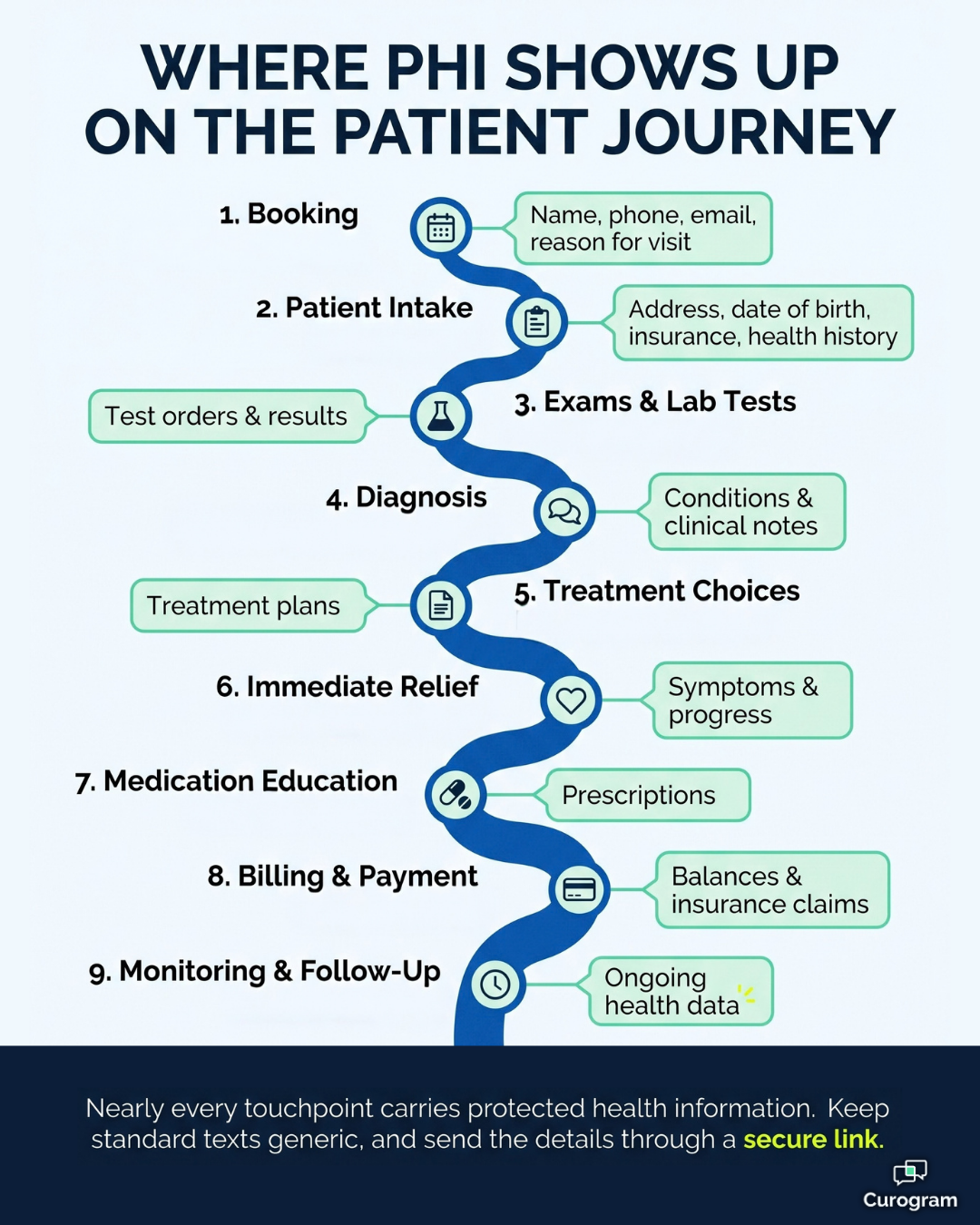
Engagement starts the moment a patient finds you online and books a visit. From there, it carries through every stage of care. As you scan the table below, notice how much patient data each stage touches.
| Journey Stage | Engagement Touchpoint | Patient Data Involved |
|---|---|---|
| Booking | Online scheduling and confirmations | Name, phone, email, reason for visit |
| Patient intake | Digital forms and insurance checks | Address, date of birth, insurance, health history |
| Exams and lab tests | Prep instructions and result updates | Test orders and results |
| Diagnosis | Follow-up conversations | Conditions and clinical notes |
| Treatment choices | Education materials and shared decisions | Treatment plans |
| Immediate relief | Check-ins after the visit | Symptoms and progress |
| Medication education | Refill reminders and dosing guidance | Prescriptions |
| Billing and payment | Statements and payment links | Balances and insurance claims |
| Monitoring and follow-up | Recall reminders and ongoing check-ins | Ongoing health data |
Each stage is a chance to give patients a smooth, pleasant experience. Patients who feel cared for, not just treated, are the ones who stay with your practice and refer friends and family.
But the table also shows the catch. Nearly every touchpoint involves information that HIPAA protects.
Patient engagement strategies succeed only with the effective use of appropriate and available patient information.
In medical practices, engaging patients usually involves their identifying information, such as:
This information is what HIPAA categorizes as PHI, which is what the law principally protects from unauthorized access, misuse, and abuse by cybercriminals. PHI is vulnerable to these attacks because patient engagement strategies are more effective with creating, storing, and sharing electronic data over the internet.
As a federal law, HIPAA provides mechanisms for how covered entities, such as healthcare providers, health plan providers, and healthcare clearinghouses, must handle PHI. The HIPAA Privacy Rule covers the safeguards in disclosing PHI by the covered entities when providing high-quality patient care without compromising privacy. The HIPAA Security Rule expands protection coverage when covered entities transmit PHI electronically (ePHI), such as during patient engagement activities.
Violating HIPAA and its rules costs responsible parties penalties or criminal charges. The United States Department of Health and Human Services (HHS) receives HIPAA violation complaints and submits any available data to state attorneys to prosecute violators.
It is imperative that medical practices and all covered entities establish the necessary administrative, physical, and technical safeguards to keep ePHI from falling into the hands of criminals, endangering patient safety and business. HIPAA compliance is a must in patient engagement.
Engaging patients while keeping their information safe can feel like a balancing act. It doesn't have to be hard. Once you know how to handle ePHI at each touchpoint, compliance becomes part of your routine instead of an extra chore.
Compliance starts with awareness. Your staff sends the reminders, answers the questions, and handles the records. The better they understand HIPAA and your security tools, the fewer mistakes they'll make.
Make training a regular event, not a one-time onboarding task. Cover what counts as PHI, which channels are approved for what, and how to spot risky requests. A well-trained team protects your patients, your reputation, and your growth.
Under HIPAA, covered entities are generally expected to:
The three measures below help you meet those goals.

Before you start texting or emailing patients, ask how they want to be contacted and record their answer. You can collect consent on the intake form, before a virtual visit, or through a text or email opt-in. Paper signatures and recorded phone approvals still work too.
Clear records protect you if questions come up later. They also respect your patients' choices about how they hear from you. Other laws, like the Telephone Consumer Protection Act, may also require consent for texts, so one clear process helps you cover both.
Only authorized staff should be able to open patient files. And when you share information with patients, only they should be able to see it. Passwords, PINs, two-step login, and biometric checks all help block unauthorized access to your files and network.
Limit access by role, too. A scheduler at the front desk may not need to see full clinical notes. The fewer people who can reach PHI, the smaller your risk.
Encryption scrambles data so that only approved users can read it. It protects files, networks, and messages even if another security layer fails. It also helps when patients don't secure their own phones or computers well.
Standard SMS and regular email are not encrypted. So the safest approach is to keep those messages generic and move sensitive details to an encrypted channel.
Here's what that looks like in practice:
| Message Type | Safe for a Standard Text | Needs Encrypted Messaging |
|---|---|---|
| Appointment reminder | "Hi John, you have an appointment on Jan. 25 at 2 PM. Reply YES to confirm." | "John Smith, your cardiology visit for coronary artery disease is Jan. 25 at 2 PM." |
| Test results | "You have a secure message from XYZ Family Practice. Tap the link to verify your identity and view it." | "Your blood sugar result is 140 mg/dL. Call your doctor." |
| Billing | "You have a balance due of $50. Tap the secure link to view and pay." | "John Smith, your bill for diabetes treatment is $200." |
| Prescriptions | "Hi John, your prescription is ready for pickup." | "John Smith, your Lisinopril (10 mg) is ready for pickup." |
The pattern is easy to remember. If a stranger reading the message would learn something about the patient's health, it belongs behind a secure link.
|
Compliant software gives you the safeguards, such as encryption, access controls, and secure messaging. But your team still decides what goes into each message and which channel it uses. Even the best platform can't stop someone from typing a diagnosis into a standard text. Before you use any tool that stores or sends PHI, sign a business associate agreement (BAA) with the vendor. Then pair that tool with clear message templates and regular training. That combination, not the software alone, is what keeps your practice compliant. |
The safeguards above add strong layers of protection. But setting them all up on your own is a heavy lift for a busy practice. It's also tempting to grab a popular free app for quick patient messages, and many of those apps don't meet HIPAA standards.
Purpose-built software closes that gap. When you compare options, look for:
Curogram brings these pieces together in one patient engagement platform. Your team can use 2-way texting with patients and personalized appointment reminders for everyday outreach. When a message needs to include PHI, Curogram's encrypted messaging and secure links keep it protected. A built-in rating system also helps you collect patient feedback.
The results show up fast. Text messages see a 98% open rate, so your reminders actually get read. Curogram practices see no-show rates 53% below the industry average, and Atlas Medical Center cut its no-show rate from 14.20% to 4.91%.
What does that mean for your schedule? Here's an illustrative example.
A practice with 400 appointments a month and a 14.2% no-show rate loses about 57 visits. At 4.91%, that drops to about 20. That's roughly 37 more patients seen every month.
Patient engagement isn't optional anymore. Patients expect reminders, quick replies, easy payments, and updates between visits. Practices that deliver those touches keep more patients, fill more appointments, and build stronger relationships over time.
But every touchpoint carries patient data. That makes patient engagement and HIPAA compliance two parts of the same job. You can't do one well while ignoring the other.
The good news is that the steps aren't complicated. Train your team so everyone knows what counts as PHI and where it can go. Record patient consent and patient communication preferences.
From there, lock down access with identity checks and role-based permissions. Encrypt anything sensitive, and keep standard texts generic. When in doubt, send a secure link instead of the details.
Most of all, remember that compliance is shared. Your software provides the safeguards, but your people and processes decide how they're used. When both are in place, you can reach patients quickly without second-guessing every message.
That's where the right platform makes a real difference. Instead of juggling free apps, personal phones, and manual workarounds, your team works from one secure system.
Everyday reminders go out by text. Results, records, and bills move through encrypted links. Your staff spends less time worrying about risk and more time caring for patients.
Curogram was built for exactly this balance. It gives medical practices 2-way texting, automated reminders, secure messaging, and patient feedback tools in one HIPAA-compliant platform. You get the reach of text messaging with the protection your patients' information deserves.
Ready to see how it could fit your practice? Book a demo to explore Curogram's secure patient messaging tools. A short walkthrough will show you how your team can engage patients more often, with less risk, and with the peace of mind that every message is handled the right way.

Is texting HIPAA compliant? Uncover rules, privacy concerns, and tips for safe communication with patients while staying secure.

 Aubreigh Lee Daculug : 10/6/26, 10:00 AM
What HIPAA actually requires of a texting vendor, what it does not, and how to test a compliance claim before you sign anything.

Using mobile devices offers healthcare professionals advantages in patient engagement and providing quality care, but you must comply with HIPAA.