
Skip to the main content.

6 min read

Answer a New Client Inquiry in Five Minutes | Keep Your Cell Private

Answer a New Client Inquiry in Five Minutes | Keep Your Cell Private
 💡 You can answer a new client inquiry in under five minutes without giving anyone your personal number. It takes a practice texting line covered by a business associate agreement, three saved replies, and one rule for the first message: confirm and schedule, nothing clinical. The client hears from you while they are still deciding. Your cell stays yours.

A new client inquiry runs about four lines. Do you take Aetna? What do you charge? Is there anything on Thursday? That same message went to three other therapists in the same sitting.

You're with a client when it arrives, so it waits. Sometimes until the end of the day, sometimes until tomorrow.

Handing out your mobile number closes the gap. It also puts your cell in the phone of everyone who ever inquired, on a carrier that never signed a business associate agreement with you. A practice texting line gets you to a reply in the same five minutes. And you keep the number when the inquiry doesn't turn into a client.

Why the First Five Minutes Decide Who Gets the Client

Speed decides more of these than fit does. A person looking for a therapist rarely contacts one. They open three or four profiles in one sitting and send the same short message to all of them.

Whoever answers first is the one they talk to. That is not a marketing theory. Look at the audit of 2,241 US companies published in Harvard Business Review. Firms that made contact within an hour were about 7 times more likely to qualify the lead than firms that waited one hour longer.

Earlier research by the same lead author, done with InsideSales, found a sharper gap. Replying at five minutes instead of 30 made a company roughly 21 times more likely to reach a qualifying conversation.

Both studies looked at sales teams, not therapy practices, and that gap is worth naming. The buying behavior is what carries over. Someone comparing four options and waiting on replies acts about the same whether they are shopping software or looking for help with panic attacks.

There is a mental health number too, and it is less flattering. An audit study of psychotherapy providers, which sent inquiries from simulated clients, found that about 22% of providers never replied at all. Not “no availability.” No answer.

So the bar in this field is low. Answering the same day already puts you ahead of a fifth of your competition. Answering in five minutes puts you nearly alone.

What Happens to an Inquiry That Sits Until 6 p.m.

An inquiry that waits until evening usually gets a reply nobody reads. By then the person has already talked to someone else, or the urge that made them reach out has passed.

Picture a normal Tuesday. The message lands at 10:42 a.m. through your Psychology Today contact form. You are with a client until noon, and you see the email during your break. Replying properly means checking your calendar, remembering your fee for that visit type, and writing something warm.

That is ten minutes you do not have, so it moves to the evening list. At 6:15 p.m. you write a careful, kind paragraph. The person booked a consultation at 2:04 that afternoon with a practice that answered in nine minutes.

Two costs come out of that day. The first is money. A weekly client at $150 who stays eight months is around $5,200. Lose one inquiry a month that way and the year gets expensive fast.

Behavioral health marketing is what put that message in your inbox. Directory fees, your website, the hours you spent on listings. All of that gets spent again every time a reply lands eight hours late.

The second cost is the one that stings more. Reaching out for therapy takes a run-up, and the window closes. Some of the people who never hear back do not try the next name on the list. They put it off, and the search restarts months later or never does.

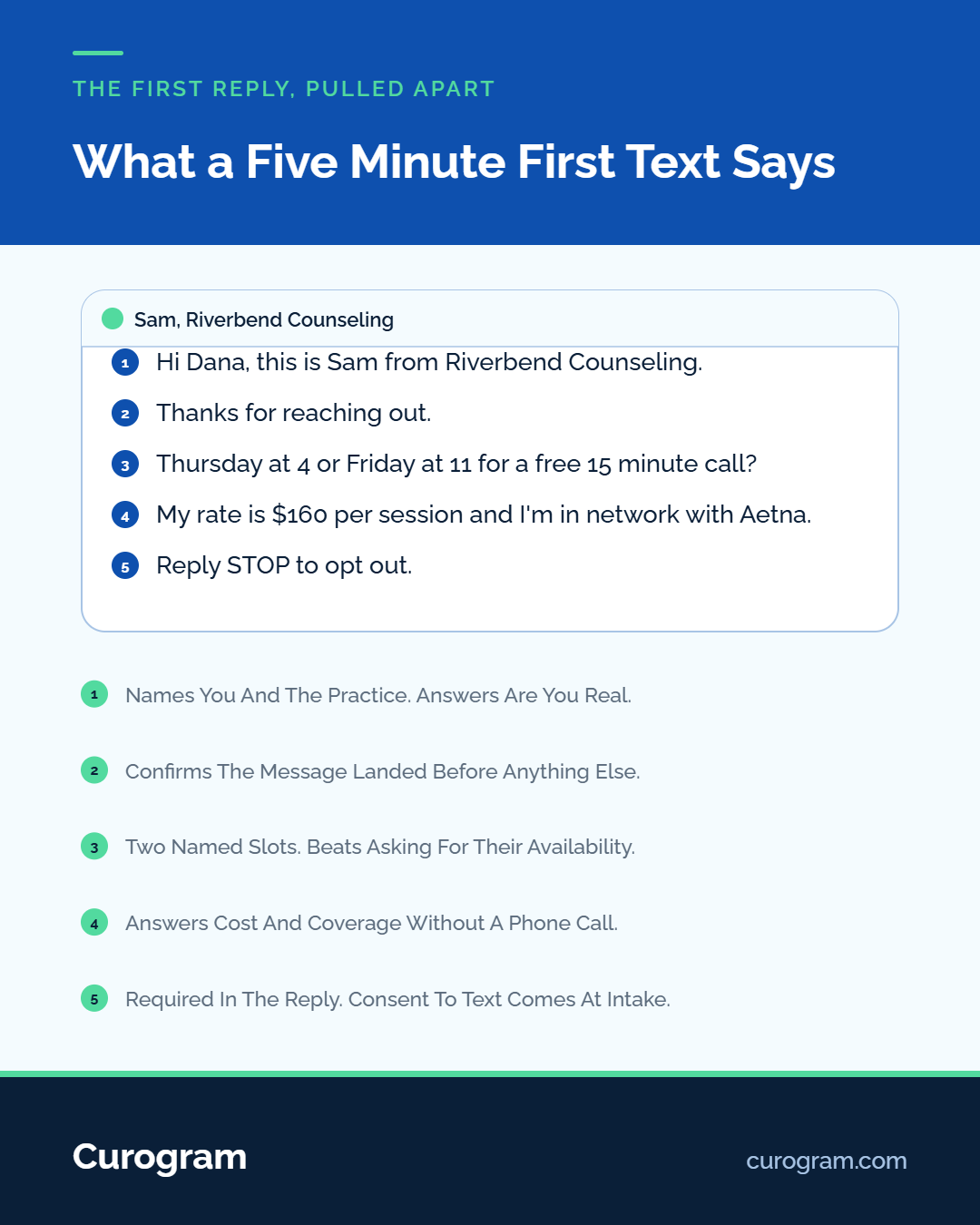
Infographic breaking down 5 key parts of an effective initial counseling text message

Why Your Personal Cell Is the Wrong Fix

Most therapists have already worked this out on their own. Giving clients your mobile number solves speed and creates four problems that are harder to undo.

You cannot take a number back. Once it is in someone’s phone, it is theirs for good, along with your evenings and your vacations. Standard carrier texting is not covered by a business associate agreement either. Those messages sit in your phone’s backup with no audit trail, and no way to produce a record if you are ever asked for one.

It also does not hand off. When you take two weeks in July, or bring on an associate, the inquiries keep landing on your personal phone. And when you close or sell the practice, that number is still yours, still receiving messages from people who found an old listing.

The common workarounds compare like this.

Option

Keeps your cell private

Covered by a BAA

Answers while you’re in session

Personal mobile number

No

No

No

Free Google Voice

Yes

No

Only with a voicemail greeting

Answering service

Yes

Usually, if you sign one

Yes

Practice texting line

Yes

Yes

Yes, with saved replies and auto-response


One caveat on the second row, because it trips people up. The free consumer version of Google Voice is not covered by Google’s business associate agreement. The Workspace version can be, depending on how your account is set up, so check your own agreement before you rely on it.

What a Five Minute Reply Actually Says

A fast first reply is short and administrative. It confirms you got the message, gives one piece of useful information, and asks for a time. Nothing clinical goes in it.

Something like this works:

Hi Dana, this is Sam from Riverbend Counseling. Thanks for reaching out. I have Thursday at 4 and Friday at 11 open for a free 15 minute call. Which works better? My rate is $160 per session and I’m in network with Aetna.


That message takes eleven seconds to send from a saved template and answers the three questions almost every inquiry is really asking. Are you available, what does it cost, and are you real.

What stays out matters as much. Do not ask about symptoms, history, medication, or what brought them in. Do not confirm anyone is a client in a message that might be read on a lock screen. Save the clinical conversation for the call, where you have context and privacy.

Consent is simple at this stage. The person texted or emailed you first, and your reply should include a line telling them how to opt out. Get their written consent to text at intake, the same way you handle everything else.

Three saved replies cover nearly all of it: you have openings, you are full and can offer a waitlist, or you are not the right fit and here are two names. That third one takes fifteen seconds and gets you referrals for years.


A Setup You Can Build This Week

None of this requires new software you have to learn. It requires a number that is not yours and a few messages written in advance.

  • Get a practice number covered by a business associate agreement. Put it on your website, your Google Business Profile, and every directory listing.
  • Write your three replies today. Openings, waitlist, referral. Keep each under 40 words.
  • Set an auto-response for inquiries that arrive during sessions. One line, sent in under a minute, buying you until the end of the day.
  • Route the phone and the texting line to the same place, so a voicemail and a text do not live in two systems.
  • Track your reply time for two weeks. Write down when each inquiry came in and when you answered. The number is usually worse than people expect.

That last step is the one most practices skip, and it is the one that shows you whether anything changed.

Blume Health Co’s therapy marketing work gets the inquiry to land in your inbox in the first place, through your listings, your site, and your local search presence. What happens in the next five minutes sits on your side of the desk.

Curogram handles that part with HIPAA-compliant, SOC 2 Type II two way texting that runs alongside whatever EHR you already use, so nobody has to change how they chart. Practices using automated confirmations on the platform hold appointment confirmation rates above 75%, based on our internal data.

If you want the wider view of how texting fits with reminders, intake, and no-show rates, we wrote about that in our guide to patient engagement in behavioral health.

Conclusion: Reply First Without Handing Over Your Number

Getting found is the hard part, and you may already have that working. Answering fast is the cheap part, and most practices are still losing clients on it.

Curogram gives your practice a HIPAA-compliant texting line, saved replies, and automated reminders that connect with any EHR, so new inquiries get a real answer in minutes and your personal phone stays personal.

Book a demo to see how it fits your practice. 


Frequently Asked Questions

How can a solo therapist reply in five minutes while seeing clients all day?

You are not writing anything in that five minutes. A saved reply goes out with two taps between sessions, or an auto-response covers you until your break. The point is that the person knows they were heard before they message the next name on their list.

Why is texting a new client from a personal phone a compliance risk?

Your mobile carrier has not signed a business associate agreement with you, so those messages live outside any covered system. There is no audit trail, no way to retain or produce records, and no way to separate practice messages from personal ones if anyone ever asks.

What should the first text to a prospective client include?

Your name, your practice name, two specific appointment times, your rate, and a way to opt out. Skip anything clinical. The first message is scheduling, and the real conversation belongs on the consultation call where you have privacy and context.

How does a practice texting line differ from an answering service?

An answering service takes a message and passes it along, which adds a step and a delay. A texting line puts you in a direct thread with the person, so a reply lands in seconds and the whole history stays in one place your team can see.

Why do so many therapy inquiries go unanswered entirely?

Replying well takes more time than it looks like it should, so it gets pushed to the end of the day and then to tomorrow. Audit research has found roughly a fifth of providers never respond to a prospective client’s email. Saved replies remove the reason for the delay.