Spruce Health Alternatives for Medical Practices (2026)
💡 The top Spruce Health alternatives in 2026 are Curogram, OhMD, Klara, Weave, and TigerConnect. Curogram connects with more than 20 EMR and...
10 min read
Aubreigh Lee Daculug
:
August 4, 2026
Table of Contents
The demo looked sharp. Role-based messaging. On-call schedules. Alarm routing across units, floors, and transfer teams.
Then someone from your side asked the only question that mattered: can it text our patients about tomorrow's schedule?
The pause after that question is why you are reading this. It is the exact moment a perfectly good tool meets the wrong job.
TigerConnect is good software. More than 7,000 acute, post-acute, and ambulatory facilities use it, and it holds HITRUST certification for security and privacy. It solves a real problem — getting the right clinician on the right message fast, inside a hospital.
But that is not the problem sitting on your front desk right now. Not even close.
Your problem is the voicemail queue. The 40 unconfirmed visits for tomorrow. The intake forms nobody filled out. The patient who no-showed and never got a follow-up call because your scheduler was on hold with an insurance line.
Hospital-grade coordination tools were never designed for that. They were designed for staff talking to staff. You need your practice talking to patients.
That gap costs real money. One study in BMC Health Services Research found an average no-show rate of 19%, with each missed appointment costing about $196. Two missed slots a day works out to roughly $2,000 a week. Across a year, that is close to $100,000 walking out the door.
Here is the good news. The market has plenty of platforms built for exactly your size and shape.
Some do texting. Some bundle a phone system. Some plug into the EMR you already run.
This guide walks through five of them, what each one is genuinely good at, what they cost, and how to tell which one matches the job in front of you.
No takedowns. Just an honest read on fit.
There is nothing wrong with TigerConnect. The mismatch is about category, not quality.
Hospitals buy clinical communication tools to solve coordination at scale. A nurse needs the on-call cardiologist at 3 a.m. A bed manager needs transport, a bed, and a receiving team lined up in one thread. Alarms need to escalate when nobody answers.
Those are serious problems. They are also problems a 12-room clinic does not have.
Your version of urgent looks different. It is a patient who wants to move a Thursday visit to Friday. It is a mom asking whether her son needs to fast before labs. It is a balance that has aged 60 days because nobody sent a payment link.
Those are patient conversations, not staff conversations.
This is exactly why interest in TigerConnect for small practices tends to fade once buyers get past the feature list and into the workflow. The tool is aimed at a different user on the other end of the message. Hospital staff will download an app because IT tells them to. Your patients will not.
That single difference — app versus no app — quietly decides whether a platform works for you.
This is the distinction most buyers miss, and it is worth slowing down for. Clinical messaging vs patient texting is not a feature comparison. They are two separate product categories that happen to share the word "messaging."
Here is how they differ in practice:
| Clinical messaging | Patient texting | |
|---|---|---|
| Who is on the other end | Nurses, physicians, on-call teams | Patients on personal cell phones |
| App required | Yes, on both sides | No, plain SMS works |
| Core jobs | On-call routing, escalation, transfers, alarms | Reminders, confirmations, forms, payments, recalls |
| What "success" looks like | Faster clinician response times | Fewer no-shows, fewer inbound calls |
| Who signs the contract | Hospital IT or the CMIO | Practice administrator or owner |
| How it is priced | Per licensed user | Per location or per provider |
Read that middle row again. It carries most of the weight.
Patients open text messages at a rate near 98%. They do not download apps, remember portal passwords, or check a secure inbox they set up once in 2022. Any platform that requires a download before a patient can confirm a Tuesday appointment has already lost most of your panel.
For your team, that means the winning tool is the one with the lowest bar to reply.
A text that says "Reply C to confirm" beats a beautifully designed app nobody installs.
Feature lists all start to look the same by the third demo. These four questions cut through faster:
Write down your answers before the next demo. It turns a sales conversation into a scoring exercise, and it keeps you from buying capability you will never staff.
Most roundups of TigerConnect alternatives for medical practices rank tools by feature count. That is the wrong axis. Each of these solves a real problem well, and the trick is matching the tool to your gap.

Best for:
Practices that want patient-facing texting layered onto the EMR they already use.
Curogram is a HIPAA-compliant two-way patient texting platform that integrates with almost any EMR. It is built as a complement to your clinical system, never a replacement, so you are not migrating charts to fix a front desk problem.
The platform is SOC 2 Type II certified alongside HIPAA compliance.
The feature set covers the daily grind: two-way texting, mass texting, customizable smart reminders, electronic patient forms, online booking, multi-user telehealth, and automated review requests.
The results are where it gets concrete. Curogram clients average a confirmation rate above 75%, and no-show rates run 53% lower than the industry average.
Atlas Medical Center cut no-shows from 14.20% to 4.91% in three months. Covina Arthritic Clinic went from 369 confirmations a month to more than 1,300. One multi-location practice collected 1,064 new five-star reviews in a single quarter.
For your team, that is the difference between chasing confirmations and reading them.
Best for:
Specialty practices already inside the ModMed ecosystem.
Klara centralizes text, web chat, call-to-text, and voicemail transcription into one thread, with shared inboxes and AI-assisted routing for the care team. It integrates with 50-plus EHR and practice management systems.
ModMed acquired Klara in 2022, and ModMed's own patient engagement module now runs on it. If you are already a ModMed shop, that tight coupling is an advantage. If you are not, you are buying a communication layer from an EHR vendor you do not otherwise use.
Pricing is not published. Expect a custom quote scoped to your specialty and provider count.
Best for:
Solo providers and small teams who want phone and text living in one app.
Spruce puts calls, voicemail, texts, secure messages, fax, and video in a single inbox.
The Basic plan runs $24 per user per month and covers app-based messaging, two-way SMS, team chat, and video visits. The Communicator plan at $49 per user per month adds VoIP desk phones, bulk messaging, payments, and API access.
The trade-off is structural. Per-user pricing is friendly at three users and much less friendly at eighteen. Spruce also passes federal, state, and local taxes and surcharges through to you, so the number on the pricing page is not the number on the invoice.
Best for:
Practices where the phone is the bottleneck.
OhMD is built around call deflection — turning inbound phone volume into text threads your staff can work through a shared inbox. It includes two-way SMS, a text-enabled landline, web chat, video visits, voicemail transcription, and broadcast messaging, plus an AI voice assistant that answers calls.
Its Communicate plan starts around $300 per month, priced by practice rather than by seat. That flat structure works in your favor if you have a large support staff and a small provider count.
Best for:
Single-location practices replacing an aging phone system at the same time.
Weave bundles VoIP, two-way texting, appointment reminders, review requests, and patient payments into one subscription. Entry pricing starts near $249 per month per location, though practices commonly report all-in costs in the $300 to $700 range once add-ons and setup fees land.
Two things to weigh. Weave's user base skews heavily toward dental and small-business practices, and the phone system is the foundation — which is great value if you need one, and money spent twice if you just renewed a VoIP contract.
| Platform | Best for | Patients reply without an app | Pricing model | Main trade-off |
|---|---|---|---|---|
| Curogram | EMR-connected patient texting | Yes | Quote-based | Complements your EMR rather than replacing it |
| Klara | ModMed specialty practices | Yes | Quote-based | Strongest fit inside the ModMed ecosystem |
| Spruce Health | Solo and small teams | Yes | $24–$49 per user, monthly | Cost climbs fast as headcount grows |
| OhMD | High inbound call volume | Yes | From ~$300 per month | Lighter on scheduling automation |
| Weave | Practices replacing phones too | Yes | From ~$249 per location | Phone-first bundle, dental-heavy user base |
| TigerConnect | Hospitals and large systems | App-based, staff-first | Per licensed user | Built for staff coordination, not front desk work |
The pattern is hard to miss. Every option in that table beats TigerConnect on patient reach, because every one of them was designed for it.

If you are hunting for a TigerConnect pricing alternative, the real question is not the monthly rate. It is how that rate scales with your team.
Run the same five-provider group through both models. Say you have 5 providers and 9 support staff — 14 people who need access.
In practice, per-user pricing rewards small teams and punishes growth. Add three medical assistants and a biller, and the per-seat option jumps roughly $1,150 a year at the Basic tier. The per-location option does not move at all.
Now put that against what the tool recovers. Say your group schedules 1,200 appointments a month with a 12% no-show rate. That is 144 empty slots. At $196 each, you are losing about $28,000 a month.
Cut no-shows by 53%, the average across Curogram clients, and roughly 76 of those slots come back. That is about $14,900 a month, or near $178,000 a year, against a software cost in the low thousands.
Even if your practice recovers a quarter of that, the math still clears the subscription several times over. This is why fit matters more than sticker price — an inexpensive tool your patients ignore returns nothing.
Most rollouts fail on change management, not technology. A few habits keep it clean:
One more thing worth saying plainly. The goal is not to add a system. It is to remove phone calls from your day. If your staff is doing the same work in a nicer interface after 90 days, something in the setup needs fixing.
TigerConnect is not the wrong software. It is software built for a different building.
Hospitals need clinicians reaching clinicians in seconds, across departments and shifts, with alarms that escalate when nobody picks up. Your practice needs patients reaching you — and you reaching them — without a phone tree, an app download, or a portal password nobody remembers.
That is the whole distinction. Once you see it, the shortlist gets short fast.
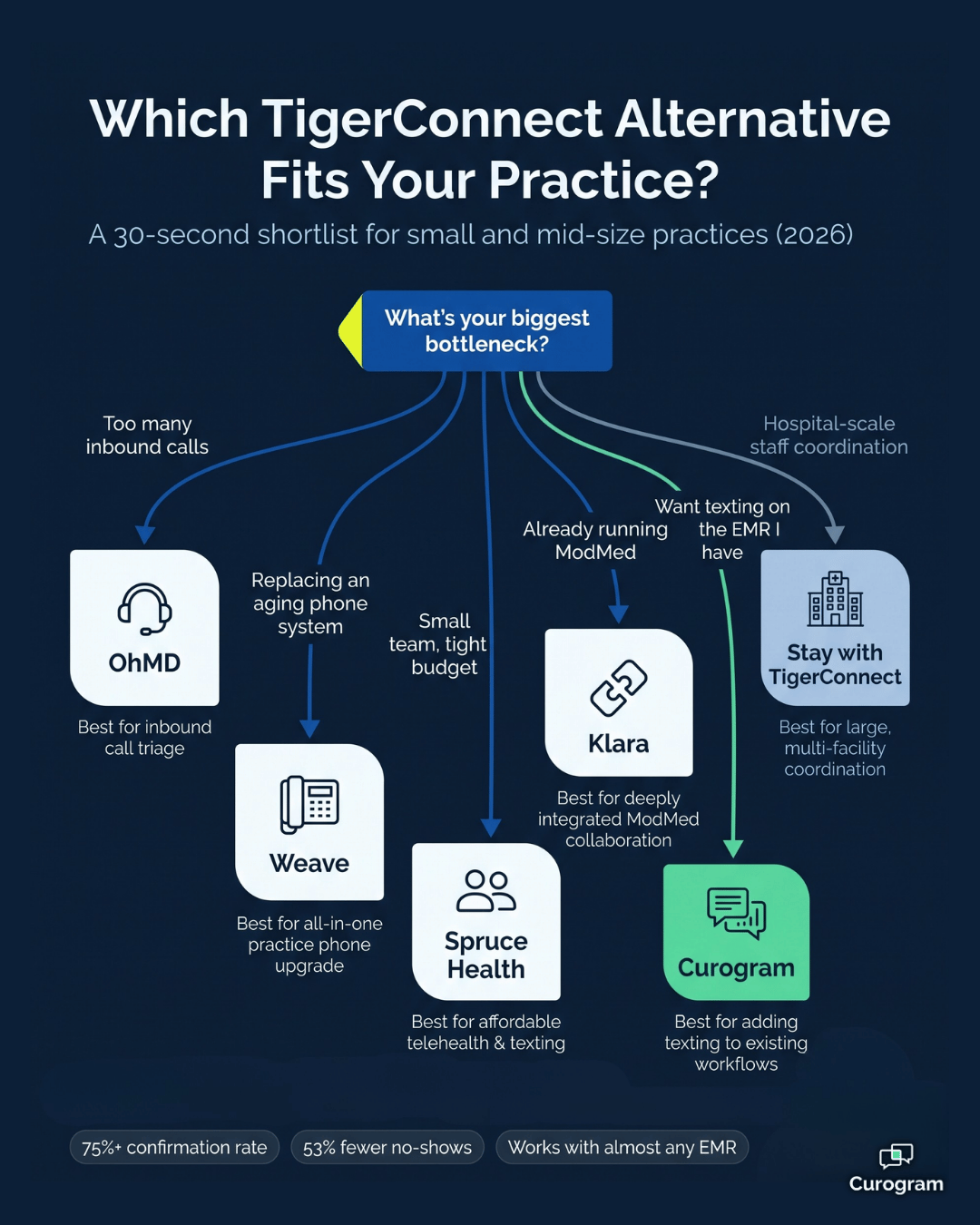
If your gap is inbound call volume, look hard at OhMD. If you are replacing a phone system anyway, Weave earns a look. If you are a three-person team, Spruce is easy to start. If you live inside ModMed, Klara is the path of least friction.
And if what you want is a patient-facing texting platform physician groups can hand to a front desk team on day one — one that works alongside almost any EMR instead of asking you to replace it — that is the space Curogram was built for.
The results speak in numbers your administrator already tracks. Confirmation rates above 75%. No-show rates 53% below the industry average.
One clinic moving from 14.20% no-shows to 4.91% in three months. Another going from 369 monthly confirmations to more than 1,300.
None of that requires a migration, a new chart system, or a six-month implementation. It requires a texting layer that speaks to the EMR you already run, and patients who can reply with one tap. For most teams, that is a far smaller lift than expected.
Your front desk has spent enough years playing phone tag. Give them a tool that answers first.
See what two-way patient texting looks like inside your own workflow. Schedule a Demo and we will walk through your EMR, your appointment volume, and the numbers you would actually move.
Yes, but that is not its center of gravity. TigerConnect offers patient engagement features, including appointment and follow-up reminders and secure patient messaging. The platform's core design and pricing, however, revolve around staff-to-staff clinical collaboration — on-call scheduling, role-based routing, and alarm management. If patient outreach is your main need, tools built patient-first will usually fit your workflow and budget better.
TigerConnect does not publish pricing. Third-party estimates put it in the range of $15 to $20 per user per month, with final cost depending on user count and which modules you buy. The vendor works through demos and custom quotes rather than self-serve signup. Because it is priced per licensed user, cost scales with headcount, which is one reason the model suits hospitals more comfortably than small practices.
Look for per-location or per-practice pricing rather than per-seat, since a five-provider group usually carries 10 to 15 total staff logins. Prioritize plain SMS that works without an app, automated reminders and confirmations, and a live connection to your existing EMR. Curogram, OhMD, and Weave all price in ways that stay predictable as your support staff grows.
It can be, with the right setup. A compliant platform signs a business associate agreement, encrypts protected health information, controls access by user, and keeps an audit trail. Curogram is HIPAA compliant and SOC 2 Type II certified. Standard consumer texting apps are not compliant, which is why practices need a healthcare-specific platform rather than a staff cell phone.
No. The strongest patient communication platforms are built as a layer on top of your clinical system, not a substitute for it. Curogram integrates with almost any EMR, pulling your schedule and writing confirmations back without changing where your charts live. That matters because an EMR migration is a months-long project, while a texting layer typically goes live in weeks.
💡 The top Spruce Health alternatives in 2026 are Curogram, OhMD, Klara, Weave, and TigerConnect. Curogram connects with more than 20 EMR and...
💡 The best secure texting platforms for small clinics in 2026 are Curogram, OhMD, Spruce Health, Klara, Weave, Falkon SMS, TigerConnect, and...
💡 The best patient texting software for multi-location practices, ranked for central routing and fewer inbound calls, is Curogram, then Klara,...