9 min read

Curogram vs Phreesia EHR Integration Architecture: Which One Wins?

Curogram vs Phreesia EHR Integration Architecture: Which One Wins?
💡 The Curogram Phreesia EHR integration architecture debate comes down to one key question: what data reaches your clinicians first? Curogram's bi-directional API sorts clinical vs financial data with a clinical-first approach, sending allergies, medications, and history into set EHR fields before the visit. This discrete clinical data write-back to the EHR saves staff from manual entry.

By contrast, Phreesia's EHR integration has a financial focus, built around insurance checks, co-pays, and balance capture. Phreesia enterprise integration complexity often means months of setup with vendor help.

The right patient engagement platform EHR architecture depends on your top bottleneck. If clinical flow slows your team, Curogram fits. If billing clean-up is your main pain, Phreesia may suit better.

Picture this: a patient fills out a digital intake form the night before their visit. They list their meds, flag an allergy, and update their home address on file. Does that info land in the right EHR fields on its own? Or does your front deskprivacy still retype it all at check-in the next morning?

This is the heart of the Curogram Phreesia EHR integration architecture debate. Both tools claim to connect with your EHR. But what they send, where they send it, and how fast they launch are not the same. Buyers miss this split all the time.

Curogram was built clinical-first. It writes data like allergies and meds into matching EHR fields through a direct link. Phreesia took a different path, with deep focus on insurance checks, co-pays, and billing flow. Both tools have value—just for very different goals on the day-to-day floor.

The tricky part? Most buyers only ask if a tool has EHR integration. Few ask which type of data gets top billing. That one gap can shape how your staff spends every work hour, and how fast you see a return on the tool.

In this guide, we'll break down what each tool puts first. We'll cover data priority, launch speed, and who wins from each choice. You'll see real numbers from clinics using Curogram today, pulled from our internal data. The goal is clarity—no fluff, just the tradeoffs that matter to your team.

By the end, you'll know which tool fits your top pain point—clinical flow or billing clean-up. If your team feels buried in calls, missed no-shows, or manual data entry, the integration choice matters most. That choice shapes your daily life for years. Let's get into the split that too few buyers see before they sign a long contract.

The Integration Priority Divide in Patient Engagement

EHR integration is not just a yes-or-no feature. The real question is what the tool sends into your EHR first. In 2026, the patient engagement market has split into two clear camps. One camp pushes clinical data first, and the other pushes financial data first.

Curogram sits in the first camp. Its design puts clinical fields at the top of the pipeline. Allergies, meds, history, and demographics flow into the right EHR fields. Phreesia sits in the second camp, with a pipeline that leads with insurance checks, co-pay math, and payment capture.

Why does this split matter? The data that lands first in your EHR shapes the rest of the visit. If clinical data is there before the patient sits down, your provider opens the chart and sees the full picture. If financial data is the star, your biller can clear the visit before the patient walks in.

One serves care. One serves cash flow. Neither path is wrong. The mistake is picking one path by brand name, not by pain point.

A busy urgent care with eligibility gaps may love Phreesia's edge. A mid-size specialty group choking on manual entry will get more out of Curogram. The smart move is to name your top bottleneck first.

Is it missed clinical data, long intake lines, and no-shows? Or is it denied claims, unpaid co-pays, and billing rework? That single answer points you to the right patient engagement platform EHR architecture.

We'll dig into both paths in the next sections, with specific data from clinics that use Curogram's clinical-first model today.

Clinical Data Write-Back vs. Financial Clearance Integration

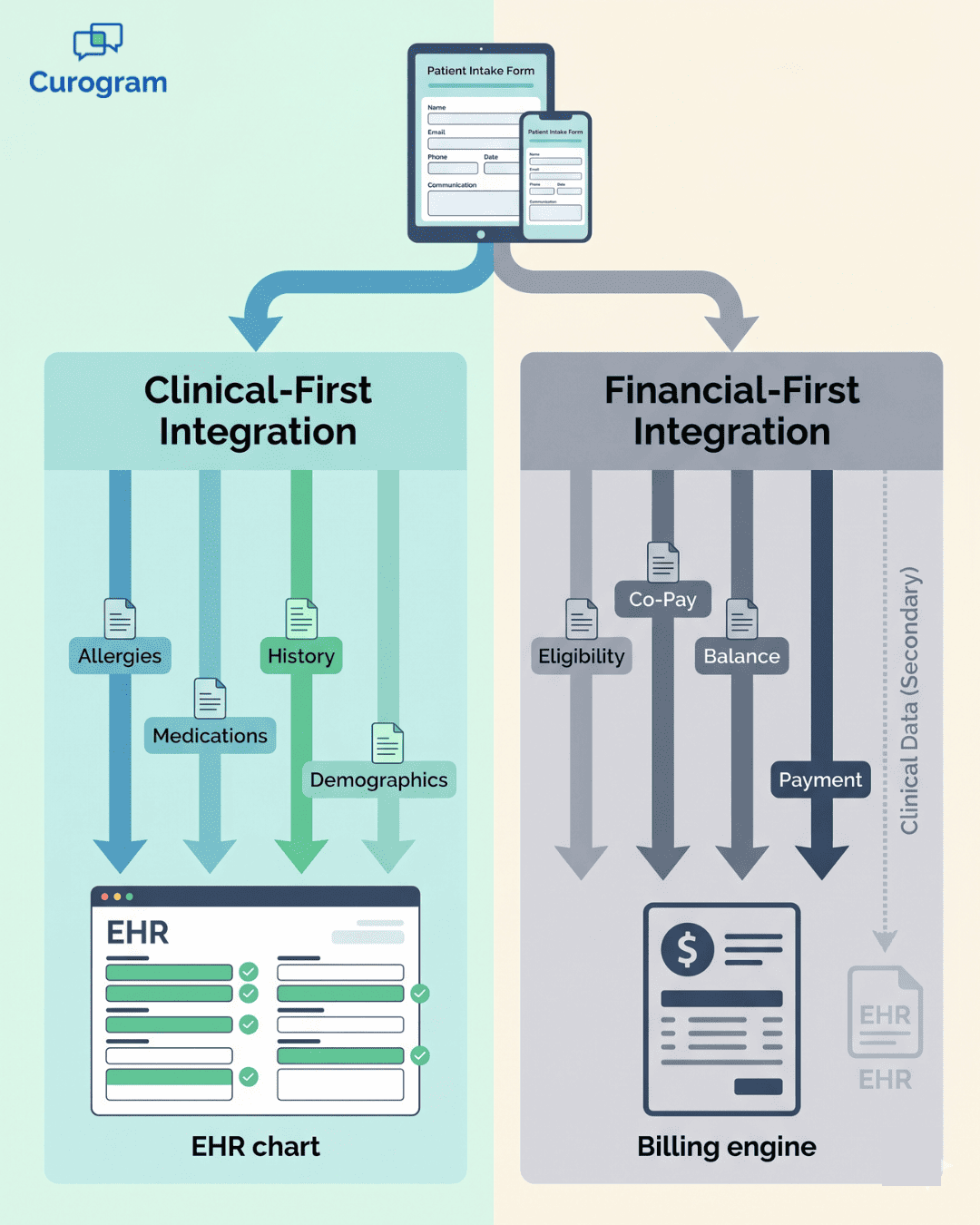
When a patient fills out a Curogram intake form, each answer flows to a set EHR spot. Allergies go to the Allergies section. Current meds move into Active Medications. Social history updates the History tab.

New addresses or phone numbers update Demographics. This is what we mean by discrete clinical data write-back to the EHR. Every field has a home, and staff don't have to retype a thing. The goal is simple: by the time the patient checks in, the chart is ready for the provider.

No copy-paste from a PDF. No nurse pausing to match a paper form to the EHR. The doctor opens the chart and sees fresh, clean data from the start. That is the point of a clinical-first design.

Phreesia's EHR integration financial focus is a different story. Its pipeline is built around insurance eligibility, co-pay math, balance checks, and upfront payment capture. These are real wins for revenue cycle teams. A clinic with lots of denied claims or unpaid balances will feel the lift right away.

But Phreesia's depth for clinical field-level write-back is not the main event. It may capture some clinical info during intake, but the core design serves the financial encounter, not the clinical one. If your provider opens a chart and still sees blank fields, the intake tool did not fully deliver what your clinicians need.

At its core, this is a bi-directional API clinical vs financial data question. Does your two-way connection serve the chart or the billing queue? Curogram's API is tuned for clinical fidelity. Phreesia's deep ties are tuned for financial lift.

Based on our internal data, Curogram clients see more than 75% average appointment confirmation rates. Each intake feeds clean data into the chart—before the visit, not during or after it.

Side-by-side diagram showing clinical data write-back to EHR versus financial clearance integration in patient intake flows

Implementation Speed and Staff Autonomy

Launching a new tool is not just a tech task. It's a time and money cost. Curogram and Phreesia take very different paths here. One is quick and staff-led; the other is slow and vendor-heavy.

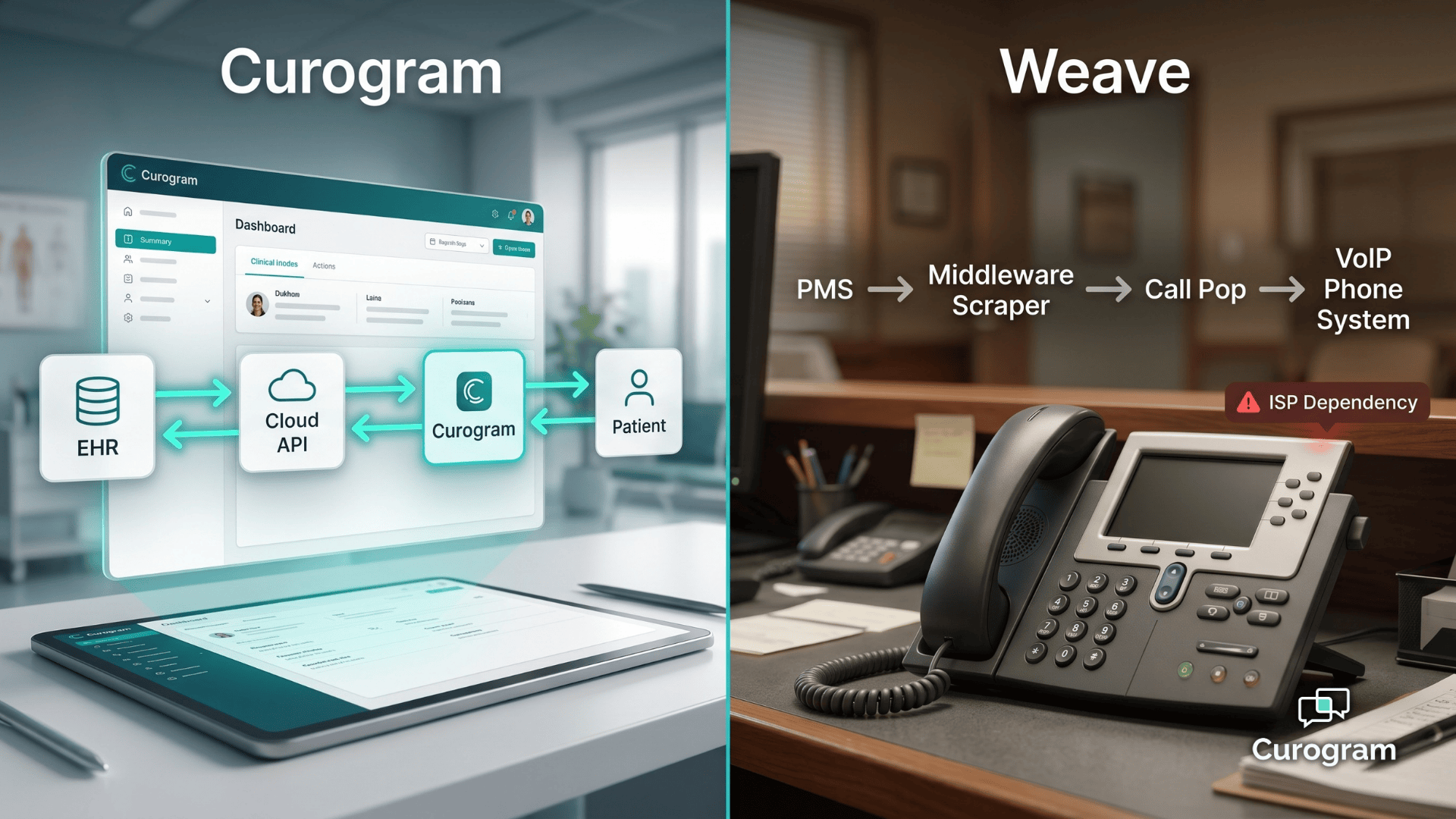
Curogram's clinical-first setup is built for speed. Most practices reach full bi-directional sync in under two weeks. Staff can then manage workflow settings on their own through the platform's main screen. There's no need to wait on IT for each small change.

Want a new reminder rule or intake form tweak? Your office lead can do it. This speed is a direct result of the platform's clean design. Direct API links to the EHR skip the extra layers that big enterprise tools add.

The result: your clinic starts saving time in weeks, not months. Atlas Medical, for example, cut their no-show rate from 14.20% to 4.91% in just three months after launch—based on our internal data. That kind of shift is only possible when the tool goes live fast.

Phreesia enterprise integration complexity looks very different. Public 2026 reviews flag long setup cycles and heavy reliance on the vendor for any workflow shift. The financial clearance engine, insurance check layer, and payment pipeline each need their own setup, test, and sign-off. This path fits health systems with big IT teams and long project budgets.

It fits less well for a 4-doctor specialty group that needs value by next month. Covina Arthritic Clinic is a good side-by-side test. After going live with Curogram, they scaled to more than 1,100 automated monthly confirmations. Their staff set up these flows with no IT help.

That kind of speed and self-serve power is the practical payoff of a clinical-first, lean integration. It's not just a sales pitch, but a day-one shift in how your team works.

Front desk medical staff configuring patient engagement platform workflows on desktop without IT assistance at clinic reception

Integration Architecture Comparison

Let's put the two tools side by side. The chart below maps the key points we've covered, plus a few more that matter on a buying call. Each row shows where the two tools sit on one core design choice. Read it slowly—the gaps tell the full story.

Dimension

Curogram

Phreesia

Integration Priority

Clinical data: meds, allergies, history, demographics

Financial data: insurance eligibility, co-pays, balances

Data Write-Back

Discrete clinical field-level write-back

Financial clearance plus demographic sync; clinical depth is secondary

Implementation Timeline

Under 2 weeks; rapid out-of-the-box launch

Weeks to months; enterprise setup cycle

Configuration Model

Staff-managed through the platform UI

Vendor-dependent; enterprise support needed

Communication Model

Bi-directional two-way messaging

Notification-heavy automated prompts

Primary Beneficiary

Clinical staff and patient care workflows

Revenue cycle and financial operations teams


A few patterns jump out from this side-by-side view:

  1. The top row sets the tone for every row below it. Curogram's clinical-first choice shows up in every layer, from data write-back to who can adjust it. Phreesia's financial-first choice does the same. This is not a small detail. It shapes your daily use.

  2. At the "Configuration Model" row, the gap there often surprises buyers. With Curogram, your team lead owns the setup and daily changes. With Phreesia, a vendor rep or IT ticket stands between you and most updates. That slows how fast your clinic can adapt to new needs.

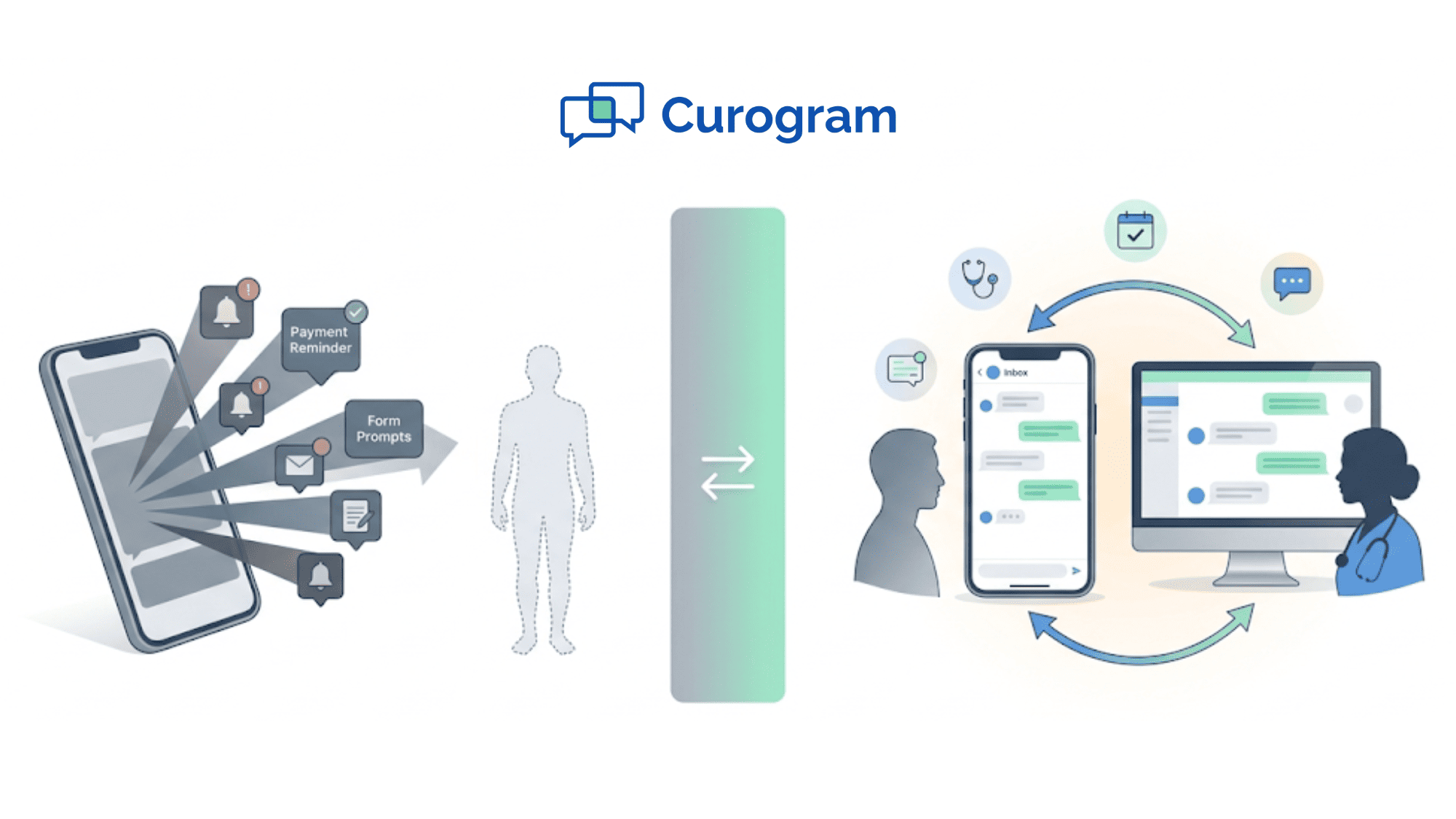
  3. The "Communication Model" row shapes the patient experience. Two-way texting lets patients reply, ask, and confirm in plain words. Notification-style prompts are a one-way street that often leave patient questions hanging.

Based on our internal data, two-way SMS helps Curogram clients cut phone call volume by up to 50%.

The table is not just a score sheet. It's a mirror for your own top problem. If you see rows that speak to your daily pain, that's the tool for you.

Choosing Integration Architecture Based on Clinical Priorities

The right choice comes down to one question: what's your top bottleneck right now? Your answer points to the right tool with very little debate.

If your clinic has hundreds of sites and struggles with upfront payments, eligibility checks across payors, and lost co-pays, Phreesia was built for that world. Its enterprise financial layer is deep and mature. A large hospital system with a dedicated IT team can put that depth to work.

If your clinic is mid-size and your main pain is clinical workflow chaos, Curogram fits better. Picture a front desk buried in calls, nurses retyping forms, patients missing visits, and follow-ups falling off. Curogram's clinical-first design cuts that noise fast.

For practices weighing the decision, HIMSS publishes frameworks for evaluating healthcare data exchange that align with the clinical-vs-financial priority split.

Think back to Atlas Medical: their no-show rate dropped from 14.20% to 4.91% within three months. That win is about clinical flow, not billing. Based on our internal data, Curogram clients also see up to 50% fewer front desk calls and a 10–20% revenue lift from recovered visits.

Here's a fast test. Ask your team these three short questions:

  • Do we lose more money to no-shows or to denied claims?
  • Does our front desk feel buried in calls, or in billing errors?
  • Would we rather add clinical intake data or add payment collection speed?

If the first answer in each pair hits home, you are a clinical-first practice. That's where Curogram shines. If the second answer hits home, your world is financial-first, and Phreesia may fit.

For mid-market specialty groups, the pattern is clear. Staff time, clean charts, and smooth visits drive the day. Curogram's architecture puts those wins front and center—discrete clinical data in the right EHR fields, before the patient walks in, with no manual steps.

Conclusion

The Curogram Phreesia EHR integration architecture story is not about which tool is better overall. It's about which design fits your clinic's real-world pain points. Curogram wins for clinical-first practices. Phreesia wins for finance-first enterprises.

The gap between those two worlds is wider than most buyers realize. The split shows up in every daily task. It affects how fast you launch and who tweaks the workflow. It shapes what the provider sees in the chart, and what the biller sees in the queue.

Pick the wrong path, and your team spends months with a tool that solves the wrong problem. For mid-size specialty groups and growing practices, the math leans toward Curogram. Clinical flow is where time and money bleed most.

When allergies, meds, and history land in the right EHR fields on their own, staff stop wasting hours. When the front desk can manage reminders without waiting on IT, change happens in real time.

The proof is in the data. Atlas Medical cut no-shows by more than two-thirds in three months. Covina Arthritic Clinic confirms over 1,100 visits each month with no IT help. Those aren't sales numbers—they're outcomes from clinical-first integration in action.

Is your top pain denied claims and missed co-pays at scale? Phreesia's depth is a strong fit for that world. Just budget for the longer setup cycle and the vendor handoffs that come with it.

For everyone else, the Curogram path is the faster, leaner way to fix what's slowing your day. Start with your top bottleneck, not the brand name. The right patient engagement platform EHR architecture is the one that matches your biggest daily problem. That match delivers wins by next quarter, not next year.

Tell us your biggest workflow bottleneck, and we'll show you exactly how Curogram solves it on-screen. Talk to one of our experts for a clear fit assessment for your practice.

Frequently Asked Questions

How does Phreesia's EHR integration differ from Curogram's in terms of data priorities?

Phreesia's integration is optimized for financial data—insurance eligibility, co-pay calculation, and payment capture—with clinical data as a secondary integration pathway. Curogram's integration prioritizes discrete clinical field-level write-back for medications, allergies, history, and demographics, ensuring clinicians have complete patient data before the encounter without manual staff entry.

Can Phreesia write discrete clinical data into EHR fields like Curogram?

Phreesia captures clinical information during its intake process, but its integration depth is primarily optimized for financial clearance data. Curogram's bi-directional API is purpose-built for discrete clinical write-back, mapping individual data elements to specific EHR fields. The architectural difference reflects each platform's core design priority: financial processing vs. clinical automation.

Why is Curogram's implementation faster than Phreesia's for medical practices?

Curogram's clinical-first architecture uses direct bi-directional API connections without the multi-layer financial processing infrastructure that enterprise platforms require. This enables deployment in under two weeks with staff-managed configuration. Phreesia's enterprise integration involves configuring financial clearance engines, insurance verification layers, and payment processing—a process designed for large health systems with dedicated IT teams and longer implementation budgets.

Why should practices care about staff autonomy in EHR integration setup?

Staff autonomy means your team can tweak reminders, forms, and flows without filing IT tickets. Changes happen same-day, not next month. That speed turns small fixes into real productivity gains over time across every workflow.

How can a clinic tell if its top bottleneck is clinical or financial?

Ask where your team loses the most hours and dollars. If it's missed visits, manual data entry, and call volume, clinical-first fits. If it's denied claims and unpaid co-pays, financial-first fits better.