
 Michael Hsu
Grow Your Market Presence through 5-Star Google Reviews!
Grow your practice's presence by increasing your 5-star Google Reviews thru automation, boosting your online reputation and avoiding negative reviews.

Your next new patient has probably already read about you. Before they ever call your front desk, they type a specialty or a symptom into Google, scan the map results, and compare star ratings. In a few seconds, they decide which practices are worth a closer look.
That habit keeps getting stronger. BrightLocal's 2026 Local Consumer Review Survey found that 41% of consumers always read reviews when they browse local businesses, up from 29% the year before. Healthcare is no exception. In rater8's 2026 Patient Choice Report, 55% of patients said they had canceled or avoided an appointment because of something they read online.
That's a lot of lost visits, and in most cases your team will never hear the real reason behind them.
The good news is that reviews work in both directions, so the same patients who pass on a poorly rated practice are drawn to one with a strong, current rating. In the rater8 survey, 68% of patients said they would leave a review if their doctor simply asked. Many happy patients are willing to speak up for you; they just need an easy way to do it.
So why do online reviews for medical practices carry so much weight? It comes down to three things: patients trust what other patients say, Google uses reviews to decide which practices show up first in local search, and a steady supply of fresh, positive reviews keeps one bad experience from defining your practice.
In this guide, you'll see how each of these works and what recent research says about how patients choose a provider. You'll also learn how to build a review process that is fair, consistent, and careful with patient privacy at every step, and how practices use automated text surveys to turn good visits into Google reviews.
Online reviews only matter because people rely on them, and patients rely on them a lot. A short note from someone who sat in your waiting room last week often feels more honest than anything on your website, because it's real feedback from a real person who had nothing to gain.
Recent research shows how much reviews shape the decision to book:
That last point is easy to miss:
A great rating from a few years ago doesn't help much if nothing new has been posted since, because patients want to know what your practice is like right now.
Google is where most of these choices happen. It handles about 90% of searches worldwide, according to StatCounter. When a patient compares two nearby practices, the Google reviews they see side by side often decide it. A practice with hundreds of recent, positive reviews will usually win over one with only a handful of older ones.
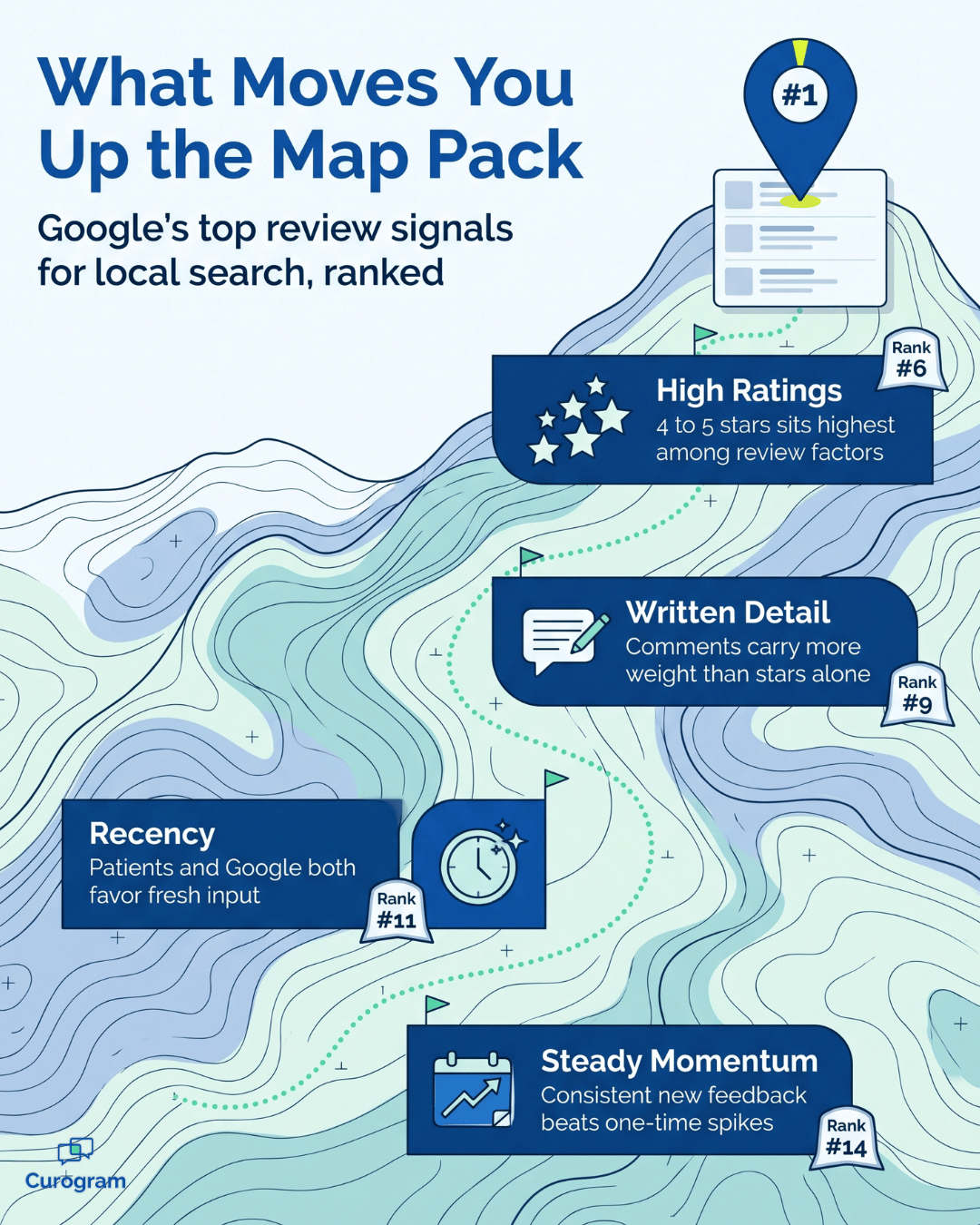
Have you ever searched for a local business and seen a map with a short list of listings at the top of the page? That's Google's local pack. For many practices, it's the biggest source of new patient traffic, and patients rarely scroll far past it.
Reviews are one of the strongest signals Google uses to decide who appears there. Whitespark's 2026 Local Search Ranking Factors report, based on a survey of local SEO experts, ranks these review signals among the top factors for map results:
Local search matters for any business, but it's especially important for medical practices. You often compete with several similar clinics nearby that offer the same services. When everything else looks equal, reviews can move your listing above the rest.
Better visibility leads to more calls and more booked visits. Your Google Business Profile is often the very first thing a patient sees. In fact, Curogram's own data shows that 90% of new patient leads see a practice's Google Business Profile before they visit its website.

The simplest way to get more reviews is to ask. In the rater8 survey, 68% of patients said they would leave a review if their doctor requested one. Most never do only because no one asked.
Make the request a routine part of every visit, not something your staff remembers on a slow day. Send it to every patient, too. Google's review policies don't allow businesses to selectively ask only satisfied customers for reviews, and an honest mix of feedback looks more credible to patients anyway.
Sooner or later, every practice gets a negative review, since a long wait, a billing mix-up, or a rushed visit can turn into a one-star post overnight. BrightLocal's 2026 survey found that 77% of consumers are discouraged by negative reviews.
You can't stop every complaint, and you shouldn't try to hide them; the goal is to make sure one unhappy review doesn't speak for the hundreds of patients who had a good experience. Here's how to get there.
Negative reviews often point to problems you can solve. In the rater8 report, the top review deal-breakers were rude or unhelpful staff (52%) and a doctor who didn't listen (52%), with long wait times (41%) and billing issues (40%) close behind.
Use your reviews as a to-do list:
If several patients mention slow phone lines or confusing bills, those are the areas to improve first.
Patients notice how you respond, and the numbers back that up. BrightLocal found that 80% of consumers are more likely to use a business that replies to all of its reviews, but 50% are put off by replies that sound generic or copied.
In healthcare, there's one extra rule: HIPAA still applies when you reply in public. Never confirm that the reviewer is your patient or mention any details of their care, even if they shared those details first. Instead, thank them, keep your response general, and invite them to contact your office directly.
Asking every patient by hand is hard for a busy front desk. That's where automation helps.
Curogram is a front desk suite that helps medical practices run more efficiently, and it can also help you grow your Google reviews. With Curogram's HIPAA-compliant texting, you can send automated post-appointment surveys that are connected to Google Reviews. Patients get a simple text after their visit, and it only takes a moment to share how it went and post a review.
The surveys also give your team useful feedback, so you can step in and follow up when a patient had a problem. In Curogram client data from a clinical setting, one multi-location practice used this approach and gained 1,064 new 5-star reviews in just three months.
Online reviews are now one of the first places patients look when choosing a new provider. They compare star ratings and skip practices that don't measure up. With 75% of patients unwilling to book below 4.0 stars, your rating is often the deciding factor before anyone picks up the phone.
Reviews do three important jobs for your practice. They build trust with patients who have never met you. They help you rank higher in Google's local pack, where many new patients start their search. And a steady flow of fresh, positive reviews keeps an occasional bad experience in perspective.
None of this requires a big marketing budget, but it does require consistency. The practices that stand out make review requests a normal part of every visit, reply to feedback with care, and use what patients tell them to improve the experience. They also follow the rules by asking every patient for a review and keeping health details out of public replies.
That routine is hard to keep up when your staff is already juggling phone calls, check-ins, and paperwork. Requests get forgotten, weeks pass without a new review, and your profile starts to look out of date to patients comparing you with the clinic down the street.
Automation closes that gap. When surveys go out by text after each appointment, every patient gets the same chance to share their experience, your team gets feedback it can act on, and your Google profile keeps growing in the background.
Your reputation is already being built online, one review at a time, and the real question is whether you're shaping it or leaving it to chance. If you're ready to make reviews a steady source of new patients, book a demo to see how Curogram's automated surveys can help grow your Google reviews.

Grow your practice's presence by increasing your 5-star Google Reviews thru automation, boosting your online reputation and avoiding negative reviews.

Use our free appointment reminder checklist to connect texts to your EMR and cut no-shows. Book a Curogram demo to see how it works for your practice.

Revenue growth through integration: real clinic results. This case study shows how Curogram was able to help boost a clinic's revenue through...