
 Carylee Gali
1 min read
Telemedicine CPT Codes
 Michael Hsu : 2/8/22, 6:08 AM
💡 Telemedicine CPT codes are the billing codes you use to get paid for care delivered by video or phone. Most virtual visits use the same E/M...

In 2019, a patient with a sinus infection called the front desk, drove to the clinic, and sat in a lobby next to anyone else who was sick. By spring 2020, that same visit was often happening on a phone screen from the patient’s couch. The exam questions were the same. Where the visit happened had changed, and it changed fast.
Telehealth wasn’t new when COVID-19 reached the US. Practices had offered it for years. Few patients used it, though, and Medicare paid for it only in limited cases.
COVID-19 forced the issue. Within a few weeks, a string of policy changes turned telehealth from a side option into one of the main ways Americans got care. And the reasons it worked in 2020 still apply to your practice today.
Most of those changes landed in March 2020:
Together, they removed the payment and access barriers that had kept telehealth small.
The sections below cover the eight healthcare events that set the stage, starting with the first confirmed US case in January 2020. You’ll also see how telehealth helped patients and practices during the crisis: quarantined doctors kept their schedules, and patients with minor problems stayed out of the ER.
COVID-19 cases climbed every day across the country, based on the COVID-19 Data Tracker from the Centers for Disease Control and Prevention (CDC). There was no cure, so vaccines became the main defense.
By the time this article first ran, more than 173 million people in the US were fully vaccinated. That was 64.9% of the population. As more people got their shots, businesses started to reopen and work in new ways. Many of those new ways ran on digital tools.
In healthcare, that tool was telehealth. It existed well before 2020, but few patients used it.
COVID-19 made it a main way to get care. Once sitting in a waiting room meant risking exposure, many patients and providers moved their visits to a screen.
In December 2019, health officials in Wuhan, China, reported a cluster of pneumonia cases caused by a new coronavirus. Within weeks, the outbreak spread around the world. The World Health Organization named the disease COVID-19 in February 2020.
The eight events below shaped US healthcare in the first months of the outbreak. They run from the first confirmed case to the shortage of ICU beds.
In January 2020, the CDC confirmed the first COVID-19 case in the US. The patient was a Washington resident who had just come back from Wuhan. A PCR lab test, which looks for the virus’s genetic material, confirmed the diagnosis.
The CDC sent a team to Washington to trace the patient’s close contacts. Its job was to find out whether anyone else got sick.
In March 2020, the US government declared the COVID-19 outbreak a national emergency. That step freed up billions of dollars in federal funding to fight the pandemic.
States and local governments received response funds and other help. They used it to slow the spread of the virus and to soften the blow to the economy.
On March 4, 2020, the CDC widened its COVID-19 testing guidelines. Doctors could now use their own judgment to order a test for patients with symptoms.
Before that, testing was much narrower. Only people who had traveled to hard-hit areas, had been around a known case, or had severe symptoms could get tested.
On March 17, 2020, the Centers for Medicare & Medicaid Services (CMS) temporarily expanded its telehealth rules. The goal was to keep older adults from being exposed to COVID-19.
Under the new rules, Medicare paid for telehealth visits the same way it paid for in-person visits. Patients could also use telehealth in more places, and nursing home residents gained access too.

On March 19, 2020, California became the first state to issue a stay-at-home order. Residents could only leave home for essential needs. The order also told healthcare systems to put the sickest patients first.
Federal guidance had already started to limit gatherings in the days before:
| Date | Source | Guidance |
|---|---|---|
| March 15, 2020 | CDC | No gatherings of 50 or more people |
| March 16, 2020 | White House | Avoid groups of more than 10 people |
| March 19, 2020 | California | Statewide stay-at-home order |
Most states followed with their own orders that spring. Non-essential businesses closed, and many government offices shut their doors or moved online. Each state set its own timeline for reopening.
On March 27, 2020, President Donald Trump signed the Coronavirus Aid, Relief, and Economic Security (CARES) Act into law. The bill provided $2 trillion in aid. That money went to hospitals, small businesses, and state and local governments.
In April 2020, a Gallup and West Health poll found that one in seven Americans would avoid a hospital or clinic if they had a fever and dry cough. Those were the most common symptoms of COVID-19.
The main reason was cost. These people worried they couldn’t afford the care they’d get.
About five months into the pandemic, many low-income areas in the US didn’t have enough intensive care unit (ICU) beds. Hospitals there had to send their sickest patients to facilities in wealthier areas.
The strain fell hardest on staff. Healthcare workers faced more exposure than most people because they treated sick patients every day. A count by The Guardian and KHN found that more than 3,600 US healthcare workers died of COVID-19 in the pandemic’s first year.
Telehealth took some of that pressure off. It let patients keep seeing their doctors during stay-at-home orders, without walking into a crowded hospital.
After the national emergency was declared, the federal government put money behind remote care. The CARES Act set aside $200 million for the Federal Communications Commission’s (FCC) COVID-19 Telehealth Program.
Healthcare providers used the funds to pay for phone and internet services and connected devices, so they could reach patients at home or in remote areas.
Before 2020, few doctors or patients used telehealth, even though it was available. Within weeks of the first case surge, that changed fast:
| Measure | Figure |
|---|---|
| Physicians using telehealth before the pandemic | 18% |
| Americans who had ever used telehealth before the pandemic | Less than 10% |
| Telehealth share of visits, March to April 2020 | From under 1% to as much as 80% |
Most of those virtual visits weren’t about COVID-19. A CDC report in the Morbidity and Mortality Weekly Report (MMWR) from October 2020 found that most telehealth patients were seeking care for other conditions.
Policy changes drove much of the jump. Lawmakers and health systems removed many of the payment, legal, and technical barriers that had held telehealth back.
Cost was one of those barriers. The Families First Coronavirus Response Act, signed on March 18, 2020, required health insurers to waive cost-sharing for COVID-19 testing. That meant a patient with possible symptoms could see a doctor by video before getting tested and not pay for that visit.
Telehealth lets doctors care for patients at home or wherever the patient happens to be. It comes in four main forms:
| Type | How it works |
|---|---|
| Live video | Doctor and patient meet face to face on screen, in real time |
| Remote patient monitoring (RPM) | Devices at home send readings, such as blood pressure, to the care team |
| Store-and-forward | Records, images, or messages are sent securely and reviewed later |
| Mobile health | Patients use phone apps and texts to manage care |
About 90% of Americans used the internet by the start of the pandemic. That gave most patients a way in. Doctors and nurses used these tools to keep treating patients while COVID-19 kept people at home.
In March 2021, the American Hospital Association (AHA) said telehealth had given patients a vital way to keep getting care during the pandemic. The AHA praised the rule changes that made this possible. Those changes let hospitals and health systems treat patients safely in their own homes.
Telehealth helped patients and providers in several specific ways during the pandemic.
A doctor sent home after a COVID-19 exposure didn’t have to cancel a full day of patients. They could still see those patients by video, so the schedule kept running.
Patients in quarantine at home got the same option. They could be treated without going out, so they didn’t put anyone else at risk. Patients isolated in the hospital could also connect with their care team remotely.
This helped slow the spread of COVID-19. It also took some pressure off medical staff.
Finding likely cases early and isolating them fast is one of the best ways to slow the spread of COVID-19. Telehealth made that first step easier.
A patient with a fever and cough could stay home and describe their symptoms on a video visit. The provider could then tell them to isolate and where to get tested. The patient never had to sit in a waiting room next to other people.
Many patients with minor, non-life-threatening problems used telehealth instead of going to the ER. A rash, a sinus infection, or a medication question could be handled on a video visit. That freed hospital staff to focus on patients who needed critical care.
Fewer in-person visits also meant less personal protective equipment (PPE) used. PPE was in short supply in 2020, so every mask and gown saved went to frontline staff who needed it.
Telehealth can save patients $19 to $121 in healthcare costs. Most of those savings come from avoiding a trip to the emergency department.
An ER visit for a minor problem is one of the most expensive ways to get care. When that same problem gets handled on a video call, the patient pays less.
Secure messages and video visits gave providers a direct line to patients about COVID-19 vaccines. Patients could ask about side effects or whether the shot was safe for them, and get an answer from their own doctor.
Providers also used these channels to help patients book appointments. Once the first dose was done, a quick reminder kept the second dose on track.
Telehealth gave practices a new source of income. A clinic could see patients in nearby towns or rural areas without opening a second office. A patient an hour’s drive away could book a video visit just as easily as someone down the street.
That mattered when in-person visits dropped in 2020. With Medicare paying the same for telehealth and in-person visits, practices could keep seeing patients and keep billing. For many small practices, those video visits helped keep the doors open.
Many AHA members saw their patients’ health improve once telehealth was in place. The reason was simple. Patients missed fewer visits when they could connect from home.
A patient without a ride, or one who couldn’t take an afternoon off work, could still keep a 15-minute check-in by video. Since the pandemic began, providers have held millions of telehealth visits.
Telehealth kept care going at a time when sitting in a waiting room was a real risk. Older patients and people with long-term conditions stayed in touch with their doctors without leaving home.
The federal COVID-19 public health emergency ended on May 11, 2023. Patients still have the same reasons to choose a video visit. A parent home with a sick child, a worker who can’t leave the job site, and a patient two towns away all want a 15-minute check-in without the drive.
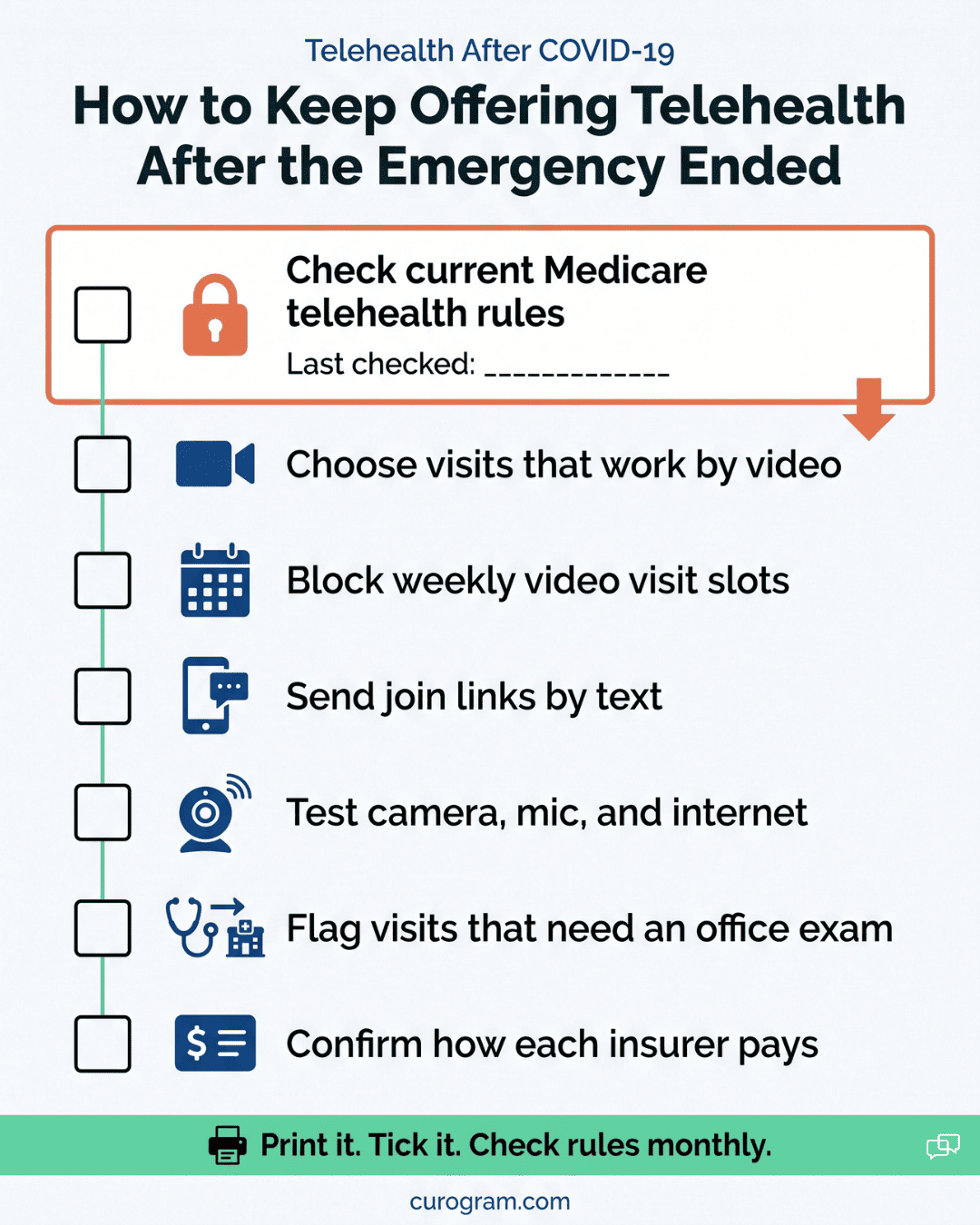
Our view is that telehealth belongs on your regular schedule. Set aside slots for follow-ups, medication checks, and test result reviews, and patients get an easy way to stay on track.
Medicare’s telehealth rules have changed several times since 2020, so check what’s in effect before you plan.
The US government is also working to get better at spotting and responding to outbreaks. When the next one comes, practices that already run video visits every week won’t be scrambling to set them up.
Curogram lets your patients join a video visit from a text link, with no app to download. Book a demo to see how it fits into your day.

1 min read
Michael Hsu : 2/8/22, 6:08 AM
💡 Telemedicine CPT codes are the billing codes you use to get paid for care delivered by video or phone. Most virtual visits use the same E/M...

1 min read
 Joshua Inciso : 2/8/22, 6:13 AM
Medicare is a federal health insurance program in the United States that facilitates medical care by providing health insurance to people over 65...

1 min read
Michael Hsu : 6/20/20, 10:49 AM
💡 Telemedicine in Maryland runs on three sets of rules: state insurance law, Medicaid policy, and licensing board rules. The Preserve Telehealth...