



13 min read
Panel Size Management for Therapists and Psychiatrists
Aubreigh Lee Daculug
:
May 3, 2026
There is no single "right" number. The right panel size balances clinician wellbeing, patient access, clinical quality, and revenue.
This guide covers benchmark ranges by role, the trade-offs of larger versus smaller panels, five warning signs your team is overloaded, and how to right-size caseloads without breaking patient access.
It also explains how panel definitions in behavioral health differ from primary care.
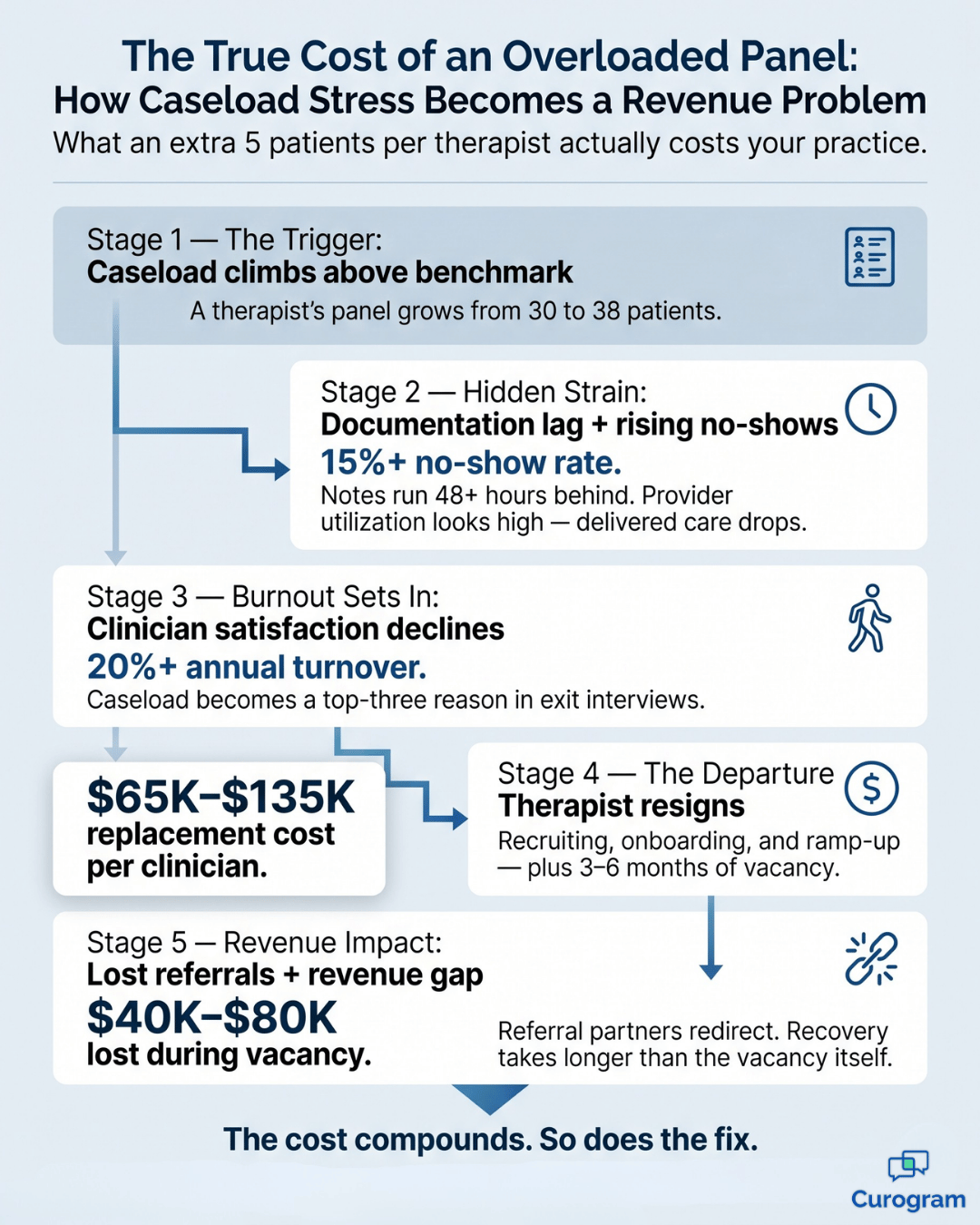
Your best therapist just gave notice. You're not surprised. You watched her caseload creep from 28 patients to 41 over six months. She stopped taking lunch. Her notes started running three days behind.
Now you have a four-week waitlist, a referral partner asking why their patients can't get in, and one less clinician to absorb the demand.
This is the cost of getting therapist panel size wrong. And most behavioral health practices are getting it wrong, because nobody can agree on what "right" looks like.
A primary care doctor's panel of 1,800 patients is well-studied. A therapist's panel? It depends on whether you mean active weekly patients, intermittent ones, or everyone in your EHR with an open chart. It depends on whether they do 45-minute therapy or 15-minute medication checks. It depends on acuity, no-show rates, and how much of the admin work falls on the clinician's desk.
If you're scaling past 10 clinicians, this becomes a strategic decision, not a scheduling one — and tools like Curogram's TherapyNotes integration can shape how that decision plays out in practice.
This article walks through benchmark ranges for therapists and psychiatrists, the real trade-offs of bigger and smaller panels, and the five signals that tell you your clinicians are carrying too much. We'll also cover practical ways to right-size without sending patients back to the waitlist.
The goal isn't to land on one magic number. It's to give you a framework you can defend to your clinicians, your board, and your referral partners.
What "Panel" Actually Means in Behavioral Health
Before you can manage panel size, you have to define it. And in behavioral health, that's harder than it sounds. A panel is the set of patients a clinician is responsible for — the question is which patients count.
Active vs. empaneled patients
An active patient is one a clinician has seen recently, usually within the last 90 days. An empaneled patient is anyone formally assigned to that clinician, whether they're showing up or not.
The gap between these two numbers can be huge. A therapist might have 60 patients on her roster but only 28 she's actively seeing.
The other 32 usually fall into one of three buckets:
- Between episodes of care, expected to return
- Lost to follow-up, with no recent contact
- Clinically ready for discharge but never formally closed
If you measure mental health caseload using the empaneled number, you'll overestimate workload. If you measure it using only active patients, you'll underestimate the administrative tail.
Most practices need to track both, and they need to clean up the inactive list quarterly.
The administrative tail matters more than most clinic directors realize. Even patients who haven't been seen in six months can generate work — refill requests, records releases, insurance questions, and the occasional crisis call. That work doesn't show up on a schedule, but it eats real clinician time, especially in practice characteristics affecting panel size.
This is also where definitions start to affect strategy. If your leadership team measures panel size one way and your clinicians experience it another way, you'll have ongoing disagreements about whether anyone is "full." Getting everyone aligned on a single definition is a small fix with outsized payoff.
How panel definitions differ from primary care
In primary care, a panel of 1,800–2,500 patients is standard. Patients are seen once or twice a year. Visits are short. The relationship is continuous but low-frequency.
Behavioral health works the opposite way. Visits are long, frequent, and emotionally demanding. A weekly therapy patient consumes roughly 50 times the clinician hours of a typical primary care patient over a year. That's why therapist caseload numbers look so much smaller — and why borrowing primary care benchmarks is a mistake.
The math gets even sharper when you factor in continuity. Primary care patients can usually see any provider in a practice without losing much continuity. Behavioral health patients can't. The therapeutic relationship is part of the treatment, so swapping clinicians has real clinical cost.
That makes panel size in behavioral health less flexible than in primary care. You can't easily redistribute patients when one clinician gets overloaded. Every assignment is, in effect, a long-term commitment.
Benchmark Ranges by Role and Care Model
There's no single industry standard for behavioral health panel management. Professional associations publish ranges, but those ranges are wide and contested. The numbers below reflect the most commonly cited benchmarks and can serve as a reasonable starting point for workforce capacity planning.
| Role and Model | Typical Active Panel | Visit Frequency | Notes |
|---|---|---|---|
| Outpatient therapist (weekly therapy) | 25–35 patients | Weekly, 45–60 min | Assumes 25–28 billable hours per week |
| Therapist (brief or intermittent) | 50–80 patients | Every 2–6 weeks | Common in EAP, brief CBT, or maintenance models |
| Psychiatrist (med management) | 200–400 patients | Every 1–3 months | Higher end requires strong support staff |
| Psychiatrist (combined therapy + meds) | 60–120 patients | Mixed cadence | Limited by therapy hours |
| Integrated BH consultant (primary care) | 500–1,000 contacts/year | Brief, often single-visit | Volume-based, not panel-based |
Therapists doing weekly outpatient therapy
A full-time therapist carrying 25–35 active patients is the most cited range. At 28 billable hours per week, you're looking at every patient seen weekly, with a small buffer for cancellations and intake. Push above 35 and either visit frequency drops or the clinician absorbs the gap on their own time.
The 25 vs 35 split usually reflects acuity.
A therapist working with high-acuity trauma patients, for example, will sit closer to 25.
A therapist running lower-intensity supportive therapy can comfortably hold 30–35.
Newer clinicians also belong on the lower end. Documentation takes longer, supervision adds hours, and treatment planning is less automatic. Pushing a first-year therapist toward 35 patients is one of the most reliable ways to drive early-career turnover.
Therapists in brief or intermittent models
Some practices run shorter, more episodic care. EAP therapists, for example, often work in 6-session blocks. Maintenance therapy might mean once-a-month check-ins.
Under these models, outpatient therapy caseload size can climb to 50–80 active patients. The total clinical hours stay the same — the patients just rotate faster.
The trade-off is administrative load. Faster turnover means more intakes, more discharges, and more documentation per patient hour. If your front-office team isn't equipped for that volume, the savings in clinical hours get eaten up by paperwork.
Psychiatrists doing medication management
A psychiatrist seeing established medication patients every 1–3 months can carry 200–400 active patients. The lower end fits a generalist seeing complex cases. The upper end usually requires a strong front-office team, EMR/EHR integration, and reliable patient outreach.
A psychiatrist panel size above 400 is achievable, but it tends to push administrative burden onto the prescriber and creates real risk around medication reconciliation and follow-up.
Visit length is the key variable here.
A 15-minute med check supports a much larger panel than a 30-minute one. Practices that try to grow a psychiatrist's panel without shortening visits usually end up with overflow that lands on evenings and weekends.
The other variable is patient mix. Stable patients on long-standing regimens can be seen every 3 months. Newly stabilized patients or those with active symptom changes need monthly visits. A panel that drifts toward higher acuity quietly shrinks even when the headcount stays the same.
Integrated behavioral health consultants
In primary care integration, the model isn't really a panel — it's a volume target. A full-time consultant might handle 500–1,000 patient contacts per year through brief, problem-focused visits. Workforce capacity planning here looks more like ED triage than traditional outpatient.
The work is structured around access, not relationship. Patients are typically warm-handed off from a primary care provider, seen once or twice, and either resolved or stepped up to specialty care. Long-term therapy isn't the goal.
That makes traditional panel-size benchmarks meaningless for these roles. The right metrics are contact volume, time-to-access, and conversion rate to specialty care — not how many patients are "on the panel."
The Trade-Offs Between Bigger and Smaller Panels
Every panel-size decision is a trade-off. There is no version where you optimize one variable and the others stay neutral. Four trade-offs matter most, and they tend to move together.
Clinician wellbeing
This is the variable practices underweight most often. A therapist seeing 40 patients a week instead of 30 isn't 33% busier — they're carrying 33% more emotional load, more documentation, more crisis calls, and more between-session worry.
Burnout drives turnover, and turnover is expensive. Replacing a therapist costs roughly 6–9 months of their salary once you factor in recruiting, onboarding, and lost revenue during the gap.
$65K–$135K |
| The all-in cost of replacing a single mid-career therapist. Lose two in a year and you've absorbed the cost of a full-time hire without adding a single patient slot. |
Patient access and waitlists
Smaller panels mean shorter waits for current patients but longer waits for new ones. Larger panels do the opposite. Patient access is a zero-sum problem unless you add capacity, which means hiring or expanding hours.
A four-week new-patient wait is the threshold most clinic directors flag as a problem. Beyond that, referral partners stop sending and patients start dropping out before their first visit.
Lost referrals are particularly costly because they're sticky. A primary care office that gets used to sending patients to a different practice doesn't switch back easily, even after your wait times improve. Recovering a referral relationship takes longer than losing one.

Clinical quality and outcomes
Quality is harder to measure than wellbeing or access, but the data is consistent. Patients seen by clinicians with overloaded panels are more likely to no-show, less likely to complete a full course of treatment, and less likely to show measurable symptom improvement.
This is where measurement-based care becomes essential. Without outcome tracking, you can't tell whether bigger panels are quietly hurting your clinical results.
Symptom improvement also tends to plateau when clinicians are stretched. Treatment plans get reused. Session prep time drops. The quality of clinical decision-making suffers in ways that are real but invisible without outcome data.
This is the trade-off most boards underestimate. Revenue numbers might look fine for two or three quarters before the outcomes catch up to the workload.
Practice revenue
Bigger panels look like more revenue on a spreadsheet. In practice, the math is messier.
A panel that's 20% larger rarely produces 20% more net revenue once you account for higher cancellation rates, more documentation overtime, faster turnover, and the slow erosion of referral relationships.
The cleanest way to see this is to compare two clinicians side by side — one carrying 30 patients with a 5% no-show rate and another carrying 38 with a 15% no-show rate. The second clinician looks busier on paper but often delivers fewer billed visits per week.
$40K–$80K |
| The lost revenue during a typical 3–6 month therapist vacancy. That's revenue your remaining clinicians can't recover, no matter how many extra patients they take on. |
Revenue volatility is the bigger issue for most practices. Panels that are pushed to maximum capacity have no slack — so when one clinician leaves or goes on extended leave, the whole system stalls.
Building in 10–15% buffer capacity sounds expensive, but it stabilizes revenue more than any other operational change.
5 Signs Your Clinicians' Panels Are Too Large
You don't need a workforce study to know your panels are too big. The signals show up in your scheduling data, your EHR, and your exit interviews.
Here are five that consistently predict trouble.
A waitlist beyond four weeks
Once new patients are waiting more than a month for an intake, two things happen. Show rates for the eventual first visit drop sharply. And referring providers — primary care, schools, hospitals — start sending patients elsewhere.
The first effect is well-documented. Patients who wait 4+ weeks for an intake are roughly twice as likely to no-show as those seen within 2 weeks. Their motivation fades, their crisis resolves on its own, or they find another provider.
The second effect is slower but more permanent. Referral partners build habits, and once they redirect patients away from your practice, getting them back takes months of relationship work.
Rising cancellation and no-show rates
When clinicians are overloaded, patients feel it. Sessions get rescheduled. Reminders go out late. The therapeutic alliance weakens.
A no-show rate climbing past 15% is usually a panel problem disguised as a patient problem. Provider utilization looks high on paper, but the actual delivered care is dropping.
The pattern is easy to miss because it builds gradually.
A no-show rate creeping from 8% to 12% to 15% over six months looks like normal seasonal drift until you compare it to clinicians whose panels stayed stable.
The overloaded ones are almost always the ones whose rates climbed.

Documentation slipping behind
If your clinicians are routinely 48 hours or more behind on notes, their panels are too large. Documentation lag isn't a discipline issue. It's a capacity issue, and it creates real compliance and billing risk.
Late notes also affect revenue directly. Claims tied to incomplete documentation either don't get submitted on time or get denied for missing detail.
A clinic with chronic documentation lag often has a quiet 5–10% revenue leak it never traces back to caseload.
The audit risk is harder to quantify but worth taking seriously. State licensing boards, payers, and accreditation bodies all expect timely documentation, and chronic lag becomes a liability the moment anyone reviews a chart.
Clinician turnover above 20% annually
The behavioral health workforce shortage means everyone is losing some clinicians. But if your annual turnover is sitting above 20%, panel size is likely a contributing cause. Exit interviews almost always surface caseload as a top-three reason.
6–9 months of salary |
| The replacement cost of a single therapist, once you include recruiting, onboarding, and ramp-up time. Caseload is one of the few drivers of that cost you can actually control. |
Drops in clinician-reported satisfaction
Most practices already run quarterly clinician surveys. Three specific items are the early warning system:
- "I have enough time to do my work well"
- "I can take time off when I need to"
- "I'd recommend working here to a colleague"
When two or more of those scores slide quarter over quarter, panel size is usually the cause. Pair survey data with utilization numbers before you adjust assignments.
How to Right-Size Without Breaking Patient Access
Reducing panel size sounds simple. Just see fewer patients. Except every patient you stop seeing is a patient who needs care, and most clinic directors aren't willing to make that trade-off bluntly. The good news is there are smarter ways to do it, and most practices can pull on more than one lever at once.
Stratify patients by acuity and frequency
Not every patient needs weekly therapy forever. Some need it for 12 weeks. Some can move to every-other-week. Some are ready for monthly maintenance.
A simple acuity review — done quarterly — can shift 15–25% of a typical therapy caseload to lower-frequency care without harming outcomes. Picture a therapist with a panel of 32, all seen weekly. After stratification, that same panel might look like 22 weekly patients, 8 biweekly, and 2 monthly. The clinical hours add up to about 5 fewer hours per week — which translates to roughly 5 new patient slots without adding a single clinical hour.
That's the difference between a four-week waitlist and a one-week waitlist.
Stratification works best when it's normalized as part of treatment, not framed as a service reduction. Patients generally accept the shift to biweekly or monthly when their clinician explains it as a sign of progress. Done well, it's a clinical milestone, not a scheduling change.
Add group and stepped-care options
Group therapy and stepped-care models multiply clinician capacity in a way one-on-one care never can. A therapist running two groups of eight patients each is delivering 16 patient-hours of care in two clinical hours.
Not every patient is a fit for groups, but many are — especially for anxiety, depression maintenance, and skills-based work. This is one of the highest-leverage moves in behavioral health panel management.
Stepped care goes further by routing patients to the lowest-intensity intervention that fits their needs. A patient with mild symptoms might start with a self-guided digital program, step up to brief therapy if needed, and only reach a full course of weekly therapy if those earlier steps don't resolve their symptoms.
Both models require infrastructure most practices don't have yet. You need referral pathways, group enrollment workflows, and clinicians comfortable running groups.
The investment is real — but so is the capacity gain.
Use measurement-based care to guide discharge
Measurement-based care — using brief tools like the PHQ-9 or GAD-7 at every visit — gives you objective data on who's improving and who's plateaued. Patients who've hit remission criteria can step down or discharge with confidence.
Without this data, clinicians often hold patients in active treatment longer than necessary, simply because there's no clear signal to stop.
The discharge conversation also gets easier when both clinician and patient can see the data. A patient looking at six months of declining PHQ-9 scores understands progress in a way that's hard to argue with. Discharge stops feeling like rejection and starts feeling like graduation.
Most EHRs designed for behavioral health now include some form of outcome tracking. The bigger barrier is workflow — getting brief assessments completed before each visit so the clinician has the data when they need it.
Shift administrative load off clinicians
A meaningful share of "panel size" pressure isn't clinical work at all. It's the administrative tail that follows every patient:
- Prior authorizations and benefit checks
- Intake paperwork and consent forms
- Reminder calls and reschedules
- Outreach to patients who've gone quiet
Curogram client data from clinical settings shows that automated patient outreach reconverts 35% of disengaged patients without clinician involvement.
That means clinicians can maintain stable panels — and stable revenue — without spending their own hours on patient recall. This is the kind of caseload management work that should never live on a clinician's desk, and is better handled through automated patient communication systems.
If you've heard discussion of these workforce models at NatCon 2026, you've seen the same theme: the highest-functioning practices are the ones treating administrative load as a leadership problem, not a clinician problem.
Conclusion
Panel size sits at the intersection of clinician wellbeing, patient access, clinical quality, and revenue. It's the single lever that touches all four. Most practices treat it as an administrative number. The strongest practices treat it as a strategic one.
The benchmarks in this article are starting points, not answers. Your right number depends on your acuity mix, your visit lengths, your support staff, your no-show rates, and your growth goals. What matters is that you set it deliberately and revisit it on a regular cadence.
The practices that get this right tend to share a few habits. They define "panel" the same way across the organization. They track it monthly, alongside waitlist length and clinician satisfaction.
And they invest in operational systems that let clinicians focus on clinical work — patient outreach, measurement-based care tracking, and intake automation — rather than chasing administrative tails.
That last point is where most practices have the most room to grow. When patient recall, reminders, and re-engagement run automatically, your clinicians can carry stable panels without burning out, and your revenue stays predictable through the seasonal dips every behavioral health practice sees.
If you're rethinking how to support your clinical team and protect access at the same time, see how Curogram serves behavioral health clinics. Our platform handles the patient outreach, recall, and engagement work that quietly inflates clinician panels — so your team can focus on care.
Book a demo to see how it fits into your workflow, and we'll walk through your current panel definitions, your bottlenecks, and where automation can give your clinicians their hours back.
Frequently Asked Questions
For a full-time therapist doing weekly 45–60 minute sessions, 25–35 active patients is the most commonly cited range. The lower end fits higher-acuity caseloads or newer clinicians. The upper end assumes strong administrative support and a manageable no-show rate.
A psychiatrist focused on medication management typically carries 200–400 active patients, depending on visit cadence and complexity. Psychiatrists doing combined therapy and medication management generally cap closer to 60–120 patients because of the time per visit.
Telehealth often improves show rates and reduces commute-driven gaps in the schedule. That can support 5–10% more patients without added clinical hours. But telehealth doesn't change the emotional load of each visit, so the gain is real but modest.
Panel utilization is the share of a clinician's expected weekly clinical hours that are actually filled with billable visits. Take billable hours delivered, divide by clinical hours scheduled, and you get utilization. Most well-run practices target 80–90% — high enough to be financially healthy, low enough to leave room for documentation and crisis response.
Quarterly is the right cadence for most practices. Monthly is too frequent — caseloads naturally fluctuate week to week, and reacting to short-term changes creates more disruption than it solves. Annually is too slow, since overload patterns can build for six months before anyone notices. A quarterly review paired with monthly tracking of waitlist length and no-show rates gives you the right balance of stability and responsiveness.