
 Michael Hsu
Is Skype HIPAA Compliant?
 Michael Hsu : 5/14/20, 12:00 AM
Is Skype HIPAA compliant? There is more to launching a profitable & streamlined telemedicine practice than whether Skype is HIPAA compliant. Learn...

The short answer has not changed in years. Messenger is not HIPAA-compliant, and the reason is a missing signature rather than a missing feature.
The pandemic rule that let practices use consumer apps also expired. It ended in 2023 and has not come back. There is a third thing the original never covered. For most practices the costlier Meta problem is not Messenger at all.
Below: the actual answer, the safeguards people argue about, and the Meta surface that has already cost health systems millions.
No. Meta will not sign a business associate agreement covering Messenger. A review of its position in January 2026 found nothing had changed.
That single fact decides it. A vendor handling protected health information on your behalf has to sign one, and no configuration substitutes for it. The safeguards below are worth understanding anyway. They are what people argue about when they want the answer to be yes.
Messenger opens to whoever is holding the phone. There is no second check before a conversation is readable. A device left on a reception desk is a reasonable thing to worry about. A shared practice account makes it worse, because nothing ties an action to a person.
There is no usable access log. You cannot show who opened a thread, when, or from where.
That matters most on the day something goes wrong. An investigation asks what was accessed, and a consumer app has no answer to give you.
This is where the original article got overtaken. Messenger turned on default end-to-end encryption in December 2023. Secret conversations are no longer a separate mode to remember.
The encryption got better, and the compliance answer stayed the same. That is the clearest proof that the agreement, not the cipher, was always the binding constraint.
Almost nobody runs a practice on Messenger. Plenty run a Meta Pixel on their own website without thinking about it.
In June 2024, a Texas court vacated part of the federal guidance on online tracking. OCR withdrew its appeal that August, so the ruling stands.
What the court struck down was narrow. An IP address visiting an ordinary public health page is no longer treated as protected information on its own.
Logged-in pages were untouched by that ruling. A Meta Pixel on a patient portal or a booking page still handles protected information. Meta signs no agreement for that either.
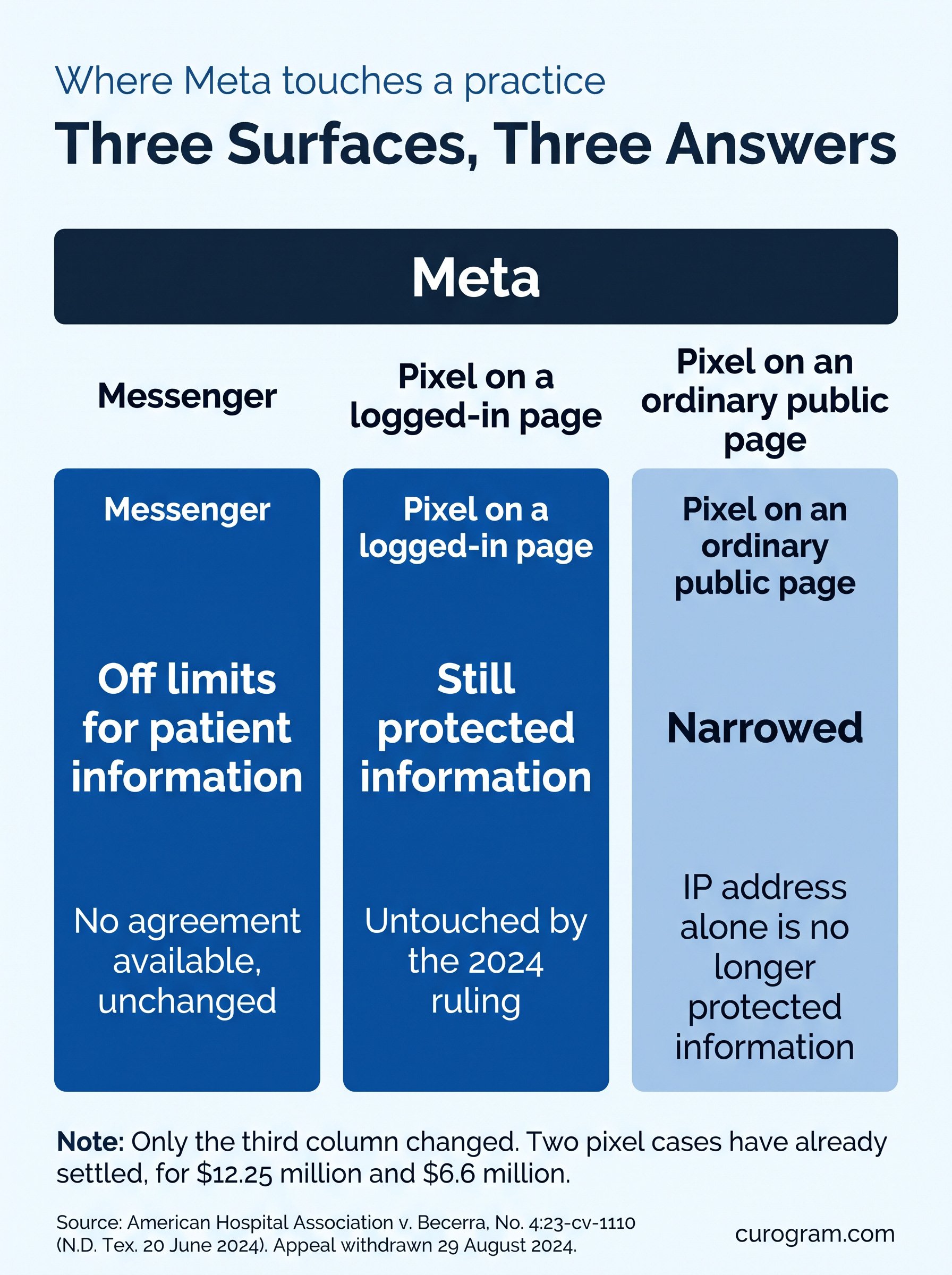
Three Meta surfaces, three different answers. Only one of them changed in 2024.
|
Where Meta touches the practice |
Current position |
|---|---|
|
Messenger for patient conversations |
Off limits for patient information. No agreement available, and that has not changed |
|
Pixel on a portal or booking page |
Still handles protected information. The 2024 ruling did not touch logged-in pages |
|
Pixel on an ordinary public page |
Narrowed. An IP address alone on a public health page is no longer protected information |
The bills are already real. Advocate Aurora Health settled a pixel claim for $12.25 million, and Novant Health settled one for $6.6 million.
This heading describes a rule that no longer exists, which is the main reason this page needed rewriting.
The enforcement discretion expired at 11:59pm on May 11, 2023. A 90-day transition for telehealth ran to 11:59pm on August 9, 2023. Nothing replaced it. A practice using a consumer app for patient information today is doing so under the ordinary rules.
If a workflow started during the emergency and nobody revisited it, that is worth an hour this month. Three years is long enough for staff to turn over. Ask whoever joined since 2023 what they were told about messaging patients.
The replacement has to do two things Messenger cannot. Carry an agreement, and leave a record attached to the patient.
Patient communication that cannot be shown to an auditor is a gap rather than a channel. Ask what the replacement logs, and for how long.
We covered HIPAA text messaging in rural clinics on Azalea Health. That piece shows what it looks like where staffing is thin.
Curogram HighlightCurogram's HIPAA-Compliant Texting sends a secure link rather than putting patient detail in the message body. A business associate agreement comes as standard, and threads attach to the patient record rather than a personal account. |

An intake form or an insurance card sent through Messenger lands in a consumer inbox outside the record. Somebody then retypes it, which is both the privacy problem and the workflow problem in one step.
Ask where a photo of an insurance card ends up. If the answer is somebody's camera roll, that is the finding.
Nothing written in Messenger reaches the chart. The conversation stays in an app your practice does not control. Ask any vendor what the connection writes back as well as what it reads. Reading alone leaves the retyping exactly where it was.
Reminders have to read the schedule to know the visit type and time. Messenger has no view of either.
Group sends are the sharper version of this. We covered sending mass text messages in athenahealth without breaking HIPAA, where the list comes from the record.
There is no way to see who is waiting, in what order, or to hand a patient between staff. Role-based access is the missing idea. Messenger has one account and one view of everything in it.
Ask who can see a waiting patient and who cannot. That list is most of what role-based access means in practice.
A reply has to reach whoever is covering, not whoever owns the phone. Consumer messaging has no concept of coverage. Our piece on two-way texting inside the CharmHealth workflow covers the return path that makes this work.
A thread that belongs to one person also leaves with that person. Staff turnover is the quiet version of this risk.
An install screen is where older patients stop. A link that opens in a browser removes most of that.
Clinicians lose time to the join, not the consultation. Test the first minute of a visit, not the platform's feature list. Ten minutes of lost joining time across a clinic day is a slot nobody booked.
Double entry is the usual complaint. If a visit leaves no trace in the chart, somebody writes it up that evening.
Records that live on a personal device are hard to bill from and harder to defend. Keep the documentation where the biller already looks.
Filled cancellations are the honest version of this. A waitlist message goes out and the first reply takes the slot.
Front desk time is the constraint in most practices. Removing retyping is the cheapest thing you can give back. Count the calls your desk makes in one week, then multiply by two minutes. That number is the budget.
One clinic in our case files moved its no-show rate from 14.20% to 4.91% over three months. That is based on our internal data.
The test is the same every time. Ask whether the vendor signs an agreement, then ask what it logs and what it writes back. Consumer tools fail at the first question, which makes the rest academic. Business tiers sometimes pass, and the free tier of the same product often does not.
Check your own website while you are at it. The pixel question reaches more practices than the messaging one ever did. Whoever runs the site may not know what is on the booking page. That conversation is usually shorter than people fear.
None of this is legal advice, and your own compliance lead should see whatever you decide.
Book a Curogram demo. One pass covers the secure link, the agreement and the write-back to the chart.
 Michael Hsu : 5/14/20, 12:00 AM
Is Skype HIPAA compliant? There is more to launching a profitable & streamlined telemedicine practice than whether Skype is HIPAA compliant. Learn...

 Joshua Inciso : 5/19/20, 5:17 AM
Is FaceTime HIPAA compliant? The short answer is no, but it's not the only reason FaceTime isn't suitable for clinic-patient communications.
 Michael Hsu : 5/19/20, 4:50 AM
HelloFax provides online faxing service, but it it HIPAA compliant or suitable for healthcare businesses in other ways? Discover more about HelloFax.