
.jpg) Mira Gwehn Revilla
Mira Gwehn Revilla
1 min read
Boost Google Reviews with Ramsoft
 Jo Galvez : Dec 17, 2025, 8:00:00 PM
💡 Boost Google reviews with Ramsoft so radiology practices build trust with patients. Most patients look at online ratings first, especially when...
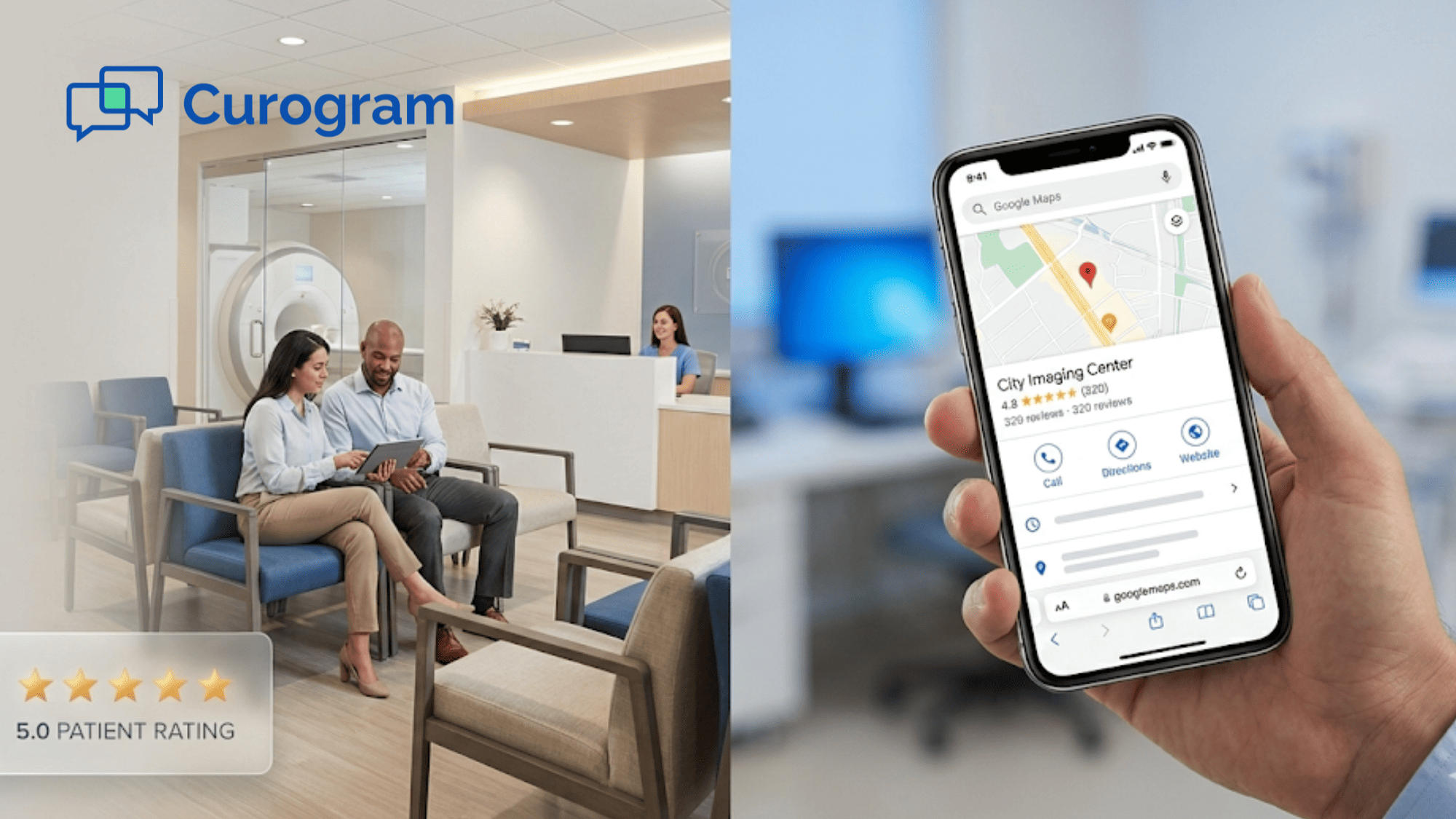
Your imaging center's Google rating shapes how patients choose where to go. A single star can make or break your revenue.
Think about it. When someone needs an MRI or CT scan, they pull out their phone. They search and compare ratings. They pick the center with the best reviews. It happens fast, and your practice either wins or loses that patient in seconds.
For StreamlineMD radiology, vascular, and IR practices, this reality hits hard. You run high-volume operations. You depend on steady referrals. One bad review can ripple through your entire patient pipeline.
But here's the good news. Reputation management isn't just about damage control. It's a proven way to boost Google reviews StreamlineMD practices rely on for growth. Done right, it drives real ROI.
The math is simple. Better ratings mean better online visibility. Better visibility means more patients find you. More patients mean more revenue. And when you automate the process, you save staff time too.
This blog breaks down exactly how reputation management pays off. We'll show you how it lifts referral volume and patient acquisition and explain how it prevents revenue leakage from preventable issues.
Whether you run a single imaging center or a multi-site network, reputation is money. Every 5-star review builds trust, and every resolved complaint saves a patient relationship. Curogram and StreamlineMD work together to make this happen.
Let's dive into the numbers and strategies that turn your online reputation into a revenue engine.
Patients choose imaging centers based on what they see online. This is not a guess. It's how modern healthcare decisions happen and why StreamlineMD integration with reputation tools matters for your bottom line.
When a patient needs a mammogram, ultrasound, or IR procedure, they search Google first. They look at star ratings. They read recent reviews. They compare your center to the one down the street. In crowded metro markets, this choice happens in under a minute.
Referring providers pay attention too. A family doctor or specialist won't keep sending patients to a center with bad reviews. They hear the complaints and see the low scores. They quietly shift referrals to higher-rated facilities. You may never know why your volume dropped.
Low-rated centers lose ground fast. In saturated markets with multiple imaging options, reputation becomes the tiebreaker. Two centers offer the same services at similar prices. One has a 4.7 rating. One has a 3.9. The 4.7 wins almost every time.
What causes bad reviews in radiology and IR? Often, it's not the clinical care. It's communication. A patient doesn't understand their prep instructions. They arrive for a scan and can't proceed. They're frustrated. They leave a 1-star review that mentions nothing about image quality or staff skill.
These are preventable problems. Clear messaging fixes them. Timely reminders fix them. Private feedback channels catch frustration before it goes public.
Here's a real-world example:
An IR center runs 40 procedures per week. They average 3 new negative reviews per month tied to scheduling confusion. Each negative review costs visibility in local search. Fewer people find the center. Appointment slots go unfilled. At $800 per procedure, even 5 missed appointments per month equals $4,000 in lost revenue.
Now flip that scenario. The same center uses automated review requests. Happy patients leave 5-star feedback right after their visit. The rating climbs from 4.1 to 4.6 over six months.
Google shows the center higher in Maps results. Phone calls increase by 15%. Revenue grows without adding a single new marketing dollar.
Strong reputation also supports pricing power. When patients trust your brand, they're less likely to shop around. They book the appointment and pay the copay. They return for follow-up imaging. This loyalty compounds over years.
For multi-site imaging networks, reputation affects the whole system. One underperforming location drags down the brand. Patients who had a bad experience at Site A won't try Site B. They'll switch to a competitor entirely.
To fix this, you should boost reputation for all locations together. Standardize the patient experience. Use consistent messaging. Route feedback through the same system. When every site improves, the whole network benefits.
Radiology, vascular, and IR practices face unique challenges here. Patients often feel anxious before scans. They may not understand what's happening. They want reassurance. When they get it, they leave positive reviews. When they don't, they vent online.
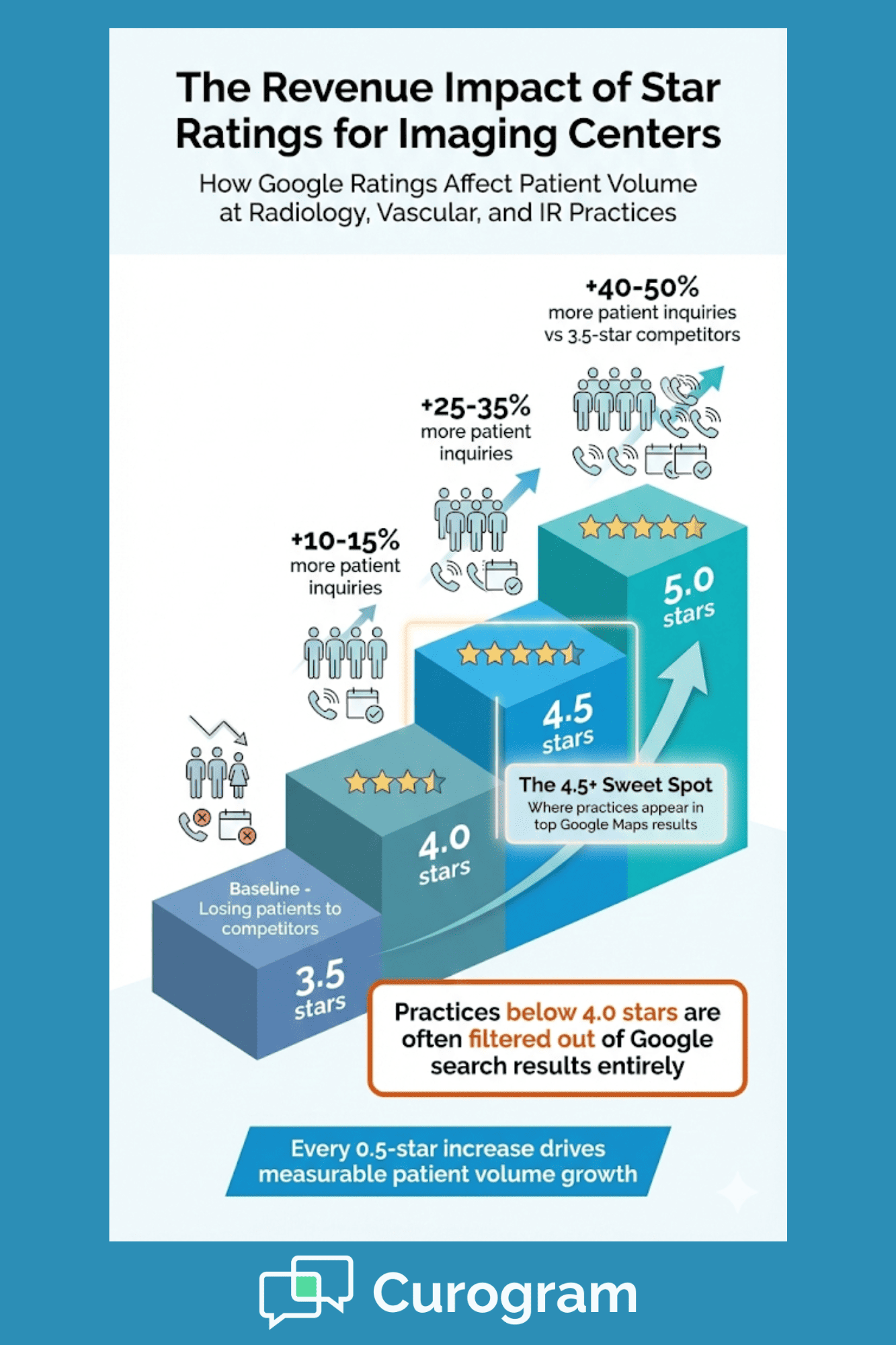
Your clinical outcomes might be excellent. Your equipment might be top-tier. But if your Google rating sits below 4 stars, none of that shows up in search results. Potential patients never see it.
This is why reputation management matters for ROI. It's not about vanity metrics. It's about connecting great care to great visibility. The connection between stars and dollars is direct. Protect your rating. Grow your revenue.
When patients can find you easily, they book appointments. When they can't, they go somewhere else. Online visibility is the first step in patient acquisition SEO, making automated review requests highly beneficial.
Google rewards imaging centers with strong reviews. The algorithm looks at quantity, quality, and recency. A center with 200 reviews averaging 4.6 stars ranks higher than one with 50 reviews at 4.2. This shows up in Google Maps and local search results.
For a vascular imaging center, this matters daily. A patient searches "vein clinic near me" or "carotid ultrasound downtown." The top three results get the clicks. Position four or lower gets ignored. Your star count pushes you up or pulls you down.
Fresh reviews carry more weight than old ones. A burst of 5-star feedback in the past 30 days signals active engagement. Google sees this as a quality marker. The center appears more often. More visibility leads to more patient inquiries.
This is how patient acquisition SEO works in practice. You're not buying ads. You're earning trust signals that Google values.
Physicians refer to centers they trust. They hear feedback from shared patients. They notice when reviews mention long wait times or rude staff. They also notice when reviews praise smooth experiences.
A primary care doctor sends 15 patients per month for imaging. They start seeing complaints on Google about your center. Even if you never hear directly, those referrals quietly shift to a competitor. You lose volume without knowing why.
The opposite happens when your reputation shines. Referring providers feel confident recommending you. They know their patients will be treated well. They keep sending cases. They might even increase volume because they trust the partnership.
This trust builds over time. Consistent positive experiences strengthen referral relationships. A steady stream of 4 and 5-star reviews proves reliability. It shows that good outcomes aren't random—they're the standard.
For interventional radiology, this matters even more. Procedures are complex. Referring physicians need to know their patients are in good hands. Your online reputation serves as public proof.
Large imaging organizations run multiple locations. Some sites naturally perform better than others. Without active management, the gap widens. Star sites thrive. Weak sites struggle.
Reputation management brings balance. Every location uses the same feedback tools. Every site captures reviews from happy patients. Problem areas get flagged early. No location falls too far behind.
This matters for brand consistency. Patients don't distinguish between Site A and Site B. They see one brand. One bad location hurts the whole network's image. One strong network lifts every location.
Example:
A 10-site radiology network averages 4.2 stars across locations. Three sites sit below 4.0. Leadership deploys automated review workflows at all sites. After six months, every location exceeds 4.3 stars. The brand gains credibility. Marketing costs drop because organic search performs better.
Systemwide growth requires systemwide effort. When all locations improve, the network becomes harder to compete against.
The result is more patients finding you and more referrals coming your way. Your online visibility becomes a growth engine that runs without constant manual effort.
Every negative review costs more than you think. It's not just about hurt feelings. It's about lost patients, lower rankings, and wasted staff time fixing problems that should never have happened.
For radiology, vascular, and IR practices, many bad reviews stem from the same root causes. Prep confusion. Scheduling mix-ups. Long wait times. Poor communication. These are all fixable issues. When you prevent them, you stop revenue from leaking out the door.
Unhappy patients want to vent. The question is where. If you give them a private channel, they'll use it. If you don't, they'll go straight to Google.
Private feedback routing works like a safety net. After each visit, patients receive a short survey. Those who had a great experience get guided toward leaving a public review. Those who had problems get routed to an internal feedback form. Staff can respond quickly. Issues get resolved before they escalate.
Here's why this matters for revenue. A 1-star review stays visible for years. It affects how every future patient perceives your center. One angry comment about "terrible wait times" might cost you dozens of bookings over time. But if that patient had emailed the office manager instead, the problem gets fixed quietly. No public damage. No lost revenue.
This is intervention in real time. Your staff catches issues before they become crises. Leadership spends less time managing reputation fires. Everyone focuses on growth instead of damage control.
Prep confusion is the single biggest cause of negative radiology reviews. A patient doesn't understand fasting rules. They eat breakfast. They show up for an abdominal CT. The scan gets canceled. They're furious.
Who do they blame? Not themselves. They blame your center. They leave a review saying nobody told them what to do. Even if you sent instructions, they didn't read them. Or they didn't understand. Or the message got lost in their inbox.
Automated reminders change this. Patients receive clear, timed messages about what to expect. The reminder comes 48 hours before. Another comes the morning of. Each message uses simple language. Each message includes specific instructions.
For complex imaging exams, this prep communication saves appointments. Contrast studies, bowel prep procedures, and interventional cases all require patient compliance. When patients understand and follow the rules, scans proceed on schedule. When they don't, everyone loses.
Consider the cost of a failed appointment. The patient is frustrated. The scanner sits empty. Staff time gets wasted on rebooking. The slot might not get filled same-day. Revenue evaporates.
Patients notice everything—from how long check-in takes to whether anyone greets them. These small moments shape their entire experience and ultimately their review.
For imaging centers, the waiting room matters. A patient walks in nervous about their scan. They stand at the front desk for five minutes while staff search for paperwork. Anxiety builds. By the time they reach the scanner, they're already unhappy. Even if the scan goes perfectly, the memory of that bad start lingers. The review reflects it.
Smooth operations earn higher scores. When patients check in quickly, get called on time, and feel informed throughout, they leave satisfied. Satisfied patients leave 5-star reviews. They tell friends. They return for future imaging.
Efficiency also reduces bottlenecks. A well-run IR suite moves patients through prep, procedure, and recovery without delays. Staff aren't scrambling. Patients aren't waiting. The whole system flows.
Think about the ripple effect. One slow patient backs up the whole afternoon schedule. Other patients wait longer than expected. They get frustrated. Their reviews mention wait times. Your online rating dips. Future patients see those comments and hesitate to book.
Now, imagine the opposite. Streamlined workflows keep everything on track. Patients leave happy. Reviews mention "fast service" and "friendly staff." Your rating climbs. More patients choose you over competitors.
Practical steps include online patient forms completed before arrival. When patients fill out paperwork on their phones, check-in takes seconds instead of minutes. No clipboards. No waiting. The front desk already has everything they need.
Digital check-in also reduces errors. Handwritten forms get misread. Online forms come in clean. Data goes straight into the system. Staff spend less time fixing mistakes. Patients spend less time waiting for corrections.
For high-volume radiology centers doing 100+ exams daily, these small gains add up fast. Five minutes saved per patient equals eight hours of staff time per day. That's a full shift worth of productivity recovered.
Positive patient experiences strengthen loyalty too. A patient who had a smooth MRI experience will return when they need a follow-up scan. They won't shop around. They'll book with you because they remember how easy it was. Over time, this repeat utilization increases lifetime patient value.
Revenue leakage happens quietly. You don't always see the patients who chose somewhere else. But the impact is real. Every smooth visit is a 5-star review earned. The ROI shows up in your numbers—higher ratings, more bookings, better retention.
Staff time costs money. Every hour spent chasing reviews is an hour not spent on patient care. Automation solves this problem for imaging centers of all sizes.
High-volume radiology centers see 50 to 100 patients daily. Asking each one for a review by hand is impossible. Staff don't have time. As they forget, requests get inconsistent.
Automated workflows handle this silently. After each appointment, patients receive a text asking about their experience. Satisfied patients tap through to Google. Unhappy patients get routed to private feedback. No staff effort required.
One front desk worker might spend 30 minutes daily on manual review outreach. Over a month, that's 10 hours. Over a year, 120 hours. At $20 per hour, that's $2,400 in labor costs—just for asking patients to leave reviews. Automation eliminates this expense entirely.
The volume advantage also matters. Manual requests might yield 5 reviews per month. Automated requests might yield 40. While they involve the same staff and patients, the output is ten times the usual volume.
Multi-site imaging networks face a scaling problem. More locations mean more reviews to manage. Hiring staff for each site gets expensive fast.
Automation scales without headcount. One system covers 5 sites or 50 sites. The workflow runs the same way everywhere. Review capture stays consistent across the network.
During peak hours, staff focus on patients, not admin tasks. The system keeps working in the background. No gaps. No missed opportunities.
For a 10-location radiology group, this means managing reputation across all sites without adding a single FTE. The savings compound as the network grows.
Early detection equals faster resolution. When problems get caught via private feedback, staff can act immediately. A quick phone call often fixes what could have become a public complaint.
Leadership benefits too. Instead of reacting to Google reviews after the damage is done, they address root causes proactively. Patterns emerge. Maybe one technologist gets repeated complaints. Maybe one time slot runs behind consistently. Data guides improvement.
This shifts time from crisis management to strategic tasks. Managers plan growth instead of putting out fires. Directors focus on quality initiatives instead of reputation repair. The whole organization operates more smoothly.
Healthcare faces strict rules about patient data. Reputation workflows must respect those rules while still driving results.
Staff texting patients from personal phones creates liability. Personal devices lack encryption. Messages mix with private conversations. Auditors see red flags everywhere.
HIPAA-compliant platforms keep communication secure. Messages go through protected channels. Patient information stays separate from public review content. No gray areas.
Every feedback response gets logged. Every private complaint gets tracked. This creates a paper trail that supports quality improvement.
When auditors ask about patient concerns, you have documentation. When leadership reviews trends, they see real data. This transparency helps imaging centers meet compliance standards while improving operations.
Patients need accurate prep instructions. Custom staff messages create risk. One person types the wrong fasting window. Another forgets a medication warning, and lability grows.
Standardized templates solve this. Every patient gets the same approved information. There are no freelance edits or accidental errors. Protection against unclear instructions that could harm patients or expose the organization to legal trouble.
Reputation compounds over time. The work you do today pays dividends for years. Here are the long-term returns of establishing stellar reputation:
Satisfied radiology patients come back. The patient who had a smooth CT scan returns for their follow-up. The vascular patient who felt cared for rebooks their next Doppler study. This repeated use adds up.
Lifetime patient value matters more than single visits. A patient who returns five times over three years generates far more revenue than a one-time visitor. Reputation keeps them coming back.
Hospitals and referring networks want to partner with high-rated imaging centers. A trusted brand commands respect at the negotiating table. Payers recognize quality and may offer better rates.
When your reputation leads the market, you don't compete on price alone. You compete on value. This protects margins and supports sustainable growth.
Strong reviews spark conversations. Patients tell friends. Family members share recommendations. Organic referrals flow without marketing spend.
A center known for excellent care attracts higher patient volume naturally. This growth builds on itself year after year. The initial investment in reputation management keeps paying off long after the work is done.
Reputation management works best as part of a connected system. Several related features amplify results.
HIPAA-compliant texting lets you communicate securely with patients throughout their care journey.
Mass texting helps you reach hundreds of patients at once for announcements or schedule changes.
Appointment reminders reduce no-shows by up to 75%, protecting revenue. Online patient forms speed up check-in and cut wait times.
Telehealth extends your reach to patients who can't come in person. Text-to-pay simplifies billing and accelerates collections.
Each feature strengthens patient satisfaction and operational efficiency. Together, they compound ROI gains.
When everything works together, your practice runs smoother, patients stay happier, and revenue grows steadily. Curogram integrates these tools with StreamlineMD to create a seamless experience across your imaging organization.
How Curogram Powers Reputation Management for StreamlineMD Practices
Curogram brings automation to the workflows that matter most. For radiology, vascular, and IR practices using StreamlineMD, this means turning every patient visit into a reputation-building opportunity.
The platform automates review requests without adding staff work. After each appointment, patients receive a simple text. Happy patients get guided to Google where they can boost Google reviews StreamlineMD centers need. Unsatisfied patients get routed to private feedback. Your team can respond before problems go public.
The results show up fast. Practices using Curogram see their online visibility improve as review counts climb. Higher ratings mean better local search placement. Better placement means more patients finding and choosing your center.
However, reputation is just one piece. Curogram also delivers automated appointment reminders that cut no-shows. It provides online patient forms that speed up check-in. It offers text-to-pay for faster collections. Each feature supports patient satisfaction, which feeds back into better reviews.
For multi-site imaging networks, Curogram scales easily. One platform covers every location. Reporting shows performance across the whole system. Leadership sees which sites need attention and which are thriving.
HIPAA compliance is built in. There's no need for staff to text from personal phones or patient data mixing with public content. Everything stays secure and documented for audits.
Overall, Curogram plus StreamlineMD equals measurable ROI. More reviews. Better ratings. Higher visibility. Protected revenue. Lower operational costs. All automated.
Reputation directly drives revenue for radiology, vascular, and IR practices. This isn't marketing fluff. It's measurable business reality.
Patients choose imaging centers based on Google ratings. Referring physicians send cases to centers they trust. In crowded markets, stars determine who wins and who loses patient volume.
Automated review workflows multiply the impact. You capture more 5-star feedback. You catch problems before they become public complaints. You boost Google reviews StreamlineMD practices need for growth—all without adding staff burden.
Better communication stops revenue leakage. Clear prep reminders prevent canceled scans. Smooth check-in processes earn positive reviews. Every prevented complaint protects your bottom line.
Operational costs drop when automation handles the heavy lifting. No more manual review requests. No more scrambling to respond to public criticism. Your team focuses on patients while the system handles reputation.
Compliance stays protected too. HIPAA-safe workflows keep patient data secure. Documented feedback supports audits and quality improvement. Standardized messaging reduces liability from unclear instructions.
Long-term, a strong reputation compounds. Patients return. Word-of-mouth spreads. Your brand gains pricing power and negotiation leverage. The investment pays dividends for years.
Curogram and StreamlineMD deliver these benefits together. The integration is seamless. The results are real. Imaging centers across the country use this combination to grow patient acquisition SEO performance and protect revenue.
Your online reputation is an asset. Treat it like one. Invest in the tools and workflows that build trust, capture feedback, and turn satisfied patients into public advocates.
The ROI is clear. Better ratings lead to better visibility, which leads to more patients and revenue. Book your demo today to see how Curogram plus StreamlineMD can strengthen your imaging organization's reputation.
.png)
1 min read
Jo Galvez : Dec 17, 2025, 8:00:00 PM
💡 Boost Google reviews with Ramsoft so radiology practices build trust with patients. Most patients look at online ratings first, especially when...
1 min read
Jo Galvez : Jan 5, 2026, 8:00:00 AM
💡 Imaging centers face unique trust issues. A single bad review can damage referral flow and hurt revenue across multi-site networks.Reputation...

1 min read
Sharee Narciso : Dec 12, 2025, 11:00:00 AM
💡 Online reviews shape how patients choose where to get care. When your practice has low ratings or few reviews, fewer new patients find you. ...