8 min read
Review Automation for SmartCare BH Orgs | Build Trust
Mira Gwehn Revilla
:
August 28, 2026
- A short text survey goes out after each visit, to every client seen, with no screening by mood or star rating
- Anyone who flags a concern hears back from your team and keeps the same public review link
- Google banned sentiment filtering in April 2026, so "happy clients only" setups now risk removed reviews
- The wording never names a program, a diagnosis, or a provider
- One dashboard shows rating, review count, and reply time for each site
Most review software sold to healthcare works the same way. Survey the client, send the 4- and 5-star responses to Google, park everyone else in a private form.
Google shut that door on April 16 and 17, 2026. Screening clients by expected sentiment before you send a review link now breaks its rating manipulation policy, and enforcement runs automatically.
Behavioral health feels that change harder than most fields. A parent choosing between two treatment centers reads reviews the way they'd call references. Price barely enters it. The question is whether to hand a child to strangers for 30 days.
We call that gap the Stigma Screen. It sits between a family's first search and the intake call your team never gets. Based on our internal data, 90% of new patient leads look at a Google Business Profile before they open the website.
SmartCare, built by Streamline Healthcare Solutions for behavioral health and human services, runs your clinical and billing work. It wasn't built to ask a client how a session went. It certainly wasn't built to watch nine profiles at once.
Our claim is straightforward, and the rest of this piece backs it up. The compliant version of review automation also happens to be the version that works better in behavioral health.
Ask every client, by text, after the visit. Keep the wording clear of any program, diagnosis, or provider name. Give anyone with a concern a fast private reply that runs alongside the public option instead of replacing it.
The Stigma Screen: Why Families Read Behavioral Health Reviews
Behavioral health selection is a high-trust decision, and stigma makes it a private one. Few families poll their coworkers about detox programs or first-episode psychosis clinics. They search, they read, and they decide alone.
Google reviews for a treatment center carry weight a brochure never will, because they come from people with nothing to sell.
The online reputation of a CMHC gets read by referral partners too. County case managers, school counselors, and emergency department social workers all check the profile before they send someone your way.
Recruiting runs through the same page. A licensed clinician weighing your job posting against two others reads what clients said about the place. Nine reviews and a 3.2 rating answer that question badly.
The Comparison You Lose Before Anyone Reads a Word
Two options sit side by side when a parent opens Maps. Program A holds a 4.6 rating across 12 reviews, and its newest one dates to 2021. Next to it, Program B holds a 4.4 across 843 reviews, with three posted last week. Program B gets the call.
Clinical quality never entered that decision. Google names review count and review score among the factors behind local prominence. Your thin profile also ranks lower in the map pack, before anyone reads a single comment.
Recency does its own damage. Say your last review predates your current clinical director. A family reads that as a place that may not even be open, which is a strange message from a program running 4,000 visits a month.
One Strong Site Does Not Cover a Weak One
Reputation damage at a multi-location organization shows up site by site, never in aggregate. Behavioral health reputation management for multi-location groups fails at the weakest address, because that address is the one a family in that county actually searches.
|
Site |
Reviews |
Rating |
Newest Review |
|
Main campus |
412 |
4.7 |
Last week |
|
North clinic |
38 |
4.5 |
4 months ago |
|
Crisis center |
9 |
3.2 |
2 years ago |
|
Youth program |
61 |
4.8 |
Last month |
|
Rural satellite |
3 |
2.7 |
3 years ago |
The Ask Nobody on Staff Wants to Make
A clinician closing a session about a relapse is not going to ask for 5 stars. Front desk staff feel the same weight at checkout, especially when someone is leaving a crisis appointment with a follow-up card and shaking hands.
So the ask never happens. Multiply that across 4,000 monthly visits and an organization generates roughly zero reviews from a very large number of positive experiences.
Some practices used to solve this with a tablet in the lobby. Google made that an explicit violation in April 2026. The same ban covers verbal requests made on site, review kiosks, and any review left on a device your organization owns.
Staff quotas went the same way. Telling a site manager to bring in 10 reviews this month is now named in Google's rating manipulation policy as a violation. That closes off the last manual workaround most groups had.
Where SmartCare Stops
SmartCare handles assessments, service notes, claims, and state reporting. It does that work for organizations serving behavioral health, substance use treatment, and developmental disability services. Review requests were never in scope.
Curogram connects with EHR systems used across behavioral health and runs as a parallel communication layer beside SmartCare, never as a replacement for it.
The same layer carries two-way HIPAA-compliant texting, which is where most organizations start before they turn surveys on at all.

A Post-Visit Survey That Asks Everyone, Not Just the Happy Ones
Timing does most of the work. Send the survey two to four hours after the visit closes out. Same day, while the client still remembers the front desk being decent about the copay.
Keep the send window inside business hours in the client's own time zone. A survey landing at 9 p.m. reads as a collections text. A survey landing while the client is still in your waiting room now reads as a policy violation, and it tells you very little anyway.
Skip weekends for outpatient programs. Response rates hold up better midweek, and a Monday send lets your team answer any concern before it ages.
Gating and Routing are Not the Same Setup
Two workflows look identical from the outside. One of them is now a liability.
|
Gating (now a violation) |
Routing (compliant) |
|
|
Who gets the review link |
Only clients who rate 4 or 5 |
Every client surveyed |
|
Where a concern goes |
Private form instead of Google |
Private reply, public link stays open |
|
What the profile shows |
A filtered sample |
The real spread of experiences |
|
Exposure |
Removed reviews, warning banner, suspension |
None from this practice |
FTC rule 16 CFR Part 465 took effect on October 21, 2024, and Section 465.7 covers review suppression.
Google's April 2026 update went further by banning the filter itself. Private feedback routing in healthcare stays clean on one condition: the private channel is an addition, never a substitute.
Enforcement is not theoretical. Google's 2025 Trust and Safety Report counts 292 million policy-violating reviews blocked or removed in one year. April 2026 sweeps then put warning banners on profiles that failed.
Wording That Survives Both Part 2 and Google
Message copy is where behavioral health parts ways with a dental office. A compliant request reads about like this:
"Hi Marcus, thanks for coming in today. Would you take 30 seconds to rate your visit? [link] Reply STOP to opt out."
No program name. No diagnosis. No provider name.
Under 42 CFR Part 2, the identity of a substance use program counts as protected information. A text naming your detox unit can expose a client's status to anyone holding that phone. OCR began enforcing the updated Part 2 rule on February 16, 2026.
Google's April 2026 update also banned asking clients to mention a staff member by name. Behavioral health needed that restraint already, so policy and clinical instinct point the same way for once.
Avoid scripted prompts of any kind. Requests for specific wording, a rating floor, or a program mention all read as coaching. Coached reviews are what the automated filters hunt for.
The Client Keeps Control
Consent belongs to the client at every step, and opt-out has to be honored at the number level. STOP stops everything on that line, surveys included, without a staff ticket or a next-day cleanup.
Clients choose what they write. In practice, most write about parking, scheduling, or how fast someone picked up the phone. A post-visit survey in behavioral health rarely produces clinical detail, which is exactly what you want on a public profile.
Anyone who does disclose treatment in a public review has made their own choice. Your reply still cannot confirm it, which is worth training once and writing down.
One Layer Beside SmartCare
Nothing new lands on a clinician's desk. Review automation for community mental health organizations rides the same texting layer that already sends appointment reminders and mass messages. Only one new screen exists, and it belongs to whoever owns marketing or quality.
Front desk staff keep one inbox for texting. Clinical staff keep SmartCare. Adding surveys changes the daily routine for roughly one person per region, which is the reason these projects survive past month two.
What Changes When Every Site's Profile Fills In
Take a community mental health organization running nine sites and about 4,000 visits a month across outpatient, crisis, and youth services. Eight weeks is enough to change what the profiles look like.
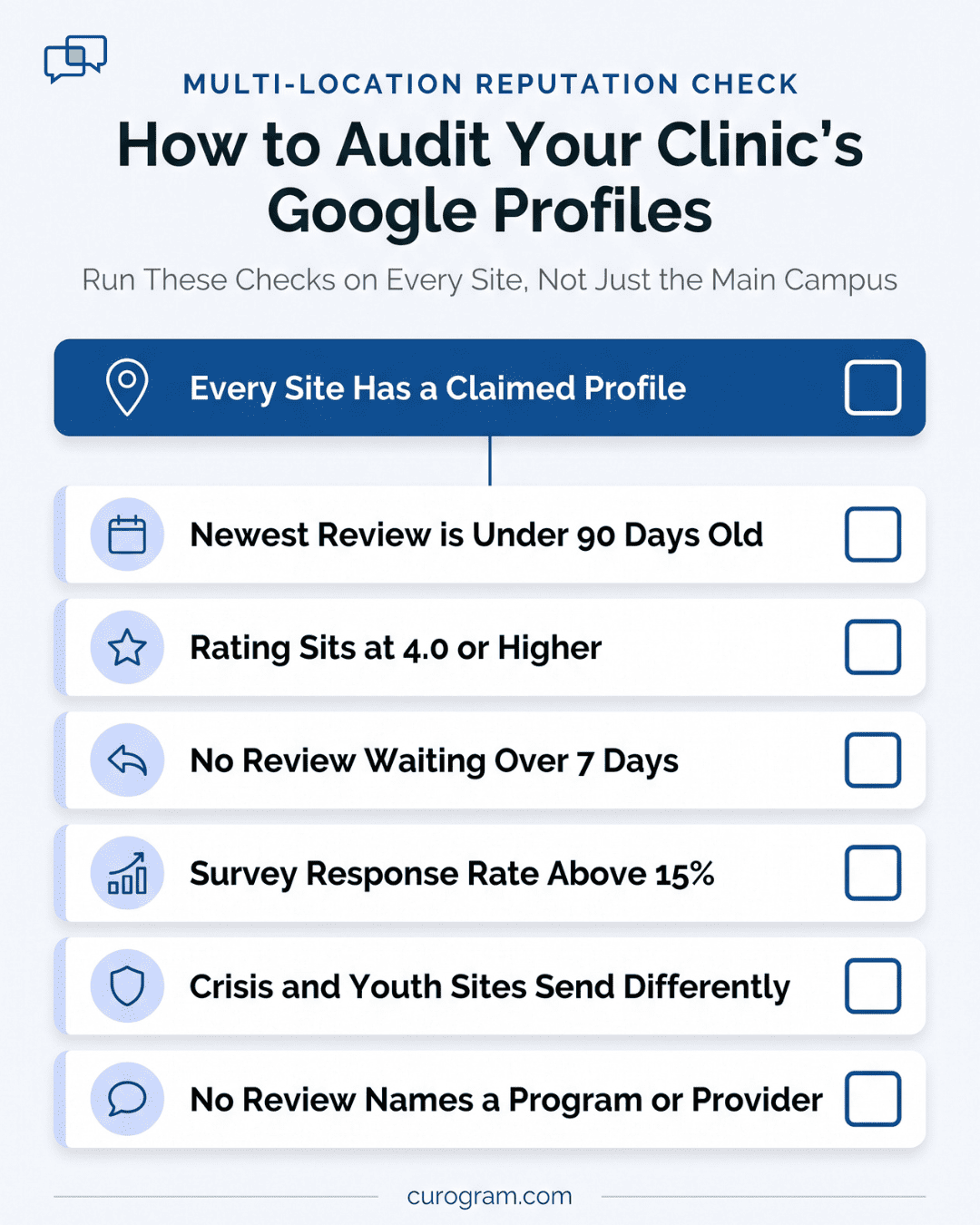
Week 1 is baseline only. Pull review count, rating, and newest review date for all nine profiles, then claim any listing nobody has verified. Two of the nine usually turn out to be unclaimed duplicates with the old suite number.
Week 2 turns the survey on at two sites, not nine.
Choose the busiest outpatient clinic and the weakest profile, because each answers a different question. Volume gets tested at one. Whether a cold profile can move at all gets tested at the other.
Week 4 gives you the first real read. That rural satellite sitting at 3 reviews for three years is at 19. Crisis center response rate is running under 10%, which usually means stale phone numbers in the chart rather than unhappy clients.
By week 8, all nine sites are live, and leadership stops asking about totals. Spread between the best and worst site becomes the number that matters, because a family searching in that county only ever sees one of them.
Automating the Ask Without Touching the Chart
Curogram's Automated Google Reviews feature sends the post-visit survey and the review invitation from the same number your clients already text for appointment reminders.
Requests fire after the visit closes out, go to every client seen that day, and carry no program or clinical detail.
Responses that signal a problem open a two-way thread with your team. A concern reaches a person, not a report nobody reads.
Your intake supervisor answers in the same inbox used for scheduling. Clients keep the public review link either way, which is what holds the setup inside Google's rules.
Leadership logs into the multi-location dashboard. Review volume, average rating, and reply activity break out by site. A director covering nine addresses spots the quiet one in about four seconds. Adding a tenth site adds a row, not a project.
Setup runs beside SmartCare rather than through it. Clinical staff keep their workflow. Nobody adds a click to a service note, and no one at the front desk has to say the words out loud.
Conclusion: Let the Mission Show
Trust is your currency, and most behavioral health organizations spend years earning it where nobody can see. Families deciding whether to call cannot read your outcome data or your CARF accreditation. They read 40 reviews and a star rating.
SmartCare delivers the care. Something else has to make that care findable, and that job now comes with rules attached. Ask everyone, keep the wording clean, and answer concerns privately and fast without closing the public door.
One multi-location practice built 1,064 new 5-star reviews in 3 months on that pattern, based on our internal data. Organizations that get there first in a county tend to stay there, since review history compounds and a competitor cannot buy three years of it.
Schedule a demo and we will audit one of your locations live. You will see the profile gap for that site. You will also see how many reviews it should earn at current visit volume, and what a compliant ask looks like in your own wording.
Frequently Asked Questions
Send the request by text after the visit, never in person and never on a clinic device. Keep it to one sentence, one link, and a clear opt-out. Wording should not reference the program, the diagnosis, or the clinician. Most clients who respond write about scheduling or front desk service rather than anything clinical.
Whether the public option stays open is the whole difference. Gating sends the Google link only to clients predicted to be positive, which Google banned in April 2026. Routing surveys everyone, gives every client the same link, and adds a private reply for anyone raising a concern. One filters the sample; the other adds a service recovery step.
Watch the spread rather than the total. A dashboard broken out by location shows review count, rating, and unanswered reviews per address. A crisis center sitting at nine reviews stands out fast against a main campus at 412. Families search by county, so your weakest profile is the one most prospects meet.
Reply without confirming that the person was ever a client. Thank them, offer a phone number or email, and move it offline. Confirming care in a public reply can disclose protected information under HIPAA and, for substance use programs, under 42 CFR Part 2. Train one person per region on the exact wording.
Volume follows visit count. A site seeing 300 visits a month at a 20% response rate produces roughly 60 survey responses. First reviews usually land within days of turning it on, with a visible rating shift inside four to eight weeks. Sites with stale phone numbers move slower until someone cleans the contact data.