
4 min read

Why Patients Should Never Get a Text From a Nurse's Personal Phone

Why Patients Should Never Get a Text From a Nurse's Personal Phone
💡Secure patient texting without personal phones in Practice Fusion offices protects the patient first. The patient carries the risk of a channel they never agreed to.

A message from a staff member's own cell arrives with no way to verify the sender, no privacy protection, and no path into the care record.

Curogram assigns each office a single number the patient has already seen before, running on HIPAA-compliant infrastructure with SOC 2 Type II certification behind it.

Threads land on the Practice Fusion chart. Pew Research found 80% of U.S. adults don't generally answer cellphone calls from unknown numbers, and people apply that same instinct to texts. An instruction from a number the patient can't place often does no clinical work at all.


Unread instructions are a clinical problem. Unknown numbers are how instructions go unread.

Pew Research surveyed 10,211 adults and found 80% don't generally answer their cellphone when an unknown number calls. Nobody has taught patients to treat texts differently, and the screening instinct is the same.

Consider what a medical assistant at your Oak Hill office sends from her own phone at 4:40 on a Friday:

> Stop the amoxicillin — your culture came back negative.

The patient's phone shows a number from an area code he half-recognizes. It lands in his list between a delivery notification and a fundraising text. He doesn't open it. He finishes the course.

Our claim: for patients, the sending number is a clinical safety feature, not a branding detail. A message that can't be verified doesn't get acted on. The ones that do cost you something: that patient just learned to trust a stranger.

None of this is a staffing failure. Staff improvise because the sanctioned route is slower than the patient's need, and improvising is what good clinical instincts look like inside a bad workflow. The cost just lands on someone who never got a vote.

Three things below: how this reads from the patient's side of the screen, what one office number changes, and who can see the thread afterward.

The Villain: The Mystery Number

The Message That Sat There for Four Days

Four extra days of an antibiotic he didn't need. That's the outcome of an unread text, and the office has no idea it happened, because there's nothing to check.

Getting a text from an unknown number, saying they’re from the clinic, puts the patient in an impossible spot. Act on medical advice they can't confirm, or don't. Most people decline that invitation and treat it as spam, which is the reasonable response.

Where the Reply Goes

Say he does open it and texts back a question about the rash on his forearm. That reply reaches one phone, currently in a gym bag, on silent. The medical assistant reads it at 7:40 Monday morning.

Nobody else could have answered it. The thread doesn't exist anywhere the covering staff can see, so from the secure messaging patient perspective, the office went quiet.

Teaching Patients the Wrong Lesson

Every helpful text from an unrecognized number trains a patient to open unrecognized numbers. That's the exact habit that makes scam texts work, and clinics are building it one dosage instruction at a time.

Personal cell PHI risk compounds from there. Lose the phone, and the exchange is exposed. The rest of the team can't see it either way. It's gone the day the medical assistant takes a job at the hospital.

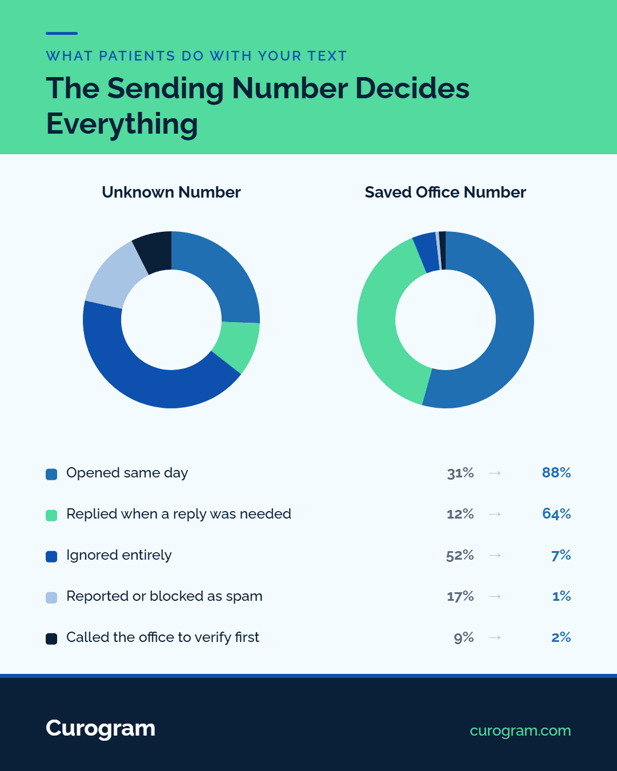
Comparison of open rates, replies, verifications with messages sent from unknown and saved office numbers

The Guide: The Compliance Backbone

Keep the Speed, Change the Sender

Curogram acts as the compliance backbone without slowing anyone down. A message on the office line goes out in roughly the time a personal text takes. What changes is the number on the patient's screen and where the thread lives afterward.

Curogram Highlight: Verified Office Numbers

Verified Office Numbers give each office one line patients already have in their contacts. Visit reminders, fasting instructions, a balance question, a lab result — all of these messages come from that one line, every time.

Patients trust the official clinic number because it's the one printed on the appointment card and answered when they call it. Consistency is what makes it verifiable — one line per office means each message vouches for the next.

Reminders run from it too, which is why centralized reminder governance and clinical texting reinforce each other rather than competing for the patient's attention.

The Thread Belongs to the Office

Conversations sync to the Practice Fusion chart. Monday's question about the rash is visible to whoever is covering, attached to the record instead of to a person.

Patient data protection stops depending on one employee's lock screen, backup settings, and length of employment — and starts depending on infrastructure the practice actually controls.

The Success: One Trusted Number, Total Continuity

Nothing Rides on a Personal Device

Every exchange recorded, protected, and continuable by anyone authorized. No thread walks out in a pocket, and no patient question waits until Monday because it landed on a phone that was off.

Recognition Does the Work

A patient who has texted the Oak Hill number eleven times without a problem opens the twelfth message. Saved contacts get read. That's the practical value of one number per office, and it applies to a patient privacy standard as much as to a response rate.

Continuity Through Shift Changes

Part-time schedules, per-diem coverage, and staff turnover stop interrupting conversations. The thread belongs to the office, so the person who picks it up on Thursday has the whole history in front of them.

Conclusion: Protect the Helpers and the Helped

The improvising began for a good reason: patients needed answers the portal couldn't deliver in time. A channel that keeps that speed and drops the exposure serves everyone in the exchange.

Your record stays secured by Practice Fusion. Their conversation gets the same treatment from Curogram — sent from a number they know, filed where the next clinician will look.

Put the question to your staff this week and take the blame out of it: how often does a patient hear from a personal cell? Whatever they say, the real figure sits above it. Then make the safe way the fast way, which is where texting governance stops being paperwork.

Book a demo and watch a message go out on the governed channel. The speed is what converts the improvisers.


Frequently Asked Questions

Why does an unrecognized number stop a patient from acting on medical advice?

People screen unknown senders by default — Pew found 80% don't answer unknown callers. A patient who can't confirm who sent an instruction usually defaults to ignoring it rather than guessing.

What happens to a patient's follow-up question when the staff member is off shift?

On a governed channel, the thread belongs to the office, so whoever is covering sees it and answers. On a personal phone, the question waits until that one person next picks up their phone.

How does texting from a personal phone put the patient at risk rather than just the practice?

Their information sits on an unmanaged device with no encryption guarantee, no consent record, and no audit trail. If the phone is lost or the employee leaves, the patient has no recourse and no notification path.

Why does using one number for reminders and clinical messages matter to patients?

Mixed senders reset the verification problem every time. A single office line means each recognized message confirms the last one was legitimate, which is how trust accumulates.

How do you move patients off a staff member's cell number they already have saved?

Send the first governed message from the office line, ask the patient to save it, and route existing threads there. Recognition usually takes three or four exchanges to establish.