
7 min read

Post-Ketamine Integration Therapy via Text Video | Osmind Practices

Post-Ketamine Integration Therapy via Text Video | Osmind Practices
💡 Integration therapy after a ketamine infusion works best in a narrow window: the 24 to 72 hours when patients are most open to processing the experience. Miss that window, and you risk losing the lasting benefit the infusion created.           

The barrier is almost always access. App downloads, logins, and forgotten passwords stop patients who are still processing a profound experience.

Post-ketamine integration therapy video visits launched through an Osmind text link remove that friction—patients tap one link and the session begins.  


For Osmind practices, this protects the clinical value of every infusion by making timely follow-up effortless. 


Your patient had a breakthrough yesterday. Today, you could lose it to a login screen.

That sounds dramatic. It isn't.

Ketamine infusions open a brief, powerful window. For roughly 24 to 72 hours afterward, the brain is unusually plastic and the patient is unusually open. This is when integration therapy does its real work—helping them make sense of what they felt and turning a moving experience into lasting change.

The infusion is the catalyst. The integration session is what makes it stick.

But here's the catch. That follow-up depends on the patient joining a video visit while they're still raw, tired, and emotionally wide open. Ask them to update an app, recall a password, or fix a login in that state, and many simply can't.

So they reschedule. By the time the next session lands, the window has closed.

You did everything right. The infusion worked. Osmind captured every detail. And the most valuable part of the protocol slipped away because of a forgotten password.

This is exactly the problem that post-ketamine integration therapy video visits, launched through an Osmind text link for patient access, are built to solve. Instead of asking patients to fight with technology at their most vulnerable, you send one text link.

They tap. Their therapist appears. The session starts inside the window that matters.

No app. No password. No friction. Just the patient and their provider, on time.

For interventional psychiatry practices running ketamine protocols, this isn't a minor convenience. It's the difference between an infusion that helps for a week and one that helps for good.

Below, we'll break down why the window closes, why most video tools make it worse, and how text-launched access protects the clinical investment you've already made.

By the end, you'll see why the fix is simpler than the problem itself.

A Window That Closes Faster Than You Think

Osmind captures your ketamine session beautifully. Dosing, vital signs, patient response, outcome scales—it's all there, clean and complete.

But the chart isn't the treatment. The integration session is.

That session depends on one fragile step:

The patient joining a video visit on their own, at home, within a day or two of a profound experience.

If joining means downloading an app, recalling a password, or fixing a login, the window can close before the call ever connects.

A morning that goes sideways

Your patient had their infusion yesterday afternoon. It was powerful—they touched grief they'd carried for years. This morning they feel raw and open, exactly the state where integration works best.

Their session is at 10:00. At 9:55 they open the app. It needs an update.

The update finishes at 10:02. They log in. The password fails—they changed it last month.

At 10:08 they give up and text the front desk: "Can't get in. Can we reschedule?"

The window is still open. But it's closing. By the time the session moves to Thursday, their defenses are back up. The infusion helped. The opening was lost.

Why this is more than a scheduling problem

Research on ketamine-assisted therapy keeps pointing to the same truth: the infusion is a catalyst, and integration is what turns it into lasting change.

Patients who complete timely sessions tend to report:

  • More durable symptom improvement
  • Better treatment retention
  • Higher satisfaction with their care

When the session slips, the return on the infusion slips with it.

1 in 4

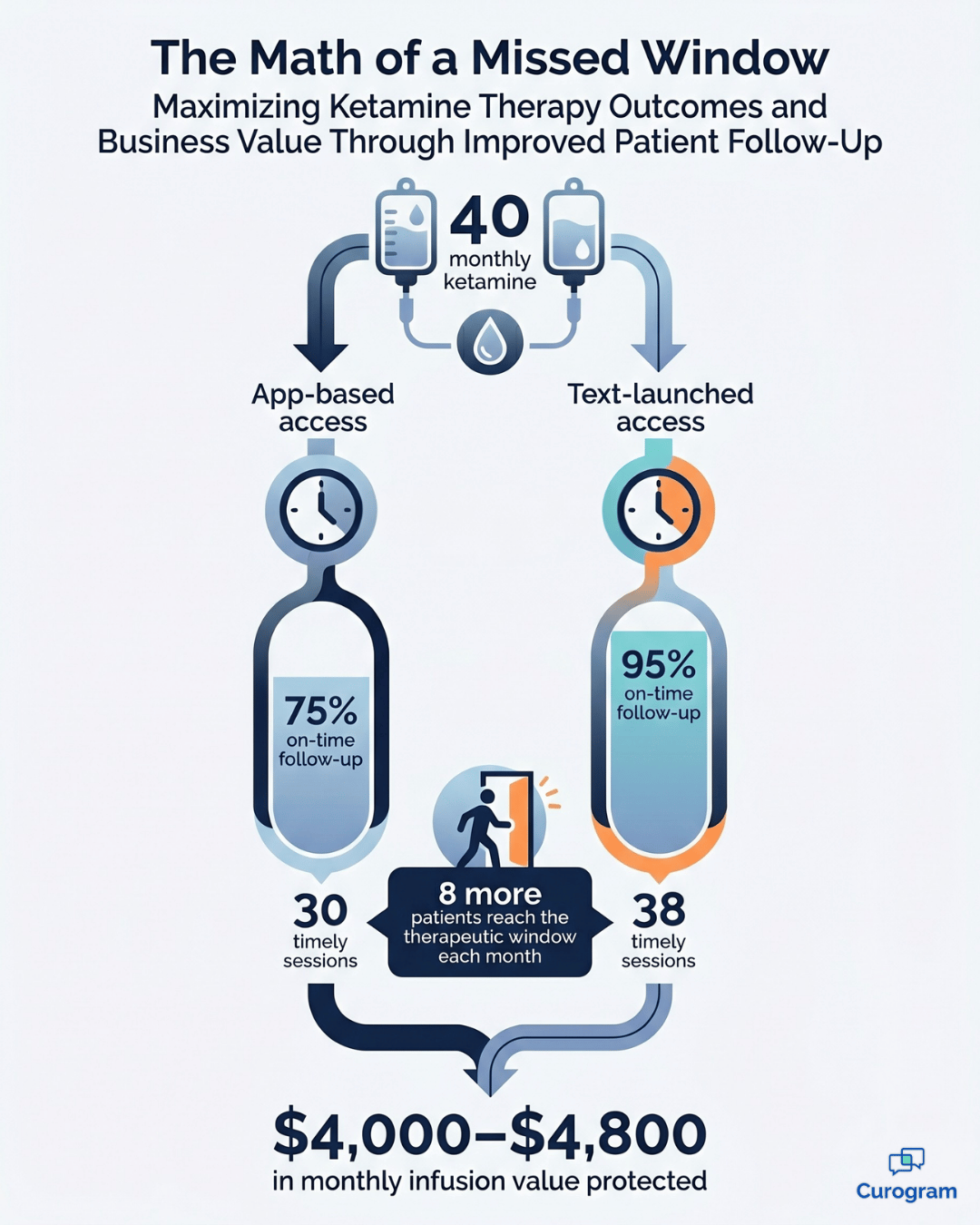
Integration sessions can fall outside the window when patients rely on app-based access—about a 75% on-time rate, with 25% slipping away.

Run the math on a single case. A $500 infusion paired with a $200 integration session isn't really two charges—it's one protocol.

Miss the $200 follow-up and you don't just lose $200. You quietly reduce the clinical value of the $500 that came before it.

Here's the part that stings. The patient who missed the session didn't skip it because they stopped caring. They were in the exact open, vulnerable state where wrestling with technology is hardest.

A system that demands the most from patients at the moment they have the least to give is working against the treatment itself.

Ketamine integration therapy follow-up rises from 75% to 95% with text access

How a Single Text Link Keeps the Window Open

Curogram protects the window by making access almost impossible to get wrong.

Five minutes before the session, a text arrives:

"Your integration session with Dr. Patel starts in 5 minutes. Tap here to join when you're ready."

They tap. The video opens in their phone's browser. The session begins. The window stays open.

Built for the moment, not just the appointment

Curogram's Contextual Video Links can be shaped for the clinical situation. For integration therapy, the reminder can use gentle, informed language that meets patients in their post-infusion state instead of cold appointment-speak.

The text feels like care, not paperwork. And the link opens instantly—no app to install, no password, no mental load when the patient has none to spare.

The result is a post-infusion follow-up video call with no app, no download, and no login standing in the way.

95%

On-time follow-up is what practices report once joining a session is a single text link—up from the 70–80% typical of app-based access.

Osmind still does the clinical work

Nothing about your Osmind workflow changes. The integration session is documented in Osmind exactly as any visit would be.

Curogram lives entirely on the access side—getting the right patient on screen at the right time, in the right state, with zero friction. Pairing ketamine ele keeps your clinical record in one place while making the patient's path effortless.

Therapist listening attentively during a ketamine integration therapy video session

Why interventional psychiatry needs this more than any specialty

No other field has quite this problem. Three things collide at once:

  • A treatment that creates a short window of mental openness
  • A therapy session designed to use that exact window
  • Access technology that's hardest to use in the very state the treatment produces

That's why this is therapeutic window follow-up built for interventional psychiatry, not a generic video tool.

Text-launched integration therapy gives ketamine patients the simplest possible path back to their provider—and the simpler the path, the more likely the session happens, and the more durable the outcome.

Healthcare everywhere! Launch a pervasive telehealth platform that's easy for both providers and patients with Curogram.

The goal is a frictionless post-treatment video visit your psychiatric practice can count on, every time.

What Changes When Follow-Up Becomes a Sure Thing

Here's where the difference shows up in numbers you can feel.

Lifting on-time follow-up from about 75% to 95% sounds minor. It isn't. In a practice running 40 infusions a month, it's the gap between 30 timely integration sessions and 38. That's 8 more patients reaching the therapeutic window every month.

Those 8 aren't just saved appointments. In practice, they're worth about $4,000–$4,800 in monthly infusion value that would otherwise deliver less than it should.

For your team, the takeaway is simple: a small change in access, a real change in outcomes.

From hoping to knowing

The shift is small but profound. You move from "I hope they can figure out the video call" to "integration is as certain as the infusion itself."

The session stops being a separate hurdle the patient clears alone.

Instead, the whole protocol flows as one connected journey:

  • Infusion — the catalyst
  • Text link — sent right on time
  • Integration session — held inside the window
  • Lasting gains — change that holds

Each step hands off cleanly to the next. The patient never has to fight the technology alone.

One patient's morning, done right

Your patient wakes up the day after their fourth infusion. Something has shifted—the depression that wouldn't move for three years feels lighter.

At 9:55 their phone buzzes: "Your integration session with Dr. Patel starts in 5 minutes. Tap here to join when you're ready."

They tap from bed. Dr. Patel appears. They start talking about what they felt during the infusion, just 18 hours earlier—well inside the window when the brain is most open.

The work they do in that session becomes the foundation for lasting change. Not because the technology impressed them. Because it disappeared.

Don't Let a Login Screen Undo Your Best Work

You've done the hard part. You built a ketamine protocol grounded in real science. You delivered an infusion that opened something in your patient. Osmind captured every detail of the work.

Now protect it.

The window after an infusion is short and precious. It's where temporary relief becomes lasting change—or where it quietly slips away. The only thing standing between your patient and that change should never be a password they can't remember.

Text-launched integration therapy access closes that gap. It makes sure post-ketamine follow-up sessions happen inside the critical therapeutic window by removing the one barrier most likely to derail them.

One text. One tap. One session that lands when it matters most.

Think of it this way. Osmind documents the infusion. Curogram makes sure the integration session that gives the infusion its meaning actually happens. One records the treatment. The other protects the window that decides whether the treatment lasts.

Because Curogram is fully HIPAA compliant and SOC 2 Type II certified, that simplicity never costs you security. The same approach that helps practices reduce virtual visit no-shows works quietly behind your ketamine protocol—no new workflow, no disruption to Osmind.

Pair it with secure online intake forms before the infusion, and the whole journey—from prep to follow-up—stays just as frictionless.

The patients who miss their window rarely miss it on purpose. They miss it because the technology asked too much at the worst possible moment. You can change that today.

Stop letting login screens close the window your infusions worked so hard to open. Give your patients the simplest possible path to the session that makes their treatment last.

Schedule a Demo to see how text-launched integration therapy access fits alongside your Osmind ketamine protocol—and hear from providers who've watched timely follow-up change what their treatment can do.


Frequently Asked Questions

Is it clinically appropriate to do integration therapy over video instead of in person?

Yes. Research supports video-based psychotherapy, and many integration therapists find patients are more comfortable processing at home—especially in the tender post-infusion state. What matters most is timing, not the screen. A session inside the therapeutic window over video beats an in-person session a week late, and text-launched access is what protects that timing.

Can the integration therapy link be sent automatically after the infusion?

Yes. Your team can pre-schedule the integration session when the infusion is booked, and the video link goes out automatically with the appointment reminder. For practices that schedule integration the day after every infusion, this runs on autopilot—no manual staff steps. The patient's follow-up link simply arrives the next morning, like clockwork.

What if the patient is too affected by the infusion to join a video session?

The text format actually helps here. If a patient gets the link and feels they're not ready, they can reply right in the thread: "Not ready today—can we try tomorrow?" Your team sees it, reschedules, and sends a fresh link for the next day—still inside the window. That two-way text channel makes rescheduling instant, instead of the phone tag a portal would require.

Is a text-launched video visit secure and HIPAA compliant?

Yes. Curogram is fully HIPAA compliant and SOC 2 Type II certified, so the convenience never comes at the cost of privacy. The link opens a secure, encrypted session—the simplicity your patient sees is matched by protection they don't have to think about. Easy access and strong security aren't a trade-off here; you get both.

Does this replace our Osmind setup, or work alongside it?

It works alongside it. Curogram doesn't replace Osmind or touch your clinical documentation—it sits entirely on the patient-access side. You keep charting the integration session in Osmind exactly as you do today, while Curogram handles getting the patient on screen at the right moment. Think of it as a layer that makes your existing workflow easier, not a system you have to swap in.