
Automate Google Reviews for Modmed Staff | No Manual Asking
 Aubreigh Lee Daculug : May 28, 2026, 5:00:00 PM
Modmed staff shouldn't ask for reviews. Curogram automates Google review requests after appointments. Zero staff effort. Book a demo.
Your happiest patients leave your clinic every day. They felt heard. They felt better. And almost none of them will ever say so online.
Not because they don't want to. Because nobody asked them.
In interventional psychiatry, this gap is brutal. You run ketamine infusion suites and TMS programs that change lives. Your outcomes are real. Yet your Google Business Profile shows a thin trickle of reviews that barely hints at the work you do.
Here's why that happens. Osmind is excellent at clinical documentation — charting, outcome tracking, safety protocols. But it has no built-in way to ask for a Google review after a visit. So the job lands on someone. Usually your front desk.
Now think about what that actually asks of them. A patient finishes an infusion. They're emotional, reflective, maybe a little disoriented. Your coordinator is supposed to smile and say, "Would you mind leaving us a review?" while three more patients wait to check out.
It feels wrong. So they skip it. And the reviews never come.
Most clinics try to fix this with sticky notes, printed cards, or a "review of the month" push. These programs always start strong. Then clinical work takes over, the reminders fade, and within weeks the whole thing quietly dies.
The cost is invisible but huge. Your reputation stalls while your competition climbs.
There's a better way, and it doesn't involve asking your staff to do one more thing. Automated review requests for Osmind clinic staff without manual follow-up turn every finished appointment into a review opportunity — automatically.
No reminders. No tracking. No awkward moment at checkout.
This article breaks down exactly how that works, what it costs you to keep doing it the old way, and the kind of results clinics see once the asking runs on its own.
Osmind does the clinical heavy lifting well. Charting, outcome tracking, safety protocols — it's built for the work that keeps patients safe. What it doesn't do is ask anyone to leave you a Google review.
So that job quietly slides onto your team. The same people already juggling infusion schedules, pre-treatment screenings, and a full waiting room are now expected to be your marketing department, too.
And the timing is impossible. A patient wraps up a ketamine session feeling raw and reflective. Are you really going to hand them a card and ask them to find your listing online? Most coordinators won't. It feels pushy at exactly the wrong moment.
So the ask gets skipped. Over and over.
Even when a manual program does run, it barely moves the needle.
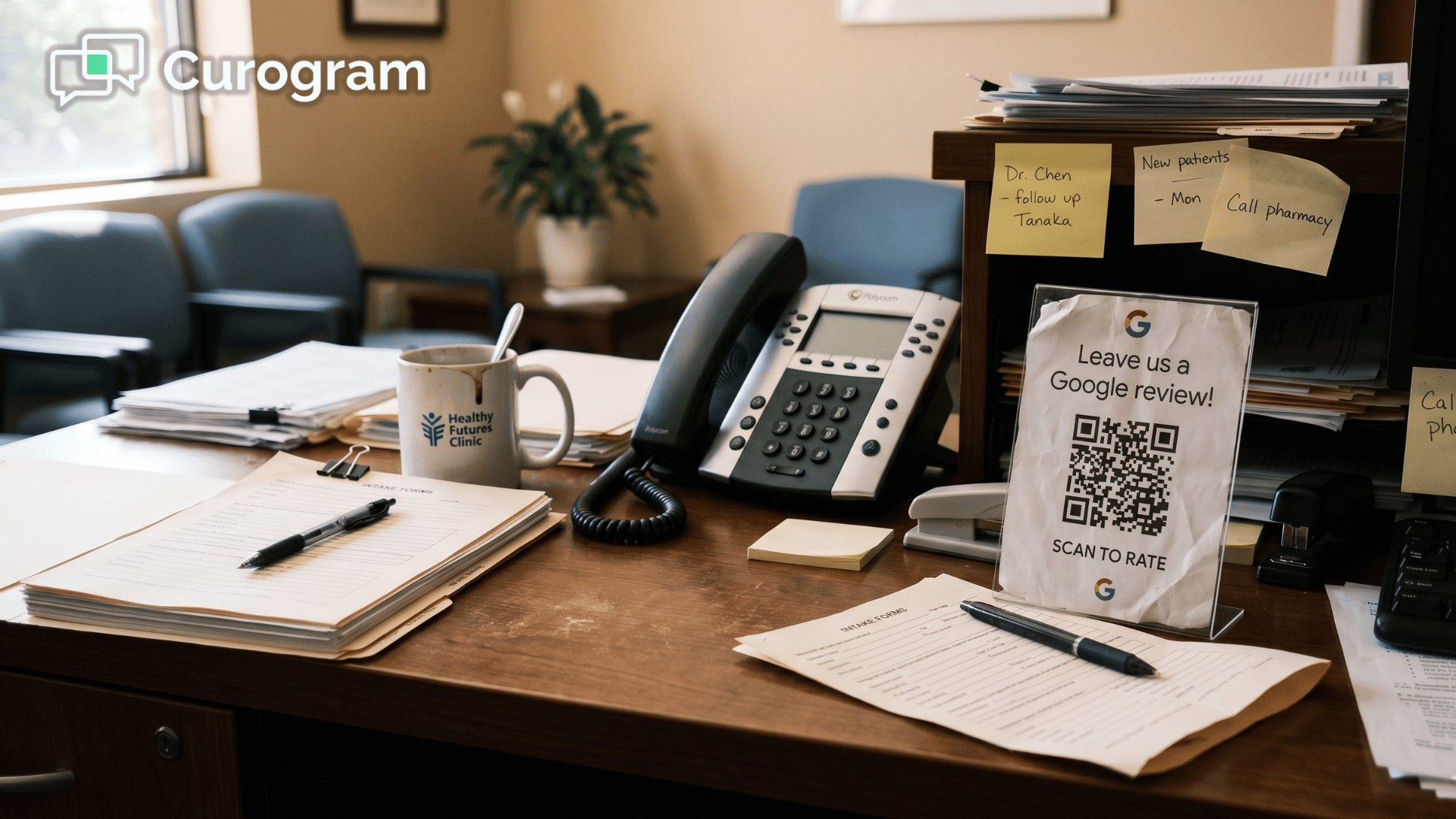
A well-meaning "remember to ask" effort captures only 5%–10% of eligible patients, and it's easy to see why:
Any one of these would dent your numbers. Together, they flatten the whole program.
Here's the math that should worry you. Say your clinic completes 300 visits a month.
At a 5%–10% capture rate, that's 15 to 30 review requests that actually land — in a perfect month. Most months aren't perfect.
The sticky notes come down, the initiative fades, and you're back to near zero.
Meanwhile, your profile tells the wrong story. You perform hundreds of successful treatments, but Google shows only a handful of reviews. New patients can't tell the difference between a great clinic and an average one. They just see the number.
That's the real cost. Not the missing reviews — the patients who never call because your profile didn't convince them.
What if the request happened on its own, every time, without anyone remembering to send it?
That's the whole idea behind Curogram's review automation.
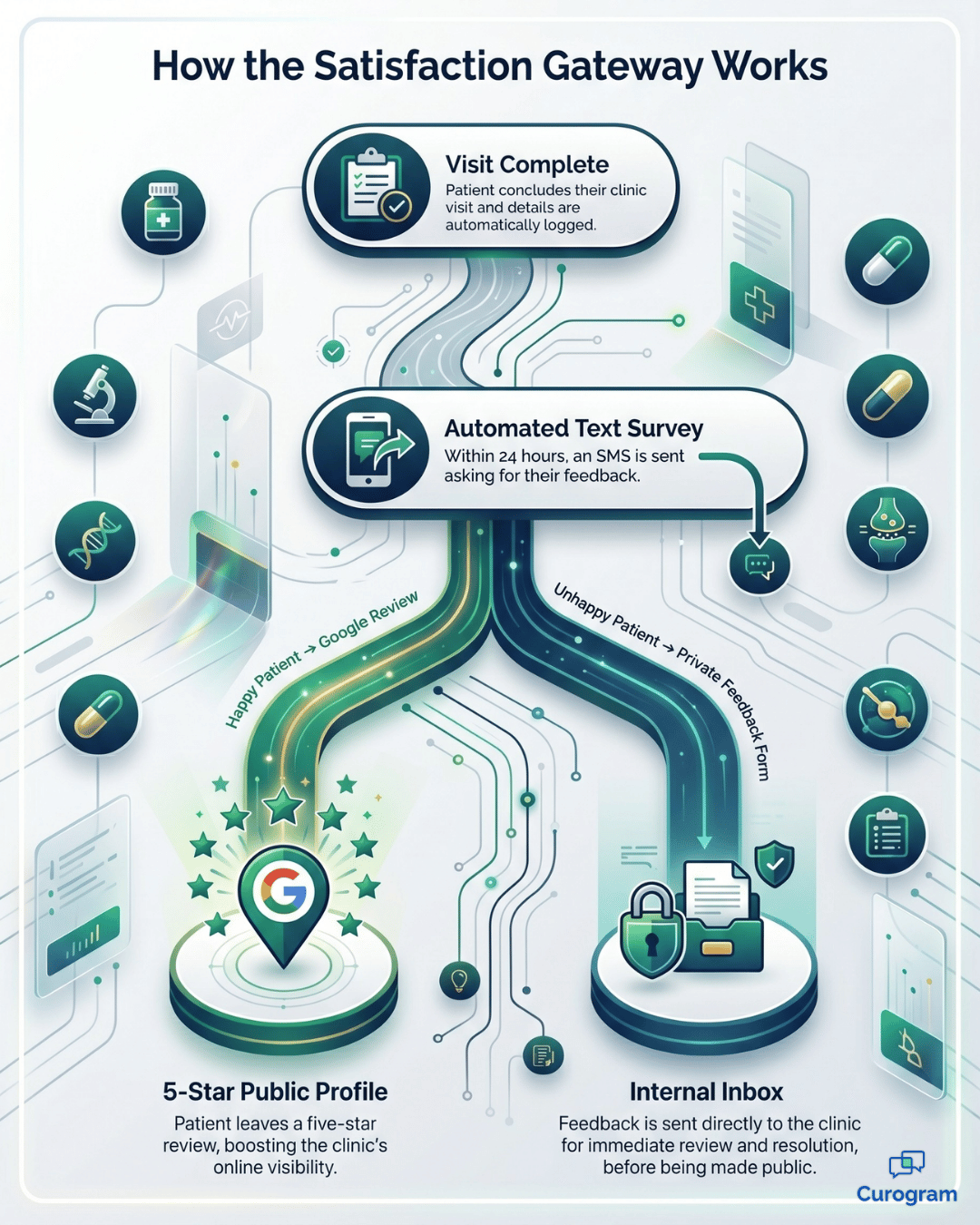
After each completed appointment, the system sends a short satisfaction survey by text. Your staff don't start it. They don't watch it. They don't chase anyone. It just runs.
Here's how it works in practice.
A patient checks out. Within a set window — say, an hour or two later — they get a friendly text asking how their visit went.
Patients who respond positively get a direct link to your Google Business Profile.
Patients who don't are sent to a private feedback form instead.
That second path matters. It's a satisfaction gateway. Unhappy patients reach you, not the public, so you can fix the problem before it ever becomes a 2-star review.
This is what makes Osmind Google review automation for front desk teams so easy to adopt. There's no list to export, no CSV to upload, no daily task to remember. The system reads completed appointments and triggers everything from there, working right alongside your Osmind scheduling.

For this specialty, the timing is the magic. The text never lands during the vulnerable post-infusion stretch. It doesn't interrupt someone in the recovery chair.
It reaches patients once they're home, settled, and able to reflect — exactly when a TMS patient finishing session 36 feels most grateful.
That's the difference between an awkward ask and a welcome one. The same automated post-visit survey your Osmind clinic coordinator would have had to send by hand now goes out at the perfect moment, every time.

The result is zero-effort patient review collection for interventional psychiatry practices — and real reputation management without staff burden for any ketamine clinic.
The numbers tell the story better than any pitch. One multi-location practice used Curogram's automated survey system and generated 1,064 new 5-star reviews in just 3 months. 90% of surveyed patients left a 5-star rating. No staff member asked a single patient for any of them.
Think about what that shift really means. Your team goes from "remember to ask" to never thinking about it at all. Reputation grows in the background while everyone stays focused on patient care.
Here's the simple before-and-after.
With manual asking, the work sits on your front desk, and patients only get reached when someone remembers — usually 5%–10% of them. The 5-star rate is anyone's guess, the effort eats around 10 hours a month, and the whole program tends to fade within weeks.
With automated requests, the system does the work for you. Every completed appointment gets reached, 90% of survey responders leave 5 stars, staff spend zero hours on it, and it never stops running.
Let me put that staff-time difference in plain terms. If asking and tracking eats just two minutes per patient across 300 visits, that's about 10 hours a month gone — roughly 120 hours a year. At $20 an hour, you're spending close to $2,400 a year on a task automation does for free.
And that's the cost of a program that actually works. Most manual efforts stall within a month, so you pay the time and still get almost nothing back.
Here's the version you actually want. Your coordinator logs in Monday and finds 12 new reviews posted over the weekend — all from last week's patients, all from texts nobody had to send. Over time, your profile climbs past 200 reviews.
This is hands-free reputation building for your Osmind practice in action. When someone searches "ketamine clinic near me," your listing shows up with social proof no competitor can match overnight.
One more number worth sitting with: 90% of new patient leads check your Google profile before they ever visit your website.
A strong profile isn't a nice-to-have. It's often the first impression you get to make.
Your clinical work is already excellent. The only thing missing is a public record that says so — and that shouldn't depend on whether a busy coordinator remembered to ask.
Automated review collection ends the guesswork. Every completed Osmind appointment becomes a chance to build your reputation, with no new task added to anyone's day. No asking. No tracking. No follow-up.
Think of it this way. Osmind handles your clinical documentation. Curogram handles your public credibility. One records what you did for your patients. The other makes sure the rest of the world knows about it — without your staff doing the telling.
That split matters more than it sounds. Your team didn't train in medicine to chase Google ratings. Freeing them from that job isn't just convenient. It's the right use of their time.
And the payoff compounds. More reviews lift your local search ranking. A higher ranking puts you in front of more patients searching for help. More patients mean more reviews. The cycle feeds itself once it starts.
So stop asking your staff to be your marketing department. Let automation build the online presence your outcomes have already earned.
Here's the best part: most practices see new reviews within 48 hours of turning the system on. Not next quarter. This week.
If your Google profile doesn't reflect the quality of care you deliver, that gap is costing you patients right now — quietly, every single day.
You've done the hard part already. The asking can run on its own.
Schedule a Demo to see how Curogram's automated survey triggers fit into your existing Osmind scheduling workflow. In one short conversation, you'll see exactly how your clinic can start turning finished appointments into 5-star reviews — without adding a single thing to your team's plate.
 Aubreigh Lee Daculug : May 28, 2026, 5:00:00 PM
Modmed staff shouldn't ask for reviews. Curogram automates Google review requests after appointments. Zero staff effort. Book a demo.
 Aubreigh Lee Daculug : Jun 4, 2026, 2:59:59 PM
90% of new patients check Google first. Curogram’s automated surveys helped one practice earn 1,064 5-star reviews in 3 months.
 Aubreigh Lee Daculug : Jun 4, 2026, 5:00:00 PM
Patients research ketamine clinics through Google reviews first. Curogram helped one practice earn 1,064 5-star reviews in 3 months.