16 min read

Secure Patient Communication Efficiency for Oracle Health Networks

Secure Patient Communication Efficiency for Oracle Health Networks

💡 Patient communication efficiency for Oracle Health networks improves when routine calls move to HIPAA-compliant texting and automation. This helps health systems scale access without adding staff. 
  • Deflect high-volume calls like confirmations, directions, and basic scheduling questions
  • Resolve more requests faster with two-way messaging and clear routing rules
  • Reduce staff strain by replacing phone tag with manageable message queues
  • Keep governance strong with templates, access controls, and searchable logs
  • Track ROI using call volume, response time, and kept-visit trends.
Start with the most repeatable workflows, then expand across departments. With the right platform, enterprise patient communication becomes both efficient and auditable.

Patient communication efficiency for Oracle Health networks is not optional in practice. It is a core driver of access, speed, and cost for leaders. One missed message can delay care, trigger repeat calls, and create more work.

Most health systems still run on phones for many routine tasks. Patients call to confirm, ask for directions, or check prep steps before visits. Staff answer when they can, then leave voicemails and try again during busy hours. By the time you reach the patient, the slot may be lost or filled.

Patients expect quick replies on mobile today. When they wait on hold, they may cancel or skip next steps entirely that day.

At enterprise scale, small delays turn into a daily tax. A 3-minute call sounds minor. Multiply it by thousands of calls across sites, and you lose whole staff days. You also lose focus as teams get pulled away from check-in, referrals, and care follow-up.

Texting and workflow tools can change that pattern. HIPAA-compliant texting shifts routine needs into a channel patients use every day. It also creates a clear record, so leaders can track volume, response time, and outcomes. When texting is tied to the Oracle Health schedule, messages stay accurate and timely.

This is not about sending more blasts. It is about better routing and clear next steps. Patients can confirm with one tap, or reschedule fast without phone tag. Staff can handle more contacts in less time, and call lines stay open for complex needs.

In this guide, we break down the system-level value of better communication. You will see how secure texting reduces inbound calls and supports faster care flow. We also share a simple ROI model you can adapt. If you are building enterprise patient communication across an Oracle Health footprint, start with high-impact wins.

Why Patient Communication Efficiency Is a System-Level Priority

Patient communication efficiency for Oracle Health networks becomes a strategic issue as soon as you scale beyond one site. Every department touches patients before, during, and after care. Each touchpoint can be fast and clear, or slow and repeated.

It helps to think in “interaction volume,” not “visit volume.” If a 12-clinic network averages 250 visits per clinic per day, that is 3,000 visits daily. Over 250 workdays, that is 750,000 visits per year. If each visit triggers three contacts (reminder, question, follow-up), you are already at 2.25 million interactions.

This scale is why small EMR gaps and manual work matter. When systems do not guide patients, staff become the guide. Phones then become the default tool for every loose end. The result is not only higher cost, but slower access.

Phone-heavy models also hide delay. A call that goes to voicemail is not “done.” It creates more work later. Staff must call back, check the chart, and repeat details. Patients may call again because they did not hear back. Those loops build backlog across sites.

Communication efficiency ties directly to access and throughput. When confirmations lag, open slots stay at risk. When reschedules take days, unused slots go unfilled. When prep steps are unclear, patients arrive unready and visits run late. All of that reduces the number of completed visits your system can support.

At enterprise scale, even small disruptions create call spikes. If a provider is out, reschedules can consume the day. Standard templates help keep messages consistent across sites. That consistency reduces repeat questions and supports enterprise patient communication, which is a core part of ROI.

The Cost of Inefficient Communication at Health System Scale

At health system scale, the cost shows up in four places: labor, time to care, trust, and staff health.

First, excess inbound calls raise labor cost. Many calls are short, but they are constant. Imagine 8,000 routine calls per day across a network, with an average handle time of 4 minutes.

That is 32,000 minutes, or about 533 staff hours daily. At 8 hours per shift, that is about 67 staff shifts per day devoted to phones. Even if your true numbers are half of that, the labor load is still large.

Second, delays slow access. A patient who cannot reach scheduling today may wait and try tomorrow. That delay can push care out by days. It can also reduce conversion from web inquiry to booked visit. The longer the wait, the more likely patients drop off.

Third, fragmented communication reduces confidence. If reminders come from one number, instructions come from another, and answers come by voicemail, patients feel unsure. They may call again just to confirm what they heard. They may also show up at the wrong place, or miss key prep steps.

Fourth, staff burnout rises when the phone line drives the day. Ringing phones interrupt check-in, referrals, and prior auth work. It also forces staff to switch tasks every few minutes. Over time, that stress can raise turnover risk and training cost.

These issues compound across departments. Imaging has prep needs. Surgery has consents. Primary care has lab follow-ups. Specialty care has referrals and authorizations. When each team solves the same problems with calls, the total load explodes.

For leaders, the lesson is simple. Communication is not a “front desk problem.” It is a system constraint. Improving patient communication efficiency for Oracle Health networks improves access, reduces waste, and protects the patient experience.


How HIPAA-Compliant Texting Improves Communication Efficiency

HIPAA-compliant texting improves communication efficiency by moving repeat questions out of the call queue. Patients do not need to wait on hold. Staff do not need to stop what they are doing to answer a ring.

This is not “consumer SMS” used on personal phones. It is secure patient communication with clear controls. The platform should support a BAA, user access rules, and full message history. It should also tie messages to the right patient record, so the team works from one source of truth.

Texting works well for short, high-volume tasks. Think: “Confirm your visit,” “Reply 1 to reschedule,” or “Here is the prep list.” These messages take seconds to send. They also reduce repeat calls because the patient can read them again later.

Oracle Health networks often run centralized scheduling and distributed clinics. Texting supports both models. A central team can send standardized updates, while local teams handle replies for their site.

It also helps when schedules change fast. If a provider is out, a bulk message can notify the right patients at once. Staff can then focus on the few patients who need complex rebooking.

Over time, these small wins add up. Fewer calls means fewer handoffs. Fewer handoffs means fewer missed notes. That is how a messaging layer improves speed and reduces avoidable errors.

Research supports the core idea that digital notifications can improve attendance. A systematic review and meta-analysis in BMJ Open found text-based electronic notifications can improve clinic attendance.

Replacing Phone Tag With Asynchronous Messaging

Phone tag is a hidden drain in enterprise settings. One patient may take three attempts to reach. Each attempt includes a dial, a wait, a voicemail, and a note. Multiply that by hundreds of patients, and the day disappears.

Asynchronous messaging breaks that loop. Patients respond when they are free. Staff respond between tasks, instead of dropping everything at once. This is especially useful for questions that do not need a live discussion.

Here is a simple example from scheduling:

Phone workflow: Call patient, leave voicemail, call again, then document the change.

Text workflow: Send a reschedule link or quick-reply option, then confirm by text.

In the second case, the team can resolve the request in one thread. The patient can also share the message with a caregiver, which reduces confusion.

Asynchronous messaging also improves clarity. A patient can re-read the exact time, address, or prep step. This reduces “double-check” calls.

Increasing Throughput Without Increasing Headcount

In a phone model, one staff member can only handle one patient at a time. In a messaging model, the same staff member can handle several threads in parallel. They can answer a quick question, then return to check-in, then close the next message.

This is how texting increases throughput without adding headcount. It does not require superhuman speed. It simply reduces “dead time” that comes from waiting for patients to answer.

To make this work at scale, health systems need structure:

  • Message templates for common tasks, approved by leadership.
  • Routing rules, so replies go to the right team or site.
  • Escalation paths, so clinical needs move to a nurse line fast.

With structure, texting becomes predictable. Teams can set service levels, such as “respond within one business hour” for routine needs. They can also track message volume by site, service line, and time of day.

When HIPAA controls are built in, the system gains speed without added risk. Patient communication efficiency for Oracle Health networks improves in a clear way. You get faster resolution, fewer calls, and a record you can trust.

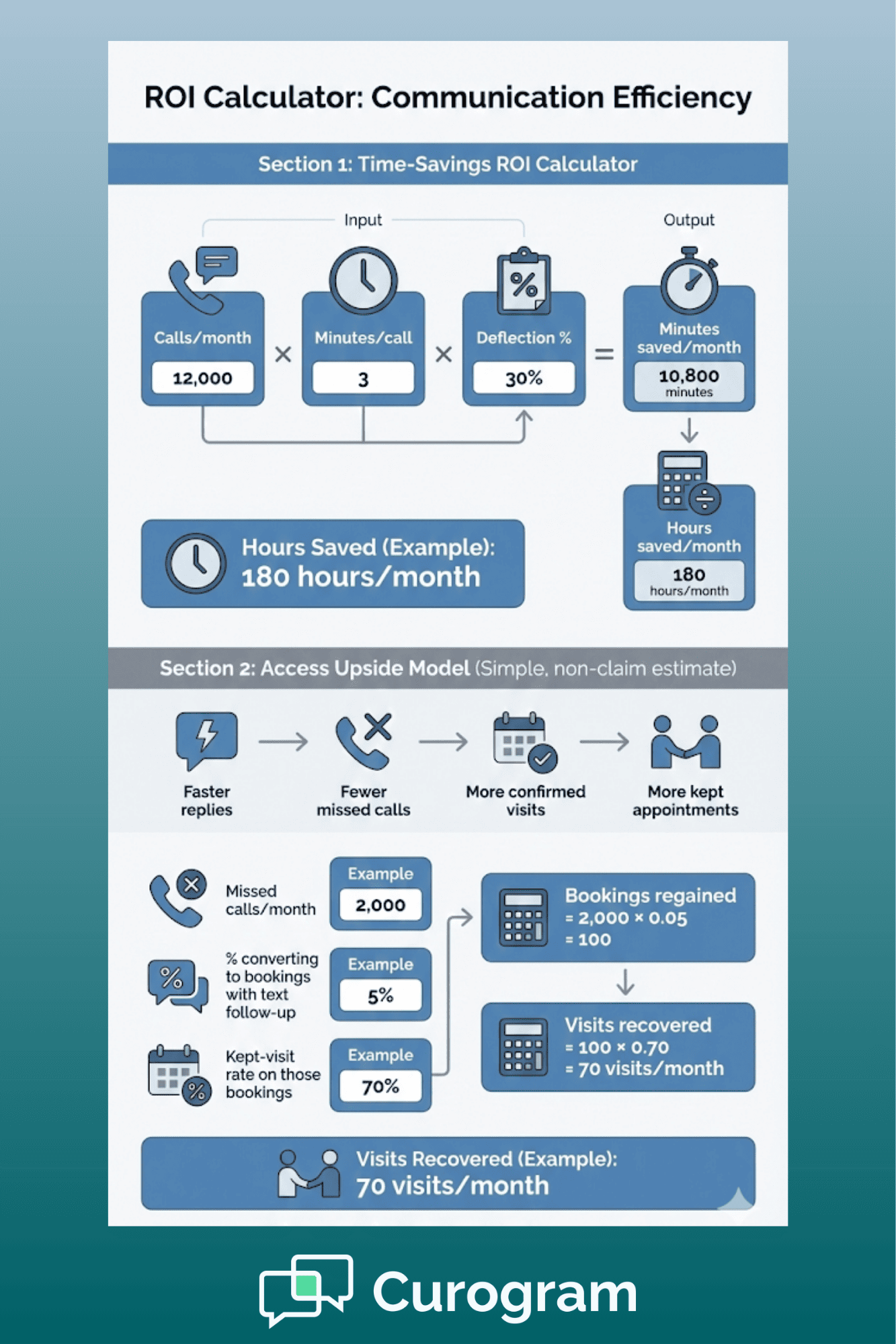
ROI calculator infographic showing call deflection and staff hours saved

Reducing Inbound Call Volume Across Oracle Health Networks

Inbound calls are expensive because they demand real-time attention. A phone line does not “queue quietly.” It interrupts, rings, and forces staff to drop other work. That is why call centers often become one of the highest operational cost centers in a large health system.

The hard truth is that many calls are not complex. They are informational or transactional. Patients are trying to do the right thing, but they cannot find fast answers. They call to confirm a time, ask where to park, or check if they need to fast.

Texting resolves these needs with less friction. It gives patients a written answer they can keep. It also gives staff a single thread they can close with a clear outcome. When the thread links to the Oracle Health schedule and chart, teams avoid the “which patient is this?” problem.

The goal is not to eliminate calls. The goal is to reserve calls for cases that truly require a live voice. That is the core of enterprise patient communication at scale: move repeat work to the fastest safe channel.

Deflecting Routine Calls at Scale

Routine calls fall into a few predictable groups. If you can script and automate these groups, you can reduce inbound volume without lowering service.

Appointment confirmations

Patients call because they fear they will be marked a no-show. A two-way text confirmation removes that fear. The workflow is simple: send the date, time, and location; offer quick replies; then log the response.

Example text flow:

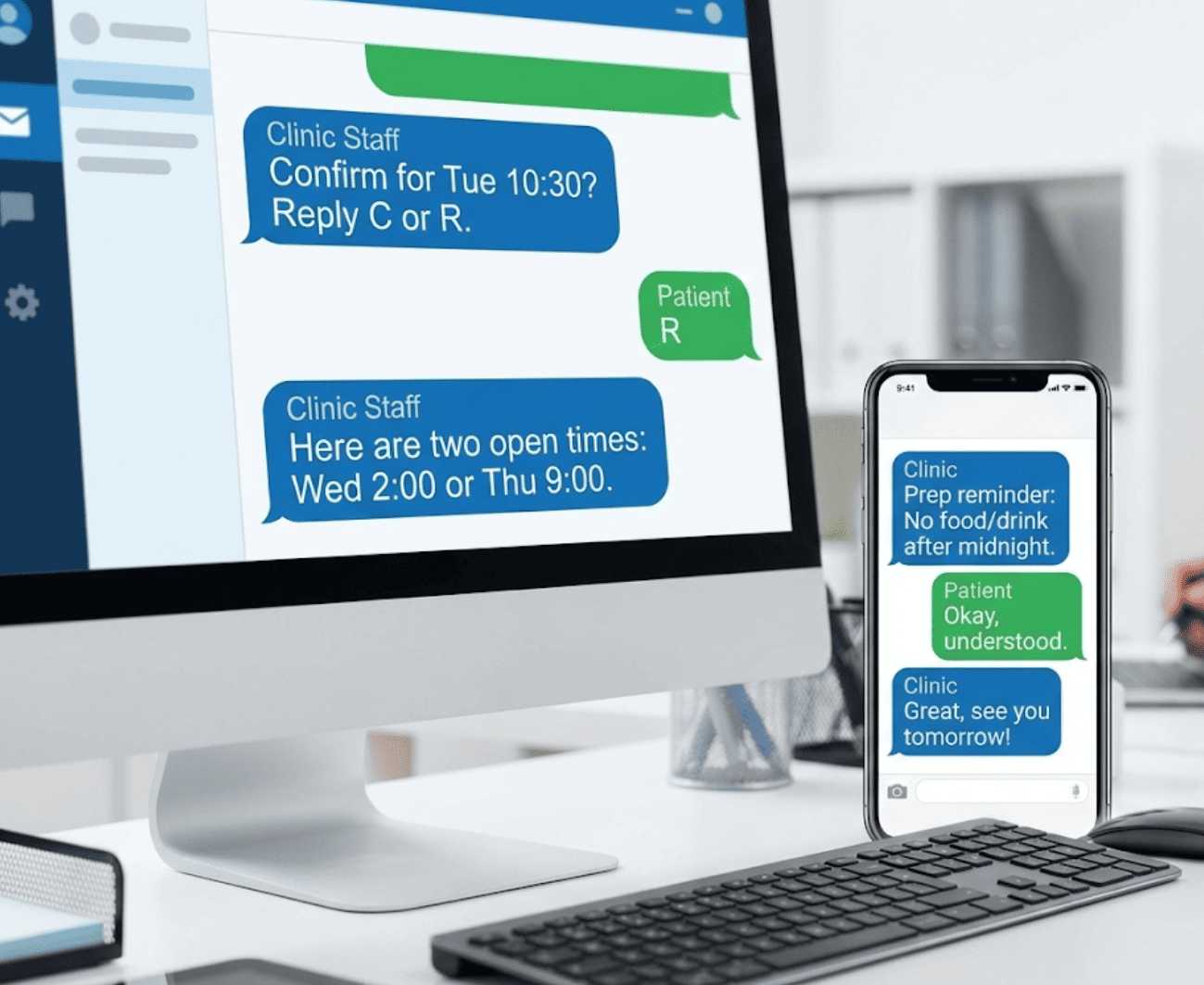
“You are scheduled on Tue 10:30 AM at Clinic A. Reply C to confirm or R to reschedule.”

Patient replies “C.”

System updates status and posts the confirmation for staff visibility.

This single thread replaces a call, a voicemail, and a manual note.

Scheduling questions

Patients often call with “Do you have anything sooner?” or “Can I switch locations?” Texting can handle most of this with guided options. A scheduling team can send two or three open slots and ask the patient to pick one. If the case is complex, staff can escalate to a call.

Example:

“We can offer Wed 2:00 PM or Thu 9:00 AM. Reply 1 or 2, or reply HELP for a call.”

Directions and parking

These are high-volume, low-value calls that still consume time. A text message can include a short address, a parking note, and a link to directions. Patients can pull it up on the day of the visit.

Example:

“Clinic A: 123 Main St. Park in Garage 2. Reply Q with questions.”

Prep instructions

Prep gaps create day-of chaos. Patients call because they do not remember the rules. Texting works well because it can be timed and tailored.

Example for imaging:

72 hours before: “Your MRI is Fri 9:00 AM. No metal items. Reply PREP for details.”

24 hours before: “Reminder: arrive 15 minutes early. Bring ID and card.”

If the patient replies “PREP,” the system can send the short prep list. If the patient replies with a clinical question, it can route to a nurse line.

Follow-up reminders

After a visit, patients often call to ask what happens next. Texting can reinforce next steps without asking staff to call each patient.

Example:

“Your lab order is ready. Reply DONE once completed, or reply Q for help.”

At scale, these workflows need more than good wording. They need rules. Practical rules that reduce inbound calls include:

  • Use one consistent sender identity per service line, so patients recognize the thread.
  • Keep each message to one task and one clear action.
  • Offer a human path (“Reply HELP”) so patients do not feel trapped.
  • Time messages to match the patient journey, not staff convenience.

Routing is also key. A centralized team can manage the first reply. If a patient’s response indicates a complex need, the case can move to a local team or a call. This is how you deflect calls without harming care. You are not blocking access. You are changing the lane.

Allowing Call Centers to Focus on Complex Cases

When routine calls move to texting, call centers get their most valuable asset back: time. That time can be used where voice support truly matters.

Complex cases often share one trait. They require nuance, empathy, or rapid back-and-forth.

Examples include:

  • Patients with multiple appointments and dependent timing.
  • Patients who need interpreter support.
  • Prior auth issues that require payer details.
  • Clinical questions that must be assessed and documented.
  • Complaints that need de-escalation and service recovery.

If routine calls stay in the queue, these cases wait longer. That can raise risk and harm the patient experience. When the queue is lighter, agents can slow down and do the job well.

A lighter queue also improves quality. Teams can use call scripts, verify identity, and document outcomes with fewer shortcuts. They can also follow up in writing, using the same text thread, so the patient leaves with clear next steps.

Here is a simple operating model that works well in large networks:

  • Text-first for routine requests and reminders.
  • Call-back for complex requests, triggered by keywords or staff review.
  • A shared inbox queue, so work can be distributed across sites.
  • Clear service levels, so leaders can manage peaks and staffing.

This model is measurable. Leaders can track:

  • Call deflection rate (routine issues handled by text).
  • Call wait time for live support.
  • Message response time by team.
  • Resolution rate without escalation.

You can also run pilots by service line. Start with a clinic that has high call volume and repeat questions. Standardize five to ten templates. Add routing and escalation rules. Then expand across the Oracle Health network once the workflow is stable.

The business outcome is clear. When you reduce inbound calls, you lower avoidable labor load. You also increase access by freeing staff for scheduling and care coordination. Most important, you create a calmer system that can scale without constant hiring.

For patient communication efficiency for Oracle Health networks, reducing call volume is not a side benefit. It is the foundation that allows every other improvement to stick.

Two-way patient texting workflow for appointment confirmation and scheduling

Improving Staff Productivity and Reducing Burnout

Phones create a work style that is reactive. Staff must answer now, even if they are mid-task. Over time, constant interruption reduces focus and morale.

Messaging creates a calmer pattern. Work arrives in a queue. Staff can handle it in order, with fewer context switches. That is one of the fastest ways to improve productivity without adding people.

Creating More Manageable Communication Workloads

A message queue is easier to manage than a ringing line. It also makes it easier to share work across teams. If one site is swamped, another team member can help from the same inbox.

This is important in an Oracle Health network with shared services. A centralized team can handle first-touch questions. Local teams can handle site-specific needs. The patient still sees one thread, not a handoff.

For example, a front desk team may juggle check-in, scan cards, and answer phones. Each call breaks their flow. With messaging, they can finish check-in, then answer five short questions in a row. That batching alone reduces stress.

Messaging also supports better distribution of work. Instead of one “phone hero” carrying the load, tasks can be assigned by role. Scheduling handles scheduling. Billing handles billing. Clinical teams handle clinical triage.

Work is also easier to measure. Leaders can see volume by hour and by type. They can then staff peak times with intent, instead of guessing. It also gives leaders a clear view of load, so staffing matches demand daily.

Supporting Retention Through Better Tools

Better tools reduce stress during peak hours. Staff feel more in control when they can close tasks, not chase callbacks. That sense of control matters for retention.

Tools also affect training. A new hire can learn templates and routing rules faster than they can learn a maze of phone scripts. Consistency reduces errors, and it protects the patient experience.

Supporting Faster Patient Access and Care Progression

Communication delays slow scheduling, follow-up, and care completion. Patients cannot move to the next step if they do not know what it is. Texting accelerates movement through the system by reducing missed connections.

On the access side, missed calls often create “hidden wait time.” A referral may sit because the patient missed a call. A procedure may be delayed because prep steps were unclear. A simple text thread can close these gaps and keep care moving.

Shortening Time to Appointment and Follow-Up

Two-way texts speed up confirmations and rescheduling. If a patient cannot make a slot, they can reply right away. Staff can then backfill the opening before it becomes lost time.

You can also use texts to reduce bottlenecks that block care. For example, a patient may need to upload an ID card, sign a consent, or confirm transport. A short text with a secure link often closes the gap in minutes.

Improving Care Continuity

Care continuity depends on clear next steps. Patients forget details, especially after a busy visit. A short follow-up text can restate the plan and offer a simple action.

Example:

“Your follow-up is due in 2 weeks. Reply 1 to book, or reply Q.”

These small prompts reduce missed steps in the care journey. They also help teams spot risk early. If a patient replies with confusion, the system can route to a nurse or care team.

When you connect these workflows to the Oracle Health schedule and records, you reduce drift. Staff spend less time searching for context. Patients spend less time trying to reach the right person. That is how patient communication efficiency for Oracle Health networks turns into faster access and steadier care flow.

Maintaining Compliance While Scaling Communication

Efficiency gains must not compromise HIPAA compliance. In an Oracle Health network, the communication tool must support security, governance, and audit needs at scale.

Reducing Risk Through Standardized Messaging

Standardized messaging lowers risk because it reduces ad hoc wording and “shadow” workflows. Start with approved templates for the highest-volume topics, such as reminders and directions. Then, control who can edit those templates and who can send them.

A simple template policy helps:

  • Define what can be sent by SMS versus secure messaging.
  • Require identity checks before sharing PHI.
  • Use role-based access so only the right teams can view threads.

Supporting Audit and Governance Requirements

Enterprise leaders also need proof. HIPAA enforcement can involve investigations, corrective action plans, and ongoing monitoring. Message history, timestamps, and user actions should be retained, searchable, and tied to the patient context.

Civil money penalties for HIPAA violations are defined in federal regulation and adjusted for inflation. Even when the issue is “just communication,” the costs can be large, and the response work is disruptive.

Governance improves when messaging is centralized. With one system, you can set rules across sites, monitor volume, and respond fast to issues. This reduces compliance exposure while supporting patient communication efficiency for Oracle Health networks.

Quantifying the ROI of Communication Efficiency

ROI is easier to defend when you connect communication changes to measurable operations. Start with three metrics: call volume, time per call, and kept-visit volume. Then, track what changes after texting workflows launch.

Cost Avoidance Through Call Reduction

Call reduction saves labor hours. Use your own data, but the math is simple.

Example:

If you receive 12,000 routine calls per month and each call averages 3 minutes, that is 36,000 minutes, or 600 hours. If texting deflects 30% of those calls, you save 180 hours per month. Multiply saved hours by your loaded hourly cost to estimate monthly cost avoidance.

This is not just about headcount cuts. Many systems use the savings to reduce overtime, cover peaks, or avoid new hires.

Revenue Protection Through Improved Access

Access improvements protect revenue by keeping schedules full. Two-way texts help patients confirm, cancel, and reschedule faster. That speed increases your chance to backfill openings.

You can estimate upside with a conservative model:

  1. Count the number of “late cancels” and no-shows you can recover.
  2. Multiply by average net revenue per kept visit.
  3. Compare to platform cost and rollout effort.

When you tie these numbers to patient communication efficiency for Oracle Health networks, ROI becomes a system story, not a single-clinic anecdote.

Why Oracle Health Networks Choose Curogram for Communication Efficiency

Oracle Health networks need more than a texting feature. They need an enterprise-grade layer that supports high-volume patient outreach without adding risk. Curogram is designed for that operational reality.

Curogram helps teams replace phone-heavy workflows with structured messaging, reminders, and routing. It supports repeatable templates, shared inbox work queues, and clear escalation paths. This makes it easier to standardize service across sites while keeping local teams in control across departments.

Curogram also supports EMR-connected workflows. When messaging is tied to scheduling and patient context, staff spend less time searching and re-entering details. This reduces friction for both patients and staff.

A Scalable, HIPAA-Compliant Messaging Infrastructure

Curogram is built for centralized and distributed teams. It supports governance through access controls and permanent audit trails.

For organizations using Cerner and Oracle Health environments, Curogram has long positioned integration as a way to create time-saving efficiencies. The goal is not “more messages.” The goal is fewer dropped steps, fewer calls, and faster resolution at scale.

When leaders evaluate patient communication efficiency for Oracle Health networks, they look for stability, control, and measurable outcomes. Curogram is built to support all three.


Explore Patient Communication Efficiency for Oracle Health Networks

If your Oracle Health network is trying to scale access, communication is a core lever overall. When routine calls move to secure texting, teams regain time. The benefits compound:

  • Reduced calls and less phone tag across sites
  • Higher staff output through shared queues and templates
  • Faster patient access through quick confirmations and reschedules
  • Better care continuity through clear next-step reminders
  • Lower operational strain during disruptions and peak seasons

Most important, the model is sustainable. You are not relying on hero staff or endless hiring. You are building a repeatable workflow layer that supports the EMR and the people who use it.

Texting should be treated as infrastructure. It needs governance, audit logs, and role-based access. It also needs measurement, so leaders can track call deflection and resolution times.

If you want a broader view of enterprise texting strategy, refer to the pillar guide on enterprise secure medical texting. Start small, then expand by service line.


Turning High-Volume Texting Into a Managed Workflow with Curogram


Large networks do not fail because they lack effort. They fail because communication lacks structure. Curogram is built to add that structure without forcing teams to change how they deliver care.

One key advantage is the shared inbox model. Instead of messages living on a single phone, threads live in a team queue. This makes coverage simple. If one scheduler is out, another can pick up the same thread. Leaders can also see workload in real time and rebalance support during peaks.

Curogram also supports templates that stay consistent across sites. For example, a health system can standardize appointment confirmations, directions, and prep steps. Each site can still add local details, like parking notes. This keeps the patient experience uniform while respecting local operations.

Routing rules turn texting into a true workflow. Routine replies can stay with scheduling. Clinical keywords can route to a nurse pool. Billing questions can move to a billing queue. When a case needs a call, the thread still holds the context, so the call starts with clarity.

A simple example shows the impact. An imaging department learns a scanner is down for the afternoon. Instead of hundreds of outbound calls, the team filters affected patients and sends one approved message.

Patients reply to confirm a new time or request a call. Staff spend time only on the complex cases, and the system keeps a record of each action.

For Oracle Health teams focused on scale, this kind of control matters. It turns texting from a “channel” into an operational asset that supports patient communication efficiency for Oracle Health networks.

Because messages are logged, audit prep is faster. Reporting also helps leaders see response times by site, so they can refine staffing and templates weekly.

Conclusion

Patient communication efficiency for Oracle Health networks determines how well a health system can grow. When communication is slow, access slows too. Patients wait, call again, and lose trust. Staff absorb the extra work, and costs rise.

The fastest way to reduce this drag is to shift routine needs off the phone. HIPAA-compliant texting replaces phone tag with a clear thread and a simple action. Patients confirm, reschedule, and ask basic questions without waiting on hold. Staff respond from a queue, with context, and with fewer interruptions.

Reducing inbound calls is only the first win. Once texting is in place, teams can standardize templates, route replies, and set clear service levels. To prove impact, leaders should measure a few core items. Track call volume, message volume, response time, and escalation rate.

Pair those metrics with scheduling outcomes, such as backfilled slots and kept visits. Use simple models to estimate labor hours saved and revenue protected.

Communication efficiency is also a compliance issue. Health systems need Curogram integration to support secure access, audit logs, and governance rules. When these controls are built in, you can scale outreach without creating new risk.

The key takeaway is practical. Treat patient communication as shared infrastructure, not a set of one-off fixes.

Curogram can help you start with the highest-volume workflows, pilot in one service line, and expand with proven templates. Over time, you build a calmer operation that serves more patients with the same team.

Improve access and strengthen ROI with a secure messaging layer. Book your demo now to see how these workflows can fit your Oracle Health environment across your sites.


Frequently Asked Questions

How can Oracle Health networks measure patient communication efficiency in a way leaders can act on?
Track call volume, message volume, response time, and resolution rate by site and service line. Add an escalation metric to see what still needs phone support. Compare these trends to kept visits and backfilled slots.
Why does reducing inbound call volume improve ROI even if you do not reduce headcount?
Call deflection reduces overtime, lowers peak staffing pressure, and frees time for higher-value work like referrals and scheduling. It also improves service levels for complex callers, which protects patient retention and revenue.
How should a health system decide which patient messages belong in SMS versus secure messaging?

Use a simple risk rule. Send logistics and reminders by SMS when they do not include PHI. Use secure messaging for details tied to diagnosis, results, or sensitive care steps. Document the rule in policy and templates.

How can teams roll out HIPAA-compliant texting without disrupting front-desk and call center workflows?

Start with one service line and five to ten templates. Train staff on routing, escalation, and response standards. Run a short pilot, review message logs weekly, then expand to new sites once the workflow is stable.

How do you prevent texting workflows from creating safety gaps when patients have urgent clinical needs?

Use clear wording that texts are not for emergencies. Add keyword triggers and routing to a nurse pool for symptoms or high-risk replies. Set escalation time limits, so unresolved threads move to a call quickly.


HIPAA-Compliant Texting for Oracle Health Systems at Enterprise Scale

HIPAA-Compliant Texting for Oracle Health Systems at Enterprise Scale

💡 HIPAA-compliant texting for Oracle Health systems lets big care teams text fast without risk. It cuts calls, keeps logs, and makes each step easy...

Read More
HIPAA-Compliant Texting for Veradigm | Curogram

HIPAA-Compliant Texting for Veradigm | Curogram

💡 HIPAA-compliant texting in Veradigm delivers measurable improvements for radiology organizations. Traditional phone-based outreach creates...

Read More
Patient Communication Efficiency for Meditab IMS Organizations

Patient Communication Efficiency for Meditab IMS Organizations

💡 Patient communication efficiency for Meditab IMS organizations directly impacts daily operations and care quality. Traditional phone-based...

Read More