12 min read

Population Health at Scale: SMS for Oracle Health | Curogram

Population Health at Scale: SMS for Oracle Health | Curogram

💡 Oracle Health mass patient messaging gives large medical practices a way to reach thousands of patients at once through SMS, secure portal messages, or email. 

It works inside Cerner Millennium workflows, so clinical teams can build patient cohorts, send personalized broadcasts, and stay HIPAA compliant without using extra vendors.

This matters because patient portals only reach 30–40% of patients, while SMS open rates hit 87–94%.


With the right setup, practices can boost flu vaccination rates, lower no-shows, and recover non-adherent chronic disease patients in days, not months.


Picture this. Your clinical operations team identifies 4,200 patients overdue for flu shots. Three care coordinators spend six weeks on the phones, calling every patient one by one.

By the time appointments are scheduled, flu season is already peaking, and only 1,847 of those patients ever picked up.

That's a 44% reach rate. And it cost your practice over $215,000 in labor.

Now multiply that scenario across colorectal screenings, diabetic check-ins, hypertension follow-ups, and pediatric vaccinations. The math gets ugly, fast.

This is the quiet crisis sitting inside most enterprise health systems today. You have the patient data. You have the clinical insight. You know exactly who needs outreach.

But the tools you're using to actually reach those patients — phone calls, email, the patient portal — are reaching less than half the people you need to talk to.

Patient portals plateau at 30–40% adoption. Healthcare emails average a 12–18% open rate. And manual phone outreach is too slow and too expensive to scale across an entire population.

It sounds simple. It isn't.

What's missing isn't more staff or a louder campaign. What's missing is infrastructure — a way to reach tens of thousands of patients at once, in a channel they actually open, without breaking HIPAA or burning out your team.

That's where Oracle Health mass patient messaging changes the equation.

Built into the EHR, paired with SMS broadcast tools like Curogram, it lets you target specific patient cohorts, send personalized messages in minutes, and track every response — all while keeping data fully compliant.

This guide will walk you through the gap, the math, and the workflow that's helping medical practices reach 85%+ of their patients in a single campaign.

Why Patient Outreach Breaks Down in Legacy Systems

For most enterprise health systems, the core problem isn't strategy.

It's the channels. The tools meant to reach patients at scale weren't built for population health, and the gaps show up in every campaign.

Why Traditional Patient Communication Falls Apart at Scale

Patient portals were supposed to fix this. They didn't.

A study of 420 large ambulatory practices found that portal adoption stalls at 32–38% of the active patient population.

The reasons are familiar: account creation friction (40%), forgotten passwords (28%), and the simple fact that healthy patients without chronic conditions don't see a reason to log in (31%).

That leaves 62–68% of your patients — the very people most likely to skip a screening or fall off a medication — completely unreachable through portal messaging.

Manual phone outreach has its own problem. It's expensive and slow. A 700-bed system running flu vaccination calls reached only 44% of target patients before slots filled up. Annual cost: $215,000 for three coordinators. To hit 70% reach, the system would need 5–7 coordinators and over $350,000 a year.

That math doesn't work for routine preventive care.

Email is no better. Healthcare email open rates sit at 12–18%, and that's before you account for spam filters and patients who just don't check inboxes daily. A flu campaign might land in front of 8–12% of your target population. That's not a campaign. That's a coin flip.

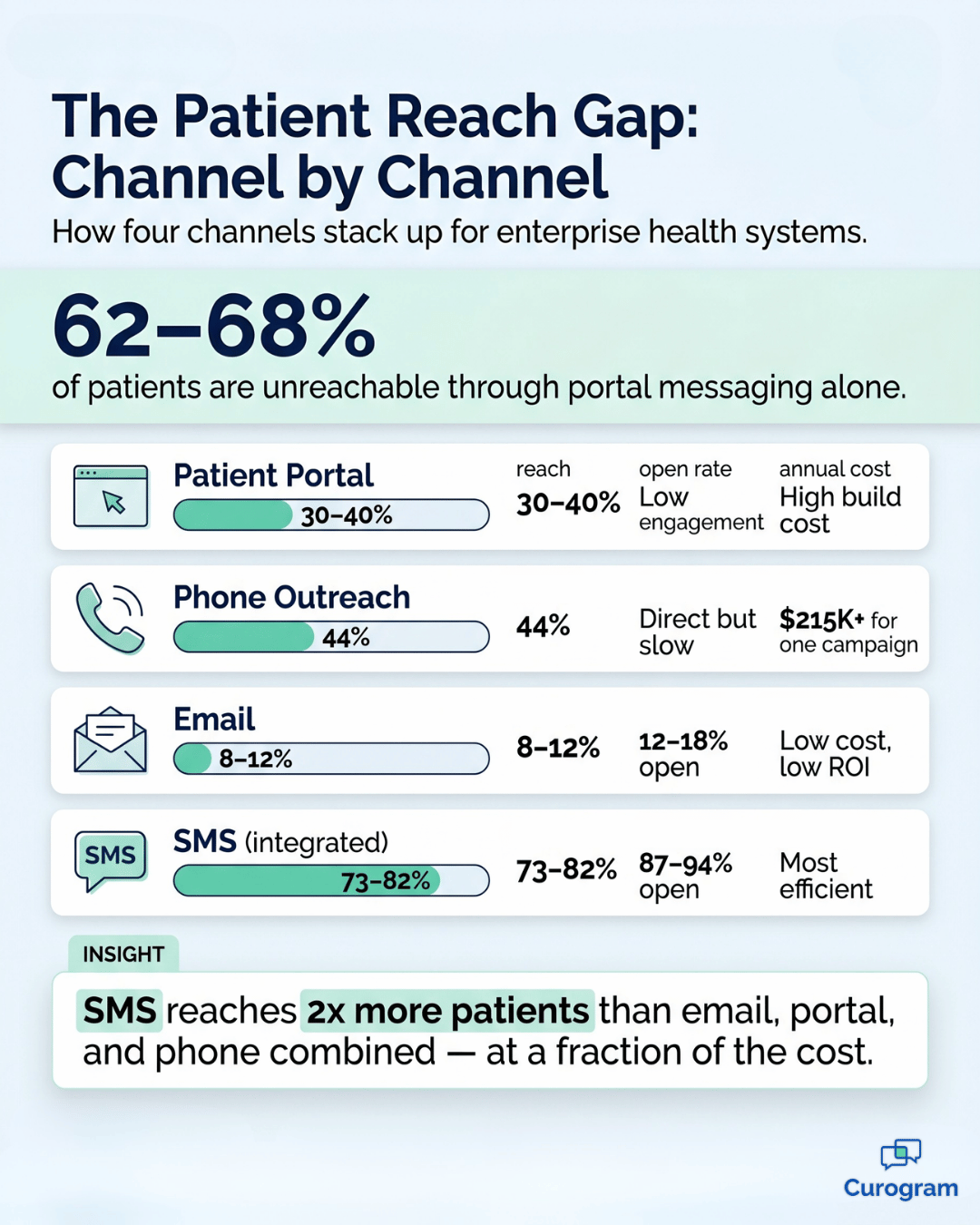
Here's how the three legacy channels stack up against your population health goals:

  • Patient portal: reaches 30–40% of patients, and skips the highest-risk groups
  • Manual phone calls: reaches 44%, costs $215K+ a year for one campaign type
  • Email: reaches 8–12%, with no certainty the message was even seen

Each one falls short on its own. Stacked together, they still leave most of your patient population unreached.

Where HealtheLife and Portal-Based Broadcast Hit a Wall

Oracle Health's HealtheLife broadcast feature lets practices message all app-engaged patients at once. The catch? Patients have to download the app first.

That filters reach down to about 15–20% of most populations — heavily skewed toward younger, tech-savvy patients. One practice using HealtheLife broadcast reported that 72% of their patients aged 65+ had never downloaded the app.

For chronic disease management in that age group, the tool was effectively useless.

There's a deeper issue too. Portal-dependent messaging quietly excludes the patients who need outreach the most: older adults, lower-income households, and patients with limited digital access.

These are the same groups with the highest rates of chronic disease and the biggest preventive care gaps. Relying on portals widens the digital divide instead of closing it.

Personalization is another weak point. Most portal broadcasts send static messages like "Flu vaccines are now available."

Compare that to a personalized note:

"As a patient with diabetes, flu vaccination cuts your hospitalization risk by 45%."

Personalized messages drive 34–48% higher response rates.

That's a huge gap to leave on the table.

Why SMS Has Become the Population Health Standard

SMS doesn't have these problems. SMS open rates run 87–94%, with most messages opened within three hours. Compare that to email at 12–18% or app messaging at 18–28%. The reach gap is enormous.

SMS also reaches 96% of US patients through their native messaging app.

No download. No account. No password. No digital literacy barrier.

For broadcast messaging, it's the only channel that hits an entire patient population — across every age group and access level.

Here's where Oracle Health mass patient messaging SMS population health workflows get powerful.

When SMS is integrated directly into Cerner Millennium through a HIPAA-compliant platform like Curogram, all patient data stays inside the EHR. No exporting cohorts to a third-party gateway.

No separate audit logs. No extra business associate agreements to manage. Just a clean, native broadcast workflow with SOC 2 Type II and HIPAA built in.

For your team, that means one less compliance headache and a channel that actually reaches patients.

Building Smart Patient Cohorts with Targeted Precision

Reach is only half the equation. Sending the right message to the wrong group of patients is just noise. The other half is targeting — and this is where cohort building inside Oracle Health changes how campaigns perform.

Defining Patient Cohorts from Your Clinical Data

Oracle Health's cohort builder lets clinical teams query the EHR with surgical precision.

A common preventive care query might look like:

"Patients age 50–75 with no colonoscopy in the past 5 years."

The platform returns a list of 1,200–3,800 patients depending on the practice size.

The same cohort logic works across every clinical priority your team manages:

  • Preventive screenings: patients overdue for colonoscopies, mammograms, or cervical screenings
  • Chronic disease control: diabetics with HbA1c above 8.0%, or hypertensives with elevated BP
  • Vaccination gaps: unvaccinated patients by flu season, age, or condition
  • Care continuity: patients who missed their last annual visit or follow-up

Send a screening reminder to that entire cohort, and you'll typically book appointments for 18–26% of contacted patients. Sporadic individual reminder calls?

They book just 8–12%. That's roughly double the conversion, with a fraction of the staff time.

For chronic disease management, the queries get even sharper.

Think "diabetic patients with HbA1c above 8.0% in the last 90 days" or "hypertensive patients with BP above 150/90 on current regimen."

Real-time outreach catches non-adherent patients before complications hit. One cardiology practice used this approach to message 847 hypertensive patients with uncontrolled BP — and recovered 623 into active follow-up.

That's a 73% recovery rate, and an estimated 31 prevented heart attacks or strokes per year.

Vaccination cohorts work the same way. A 15-location system used Oracle Health vaccine cohort messaging to lift flu vaccination rates from 47% to 71% in a single season. National benchmarks didn't even come close.

Personalization and Patient Preference Management

Generic messages get generic results. Personalized messages perform 22–34% better, and Oracle Health's template system makes personalization automatic.

Instead of "Flu vaccines are available," the system pulls in patient-specific context:

"Hi [Patient Name], as a [patient age/condition] patient, flu vaccination reduces your risk of complications by [X%]. Schedule now: [clinic link]."

Same staff effort. Much higher response.

Patient preferences matter too. Some patients want SMS. Others prefer secure portal messages or email. Oracle Health stores these preferences and routes outreach to each patient's preferred channel automatically.

Practices that respect preferences see 8–12% lower opt-out rates compared to single-channel broadcasts.

For multilingual communities, the system handles language and cultural customization out of the box.

A California practice serving 45% Spanish-speaking patients saw real engagement gains just by auto-sending in the patient's preferred language.

That's a meaningful step toward health equity.

Smarter Campaign Scheduling and Timing

Timing matters more than most teams realize. Oracle Health lets you schedule sends for specific windows — say, Tuesday through Thursday between 10 AM and 3 PM. Campaigns that hit during high-attention windows see 12–18% better engagement than randomly timed sends.

One practice tested this with flu reminders.

Tuesday morning sends pulled a 24% conversion rate. Friday afternoon emails? Just 17%.

Same audience, same offer — different timing.

Multi-wave campaigns push results even higher. A typical sequence sends an initial message, a follow-up at 5 days, and a final reminder at 14 days. Multi-wave campaigns convert 28–35% of patients to appointments. Single-send broadcasts convert just 12–16%. That's the difference between a good campaign and a great one.

The campaign dashboard tracks open rates, response rates, and appointment conversion in real time. If a wave underperforms, you adjust the next one. Continuous improvement, baked in.

Infographic comparing patient reach rates across portal, phone, email, and SMS messaging channels

Real Clinical Use Cases and the Outcomes They Drive

Numbers in a vendor pitch are easy to dismiss. Real campaigns aren't.

Here's what mass patient messaging actually delivers when it's tied to specific clinical goals.

Preventive Care: Colorectal Cancer Screening Campaign

A 12-location primary care network in the Midwest pulled a cohort of 3,247 patients aged 50–75 with no colonoscopy in 7+ years. These patients were sitting squarely in the high-risk window for late-stage colorectal cancer.

The team sent a personalized message in waves over four weeks:

"Hi [Patient Name], colorectal cancer screening saves lives. You're due for a colonoscopy. Schedule with [clinic]: [link]."

Within 60 days, 847 patients (26%) had scheduled their screening. Of those:

Outcome Patients
Polyps detected 127 (15%)
Early-stage adenoma 19 (2%)
Advanced cancer 0

The estimated savings:

$1.2M in prevented late-stage cancer treatment costs against just $47,000 in campaign and screening intervention costs.

That's a 25x return — and an unknown number of lives extended.

Chronic Disease: Diabetic HbA1c Recovery

A 400-bed health system with 18,000 active diabetic patients ran a query for "HbA1c above 8.0% in the past 90 days." The cohort: 2,134 patients with suboptimal blood sugar control.

Instead of waiting for the next semi-annual visit, the team sent immediate outreach:

"Your recent lab showed your blood sugar is higher than goal. Let's adjust your medications. Reply YES to schedule, or call [number]."

Of 2,134 patients, 1,847 re-engaged with care — an 87% recovery rate. Over 12 months, average HbA1c in the cohort dropped from 8.6% to 7.4%.

The downstream impact:

Prevented Outcome Estimated Cases
DKA or hyperosmolar hospitalizations 47
New diabetic neuropathy diagnoses 23
New diabetic nephropathy diagnoses 12

Preventive value: roughly $4.1M against $89,000 in messaging and care coordination expense. For your team, that's the difference between reactive sick care and proactive population health.

Appointment Adherence: Cutting No-Show Rates

No-shows quietly burn revenue. Primary care practices average 18–22% no-show rates, which means roughly one in five booked slots vanishes.

A 23-location practice deployed Oracle Health appointment reminders — an initial reminder seven days out, a follow-up 48 hours before.

No-show rates dropped from 19% to 11%. That's a 42% improvement and 247 recovered appointment slots per month across the network.

Annualized, that's 3,000 additional completed visits and $1.8M in incremental revenue. Same providers. Same schedules. Just better outreach.


Compliance, Privacy, and Governance Done Right

Reach and personalization are powerful. They're also where compliance risk lives. Mass messaging done wrong creates HIPAA exposure, audit nightmares, and patient trust issues.

Done right, it actually strengthens your compliance posture.

HIPAA and SOC 2 Type II Architecture

Oracle Health mass messaging keeps full HIPAA compliance through four core controls:

  • Encryption in transit: all SMS content is secured using TLS 1.2 or higher
  • Minimum necessary access: clinicians can only message patients they treat
  • Full audit logging: every send, open, and reply is recorded for compliance reviews
  • Carrier-level BAAs: the platform holds business associate agreements with downstream SMS carriers

SOC 2 Type II attestation closes the loop. It confirms these controls aren't just designed but tested and sustained over time. For compliance officers, that's the legal certainty audit teams want.

One important note from our HIPAA framework: standard SMS isn't encrypted at the device level.

That means SMS should be used for non-PHI content like appointment reminders and general notifications.

For anything containing protected health information — like specific test results or diagnoses — secure portal messages or encrypted links are the right channel.

Curogram's platform handles this routing automatically, so your team doesn't have to think about it.

Doctor showing patient an SMS appointment reminder on smartphone in modern clinic exam room

Navigating State Telehealth Regulations

State telehealth rules are a moving target. The good news is that most mass messaging falls outside their scope. Appointment reminders, preventive care outreach, and educational messages aren't classified as telehealth in any state and don't require special licensing.

The line shifts when messages start including medical advice, medication changes, or clinical assessments. States like California, Texas, and New York have specific rules for those situations.

The fix is governance — defining message templates by jurisdiction so your team doesn't accidentally cross a regulatory line. Oracle Health's framework supports this directly, which matters a lot if you're operating across state lines.

Consent, Opt-In, and Opt-Out Management

HIPAA splits messages into two buckets: transactional and marketing. Transactional messages — appointment reminders, test result notifications, follow-ups — don't require explicit opt-in. Marketing messages — wellness content, preventive education campaigns — do.

The system enforces this distinction automatically. Transactional messages flow to all patients with active phone numbers. Marketing messages check consent status before sending.

Opt-out is fully automated too.

When a patient replies "STOP," they're immediately removed from future campaigns. The opt-out persists across every campaign and every location, so patients never get re-added by accident.

That's how you protect trust and reduce your TCPA exposure at the same time.

Rolling It Out: Implementation and Change Management

A great platform with bad rollout is just shelfware. The good news is that mass messaging has one of the smoother implementation arcs in healthcare IT — usually 4–6 weeks from contract to first full campaign.

Staffing and Workflow Integration

Implementation needs two types of staff. Clinical operations leads (a director or manager) define cohorts, draft message templates, and approve campaigns before they go out. IT administrators handle phone number provisioning, carrier agreements, and system monitoring.

Most practices end up assigning 0.5 to 1.0 FTE for ongoing campaign management once the platform is live. Compare that to phone-based outreach, which needs 3–7 coordinators.

That's an 85–90% reduction in administrative burden — labor your team can redirect to higher-value clinical work.

Training and Adoption Cycles

A typical 4–6 week rollout follows a clear arc. In weeks 1 and 2, IT configures the platform and sets up SMS carrier agreements. By week 3, clinical operations is drafting message templates and running them through compliance review.

Weeks 4 and 5 are the pilot phase — a small campaign of 500 to 1,000 patients to test content, timing, and response workflows. Week 6 is the full rollout, with lessons from the pilot already applied.

Early-adopting practices report over 80% staff satisfaction and 65%+ adoption within 90 days. The pilot phase is the secret. It catches messaging issues, timing misfires, and response workflow gaps before they hit your full population.

By the time you go live, the major bugs are already worked out.

For your team, this means less risk and faster time to results. Most practices see their first measurable wins — recovered no-shows, higher screening conversions, faster chronic disease re-engagement — within the first 60 days.

Ready to Reach Every Patient, Not Just the Ones Who Log In?

The gap between what your patients need and what your current channels can deliver is the most expensive problem most enterprise health systems aren't measuring.

Patient portals reach 30–40%. Phone outreach reaches 44%. Email reaches 8–12%. SMS, sent through an integrated platform like Curogram inside your Oracle Health workflows, reaches 73–82% with confidence the message was actually seen.

That's not a marginal improvement. That's a different category of population health.

The practices winning at this aren't working harder.

They're working with better infrastructure. They're identifying high-risk cohorts in minutes. They're sending personalized broadcasts in waves. They're cutting no-shows by 42%, lifting flu vaccination rates by 24 points, and recovering 87% of non-adherent diabetic patients into active care.

And they're doing it all with one FTE instead of five.

For your practice, the question isn't whether mass messaging works. The data is in. The question is how much longer your team can afford to keep using channels that miss two-thirds of your patient population.

If you're a COO or clinical operations director thinking through population health strategy, the path forward is clear. You need a platform that lives inside your EHR, sends across channels your patients actually use, and stays HIPAA compliant from end to end.

Curogram's mass texting integrates with Oracle Health and almost any other EMR — so your team can launch its first campaign without ripping anything out.

Schedule a demo with Curogram and see exactly how mass patient messaging works inside your Oracle Health environment. We'll walk through cohort building, real preventive care templates, the compliance framework, and the financial ROI math for a practice your size. 


Frequently Asked Questions

What percentage of patients will receive SMS messages if we switch from email to SMS?

Most US health systems have valid, active cell phone numbers for around 87% of their patients. SMS reaches that whole group with an 87–94% open rate within 3 hours. Compare that to email, which reaches 12–18% within 48 hours. The net effect is that SMS gets your message in front of 73–82% of your patient population with confidence they actually saw it, while email lands with 10–15% — and that's assuming the message dodges the spam folder. For preventive care, vaccination, and chronic disease outreach, that gap is clinically meaningful.

Does Oracle Health mass messaging require patient consent, or is it automatic?

It depends on the message type. Transactional messages — appointment reminders, test result notifications, and appointment follow-ups — don't require explicit consent under HIPAA's transactional exemption, so they go to any patient with a valid phone number and an active treatment relationship. Marketing messages, like preventive care education or wellness content, require explicit opt-in consent. The platform handles this distinction automatically, so transactional outreach flows freely while marketing campaigns check consent before sending. That way your team can run preventive care without getting stuck in consent bottlenecks.

How do we handle patients who don't have cell phones or prefer not to receive SMS?

Every Oracle Health patient record stores phone status, SMS preference, and alternative channels like email or portal. If a patient has no valid phone or has opted out, the system automatically routes outreach to their next preferred channel. Patients with no contact info on file get flagged to clinical staff with a note recommending an outbound call or in-visit conversation. This catch helps make sure high-risk patients — like someone with a dangerously elevated HbA1c — don't slip through just because they lack SMS access.

What is the cost of implementing Oracle Health mass messaging?

Costs vary by the size of your organization, but most practices fall into a predictable range. Platform licensing typically runs $15,000–$45,000 annually, SMS carrier costs add $3,000–$15,000 a year at roughly $0.015–$0.025 per message, and one-time IT implementation lands between $8,000 and $25,000. On top of that, most teams allocate 0.5–1.0 FTE for ongoing campaign management. Total annual investment for organizations sending 400,000+ messages usually runs $26,000–$85,000, and ROI typically clears 300% in year one — driven by recovered no-show revenue, better preventive care outcomes, and consolidating multiple messaging vendors into one platform. For most practices, it pays for itself well before year-end.

How long does it take to launch our first mass messaging campaign?

Most practices go from contract to first full campaign in 4–6 weeks. The first two weeks cover platform setup and SMS carrier provisioning on the IT side. Week three is for clinical operations to draft message templates and route them through compliance review. Weeks four and five run a pilot campaign of 500 to 1,000 patients to test content, timing, and response handling, and week six is the full rollout with pilot lessons applied. Most teams see their first measurable results — recovered no-shows, higher screening conversions, or chronic disease re-engagement — within the first 60 days after launch.