Text messages hit 95%+ open rates within three minutes. Portal notifications hover at 25–40% engagement.
SMS removes the biggest barriers to confirmation: passwords, app downloads, and unreliable notifications.
It works for elderly patients, non-English speakers, and patients using screen readers. It also feels personal instead of automated.
Practices using SMS-first strategies see no-show rates drop from 14% to under 5%. The reason is simple. Patients finally get confirmations in a channel they actually check.
Picture this. A patient gets a HealtheLife notification two days before their appointment. The message says, "You have a new message from your provider."
No details. No time. No doctor's name.
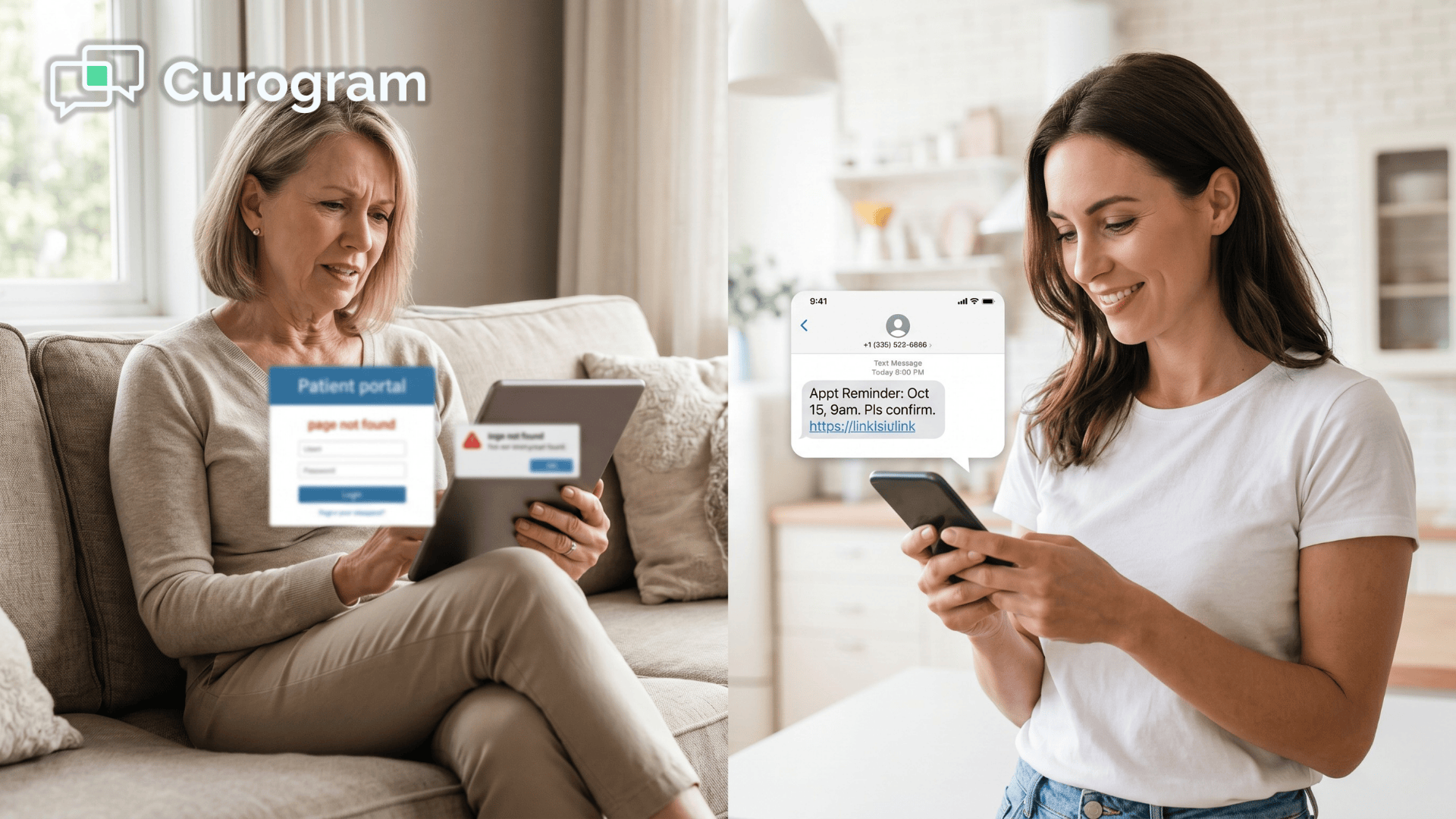
To see what it actually says, they have to log in. But the password reset email is buried in spam. The mobile app needs an update. The browser keeps looping back to the login screen.
They give up.
Two days later, your front desk stares at a 9 a.m. no-show.
The chair sits empty. The revenue is gone. And nobody on your team knows what went wrong, because the portal showed the message was "delivered."
This is the quiet problem eating at your schedule. Portal-based patient appointment confirmation looks modern on paper.
In practice, it blocks the very people it's supposed to reach. Engagement hovers between 25% and 40%, and those numbers don't improve with more reminders. They improve when you change the channel.
Your patients aren't indifferent.
They aren't irresponsible. They're just not living inside your portal. They live inside their text messages, where 98% of adults can be reached and 90% of messages are read within three minutes.
That gap, between where you're sending confirmations and where your patients actually look, is costing you real appointments.
It's costing you revenue. It's costing you the trust of patients who walk away feeling like your practice is hard to deal with.
So let's talk about why SMS confirmation rates vs. portal engagement are so lopsided.
Let's talk about what your patients actually want. And let's talk about the fix that works across every demographic you serve.
Where Portal-Based Confirmations Break Down
Your portal was supposed to simplify patient communication. For a small group of engaged, tech-savvy patients, it does. For everyone else, it adds a wall between your practice and the people you serve.
That wall has three layers. Once you see them clearly, you'll understand why no amount of portal tweaking will fix the core problem.
The login wall most patients never climb
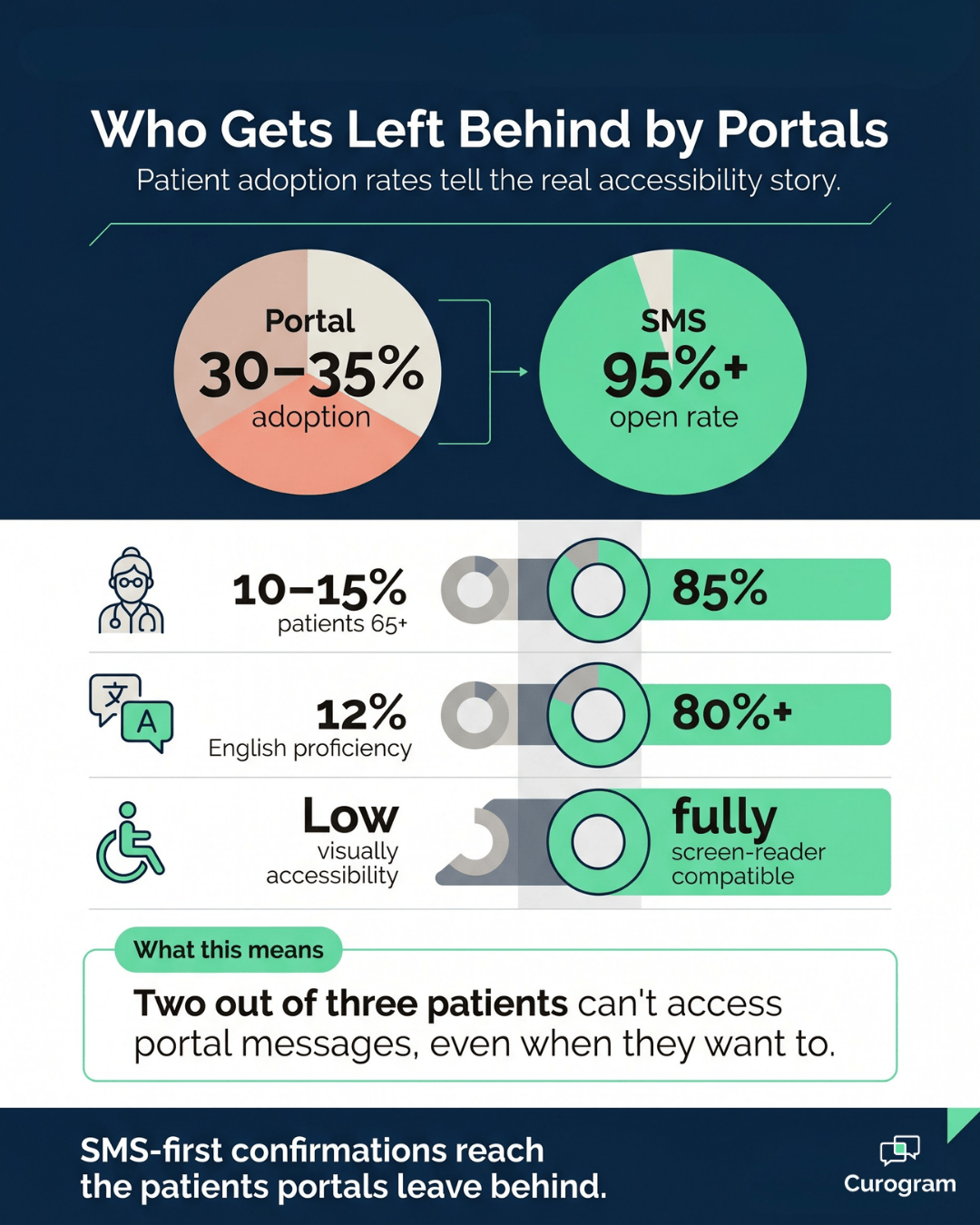
Only 30–35% of invited patients ever create a portal account. Of those who do, 60–70% forget their passwords within months.
For patients aged 65 and up, portal adoption drops to just 10–15%.
That's not a small gap. It means roughly two out of three patients can't access your portal messages even when they want to.
The mobile app route is worse. Patients must download yet another healthcare app, keep it updated, and dig through notification settings.
Nearly 45% of healthcare apps are uninstalled within 30 days. Your reminders go with them.
When someone does hit the password reset flow, it takes two to three minutes of focused effort.
Many abandon the process halfway through. By then, the appointment reminder is long forgotten.
Message fatigue that trains patients to ignore you
Portal notifications often arrive as vague alerts. "You have a new message" tells a patient nothing useful. To find out if it's urgent or routine, they have to log in, which means hitting the login wall all over again.
Patients don't check portal inboxes the way they check text messages. They don't live there. Over time, portal messages become out-of-sight, out-of-mind.
Multi-location practices make it worse. A patient might get separate portal notifications for a clinic reminder, pre-op instructions, and a billing inquiry, all in the same week. Inbox overload leads to a simple coping strategy: ignore everything.
Technical failures that push patients to give up
HealtheLife and similar platforms are known for login loops, "page not found" errors, and unreliable push notifications. For a patient trying to confirm a Tuesday appointment on a Sunday night, one error is enough to quit.
There's no delivery guarantee. No read receipt.
Spam filters can eat email-based portal alerts, and notification settings buried deep in iOS or Android can silence the app. You never know if the message reached them.
40% |
| Of patients have not engaged with a portal confirmation by two days before their appointment. |
The result is predictable. Some no-show. Others flood your phone lines asking questions the portal should have answered.
Why SMS Reaches Every Patient You Serve
SMS doesn't solve appointment confirmation by being fancier than a portal. It solves it by removing friction.
No download. No password. No app update. Just a message that appears on the same screen where your patients read texts from family.
That's why SMS confirmation rates vs. portal rates look so different across every population your practice touches. The wins show up in three distinct ways.

Universal access and instant delivery
98% of American adults have a mobile phone. 90% of SMS messages are opened within three minutes.
Compare that to portal messages, where only 30% are opened within 24 hours.
95%+ vs. 25–40% |
| SMS open rate compared to portal notification engagement. |
What makes SMS work so broadly is that it has almost no technical requirements:
- Works on any phone, including flip phones and basic Android devices
- No internet connection, storage space, or app store account needed
- No login, password reset, or account setup ever required
That last point matters most for patients in rural areas, low-income households, and older age groups. They may not have reliable Wi-Fi, but they almost always have mobile service. SMS meets them where they already are.
Accessibility for the patients portals leave behind
Elderly patients (65+) show 85% SMS adoption compared to 15% portal adoption.
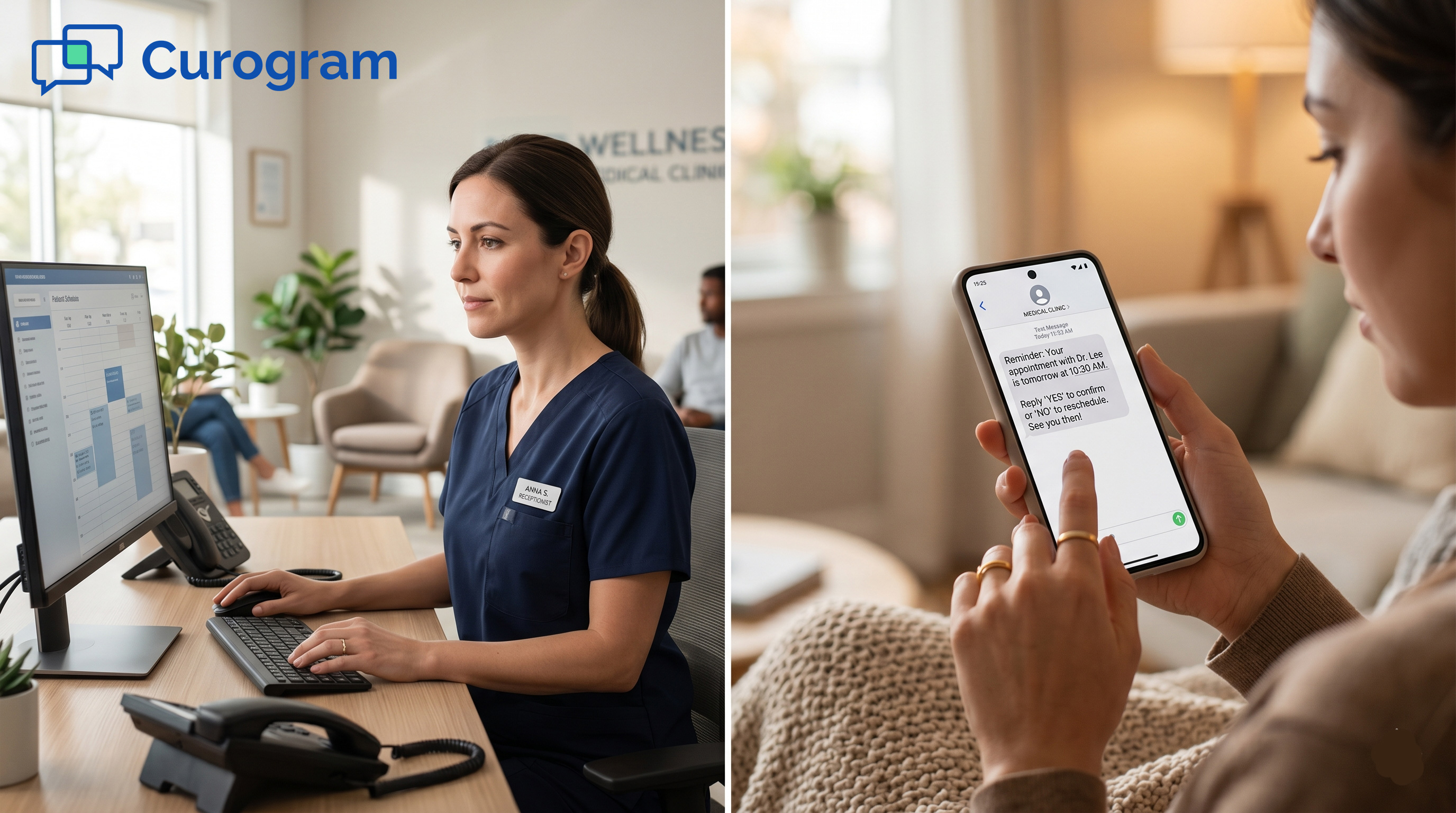
Texting feels familiar to them, and modern SMS reminders use plain language with simple reply options like "Reply 1 to confirm."
Patients with limited English proficiency benefit too. A good texting platform supports translation into 50+ languages, inside the message itself.
Portals typically offer English and Spanish, and the translation quality often isn't strong.
For visually impaired patients, SMS is objectively more accessible. It works cleanly with screen readers and text-to-speech tools. Portal interfaces often fail on accessibility basics, from poor color contrast to missing alt text on buttons. SMS removes those barriers entirely.
The emotional difference a text makes
There's a psychology behind why SMS works. A message that says "Hi Maria, your appointment is tomorrow at 2 p.m. with Dr. Chen" feels like a note from someone who knows you.
A generic portal alert feels like noise from a system.
Your brain treats incoming SMS as important. You check it. You read it. You often re-read it throughout the day because it sits in your thread. Portal notifications register as administrative static, and static gets deleted.
Two-way texting adds one more layer.
"Reply CONFIRM" invites participation. The patient takes a small action, which builds engagement instead of passive scrolling.
That's why HIPAA-compliant 2-way texting feels fundamentally different from any portal alert.
The Numbers Behind the Patient Experience
Everything we've covered so far shapes outcomes you can measure. Confirmation rates. No-show rates. Review counts. New patient referrals.
The business case for SMS isn't theoretical, and the data from real practices makes that clear.

Confirmation lift and recovered revenue
Atlas Medical Center reduced their no-show rates from 14.20% to 4.91% in just three months after switching to automated SMS confirmations. That's 3x better than the industry average.
Covina Arthritic Clinic saw a similar story. Their confirmed appointments per month jumped from 369 to over 1,100 after rolling out automated SMS reminders.
Here's the revenue math for a mid-size practice running 25,000 appointments a year.
A portal-based workflow confirming at 30% delivers 7,500 confirmed appointments. An SMS-based workflow confirming at 75% delivers 18,750.
~$1.1M |
| Estimated annual revenue recovered from prevented no-shows at $150 per visit. |
This means that for your team, the difference between a portal-first workflow and an SMS-first one could be over a million dollars a year in prevented no-shows.
That's not counting the follow-up visits, referrals, and repeat appointments those recovered patients bring.
Patient satisfaction and online reputation
Covina Health Center also saw 1,064 new 5-star Google reviews in just three months after implementing SMS confirmations.
90% of patients who were surveyed left a 5-star review.
Patients specifically mentioned the ease of the confirmation process in their reviews.
Common themes included:
- "Finally a practice that texts me"
- "Easy to confirm without calling"
- "Didn't have to deal with a portal or login"
Those quotes aren't marketing. They're the direct effect of removing portal friction.
The business impact compounds from there. Reviews drive Google search visibility, and Google is the number one source of new patients for most clinics.
90% of new patient leads see your Google Business Profile before your website, so a wave of 5-star reviews often translates into hundreds of new patient referrals per year, on top of the revenue you recover from no-show prevention.
Privacy, Consent, and Patient Control
Patients feel more in control of SMS than portal notifications. They opted in by giving their phone number. They can opt out anytime by replying STOP. And the messages live inside a personal device they check multiple times daily.
HIPAA compliance is the same across both channels when done correctly. Encrypted SMS sent through a HIPAA-compliant platform meets the same standard as portal messaging. But patient perception is very different.
SMS feels like a trusted, personal channel. Portal messaging often feels institutional and invasive.
This is where a purpose-built platform like Curogram comes in.
Curogram's HIPAA-compliant 2-way texting lets your practice send real-time appointment confirmations that patients actually read, without forcing them through a portal login or app download.
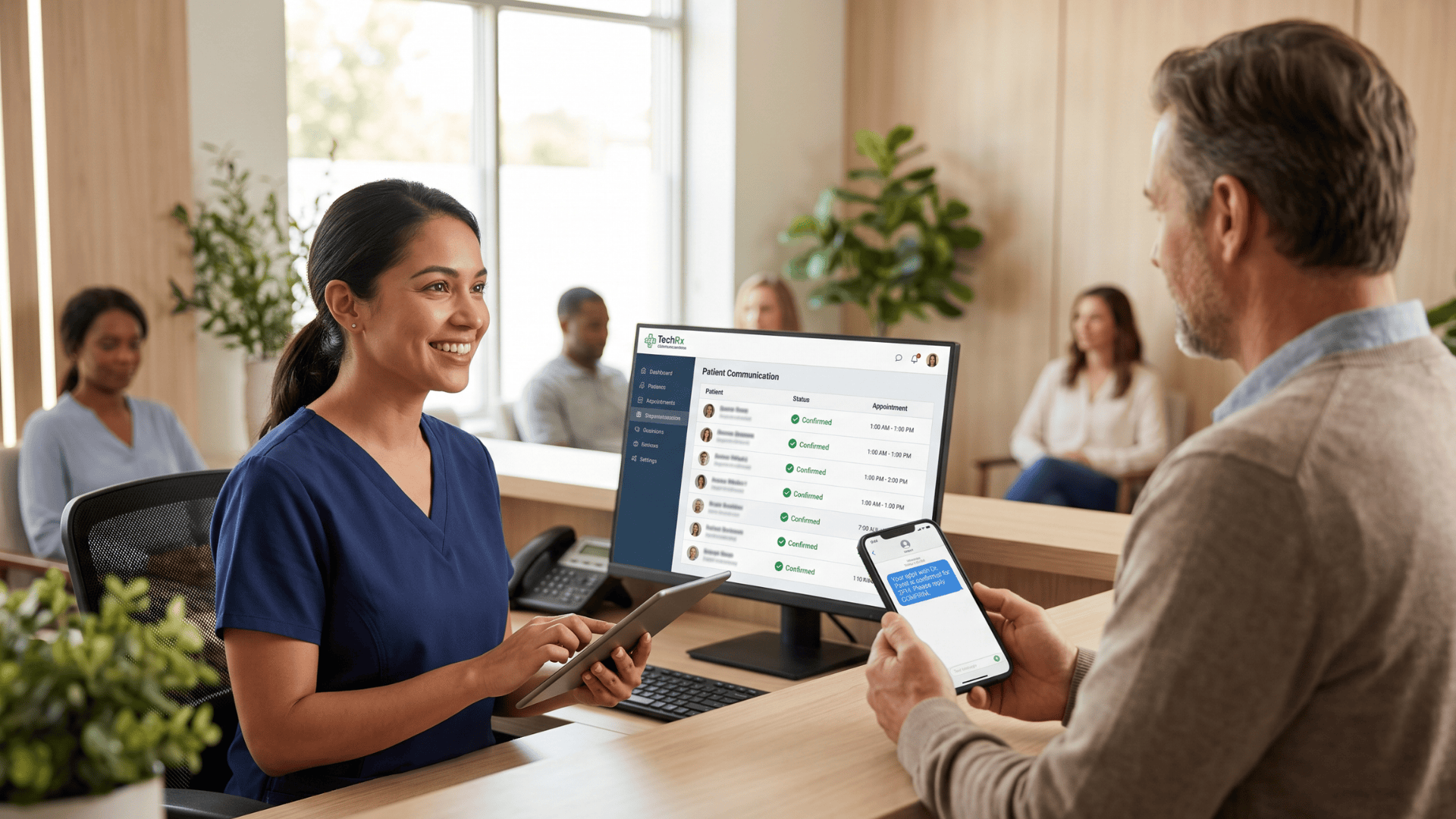
It integrates with your existing EMR, automates the reminder flow, and handles the compliance side so your team doesn't have to think about it.
For practices using Oracle Health or similar EMRs, this is the layer that turns scheduled appointments into confirmed ones, without adding work for your front desk.
Stop Losing Appointments to a Channel Patients Ignore
Your patients want to show up. The data makes that clear.
They just need the confirmation to reach them where they actually live. Not buried in a portal inbox. Not trapped behind a password they forgot six months ago.
In their text thread, where it takes three seconds to read and one tap to confirm.
Every no-show costs your practice roughly $150 in lost revenue. Multiply that by the appointments slipping through portal friction each month, and the number gets serious fast.
For a mid-size practice, that's easily six figures a year walking out the door.
You don't need to rebuild your entire tech stack to fix this. You need the confirmation layer to shift to a channel patients trust. That's what Curogram does, and it does it without replacing your EMR, retraining your staff for weeks, or adding work to your front desk.
Staff training runs about 10 minutes. Integration with your existing systems happens behind the scenes.
Your front desk keeps doing what they do. Only now, confirmations land in text messages instead of portal notifications, and the results speak for themselves.
Practices using Curogram see confirmation rates above 75%, no-show reductions of up to 75%, and a 50% drop in inbound phone call volume. Those aren't projected numbers. They come from real clinics running real schedules.
If you're watching empty chairs add up and wondering where the gap is, it's almost always the channel. Fix the channel, and the rest takes care of itself.
Ready to see what SMS-first confirmation could do for your practice? Schedule a demo with Curogram and walk through your specific workflow with a specialist who understands healthcare operations.
Frequently Asked Questions
Not when SMS is sent through a HIPAA-compliant platform. Patients often trust texting more than portals because it's a channel they already use for personal communication. Curogram's platform uses the right safeguards to keep appointment reminders and confirmations compliant, following HIPAA rules for what can and cannot be sent via standard SMS. For anything involving Protected Health Information, encrypted secure messaging is used instead.
A good patient communication platform supports multi-channel confirmation. SMS reaches roughly 70% of patients as the primary channel, email covers another 20%, and phone calls handle the remaining 10%. Patients can set their preference at check-in, so nobody gets left out. The hybrid approach typically gets 95%+ of patients confirmed in their preferred channel.
SMS doesn't stop forgetfulness. It removes friction between remembering and confirming. A portal notification requires a login to see the details. An SMS shows the appointment time the moment the patient opens the message, and it stays in their text thread for easy reference throughout the day. That repeated exposure is exactly why SMS drives 70%+ confirmation rates compared to 30% for portals.
Yes. Curogram is built to integrate across EMRs, including Oracle Health, so appointment data flows directly into the texting workflow. You don't have to manage two systems or copy information manually. The platform pulls scheduled appointments, sends the confirmation, processes the reply, and updates your EMR automatically.
Curogram implementation is designed to be quick. Staff training usually takes 10 minutes. Most practices see a measurable drop in no-shows within the first 30 to 90 days, based on real client data like Atlas Medical Center's three-month turnaround from 14.20% to 4.91%.