
8 min read
Patient Communication Without Portal Login | Meditab IMS Texting
Aubreigh Lee Daculug
:
May 8, 2026
While IMS CarePortal sees only 25–30% active use, text messages hit a 98% open rate. Curogram syncs with Meditab IMS so confirmations, forms, reminders, and payment links flow through the patient's native text thread.
For practices in primary care, dermatology, GI, and pain management, this means fewer no-shows, lower phone volume, and patients who actually engage.
Your dermatology patient just got a portal invitation for her biopsy follow-up. She clicks the link.
She hits the login page. She forgets her password. She requests a reset. She waits for the email. She gives up and calls your front desk instead.
Multiply that by every recall, every follow-up, every appointment confirmation your practice sends in a week. That is the silent tax of "The Portal Nobody Uses."
IMS CarePortal was built with good intentions. It centralizes records, secures messages, and gives patients a place to check results. But it also asks them to download an app, create an account, and remember credentials before they can do anything useful.
Roughly 70% of patients never actively use their portal. They default to phone calls, voicemails, or simply disengaging until your front desk has to chase them down.
Now think about how those same patients communicate everywhere else. They confirm dinner reservations by text.
They split bills by text. They reply to their kid's school by text. The phone's text thread is the most-used app on their device. Asking them to download a separate medical app to confirm a Tuesday appointment feels like asking them to fax it back.
This is where Meditab IMS patient communication without portal login via secure texting changes the equation.
When patients can engage with your practice the same way they text a friend, confirmations rise, no-shows drop, and your front desk stops playing phone tag. The friction disappears — and so does the lost revenue that came with it.
Let's break down why portal adoption keeps stalling, what it's actually costing your practice, and how a zero-setup texting layer fixes the gap.
Why "The Portal Nobody Uses" Quietly Drains Your Practice
Patient portals look great in a sales demo. In real life, they create barriers your patients were never going to cross. To see the full cost, it helps to look at where the breakdown actually happens — starting with the very first thing your patient is asked to do.
The App Download Problem
IMS CarePortal and the IMS Care mobile app ask patients to install software, create credentials, and log in before they can do anything useful. That includes simple tasks like confirming an appointment, viewing a result, or paying a bill.
Think about your patient mix.
The 72-year-old pain management patient managing chronic injections.
The 35-year-old parent juggling three kids and a job. The 50-year-old who just wants to reply "yes, I'll be there Tuesday."
For every one of them, the portal is a wall standing between them and your practice.
70–75% |
| Of patients default to phone calls, voicemail, or disengage entirely instead of using the portal. |
The result is not "low engagement." The result is that patients stop trying. And that stops mattering only if you do not measure it — which most practices don't.
The Real Patient Experience
Here is what actually happens when your dermatology practice sends a portal invite for a biopsy follow-up. The patient receives an email.
She clicks the link. She lands on a login page she does not recognize. She cannot remember her password. She requests a reset. She waits. She finally sets a new password. She clicks back. She finds the appointment.
~50% |
| Of patients give up before step three of the portal login process. |
The ones who push through are already frustrated before they walk in the door. The rest pick up the phone — which means your front desk handles a call that should never have happened.
This is the no app download patient texting IMS use case in plain terms:
Any communication that requires friction will lose to communication that does not.
The Drop-Off Numbers
Industry data on IMS CarePortal patient adoption rates lands around 25–30% for active use. That number gets ugly fast when you map it onto specialty practices that depend on consistent recalls.
The patients most likely to drop off are usually the ones with the most appointments to keep:
- Colonoscopy and endoscopy follow-ups in GI practices
- Post-op check-ins after dermatology procedures
- Injection and infusion series in pain management
- Biologic refill cycles and chronic condition recalls
For your team, the takeaway is straightforward. The patients you cannot reach digitally are the same patients most likely to no-show — and the cost compounds every month you let it slide.
The Expectation Gap
In 2026, patients operate with digital-first healthcare communication expectations — they pay friends, book rideshares, and confirm dinner plans through their phone's text thread.
Asking them to download a medical app to say "yes, I'll be there" feels out of step with how they live the rest of their day.
That gap between what patients expect and what your portal delivers is exactly where satisfaction quietly erodes. It also shows up later in your Google reviews — and once that pattern starts, it is hard to reverse.
A Zero-Setup Channel That Meets Patients Where They Already Are
Once the problem is on the table, the fix gets simple. You stop trying to drag patients into a portal and start meeting them in the channel they already use every day. From there, every other workflow gets lighter.

Texting With Zero Barriers
Curogram's secure texting reaches every patient through SMS. There is no app to install. There is no account to create. There is no password to forget. The barrier to entry for the patient is literally zero.
A practice running Curogram alongside Meditab IMS can text the things that actually drive engagement:
- Appointment confirmations and rescheduling requests
- Pre-visit instructions and intake form links
- Follow-up reminders and recall outreach
- Payment links and balance notifications
This is the heart of Meditab patient portal alternatives text messaging: the channel is already on every patient's phone, and the practice does not have to teach anyone how to use it.
One-Tap Patient Engagement
Patients receive a text and respond with a single tap or a short reply. Confirming an appointment takes one word. Rescheduling takes a sentence. Asking a quick question about a medication takes ten seconds.
Under 30 seconds |
| To complete a text-based interaction, compared to 5–10 minutes for a portal-or-phone process. |
That speed is the engine behind Meditab IMS patient experience improvement SMS — patients respond because responding does not interrupt their day.
Once that pattern sets in, the front desk feels the difference within the first week.
Two-Way Sync With Meditab IMS
Curogram integrates with Meditab IMS so patient contact information and appointment data flow automatically.
When a patient confirms by text, the confirmation is captured. Your front desk does not have to manually cross-reference portal activity against the IMS schedule.
This matters because it removes the most common staff complaint with bolt-on tools: double data entry. Your team works in IMS. Curogram works in the background. Nobody has to learn a new chart system to send a reminder.
Universal Accessibility
Texting supports universal mobile accessibility in healthcare communication — it does not discriminate by age, tech literacy, or language.
It works for the elderly patient who has never downloaded an app. It works for the parent answering between meetings. It works for the non-English-speaking patient who finds portal navigation overwhelming.
For Meditab practices serving diverse communities, this is what real patient engagement without portal login healthcare actually looks like — accessible to everyone, not just the digitally fluent.

Real Numbers When You Eliminate the Friction
A new channel is only worth adopting if it moves the metrics that matter. The data on texting versus portals is not close — and once you see it side by side, the case writes itself.
The Engagement Gap
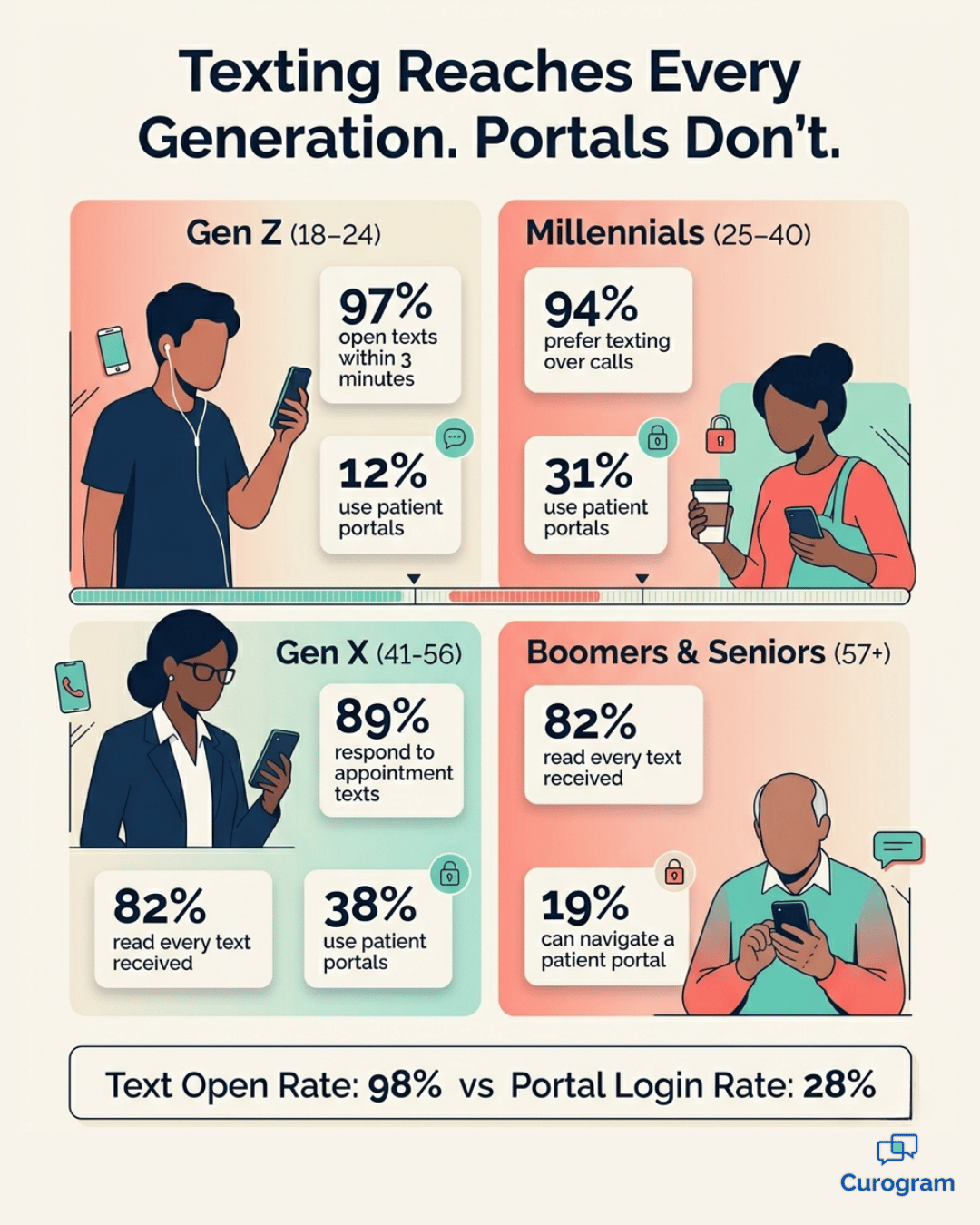
Text messages carry roughly a 98% open rate and around a 45% response rate. Active portal use sits at 25–30%. That is not a preference difference. That is an order-of-magnitude difference.
In practice, every 100 portal messages might reach 28 patients in any meaningful way. Every 100 text messages will reach 98. Same patient list. Same practice. Different channel. The gap shows up in your schedule before it shows up in your reports.
What Friction Removal Looks Like in Confirmations
For a mid-size practice sending 1,500 reminders per month, the response shift is dramatic. Portal-only outreach typically captures around 180 confirmations.
The same volume sent via Curogram texting captures roughly 675 — an additional 495 confirmations from the same reminder volume, without adding a single staff member.
This is the part that surprises most office managers. The work does not change. Only the channel does. And the engagement curve climbs from there.
What Friction Removal Looks Like in Revenue
When confirmations climb, no-shows fall. Portal-only practices commonly sit around an 18% no-show rate. Practices with active text-based reminders trend closer to 8%. That ten-point swing is where the revenue math gets serious.
~$30,000/month in recovered no-show revenue for a mid-size practice (1,500 monthly reminders at $200 per visit).
Curogram has reported reductions in no-show rates of up to 75% and phone volume cut by around 50% across client practices. Both compound as your patient panel grows — and neither requires hiring.
The Frictionless Practice Effect
When patients can engage as easily as they text a friend, the soft metrics start moving alongside the hard ones. Confirmations climb. Phone volume drops. Satisfaction scores tick up. Google reviews increase organically because patients feel cared for instead of frustrated.
Picture a gastroenterology patient who receives a text with colonoscopy prep instructions two days before her procedure. She reads it in 20 seconds, replies "got it, thanks," and her chart logs the acknowledgment.
No portal login. No phone call. No missed prep. No rescheduled procedure that costs your practice a full day of the schedule. That is what engagement looks like when the friction is gone.
Stop Asking Patients to Download an App Just to Talk to You
IMS CarePortal serves a real purpose. It centralizes clinical data, stores records, and gives patients a secure place to view sensitive information when they want it.
But it was designed around your workflow, not your patient's convenience — and that is why most patients never actively use it.
The fix is not replacing your portal. The fix is adding a channel that works for the 70% of patients the portal will never reach.
Meditab IMS handles your clinical record. Curogram handles your patient relationship. Together, they give you a practice that respects both — the chart stays in IMS, and the conversation happens where your patients already live, in their phone's text thread.
Patients deserve better than being asked to remember a password just to confirm a Tuesday appointment. Your front desk deserves better than chasing the same 30 confirmations every morning. Your bottom line deserves better than absorbing no-show losses that a single text could have prevented.
If you are a Meditab IMS practice in primary care, dermatology, gastroenterology, pain management, or any high-recall specialty, the math is hard to argue with. Patients respond to texts at roughly three times the rate they engage with portals.
Confirmations rise. No-shows fall. Phone volume drops. Reviews improve.
Schedule a demo to see how Curogram's secure texting works alongside your Meditab IMS system. The platform is HIPAA-compliant and SOC 2 Type II certified, with no long-term contract and staff training that takes about 10 minutes.
Frequently Asked Questions
Yes. Curogram's texting platform is fully HIPAA-compliant and SOC 2 Type II certified. All messages are encrypted, and the platform operates under a Business Associate Agreement. Texting through Curogram is just as compliant as portal messaging — with dramatically higher patient engagement.
No. That is the whole point. Patients receive messages on their phone's native text messaging app — the one they already use every day. There is no download, no account creation, and no password. If a patient can receive a text, they can communicate with your practice through Curogram.
Patients can opt out of text communication at any time with a simple "STOP" reply, which keeps you compliant with TCPA regulations. CarePortal stays available for patients who prefer it. Curogram is an additional channel, not a replacement — and giving patients the choice is exactly what increases overall engagement across your panel.
Curogram pulls patient contact information and appointment data directly from Meditab IMS so your team does not have to re-enter anything. Confirmations, replies, and message history are captured automatically. Your front desk continues working in IMS while the texting layer runs in the background.
In most cases, yes. Practices using Curogram have seen no-show rates drop by up to 75% and phone volume cut by around 50%. The reason is simple: a 98% open rate beats a 28% portal login rate every time.