9 min read
Why Patients at GE Centricity Practices Engage 10x More Through Text
Jo Galvez
:
May 14, 2026
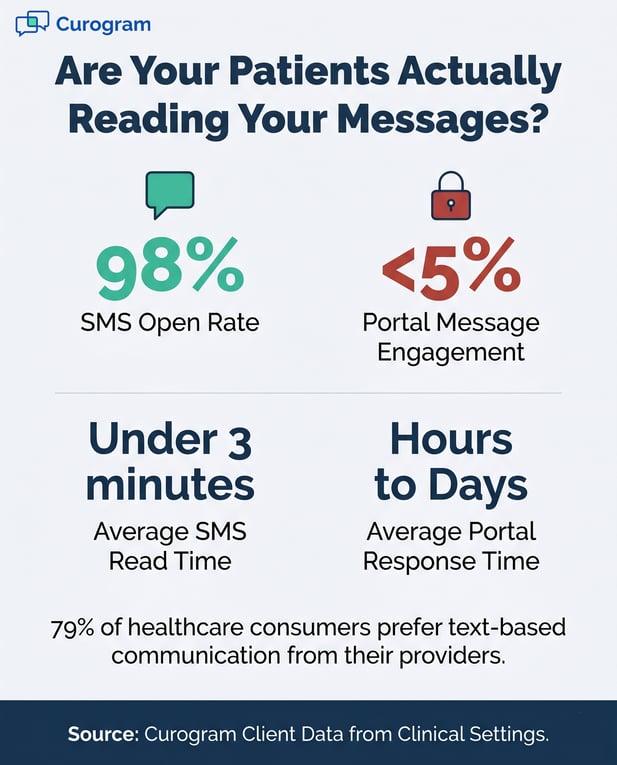
SMS reaches patients on phones they already carry, with a 98% open rate. Most messages are read within 3 minutes.
Portal messages, by contrast, require patients to remember a login, navigate a web interface, and find the right screen. The drop-off rate for portal messages can reach 80-95%.
Curogram's two-way texting gives GE Centricity clinics a direct line to patients via standard SMS. No app to download. No account to create. Just a text, and a reply.
For large practices and FQHCs serving diverse groups, this shift in the patient texting experience is a major step toward better care.
Think about the last time you needed to reach your doctor's office. Did you call and wait on hold?
Did you log into a portal you barely remember signing up for? Or did you wish you could just send a quick text?
Your patients are asking the same question. And the data shows most of them give up before they ever reach you.
The gap between how patients want to communicate and how most GE Centricity practices currently communicate is wide.
Text messaging sits on one side. The patient portal sits on the other. And the difference in engagement is not small. It is roughly 10 to 1.
Patients today text their hair salon, their kids' school, and their dentist. But many large medical practices still route all non-urgent communication through a web portal that a large portion of patients never bother to log into.
This article breaks down why that gap exists, what it costs your practice, and what changes when you replace portal-only messaging with two-way SMS.
The Portal Experience vs. The Text Experience
Most practices know that patient portal adoption is low. But few have mapped exactly where the drop-off happens.
When you compare the steps involved in each channel, the contrast is stark, and it explains almost everything.
The Portal Patient Journey
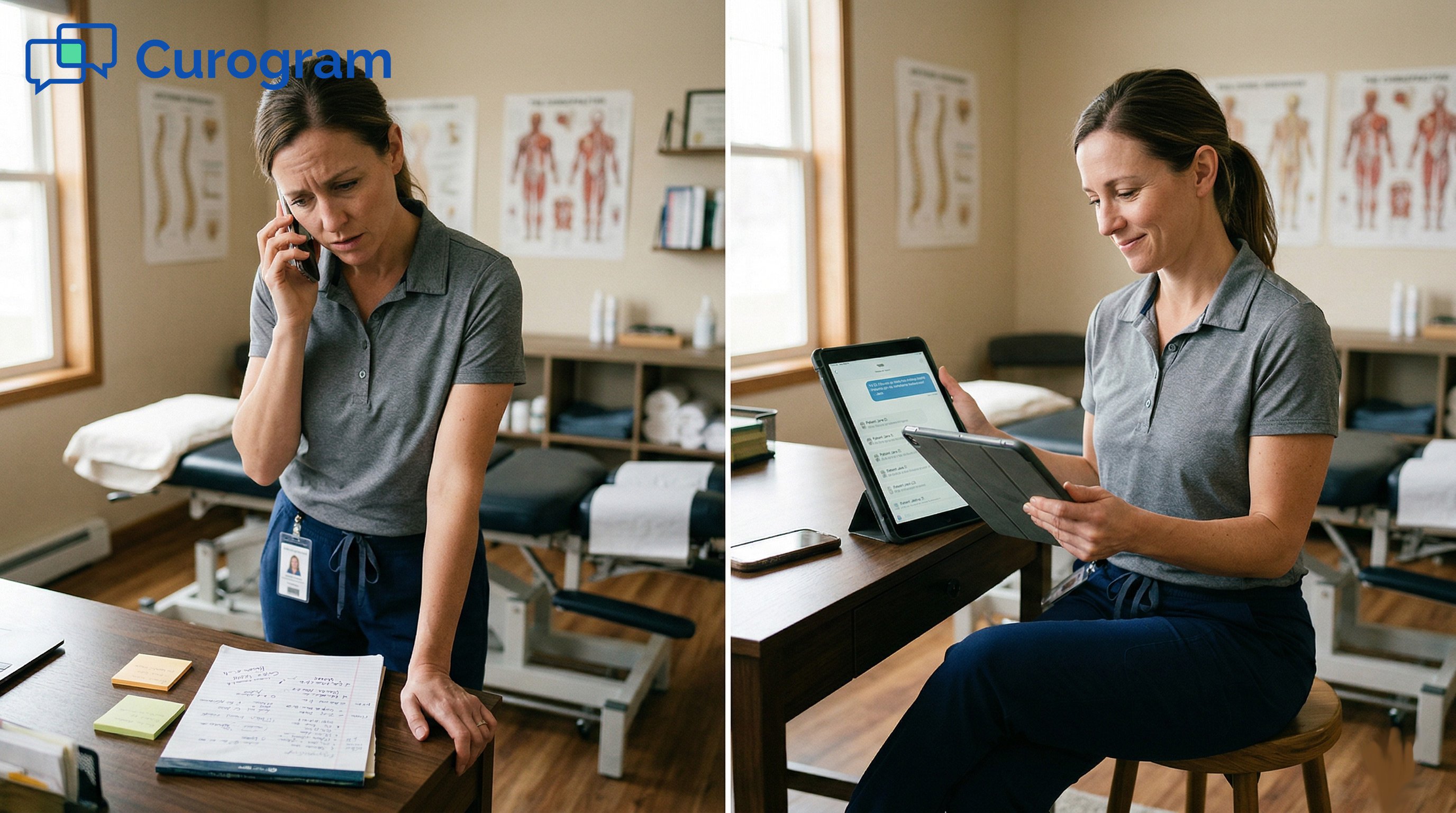
Getting a patient to read and reply to a portal message is not a one-step process. It involves at least eight separate actions:
- The practice sends a message.
- The patient gets an email notification (if they opted in).
- The patient opens that email.
- They click a link, enter a username and password that are often forgotten.
- They navigate the portal interface, find the message section, read the message, and then type a reply.
Each of those steps is a place where a patient can drop off. And many do.
Based on Curogram client data from clinical settings, 80-95% of patients never complete this journey. The portal login wall does not just slow things down. It actively stops patients from engaging.
Where Patients Drop Off
The biggest failure points are predictable. Email notifications end up in spam folders. Passwords get forgotten, which triggers a reset loop that many patients abandon.
The portal interface is rarely designed for mobile. Patients associate portal messaging with formal, time-consuming interactions. It does not feel like communication. It feels like paperwork.
Younger patients under 45 often find portals outdated. Older patients over 65 frequently find them confusing.
Low-income patients may not have reliable internet access at all. The result is a communication tool that works well for a very narrow segment of your patient population.
The Cost of Low Portal Engagement
Low engagement means missed pre-visit instructions, unanswered follow-up questions, and patients who feel disconnected from their care team.
It also means more inbound phone calls, as patients who cannot reach you through the portal simply call instead.
According to Curogram client data from clinical settings, practices that move to two-way texting see inbound phone call volume drop by as much as 50%.
The Text Message Patient Journey
The SMS experience is almost the opposite of the portal experience. It is short, familiar, and requires almost nothing from the patient.
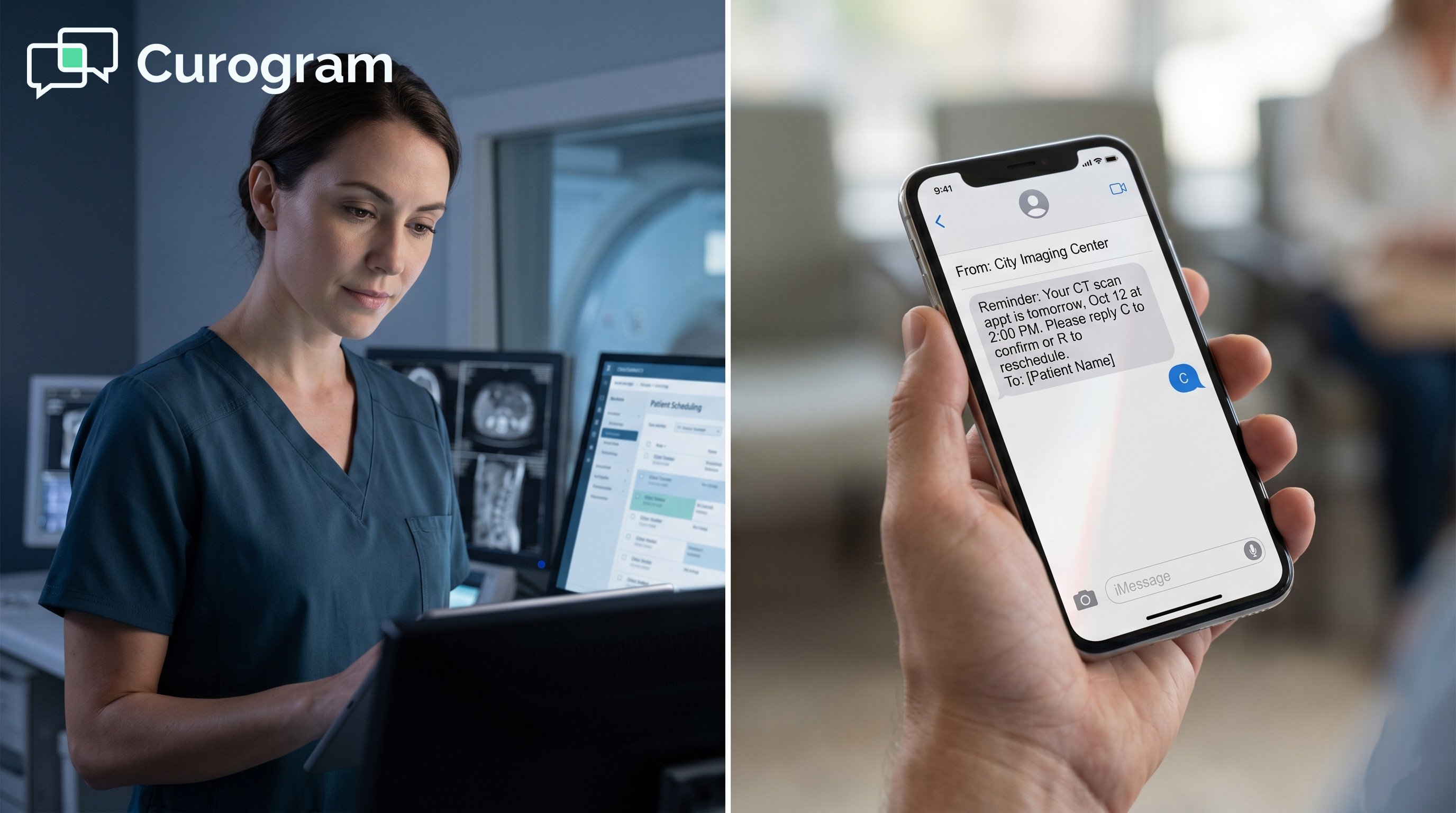
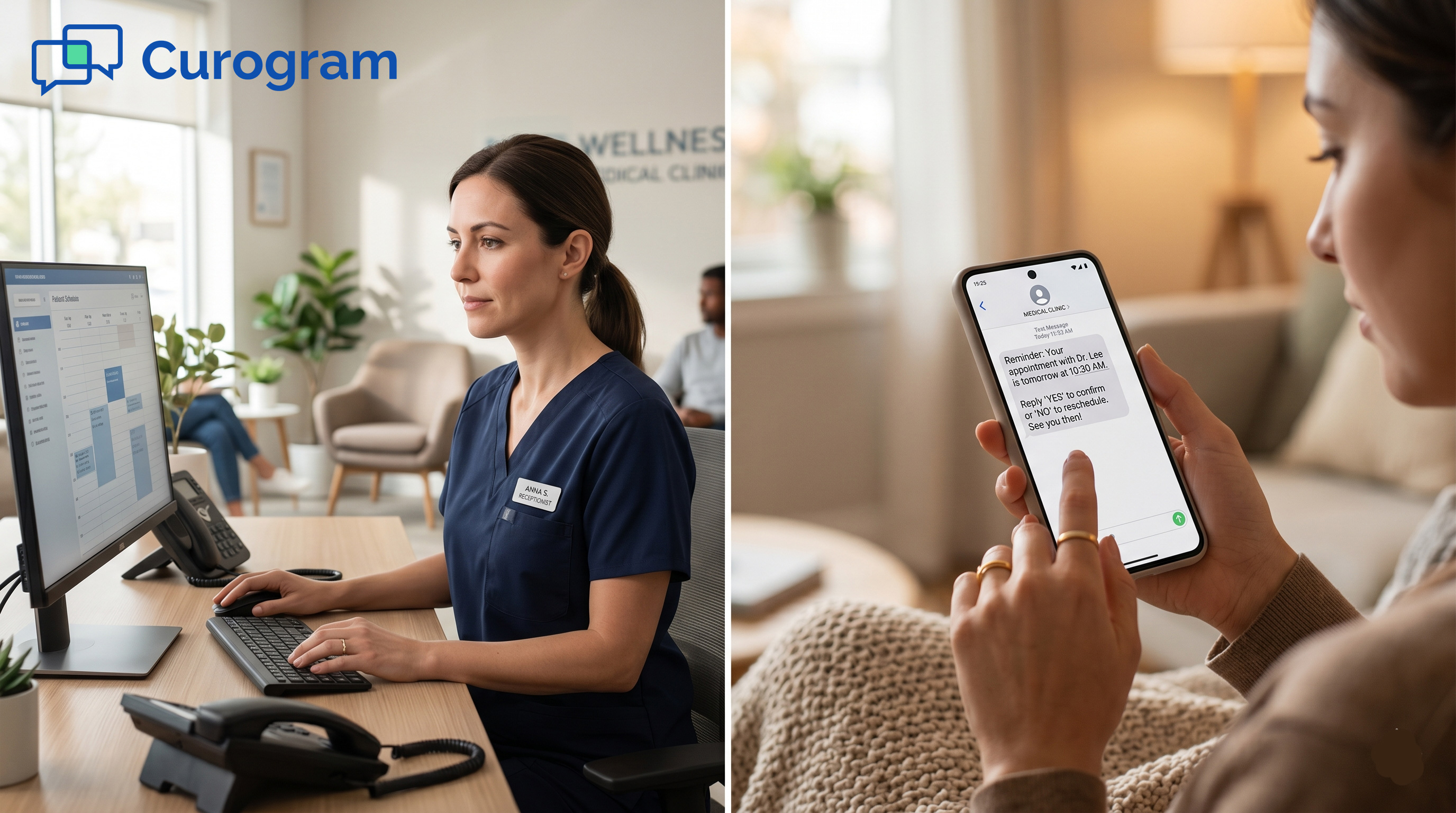
The practice sends a text, the patient's phone buzzes, the patient reads it, and the patient replies.
That is four steps, two of which are passive. Most of the time, it takes less than 60 seconds from start to finish.
Zero Friction by Design
There is no app to download. No account to set up. No password to remember.
The message arrives on the device the patient already uses dozens of times a day, inside the same messaging app they use to text friends and family.
The channel is completely familiar, which means the patient does not have to think about how to use it. They just reply.
Two-way capability makes the exchange feel like a real conversation. Patients do not just receive messages.
They ask scheduling questions, report symptoms, request medication refills, and confirm appointments. The interaction is quick and natural, not formal and slow.
What the Numbers Say
SMS open rates sit at 98%, with most messages read within 3 minutes. Portal message engagement rates are in the single digits.
Response times for portal messages are measured in days. That is not a small gap. It is a fundamentally different level of access to your patients.
Studies also found that healthcare consumers prefer text-based communication from their providers. That preference only grows stronger with each new generation of patients entering the system.
Patient Engagement Data: Portal vs. SMS
Here is a direct comparison of how the two channels perform across the metrics that matter most to practice operations:
|
Metric |
Patient Portal |
SMS (Curogram) |
|
Open Rate |
Single digits |
98% |
|
Average Read Time |
Hours to days |
Under 3 minutes |
|
Patient Drop-Off Rate |
80-95% |
Very low |
|
Steps to Respond |
8+ steps |
2 active steps |
|
Device Required |
Computer or smartphone with internet |
Any phone (including basic) |
|
Login Required |
Yes |
No |
|
App Required |
Sometimes |
No |
Better engagement through text does not just help patients. It directly improves your quality metrics.
Higher SMS engagement links to fewer no-shows, better pre-visit preparation, and stronger patient satisfaction scores, all of which affect CMS ratings and MIPS performance.
|
Your patients check their phones 96 times a day. Your portal gets checked once a month. See the difference two-way texting makes. |

Accessibility and Inclusion
Not all patients face the portal problem in the same way. For some groups, the portal is simply inconvenient.
For others, it is completely out of reach. Understanding who your patients are and how they communicate is key to choosing the right channel.
The FQHC Patient Population
Federally Qualified Health Centers that run GE Centricity often serve patients with unique communication needs.
Low digital literacy, limited internet access, language barriers, and financial stress all reduce portal engagement to near zero in many FQHC settings.
In these environments, the portal is not just unpopular. It is functionally useless for most of the patient base.
SMS as the Universal Channel
Text messaging works on any phone, including basic devices without smartphone features. It does not require internet access because SMS runs on the cellular network.
It can be sent in any language. For FQHC patient populations, SMS is not just a more convenient option. It may be the only digital communication channel that actually works.
Curogram supports multilingual messaging. Templates and automated messages can be set up in multiple languages.
Practices serving Spanish-speaking, Khmer-speaking, or other non-English communities can reach patients in their preferred language without manual translation on every message.
Real Results in Underserved Communities
The impact of SMS in FQHC settings goes beyond convenience. When patients receive appointment reminders and care instructions in their own language through a channel they can actually use, adherence improves.
Staff spend less time on phone calls chasing confirmations. And patients feel like the practice is truly trying to reach them.
Elderly Patient Access
Many older patients at GE Centricity practices struggle with portal technology. App downloads, account creation, and password management are significant barriers for patients over 65.
But text messaging is familiar. Most older patients who own any phone can read and reply to a text message without needing instructions.
The Caregiver Advantage
For elderly patients with caregivers, text messages offer a practical benefit that portals cannot match. Messages can arrive on a shared or family phone.
Caregivers can manage appointment confirmations, read care instructions, and coordinate follow-up without navigating a portal on behalf of the patient. The channel works for the whole care circle, not just the patient alone.
Trust and Familiarity
Patients recognize texts from their practice because they come from a consistent local number, the same one they use for two-way conversations with the front desk.
That familiarity builds trust. Emails and portal notifications can feel like they come from nowhere. A text from a known number feels like a real person reaching out.
On the privacy side, the text body contains only basic scheduling or administrative details. Any protected health information is shared via a secure link within the text.
Patients can reply to any message and be connected directly to the practice through a channel they already know.
Patient Satisfaction and Retention Impact
Better communication does more than reduce friction. It shapes how patients feel about your practice.
How patients feel has a direct effect on whether they stay, whether they show up, and whether they tell others about you.
How SMS Drives Satisfaction Scores
Practices that move from portal-only messaging to two-way texting see real improvements in patient satisfaction.
When patients feel that a practice communicates on their terms, they rate their overall experience higher, even when the clinical care itself has not changed. The communication upgrade alone shifts how the practice is perceived.
What Curogram Client Data Shows
Curogram client data from clinical settings shows that practices using two-way texting see 60-70% of routine inbound phone calls shift to text within the first 60 days.
Patients prefer texting because it fits into their schedule. They can send a question during a work break and get a reply without waiting on hold.
Staff benefits, too: fewer calls mean more time for tasks that actually need a human voice.
Atlas Medical Center reduced its no-show rate from 14.20% to 4.91% in just three months after adopting Curogram's automated reminder system.
That is three times better than the industry average, and it is a direct result of reaching patients through a channel they actually respond to.
The Referral Effect
Patients who have a smooth communication experience tell people about it.
"My doctor's office actually texts me now. It's so easy."
That kind of word-of-mouth is hard to buy with advertising. It is the natural result of removing friction from an experience that most patients have found frustrating for years.
Based on Curogram client data from clinical settings, 35% of patients who received an SMS recall message scheduled an appointment within a month.
One multi-location practice brought back 1,240 patients through recall messages alone. That is not just a retention number. It is a revenue number.
Competitive Retention and Downstream Quality
Large GE Centricity organizations compete for patients against health systems running modern EHR platforms with built-in SMS tools.
Patients who experience friction when trying to communicate with your practice may quietly move to a competitor that offers a smoother experience. Two-way texting closes that gap.
How Better Communication Affects Clinical Outcomes
Patients who engage through text are more likely to complete pre-visit forms, follow post-visit instructions, and report symptoms early. That upstream engagement feeds downstream quality.
Practices see better chronic disease management, stronger follow-up adherence, and cleaner quality metrics for MIPS and other value-based programs.
Covina Arthritic Clinic confirmed more than 1,100 appointments per month using Curogram's automated confirmation system.
That kind of volume, handled automatically, frees staff to focus on clinical support rather than phone tag.
The Bigger Picture
When a practice commits to SMS-based patient communication, the effects ripple outward. Staff are less burned out. No-shows drop. Patients feel seen.
Reviews improve. And the practice earns a reputation for being easy to work with, which matters more than ever in a competitive healthcare market.
Improving the patient texting experience at a GE Centricity practice is not a technical upgrade. It is a patient care upgrade. And the data make a clear case that patients notice the difference.
Conclusion
The portal has a role in healthcare. But for everyday patient communication, it doesn't work.
The drop-off rates are too high. The friction is too much. Too many patients are being left behind by a system that was built for a narrow slice of the population.
Two-way text messaging is not a trend. It is how your patients already communicate. GE Centricity practices that make the switch give patients something they actually want: a fast, familiar, and friction-free way to stay connected to their care.
No app. No login. No hold music. Just a text.
The patient texting experience at GE Centricity clinics does not have to lag behind the rest of their digital lives.
With the right SMS platform, the gap closes quickly, and the results show up in satisfaction scores, no-show rates, and revenue.
Patients check their phones constantly. The question is whether your practice shows up when they do.
Modernize Your Patient Communication — Schedule a Consultation
Frequently Asked Questions
SMS removes every barrier that causes patients to drop off. There is no login, no app, no portal navigation, and no password to remember. The message arrives on a phone the patient already has in hand, and replying takes seconds.
Portal messages require 8 or more steps, and most patients abandon the process before completing it. The result is a 98% open rate for SMS versus single-digit engagement for portal messages.
When patients know they can text their practice, they stop calling for routine questions. Curogram client data from clinical settings shows that 60-70% of routine inbound phone calls shift to text conversations within the first 60 days of deployment.
That reduction in call volume frees front desk staff to handle more complex tasks and reduces hold times for patients who do need to call.
FQHCs often serve patients with limited internet access, low digital literacy, or language barriers that make portal use nearly impossible. SMS works on any phone, does not require internet access, and can be configured in multiple languages.
For many FQHC patients, text messaging is the only digital communication channel that is both accessible and easy to use. This makes it far more effective than any portal-based approach.
Curogram's messaging platform is HIPAA-compliant with configurable controls for protected health information. Basic scheduling details can appear in the message body.
Sensitive or clinical information is shared through a secure link that requires verification before the patient can view it. All messages are encrypted in transit and at rest, and the practice keeps full audit logs of every conversation for compliance purposes.
Patients who can reach their practice easily are more likely to stay with that practice. Poor communication is one of the top reasons patients switch providers. When texting replaces the portal for routine exchanges, patients experience less friction, feel more valued, and are more likely to recommend the practice to others.
Curogram client data from clinical settings shows that recall messages sent via SMS brought back 35% of overdue patients, with one practice recovering 1,240 patients through SMS alone.