
 Jo Galvez

Many of these groups run series-based care, like chiropractic plans, therapy schedules and chronic care visits, so one lapsed patient can mean six or more lost visits.
Curogram builds recall lists from appointment history synced from Office Ally, sends win-back texts from each location's local number, and sends replies to staff for booking.
In Curogram client data from clinical settings, 35% of a multi-location practice's patients who got an SMS recall booked within a month, and 1,240 patients were seen from recall texts alone.
A patient finishes six of twelve visits in a chiropractic plan. She cancels one for a work trip and means to rebook. Nobody follows up.
Four months later her back flares up again. She searches for a chiropractor near her, and she may not land on yours.
Nothing about her case is unusual. Ask any front desk in a chiropractic or therapy group and they can name five patients like her from memory.
Practice Mate recorded every step of that. The cancelled visit is there, and so is the empty space where her next six visits should be. Recording a dropout doesn't bring the patient back, though, and no lean front desk has spare hours to work that list.
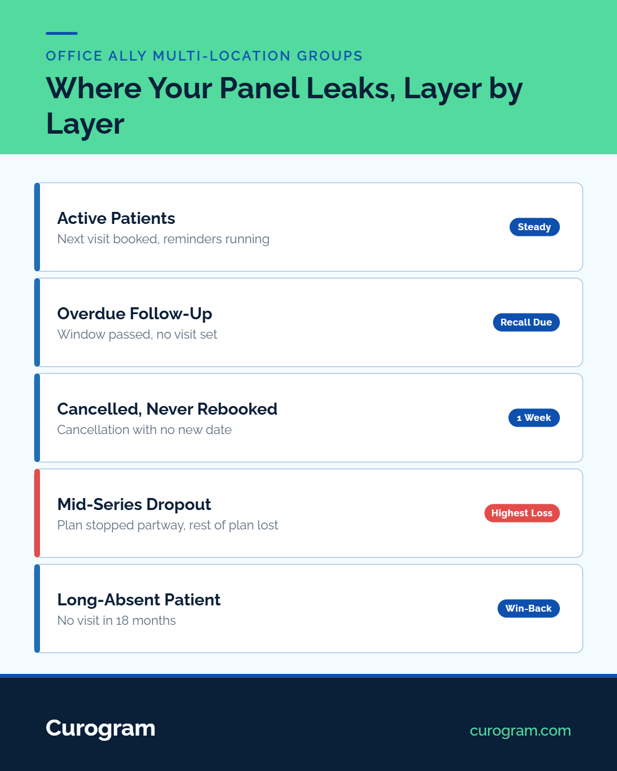
We call this the leaky panel. Every location in the group has one. In series-based care the loss is bigger than one slot, because each lapsed patient takes the rest of the plan with her.
Our view: the cheapest visits a group can add are with patients who already know its staff. Patient recall campaigns for multi-location Office Ally groups turn that idea into a standing system.
Lists come from appointment history, texts go out from each site's own number, and staff only touch the patients who reply.
Growth plans tend to chase new patients first. Ads, listings, and referral pushes all court strangers. Meanwhile, the back door stays open at every site, and the panel drains a few patients a week. Recall closes that door before the group spends another dollar on reach.
How the Leaky Panel Drains Each Location
Most lapses don't start with a decision. They start with one missed visit and a week where nobody called.
Why Series Care Loses More
A one-time visit that lapses costs one slot. A series that lapses costs every visit left in the plan. Say a patient drops after visit six of twelve. The schedule loses six visits the provider had planned around, and the patient loses the care she needed.
That's what makes care series dropout recovery worth more in chiropractic, physical therapy and behavioral health than in most specialties. Each patient brought back restarts a stream of visits.
Four Kinds of Lapsed Patients
Patient panel leakage shows up in four common groups. Each one needs different wording and a different timing window.
|
Lapsed group |
What the schedule shows |
When to reach out |
|---|---|---|
|
Mid-series dropout |
Plan visits stopped, nothing booked |
2 to 3 weeks after last visit |
|
Cancelled, never rebooked |
Cancellation with no new date |
1 week after the cancellation |
|
Overdue follow-up |
Follow-up window passed |
Day after the window closes |
|
Long-absent patient |
No visit in 18 months |
Once, then on a set cycle |
These windows are starting points. Each location can tune them to its own providers and plan lengths.
Why Nobody Works the List
The list exists. Most practice systems can print it. What's missing is time.
A front desk that runs check-in, copays, phones, and the waiting room won't reach page two of a recall report. The report gets printed, gets a few calls, and gets replaced next quarter by a longer one with the same names.
What It Costs the Group
Groups feel it in revenue. In a June 2026 MGMA Stat poll, 36% of medical group leaders said revenue was down from the year before. Many of those groups pointed to falling patient and visit volume. The same article reports that 84% of groups saw higher operating costs.
How Recall Campaigns Work on Top of Office Ally
Recall works best as a system that runs every month. Curogram adds that layer and leaves Office Ally as the record.
Lists Built From Appointment History
Curogram's Office Ally integration syncs appointment data from Office Ally. From that history, Curogram can sort patients by last visit date, appointment type, location, provider, and whether a future visit is on the books.
That's how recall automation text campaigns stay precise. A mid-series chiropractic recall reaches patients with an adjustment-plan appointment type and no next visit. It never reaches a one-time consult.
Texts From the Number Patients Know
Each location sends from its own local number. Messages name the patient's site and provider, which makes them read as care from that office. Staff write one template per lapsed group, so a mid-series patient hears about finishing her plan and a long-absent patient gets a simple welcome-back note.
For larger sends, see our page on mass texting for Office Ally users.
Replies Go Straight to Booking
A patient who replies YES lands in the staff inbox with her site and last visit attached. A scheduler offers two times and books the one she picks in Practice Mate.
Once she's back on the schedule, her reminders and confirmations run like any other visit, and her reply writes back to Office Ally as Confirmed.
Groups set those reminder rules once for every site; our guide to centralized reminder governance covers how.
Curogram Highlight: Automated Recall Campaigns
Automated Recall Campaigns find lapsed patients in the appointment history Curogram syncs from Office Ally and text them on a set schedule. Each location sends from its own local number, with templates the group approves once and every site uses.
Staff choose batch sizes per location, so replies arrive at a pace the front desk can book. Opt-outs are recorded automatically. Curogram is HIPAA-compliant and SOC 2 Type II certified, and it signs a BAA.
We cover the staff side in more detail in our guide to automating patient reactivation outreach. For the patient's view, see our piece on bringing lapsed patients back with text outreach.

What a Self-Refilling Schedule Looks Like
The first month of recall usually shows which locations had the deepest leaks.
The Reconversion Number
The reconversion rate on recall is the share of texted patients who book again. In Curogram client data from clinical settings, 35% of a multi-location practice's existing patients who got an SMS recall scheduled within a month. That same practice saw 1,240 patients from recall messages alone.
In series care, each of those bookings can restart a plan. One recovered patient at visit six can mean six more visits on the schedule.
Lapsed Patient Win-Back in Chiropractic and Therapy
Lapsed patient win-back in chiropractic and therapy works because the patient already knows the provider and the plan. She doesn't need to be sold on the clinic. She needs an easy way back in, and a text she can answer from her phone is the shortest path.
Starting With One Location
Most groups don't launch recall everywhere on day one. They pick the site with the longest list of mid-series dropouts and run one campaign for a month.
Staff learn the reply flow on a small batch, the template gets tuned, and then the next site joins with the same settings.
Watching It Site by Site
Recall runs best when managers can compare locations. Per-site results come with Curogram's data analytics package, sold separately. Our guide to enterprise analytics and location benchmarking explains how groups read those numbers.
Office Ally patient reactivation outreach then becomes a monthly routine with a result attached, where it used to be a slow-week project.
Conclusion: Patch the Panel Before Buying More Water
A group can spend heavily to find new patients while its own panel drains at every site. That math rarely favors the ad budget. The patients who already started care with you are the easiest ones to bring back. They know the provider, they know the parking lot, and they already agreed the plan was worth doing.
Office Ally holds the record of who came, who stopped, and who's overdue. Curogram turns that record into a monthly reason for those patients to come back.
Start with a count. Pull the mid-series dropouts and the patients with no visit in 18 months, location by location. That total is your recall audience.
Book a demo and bring that count. We'll size your recall opportunity from your own panel and show what a 35% response would mean for your schedule.
Frequently Asked Questions