
 Jo Galvez

A short, specific text from their own clinic's number gives them an easy way back: "Hi Daniel, it's Riverside Chiropractic. We'd love to help you finish your care plan. Reply YES and we'll find a time."
Curogram sends these from each location's local number and routes replies to staff for booking. In Curogram client data from clinical settings, 35% of a multi-location practice's patients who got an SMS recall booked within a month.
Patients rarely decide to stop a care plan. They drift.
Series care makes this easy to slip into. Chiropractic plans, therapy sessions and follow-up visits all ask the same thing of a patient. She has to show up again next week, and the week after, while the rest of life keeps moving.
A work trip pushes one visit. A sick kid takes the next. Then the patient tells herself she'll call on Monday, and Monday fills up. Four months later she's still meaning to get back to it.
Every time her neck stiffens, she thinks about calling. The clinic's hours match her work hours, and the thought passes. Eventually the pain wins, and she may book with whoever has an opening, which might not be you.
We call this the silent goodbye. Nobody chose it. The patient lost the result she was working toward, and the practice lost the visits it had planned around her.
Our view is that the practice should be the one to reach out. Bringing lapsed Office Ally patients back with text outreach puts a short, specific message in front of her. It names her clinic and her provider, and it gives her an easy way back. She answers with one word.
A text like that reads as the office noticing she was partway through and wants to help her finish.
For many patients, that's the first sign anyone was tracking their care at all. It also tells her the door is still open, with no awkward phone call needed to walk back through it.
Why Patients Drop Out of Treatment Series
Most dropouts come down to logistics: time, travel, and office hours.
Drift Starts With One Missed Visit
Why patients drop out of treatment series comes down to ordinary life more often than a choice. One missed Tuesday becomes four missed months.
Research backs up the logistics story. A 2025 qualitative study in Musculoskeletal Science and Practice interviewed physical therapy patients who stopped after their first visit.
Access issues were the most common reason, named by 26.9% of them, ahead of not seeing value at 23.1%.
Silence Reads as Not Caring
When a patient drifts and the practice says nothing, she fills in the gap herself. She figures the office didn't notice, or didn't mind. That makes coming back feel awkward, like she has to explain the gap.
A text from the clinic removes that feeling. The office spoke first, so she doesn't have to.
She Still Thinks of You as Her Clinic
Lapsed patients usually haven't replaced the practice. In the CDC's 2024 national survey data, 90.3% of U.S. adults reported a usual source of care.
Most of them, 77.5%, named a doctor's office or health center. A patient who drifted from your clinic still counts it as hers.
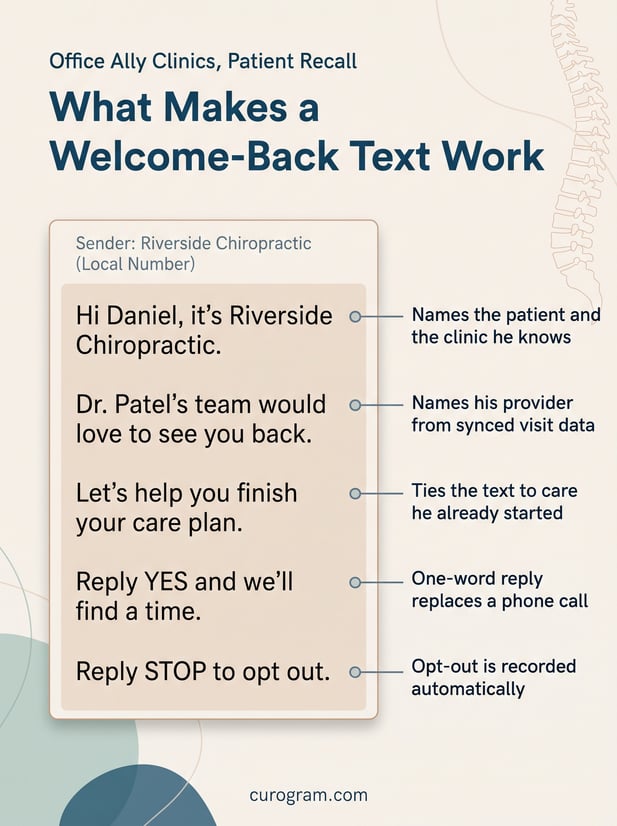
What a Welcome Recall Text Looks Like
A good patient win-back message experience starts with details only her clinic would know.
Specific Beats Generic
Compare two texts. "We miss you! Book today" could come from any business.
"Hi Daniel, it's Riverside Chiropractic. Dr. Patel's team would love to help you finish your care plan. Reply YES, and we'll find a time" could only come from his clinic.
A "finish care plan" reminder works because it names the plan, the place, and the provider. It reads as follow-through on care she already started.
Timing the First Text
Timing shapes how the text lands. A week after a cancelled visit, it feels like a natural follow-up. Two to three weeks after a mid-series dropout, the plan is still fresh, and the gap hasn't grown awkward. Wait six months and the same message has to work much harder.
Context From Office Ally
Curogram's Office Ally integration syncs appointment data from Office Ally. That gives each text the right site, provider, and visit type. Health details stay out of the message, so the text is personal without exposing anything private.
For practices sending to a large lapsed list, our page on mass texting for Office Ally users covers the setup.
How Replies Are Handled
|
Patient replies |
What happens next |
|---|---|
|
YES |
Scheduler texts two open times and books in Practice Mate |
|
NOT YET |
Staff set a follow-up date for a later batch |
|
I'VE MOVED |
Patient is marked and leaves future recall batches |
|
STOP |
Opt-out recorded, no more texts |
Curogram Highlight: Personalized Recall Texts
Personalized Recall Texts use each patient's own location, provider and visit type, drawn from appointment data synced from Office Ally. Each one goes out from the clinic's local number, so the patient sees a name she already has saved.
Replies route to staff for booking. Opt-outs are recorded automatically. Curogram is HIPAA-compliant and SOC 2 Type II certified, and it signs a BAA.

From Drifted Away to Back on Plan
The reply is where the patient's intention finally meets an easy path.
Rebooking by Text Reply
Rebooking by text reply removes every step that stopped her before. There's no call during work hours, no hold queue, and no portal login. She types YES at lunch, gets two times, and picks one.
In Curogram client data from clinical settings, 35% of a multi-location practice's existing patients got an SMS recall scheduled within a month. That practice saw 1,240 patients from recall messages alone.
When She Says Not Yet
Some patients reply NOT YET. Maybe a trip is coming up, or money is tight this month. Staff set a follow-up date, and she hears from the clinic again then. A soft no still keeps the door open, and she knows the clinic will check back.
Protecting the Restarted Plan
Once she's booked, her visit gets the same reminders and confirmations as any other. Her YES writes back to Office Ally as Confirmed, so the front desk doesn't have to chase it.
Our guide to centralized reminder governance covers how groups keep those reminders consistent across sites.
Care Continuity From the Patient View
Care continuity from the patient view is simple. She started a plan, she wanted to finish it, and someone made that easy. Welcome back outreach from the clinic turns "I should get back to that" into a booked visit.
More detail on the group-wide strategy is in our guide to patient recall campaigns for multi-location Office Ally groups.
Conclusion: Say Let's Finish What We Started
Most lapsed patients are one well-timed text away from being current patients again. Most of them got busy, and nobody called.
Office Ally keeps a record of the plan she started. Curogram sends the message that tells her the clinic remembers it too.
Think of the last patient who vanished partway through a plan. She probably never decided anything. Send her a reason to come back.
Then think of the dozens like her at every location. Each one is a plan someone started and meant to finish. A short text from the clinic she knows is often all it takes to restart it.
Book a demo and we'll show a recall campaign going from lapsed list to booked visit in one session.
Frequently Asked Questions