
Payment records sit in Curogram, ready to reconcile against your Notenetic billing reports. Sliding-scale amounts and post-telehealth copays travel inside the link at the exact figure you set, so the number stays between you and the client. Practices that move balance outreach to SMS shorten the gap between the session and the settled account.
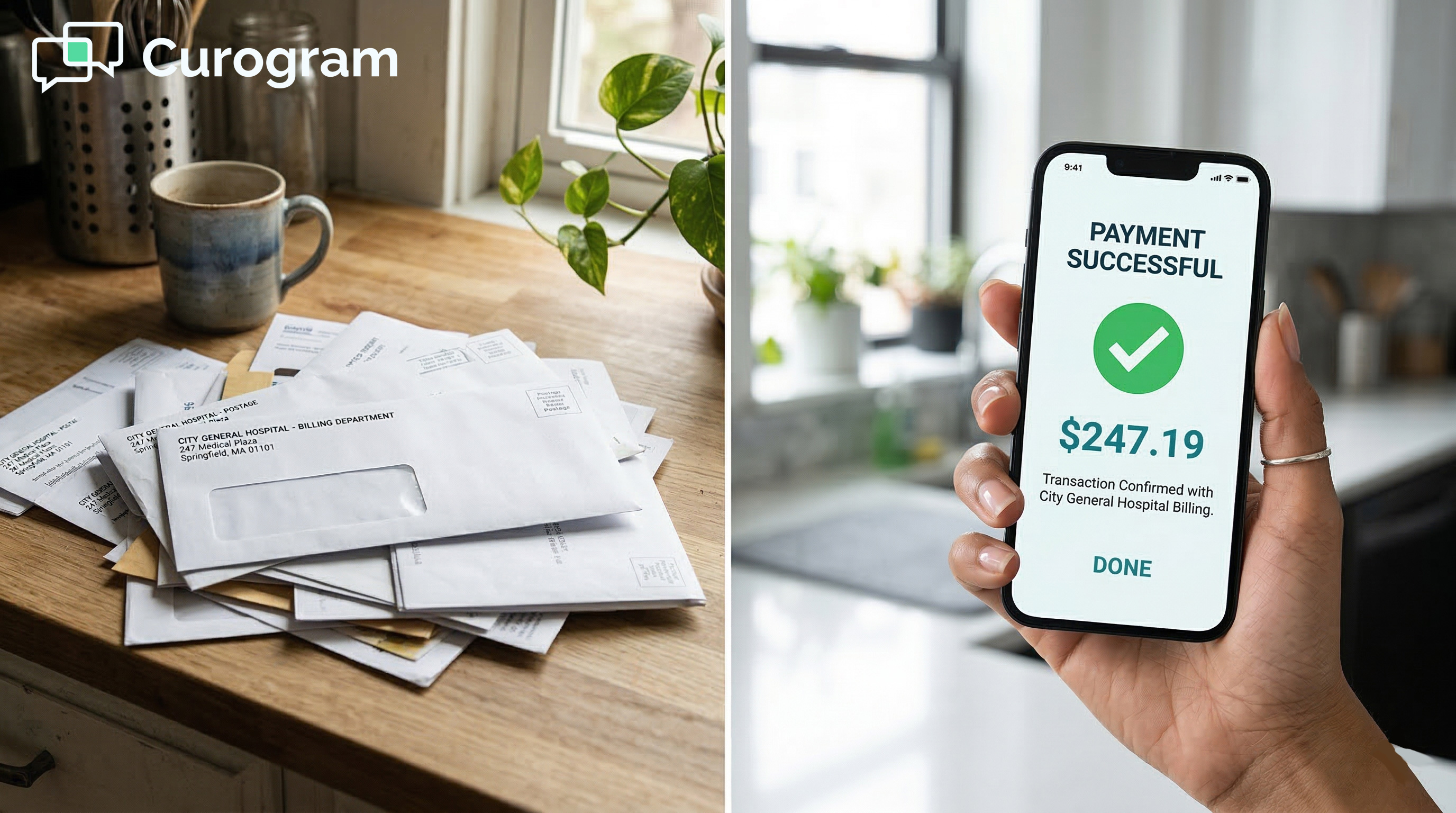
Run the billing aging report in Notenetic and the 60-plus column tends to hold the same names month after month. Few of those accounts are hostile. Most belong to clients who meant to pay, set the envelope on the kitchen counter, and lost it under a stack of mail.
Willingness isn't the leak. Channel is. A claim we'll defend for the rest of this piece: your collection rate measures the path you offer more than it measures the people you treat.
Notenetic does the heavy billing work well. Claims go out to thousands of payers, remittance and aging reports are built in, and the Client Portal gives clients a place to sign documents and message their clinician. What it doesn't carry is the balance itself, out to wherever the client already is.
That outreach gap is where money ages. A text message with a payment link closes it. Nothing about it requires a new login for the client.
Below, we cover why the paper-and-portal path leaks revenue, what a text-based collection flow looks like step by step, and how the aging report changes once the friction is gone.
Text-to-pay in healthcare fits behavioral health for a reason that has little to do with technology: it moves the money conversation out of the therapy hour.
The Villain: The Awkward Ask
Two paths exist today for a Notenetic practice trying to collect a $40 copay after the fact. Both of them ask the client to come to the money.
Five Steps Before a Dollar Moves
Portal access in Notenetic starts on your side. Staff open the client profile, click Set-Up Login Credentials, and the system generates a temporary password that goes out by email.
The client opens that email, logs in, and changes the password before anything else can happen. Forgot it later? The reset flow means another email and another wait.
Count the steps. Five, minimum, before a payment screen appears. Each one is a place to close the tab. For a client managing panic symptoms or early recovery, a password reset lands on top of a bill they were already ambivalent about, and ambivalence usually wins.
The Statement, Then the Phone Call
Paper follows a predictable arc. A statement mails on day one, gets set aside, and a second copy goes out around day 30. By day 60, someone in billing is dialing a client about money. That call is the worst touchpoint in a therapeutic relationship and the one most likely to end the treatment.
Privacy costs stack on top. An envelope carrying a recognizable program name, sitting in a shared mailbox, is real exposure for practices operating under 42 CFR Part 2.
An October 2025 MGMA Stat poll of 247 medical group leaders found 29% reporting worse patient balance collections than the year before. Staff hours climb while the balance ages toward write-off.

The Guide: The Gentle Collector
The fix is a channel swap, not a new system. Choosing to collect therapy copays by text changes one thing at the front desk: nobody has to ask.
The Flow, Step by Step
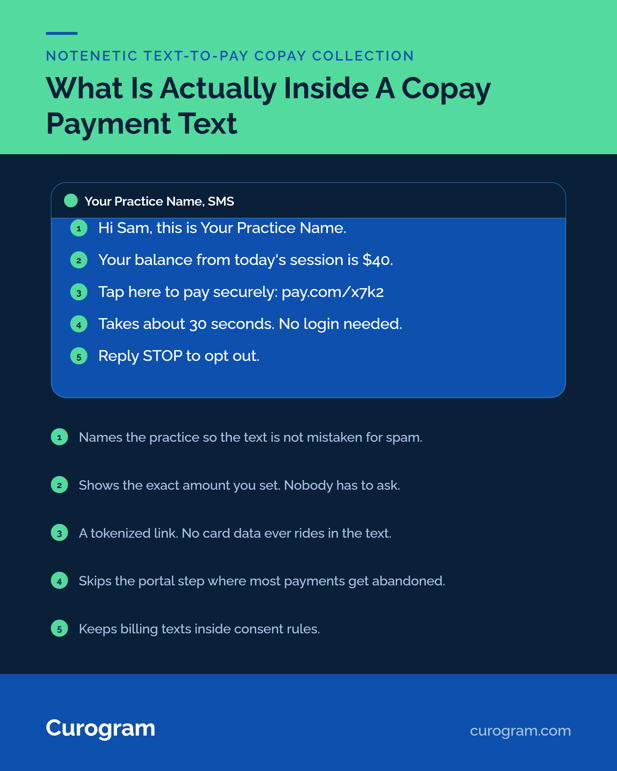
From the client's phone, the whole thing runs in four taps.
|
Step |
What happens |
Elapsed |
|---|---|---|
|
1 |
Staff send the balance from Curogram at session end or on your billing cadence |
0:00 |
|
2 |
Plain SMS lands with a secure link and the exact amount |
0:05 |
|
3 |
Client taps once; the payment page opens with no login |
0:12 |
|
4 |
Saved card selected or new card entered; payment clears |
0:25 |
|
5 |
Receipt arrives by text; the record posts in Curogram |
0:30 |
No app download, no username. Patient payment links by SMS work because the client is already holding the device and because the message never asks them to become a user of anything. Portal-free patient payments skip account creation altogether.
Curogram Highlight: The Gentle Collector
Text-to-Pay sends a tokenized payment link over SMS. Card data never appears in the message body. Processing meets PCI standards, and the platform is HIPAA compliant and SOC 2 Type II certified.
You set the amount inside each link, which is what makes sliding scale balance collection workable in practice. A client paying $25 and a client paying $180 receive the same message shape, and neither figure is spoken aloud within earshot of a waiting room. Recurring plans go out on your cadence without a phone call.
Payment records live in Curogram for reconciliation against your Notenetic remittance and aging reports. Data flows one way here, and we don't promise automatic write-back to the Notenetic ledger.
Any vendor who does promise it should be asked to demo the write-back live. Consent to text about billing belongs on the paperwork clients already complete, which secure online forms handle before the first session.
The Success: The Closed Loop
Collection outcomes move when the channel moves. Two effects show up first, and they show up on different timelines.
Settlement While Goodwill Is Highest
Balances clear fastest in the hour after a session, when the client still feels the value of what they paid for. Sixty days later, that same $40 competes with rent, and the memory has cooled.
Cutting paper statements at a mental health practice saves the obvious things first: postage, envelope stock, the staff hour spent stuffing them. The bigger number shows up in the 60-plus column, which stops growing.
The Friction-Removal Precedent
We don't publish a text-to-pay collection rate, so take the adjacent evidence instead. Covina Arthritic Clinic averages more than 1,100 appointment confirmations per month through automated SMS, based on our internal data. The mechanic is identical. Remove the login, remove the callback, and response rates climb.
Revenue follows the same pattern. Across our client base, recovered appointment slots drive a 10% to 20% increase in revenue, based on our internal data.
Practices already sending appointment reminders through Curogram know the response curve; payment links ride the same channel and the same consent.
Conclusion: Close the Billing Gap Gently
Notenetic runs your billing. The open question is who runs the collection outreach, and at most practices the honest answer is a printer and a phone.
Hand that job to the channel your clients already answer. Two things make the switch cheap to test: the texting layer exists if you're sending reminders, and consent language belongs on the intake form you're sending anyway.
The aging report is your scoreboard. Watch the 60-plus column for one quarter after the change and set it beside the quarter before.
Book a demo and we'll send a live payment link to your own phone so you can time it yourself.
Frequently Asked Questions
The SMS carries a tokenized link, never card data. Processing meets PCI standards, and Curogram is HIPAA-compliant and SOC 2 Type II certified. A glanced-at phone screen shows a link, not a payment method.
Notenetic owns documentation, scheduling, claims, and your ledger. Curogram covers the outreach layer: balances after telehealth, copays the front desk skipped, and aged receivables. Records reconcile against your Notenetic remittance reports.
You set the exact amount inside each link. The figure never appears on a counter screen and never gets spoken across a waiting room. Your client sees their number, and nobody standing nearby does.
Portals ask for account creation during a week the client may already be struggling. A text asks for one tap. Removing the login step removes the most common place people abandon a payment.
Add consent language to your intake and update forms, then mention it once at the end of a session. Most clients treat it as relief, because it ends the counter conversation about money entirely.