11 min read
How Medstreaming OBL Staff Call Deflection SMS Workflow Cuts No-Shows
Mira Gwehn Revilla
:
May 11, 2026
- SMS gets 68-78% reply rates within 2 hours, vs. 25-35% for voicemail
- Staff calls only when SMS fails, freeing 1-2 FTEs each day
- A 5% cancellation drop recovers around $31.7K per month for a 40-procedure facility
- Every message is logged with a timestamp, ready for any audit
- Small labs replace risky personal cell phone use with one compliant channel
Ask any OBL admin where staff hours disappear, and the answer comes back the same: prep calls. A team of four can spend half the workday on the phone.
They dial patients, leave voicemails, and wait for callbacks that often never come. Procedure day still brings the worst kind of surprise — a patient who shows up unprepared, forcing a last-minute cancel.
The math behind these cancellations is brutal for any vascular OBL. A single canceled angioplasty slot can mean $5,000 to $15,000 in lost revenue. At a 15% cancel rate, a busy 40-procedure facility loses about $18,000 each day. Stretched across the year, that's roughly $4.7M walking out the door.
Two-way SMS shifts that math for Medstreaming users in real, measurable ways. Patients reply to texts at two to three times the rate they return voicemails.
Staff stops chasing and starts confirming on the first try. A Medstreaming OBL staff call deflection SMS workflow turns prep outreach from a daily grind into a quick two-way check-in.
This article walks through what that shift looks like in real practice. You'll see how SMS trims call volume by 50-70% and frees staff for better tasks. We'll cover the cancellation cost math, the new daily workflow, and the audit trail benefits. We'll also explain why small labs need to stop using personal cell phones now.
By the end, you'll have a clear plan to recover lost revenue without burning out your team. The path is simpler than most admins expect.
The tools already exist, the integrations work, and the case studies back it up. The only thing left is the decision to change the workflow before another quarter of cancellations stacks up.
The Economics of Cancellation Prevention
Before we talk workflow, let's talk money. Every canceled procedure slot has a price tag. That price is rarely just the lost service fee. It includes wasted prep time, idle staff, and a missed chance to fit another patient in.
Per-Procedure Revenue Loss from Cancellations
The industry baseline for cancel rates sits around 15%. That's a heavy load when each slot is worth thousands. Here's what gets lost when a patient backs out at the last minute:
|
Procedure type |
Revenue range per case |
|
Diagnostic angiogram |
$1,500-$3,000 |
|
Cardiac catheterization |
$3,000-$8,000 |
|
Angioplasty |
$5,000-$15,000 |
Take a 40-procedure-per-day facility with a 15% cancel rate and a $3,000 average case value. That's $18,000 lost each day. It comes to $90,000 each week and roughly $4.75M each year. Most of that loss is preventable with the right outreach.
What drives those cancellations? Industry patterns point to five main causes:
- Prep non-compliance: about 30%
- Transportation gaps: about 25%
- Patient anxiety or forgetfulness: about 20%
- Schedule conflicts: about 15%
- Other reasons: about 10%
Look at the top three causes. They all involve breakdowns in patient-staff contact that happen days before the procedure. SMS catches those problems early, when staff still has time to act.
SMS Two-Way Confirmation Impact
Here's where the numbers turn around. Based on our internal research, Atlas Medical Center cut their no-show rate from 14.20% to 4.91% in just three months using SMS confirmations. That's a 9.29% drop — three times better than the industry average.
Translate that into vascular OBL phone volume reduction terms for a 40-procedure-per-day lab. At a $3,000 average case value, a 9.29% improvement equals about $1.12M per year in recovered revenue. Even at half that gain, you're still recovering more than $560K per year.
A more conservative target — 5% to 8% drop in cancellations — works for most facilities:
- 40 procedures per day at 5% drop: about $237K per year recovered
- 40 procedures per day at 8% drop: about $380K per year recovered
- 10-15 procedures per day small lab at 5% drop: about $150K-$225K per year recovered
For a small lab, a single quarter of recovered revenue often covers the SMS platform cost for the entire year. Most labs see ROI breakeven inside the first 60 days.
The point is simple: cancellation prevention isn't a soft benefit. It's a direct line to recovered revenue. The recovery scales with facility size — bigger labs see larger absolute gains, while small labs see fast ROI on a tight budget.
There's a hidden multiplier here, too. A 5% drop in cancellations doesn't just recover the lost case revenue. It also frees up the slot for a new patient, the prep time for productive use, and the staff hours for higher-value work. The total recovered value is often 1.5x the direct revenue figure.
The cost math is just step one. The next question is what changes inside daily operations. How much staff time gets returned? Where does that time go? And what does the new workflow look like in real terms?

Workflow Automation and Staff Time Savings
Cost savings start with workflow change. The shift from phone-first to SMS-first is more than a tool swap. It's a reset of how the front desk spends its day.
Current State: Voicemail Tag-of-War
The standard prep call cycle goes like this. A staff member dials a patient and gets voicemail. Hours later, the patient calls back during a staff break. The staff member calls again the next day, leaves another voicemail, and the loop continues.
By procedure day, the patient is unsure about their meds. They may cancel — or worse, show up unprepared. The cycle eats time without solving the problem.
The math on the old workflow is harsh. At 2-3 minutes per call attempt, 40 patients per day, and 2.5 attempts per patient, you're spending 300-500 minutes daily on prep calls alone. That's 5-8 staff members tied up just on phone tag.
Voicemail rates make it worse. 40-60% of calls go to voicemail. That means 16-24 daily voicemail attempts that all need follow-up. That's not patient care — it's phone call cleanup duty.
SMS Two-Way Workflow
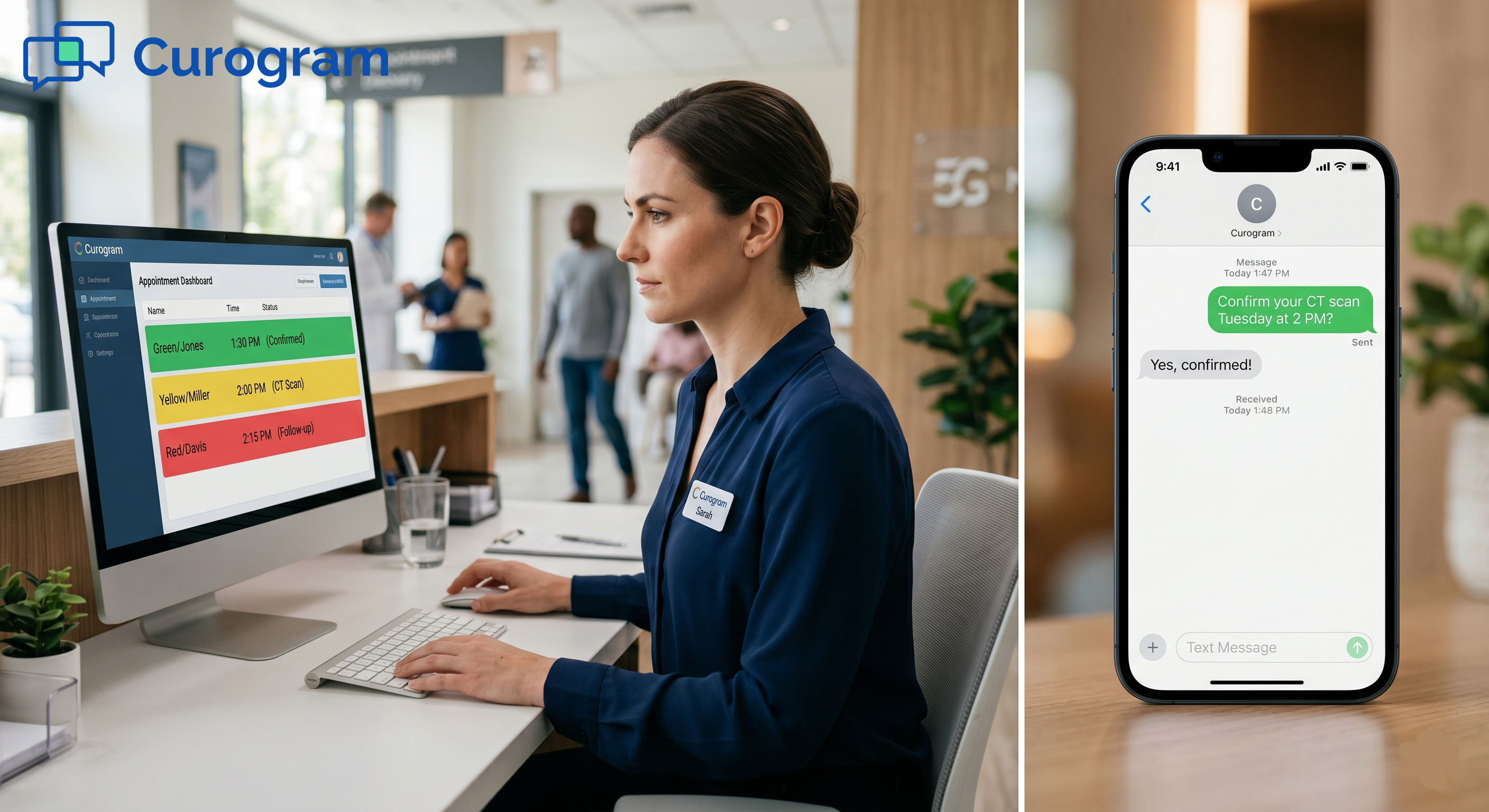
Here's how the new workflow runs. About 48 hours before the procedure, an automated SMS goes out from Medstreaming. The text is short and clear: "Your angioplasty is Saturday at 2 PM. Hold aspirin and clopidogrel starting Friday. Reply YES to confirm."
The patient replies within two hours about 68-78% of the time. Medstreaming logs the response as structured data — medication hold confirmed, transportation noted, allergies updated. Staff sees a clean dashboard, not a voicemail backlog.
If a patient doesn't respond by the 24-hour mark, the system flags the chart. Only then does staff make a phone call, with full message history already in front of them. This is what cath lab call deflection looks like in practice.
The result is a 50-70% drop in call volume. That frees 2-4 FTEs each day for other tasks. Prep call elimination SMS doesn't mean zero phone calls — it means phone calls only when SMS hasn't already done the job.
Reassigned Staff Capacity
Here's the part most teams don't expect: freed time turns into recovered revenue. Staff who used to chase voicemails now handle higher-value work. That includes medication checks, insurance pre-authorization, and patient education.
A single FTE doing insurance pre-auth can recover $50K-$100K per year in prevented claim denials. That alone covers the platform cost several times over. OBL staff workflow automation isn't just about saving time — it's about putting that time to work.
Here's a real example. A mid-size lab cut prep call staffing from four people to two after rolling out SMS confirmations. The other two staff members now handle medication checks and pre-auth work. The lab reported an 8% drop in insurance denials and recovered $35K in the first quarter alone.
That kind of Medstreaming front desk efficiency gain is repeatable. The math doesn't change with facility size — only the absolute dollar amounts do. A small 12-procedure-per-day lab can shift one FTE from prep calls to pre-auth and still see five-figure quarterly gains.
The new workflow also reshapes the patient experience. Patients get clear, written prep instructions they can reread. They don't have to call back during work hours or play voicemail tag with the front desk. That alone reduces anxiety and improves prep compliance — which feeds back into lower cancellations.
Audit Compliance and HIPAA Documentation
Prep calls don't just eat time — they create blind spots. When staff leaves voicemails, the only proof of contact is a quick chart note like "called pt, left msg." That's not enough during an audit. In a HIPAA review, vague records can turn into fines, lawsuits, or both.
SMS solves this in a way phone calls never could. Every text creates a clear, time-stamped record that holds up under any audit. The shift from phone to text isn't just an efficiency move. It's a compliance upgrade.
The Undocumented Communication Problem
The scenario plays out like this. A patient claims the facility never warned them about a contrast allergy risk. The staff did call — twice — but only left voicemails. There's no proof of any actual conversation, just two short chart notes saying a message was left.
In court or in audit, that's a weak position. The facility can't prove the patient was notified. The patient's claim wins by default.
The risk grows when staff uses personal cell phones. This still happens at smaller labs that haven't moved to a HIPAA-compliant system. Every personal phone call creates a triple problem: zero documentation, possible HIPAA breach, and direct liability if the device is lost or hacked.
For small labs, the personal phone problem is the biggest hidden risk on the books. Staff thinks they're being efficient. In reality, they're stacking up audit exposure every single day. One lost phone, one wrong number, or one screen viewed by an unauthorized person can trigger a serious HIPAA event.
SMS Audit Trail as Compliance Evidence
SMS flips the script. Every message sent through Medstreaming is captured automatically. The log includes the timestamp, the message content, the recipient, the patient's response, and any escalation taken. Nothing depends on memory or hand-typed notes.
A patient asks why they weren't told about a contrast allergy risk. The facility pulls up the SMS log and shows the exact message — sent on a specific date and time, with the patient's "YES" reply confirming receipt. The patient signed off in writing, electronically.
That kind of proof changes the audit conversation completely. Instead of defending a missing record, the facility presents one. Instead of arguing about what was said, they show what was sent.
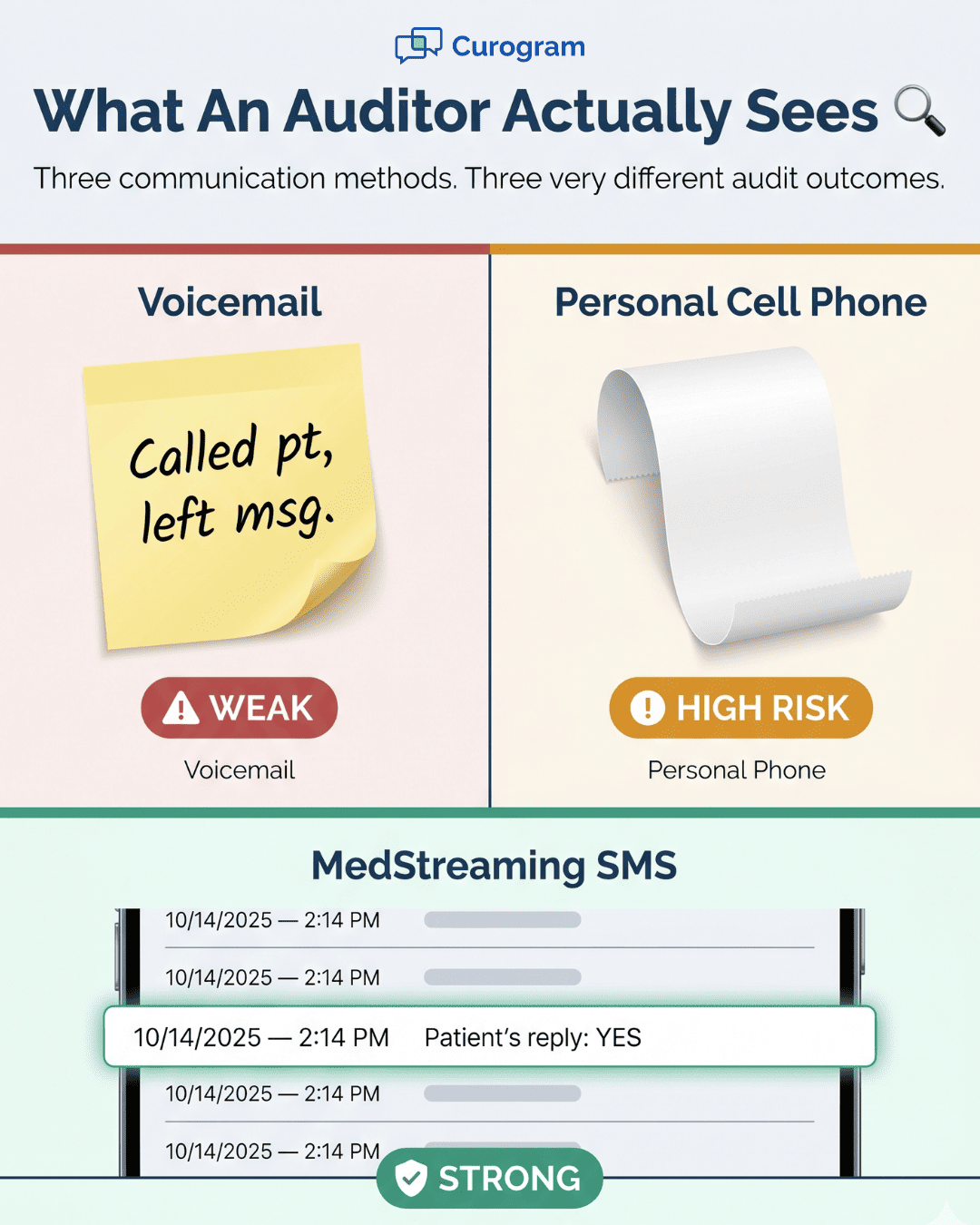
Here's a quick comparison of the three approaches:
|
Communication method |
Documentation quality |
Audit readiness |
|
Voicemail |
"Called pt, left msg" — minimal |
Weak |
|
Personal cell phone |
Often none |
High risk |
|
MedStreaming SMS |
Full timestamped log |
Strong |
A small lab admin recently shared their experience. After moving from personal phones to SMS through Curogram, their next regulatory audit came back clean. Every patient communication was documented. The personal phone liability they used to lose sleep over simply went away.
This kind of audit trail also helps internal quality reviews. Teams can spot patterns — like which prep instructions get the most questions — and update their templates. SMS doesn't just protect the lab. It makes the lab smarter over time.
There's also a clear win for malpractice defense. If a patient ever sues over a procedure, the SMS log provides clean evidence of every prep instruction sent. Insurers often weigh this kind of documentation when setting facility premiums. Strong records can lower coverage costs over time.
Consent Management and State-Specific Requirements
Compliance goes beyond audit trails. Patient consent is its own area of risk. Every text message must follow TCPA rules, which require clear opt-in before any non-emergency outreach. State laws layer on top of that. California requires written consent. Texas allows verbal consent in some cases. Other states have their own twists.
Tracking all of this manually is a nightmare. One missed opt-in can turn into a lawsuit or a fine. Many small labs simply skip the documentation step and hope nothing comes up. That's not a strategy — it's a ticking clock.
Curogram's SMS consent framework handles this automatically. Each patient's consent status is stored in the chart and synced with Medstreaming. Staff can verify consent before any text goes out. Opt-in dates are logged. Opt-out requests are honored across the entire platform.
Every message also includes a clear opt-out option, which keeps the facility on the right side of TCPA. If a patient replies "STOP," the system pulls them out of all SMS lists immediately. No more guessing whether someone unsubscribed three months ago. The system remembers.
This level of automation is hard to match with manual systems. For OBLs and cath labs that handle thousands of patient interactions per month, consent automation isn't a luxury. It's a baseline requirement for staying compliant at scale.

How Curogram Builds Audit-Ready SMS Workflows Inside Medstreaming
Curogram is built specifically for the kind of high-stakes outreach OBLs and cath labs handle every day. The platform sits directly inside Medstreaming, so staff doesn't have to switch tools or copy-paste between systems. Confirmations, prep instructions, and follow-ups all flow through one HIPAA-compliant pipeline.
Here's what that looks like in practice. When a procedure is scheduled, Medstreaming triggers an automated SMS prep sequence through Curogram.
The text uses pre-built templates that staff can edit on the fly. Patient replies log back into Medstreaming as structured data — medication status, transportation, consent updates — so charts stay current without manual entry.
Every text is encrypted, time-stamped, and stored for audit. Curogram's TCPA consent framework runs in the background, tracking opt-ins, opt-outs, and state-specific rules. If a patient sends "STOP," the system updates across every list automatically. Staff doesn't need to remember anything.
The escalation logic is just as important as the texting itself. If a patient doesn't reply within 24 hours, Curogram flags the chart for staff follow-up. Staff sees the full message history before picking up the phone. That makes the call shorter, more focused, and much more likely to get a clear answer on the first try.
For small labs, Curogram replaces personal cell phone use entirely. Every contact runs through a compliant channel with full records attached. The HIPAA risk that used to live on staff phones simply disappears.
Practices using Curogram report 50%+ drops in phone volume and >75% confirmation rates, based on our internal data. Front desk teams shift from chasing voicemails to handling higher-value work. The platform pays for itself in recovered revenue, often within the first quarter of use.
Conclusion
The case for two-way SMS in OBL and cath lab settings comes down to three numbers. First, a 50-70% drop in call volume that frees 1-2 FTEs every day for higher-value work. Second, a 5-8% drop in cancellations that recovers $237K-$380K per year for a 40-procedure facility. Third, a clean audit trail that protects against HIPAA exposure and undocumented communication risk.
Each of these benefits compounds over time. Freed staff time means more insurance pre-auth, which means lower denial rates and more recovered revenue. Lower cancellations mean better schedule density and higher patient throughput. Better records mean less audit anxiety and stronger defenses if claims arise.
The shift isn't about replacing human contact. It's about using each phone call where it matters most — for patients who need extra support, complex prep questions, or last-minute issues. Routine confirmations don't need a human voice. They need a fast, two-way channel that respects the patient's time.
For small labs, the move is even more urgent. Personal cell phone use creates HIPAA risk that no admin should be carrying. A compliant SMS platform removes that risk on day one. It replaces it with documented, auditable contact across every patient touchpoint.
The technology is no longer the hard part. The platforms exist, the integrations work, and the case studies are clear. What remains is the decision to make the change.
If your team is still spending half its day on voicemails, the path forward is clear. Cancellations will keep happening as long as the workflow stays the same.
SMS doesn't fix every issue, but it fixes enough to move the needle on revenue, staff well-being, and compliance — all at once. Most labs see returns within the first quarter.
Replace personal cell phone risk with audit-ready SMS in one workflow change. Book a demo and see the compliance trail in action.
Frequently Asked Questions
SMS catches three top cancel causes early: prep non-compliance, medication confusion, and transportation gaps. Patients reply hours after texts arrive, while voicemails sit unheard. Staff has time to fix issues 24-48 hours before procedure day rather than scrambling at the last minute.
Personal phones create zero documentation, lack encryption, and can leak PHI if lost or hacked. Each call adds audit risk, and missed messages can't be proven later. A compliant SMS platform removes this entire liability category in a single workflow change.
Freed staff usually shift to insurance pre-authorization, medication checks against pharmacy records, and patient education outreach. A single FTE doing pre-auth alone can recover $50K-$100K per year in prevented claim denials, easily covering the SMS platform cost.