

7 min read

Patient Satisfaction Surveys for Meditab IMS | Improve Reviews

Patient Satisfaction Surveys for Meditab IMS | Improve Reviews
💡 Meditab IMS tracks vitals, diagnoses, and prescriptions. It does not track how patients feel about their visit. That gap is where bad reviews are born and good experiences quietly disappear.

Curogram closes the loop with text-based post-visit surveys sent 1–2 hours after each appointment. Happy patients are guided to Google Reviews. 

Unhappy ones are routed to private feedback so the practice can fix the issue before it becomes public.

One multi-location group used this exact workflow to generate 8,159 Google reviews with a 90% five-star rate, while turning patient sentiment into real operational intelligence.

A patient walked out of your practice yesterday. They may have loved the visit. They may have hated it. You won't know — at least not until they decide to tell the internet.

That silence is the problem. Meditab IMS does an excellent job tracking clinical data. It tracks none of the human data: how the front desk treated them, how long they waited, whether the provider made them feel heard.

All of that lives in the patient's head until something pushes them to share it publicly.

Usually, that something is frustration.

This is the gap that Meditab IMS patient satisfaction surveys improve care ratings Google reviews systems are built to close.

Practices need a feedback loop that runs automatically after every visit, not a Monday-morning panic when a one-star review shows up on Google.

The numbers tell the story.

Without a system, practices capture feedback from almost 0% of visits. With a simple text-based patient survey healthcare workflow, that number jumps to 40–60%. The same patients who would never log into a portal or write a long email will happily tap a star rating sent to their phone.

This article walks you through what the feedback void really costs your practice, why most fixes fail, and how a properly set up post-visit patient survey Meditab IMS practice workflow can do two jobs at once.

It quietly improves care behind the scenes. It also turns your happiest patients into your most powerful marketing asset — without anyone on your team chasing reviews.

The Silent Cost of Not Knowing What Patients Think

The Quiet Hours After Every Visit

There's a window of time between when a patient leaves your office and when they form a lasting opinion of your practice. That window is short. And right now, it's invisible to you.

Meditab IMS tracks the visit on paper. It does not track the feeling. The patient could be telling their spouse you saved their life — or telling them they're switching providers. You have no idea which.

This is what a missing patient feedback loop medical practice IMS setup creates. A daily blind spot. Hundreds of small moments of either delight or disappointment that never reach you.

The Monday Morning Review Surprise

Imagine your office manager opens her laptop at 8 AM.

A new Google review is sitting there:

One star, 45-minute wait, no explanation given.

She has no context.

Was there an emergency that morning?

Did the front desk tell the patient about the delay?

Did anyone apologize?

She doesn't know — and now she has to write a public response to a story she's hearing for the first time.

That review will outlive the patient's frustration. It will sit on your Google profile for years, influencing every prospective patient who searches your name. All because there was no way to hear the complaint before it went public.

The Intelligence You're Throwing Away

Patient feedback is operational data. When three patients in one week mention a confusing check-in process, that's a process problem. When five patients praise a specific medical assistant, that's performance data you can act on.

Without a system, none of this reaches you.

The kinds of signals that go undetected include:

  • Front-desk friction like long check-in times or unclear instructions
  • Provider-specific performance trends, both strengths and weak spots
  • Appointment-type pain points unique to new-patient or follow-up visits
  • Scheduling problems tied to specific days, locations, or providers

You end up improving your practice by accident instead of by design. That's the cost of missing patient satisfaction data Meditab IMS practices need. You can't fix what you can't see.

What Patients Actually Want

Here's the part most practices get wrong. Patients do want to share feedback. They just don't want to work for it.

A phone call? No. A portal login? No. A long email? Definitely not.

But a single text with a star rating they can tap in ten seconds? Yes. The friction is everything.

Lower the friction, and the feedback comes flooding in.

How a Simple Text Can Reshape Your Reputation

The Workflow in Plain English

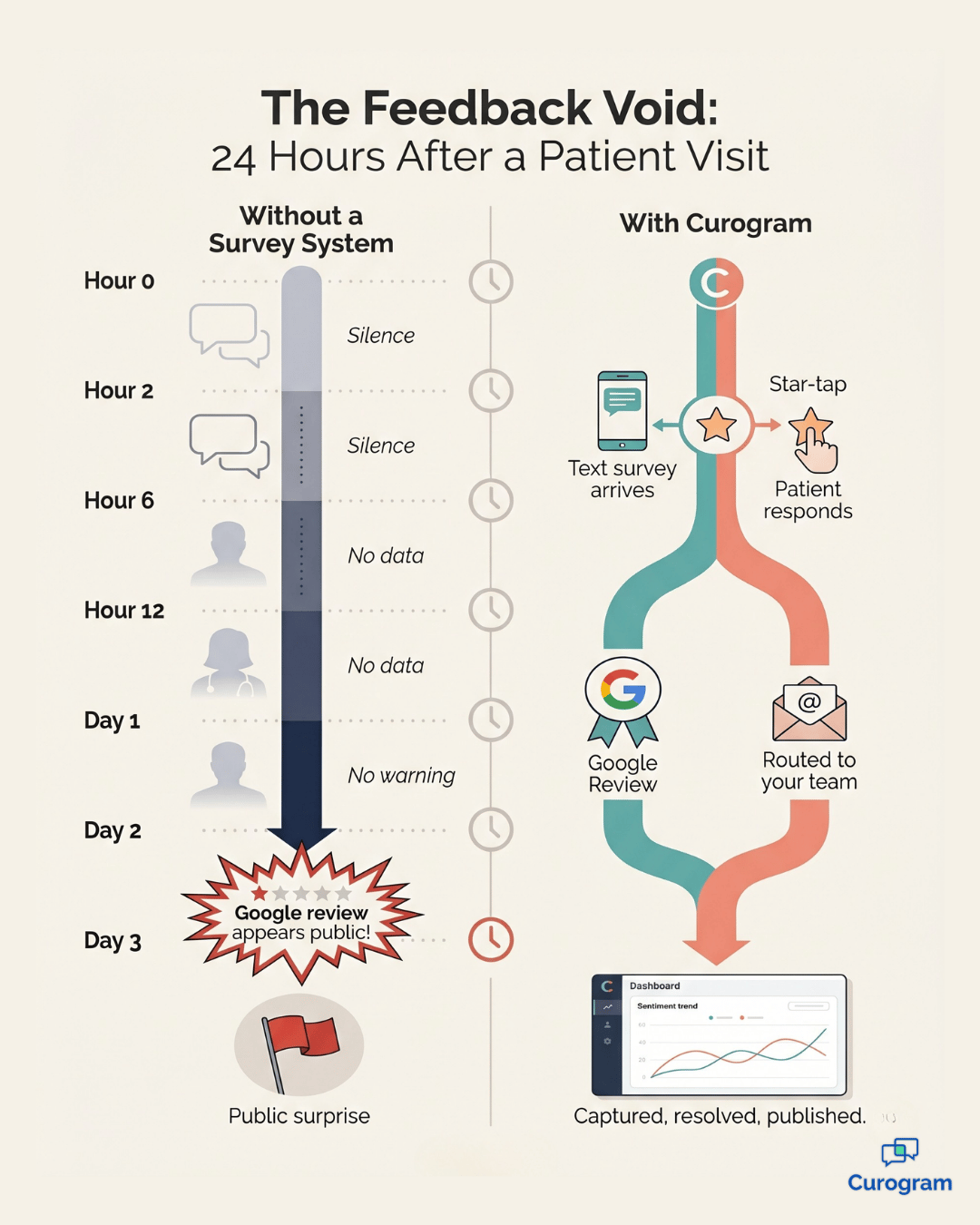
Curogram sends a short survey 1–2 hours after every completed visit on your Meditab IMS schedule. It's a text, not a portal. One tap to rate. Done.

The full loop, start to finish, looks like this:

  • Visit completes on your Meditab IMS schedule
  • A short text survey goes out within 1–2 hours
  • The patient taps a rating in seconds, no login required
  • Positive ratings are guided toward a Google Review link
  • Negative ratings are routed privately to your team

You get both — public proof and private intelligence — from one automated workflow. This is what a real post-visit patient survey Meditab IMS practice setup looks like. Quiet. Consistent. Always running.

Timeline infographic comparing patient feedback capture with and without Curogram post-visit surveys

Seeing Sentiment in Real Time

Anecdotes are easy to dismiss. Data is harder to ignore.

Curogram's dashboard pulls all of this satisfaction data into one place. You can see which providers are consistently rated highest, which days of the week dip in satisfaction, and whether that new scheduling change you rolled out last month actually helped.

This is Meditab IMS patient sentiment tracking reviews working as a single system. Instead of guessing whether patients are happy, your leadership team finally has numbers.

Tied to Your Schedule, Not Bolted On

The survey data isn't floating in some separate tool. It's linked back to your IMS schedule by appointment type, provider, and location.

That means you can slice satisfaction data the way you actually need to use it.

Compare gastroenterology against dermatology.

Compare Tuesday afternoons against Friday mornings.

Compare two providers seeing the same visit type.

For a multi-specialty practice, this is how you turn vague impressions into clear answers about where the patient experience is strong and where it's leaking.

Why Patients Actually Engage

The format matters more than people realize. A text survey feels like care, not paperwork.

For older patients, it's accessible — no app, no login, no learning curve.

For younger patients, it's exactly how every other service they use already works. One tap, no commitment, done in seconds.

That's how you improve patient experience Meditab ratings without adding a single new task to your front-desk team's plate.

Doctor and patient in candid consultation room conversation during a medical visit

What Happens When Practices Actually Listen

Two Outcomes, One Workflow

Here's a quick view of what changes when the feedback loop is in place:

Without a Survey System With Curogram Surveys
Near-zero feedback capture 40–60% of visits captured
Reviews appear without warning Issues caught privately first
Reputation grows by accident Reputation grows by design
Improvements based on guesses Improvements based on data

That same workflow produced 8,159 Google reviews at a 90% five-star rate for one multi-location practice. The survey is doing two jobs at once — improving care and building reputation.

The Trust Effect

Patients notice when a practice asks for feedback and then changes something because of it. That's where loyalty is built.

A patient mentions a long wait. Their next visit moves faster. They notice. A patient leaves negative feedback. Someone from the office calls them personally.

That patient often becomes a stronger advocate than the ones who never had a problem.

A feedback loop isn't just data collection. It's a relationship.

A Real-World Example

A pain management clinic running Meditab IMS launches Curogram surveys. Within 60 days, the data shows that one provider's patients consistently report longer waits.

The clinic adjusts that provider's scheduling template and removes the overbooking. Wait times drop. Satisfaction scores climb within weeks. Three months later, that same provider has 45 new five-star reviews — many of them mentioning the improved experience by name.

The survey didn't just collect reviews. It identified a fixable problem, drove a real operational change, and then captured public proof of the improvement. That's the full cycle, working exactly as designed.

Hear Every Patient, Not Just the Loudest Ones

You already deliver good care. The problem isn't quality. The problem is visibility.

Right now, your practice only hears from the patients who are angry enough to post publicly. Everyone else — the satisfied ones, the quietly disappointed ones, the ones with a small suggestion that could change everything — stays silent.

That silence costs you reviews, referrals, and the chance to fix problems before they grow.

Meditab IMS gives you a complete clinical picture of every patient. It does not give you the human picture. Curogram fills in the rest. Together, you finally see both sides: what happened medically and how the patient felt about the entire experience.

That combination is what separates practices that grow steadily from practices that get blindsided. One has a system. The other has hope.

Here's what changes once the loop is closed.

Your team stops dreading Google. Your providers see real-time feedback on their own performance. Your office manager spots operational patterns before they become complaints. Your reputation grows on autopilot because the right patients are being asked at the right moment, in the right format.

There's no long-term contract. The platform is HIPAA-compliant and SOC 2 Type II certified, so patient data stays protected. Setup works directly with your existing Meditab IMS schedule, so there's no rebuilding workflows or retraining your team.

If you've been waiting for a sign that it's time to close the feedback void, this is it. Your patients have opinions about every visit. The only question is whether you're going to keep guessing what those opinions are.

Schedule a Demo with Curogram and see your post-visit survey and reputation workflow running on your own Meditab IMS schedule. You'll see the dashboard, the patient flow, and exactly how the first 60 days look for a practice like yours.


Frequently Asked Questions

Do text-based surveys violate HIPAA if they reference a patient's visit?

No. Curogram's surveys are designed to stay HIPAA-compliant by avoiding any protected health information in the text itself. The message reads something simple like "How was your visit today?" with no mention of diagnosis, treatment, or provider name. The survey link opens a secure form, all communication is encrypted, and everything is covered under Curogram's Business Associate Agreement.

Will patients feel bombarded if they get a survey after every visit?

Survey fatigue is a real concern, and the system is built to prevent it. You can configure frequency limits per patient — for example, no more than one survey per month, no matter how many visits they have. Patients with multiple visits in a short period won't get a text every single time, so the experience stays respectful while the data stays useful.

Can we use the survey data for internal quality improvement reporting?

Yes. All sentiment data can be exported and used for quality meetings, provider performance reviews, and operational planning. The data is segmented by provider, location, appointment type, and time period, which gives leadership the kind of granularity needed to make real decisions instead of just reading anecdotes.

How long does it take to set up Curogram with our Meditab IMS system?

Most practices are up and running within a few business days, not weeks. Curogram connects directly to your existing Meditab IMS schedule, so there's no manual data entry or workflow rebuild required. Your team gets a short walkthrough of the dashboard, the survey templates are customized to your brand and tone, and the surveys start sending automatically after each completed visit.

What happens when a patient leaves negative feedback in the survey?

Negative responses are routed privately to a designated team member instead of being pushed to Google. That person gets an alert in real time, along with the patient's contact details and the specifics of the complaint. This gives your team a chance to call the patient, resolve the issue directly, and often turn a frustrated patient into a loyal one before the experience ever becomes a public review.


Patient Communication Without Portal Login | Meditab IMS Texting

Patient Communication Without Portal Login | Meditab IMS Texting

💡 Meditab IMS patient communication without portal login via secure texting lets practices reach patients through SMS — no app download, no...

Read More
Reduce No-Shows in Meditab IMS Specialty Practices | Smart Reminders

Reduce No-Shows in Meditab IMS Specialty Practices | Smart Reminders

💡 Reducing patient no-shows in Meditab IMS specialty practices with automated reminders means matching the reminder sequence to the appointment...

Read More
Reduce No-Shows at Meditab IMS with Text Reminders

Reduce No-Shows at Meditab IMS with Text Reminders

💡 Meditab IMS patient communication without portal login via secure texting lets practices reach patients through SMS — no app download, no...

Read More