
7 min read

Accelerate Patient Collections at Meditab IMS | Text-to-Pay

Accelerate Patient Collections at Meditab IMS | Text-to-Pay
💡 Meditab IMS billing teams accelerate patient collections with text-to-pay workflows by sending an automated SMS payment link the same day a balance posts.

This replaces the slow paper statement cycle and awkward collection calls with a single tap-to-pay link patients open from their phones.

Practices typically collect 60–70% of patient balances within 7 days of the first text. Paper statement volume drops 50–70%, and AR over 60 days shrinks by 40–50%.

The result is faster cash flow, lighter administrative load, and a billing team that finally spends less time chasing payments and more time on higher-value revenue cycle work.

The first Monday of every month, the AR aging report lands in your inbox. You scan the columns. Sixty days. Ninety days. The total at the bottom has barely shifted since last month, and your team isn't sure what else to try.

That sinking feeling has a name, and most billing teams running Meditab IMS know it well. You've sent the statements. You've made the calls. You've left the voicemails that nobody returns. The balances keep aging anyway.

Here's the part that stings.

The longer a patient balance sits, the less likely you are to ever collect it. By day 90, your odds drop below 30%. Every week of silence is a week your money loses value.

Now think about how patients actually live.

They check their phones constantly. They tap to pay for coffee, rideshares, and groceries. They almost never check their mail, and a paper statement that arrives weeks after the visit barely registers.

The collection tool you're using does not match the way your patients live.

Meanwhile, your billing team is stuck doing the most expensive work in the practice. Eight to twelve minutes per phone call. Hours of awkward conversations. Real labor pulled away from claim follow-up and other revenue cycle work that actually moves the needle.

This is the gap that a smart text-to-pay setup for Meditab IMS practice operations is built to close. Instead of pushing slow paper and harder calls, you meet patients on the device in their pocket.

A short text. A secure link. A payment cleared in days, not months.

The shift sounds small. The downstream impact is anything but.

What the AR Aging Report Is Really Telling You

The AR aging report is the most honest document in your practice. It does not care how busy your team has been or how many statements you mailed last week. It just shows you the truth: how much money is sitting, how long it has been sitting, and how long until you write some of it off.

For practices running Meditab IMS, that truth tends to look painfully similar from one month to the next. And the reason is structural, not effort-based.

The 90-Day Reality

The aging pattern in a typical IMS practice is predictable. Insurance adjudicates in 2–4 weeks. The first paper statement goes out at week 4–6. A second statement follows at 60 days. By 90 days, your billing manager is choosing between a third statement, a phone call, or a write-off.

Each step takes time and costs money. And the math gets worse the longer it drags on. After 90 days, the share of patient responsibility you can realistically collect drops below 30%. The longer the cycle, the smaller the payout.

The Monthly Collections Meeting Nobody Looks Forward To

The billing manager pulls the report. $45,000 over 60 days. $22,000 over 90 days. The practice owner asks the same question every quarter: why are we not collecting more?

The answer is always the same too. We sent statements. We made calls. Patients are not responding. The tools are not working, but they are the only tools the team has.

The Hidden Cost of Collection Calls

Patient balance calls average 8–12 minutes once you factor in hold time, voicemails, and the actual conversation. For 100 outstanding balances, that is 13–20 hours of staff time in a single week.

Now compare that against the same hours spent on insurance verification or denied-claim follow-up, where the return per hour is several times higher.

The phone-based collection model is one of the most labor-intensive, lowest-yield activities a billing team can run.

Collection Activity Time per Account Typical Yield
Paper statement (single send) ~2 min + postage 20–35%
Phone collection call 8–12 min 15–25%
Text-to-pay SMS seconds 50–70% within 7 days

For your team, the takeaway is simple. You are spending the most expensive minutes on the lowest-yielding channel.

The Quiet Staff Toll

There is one more cost no spreadsheet captures. Calling patients about money is the least favorite task on any billing team.

The damage shows up in places revenue reports rarely track:

  • Burnout among your most experienced billers
  • Time bled into voicemails that never get returned
  • Patient relationships strained before the next visit
  • Quiet turnover that costs more than the balances themselves

Good staff stop feeling like healthcare professionals and start feeling like debt collectors. This is where patient payment automation matters most. An IMS billing team that hands first-touch collections to an automated text removes the awkward call from the equation entirely.

The patient gets a link, pays on their own terms, and the balance clears without anyone dialing a number.

How Text-to-Pay Fits Your Billing Workflow

The point of text-to-pay is not to replace your billing system. It is to slot a faster, friendlier collection channel in front of every other tool you already use, so most balances get paid before the slow channels ever activate.

The Workflow in Plain Terms

Here is how a billing workflow text-to-pay Meditab IMS practice typically runs:

  • A patient balance is finalized in IMS after insurance adjudication.
  • The balance is exported to Curogram.
  • Curogram sends an SMS payment link to the patient that same day.
  • The patient taps the link, pays in under a minute, and the receipt is logged.
  • Anyone who does not pay enters an automated reminder sequence.
  • Only the patients who still have not paid after the reminder window reach the paper statement cycle.

That is the entire shift. Same billing data. Same posting rules. Different first touch, with a much shorter path to cash.

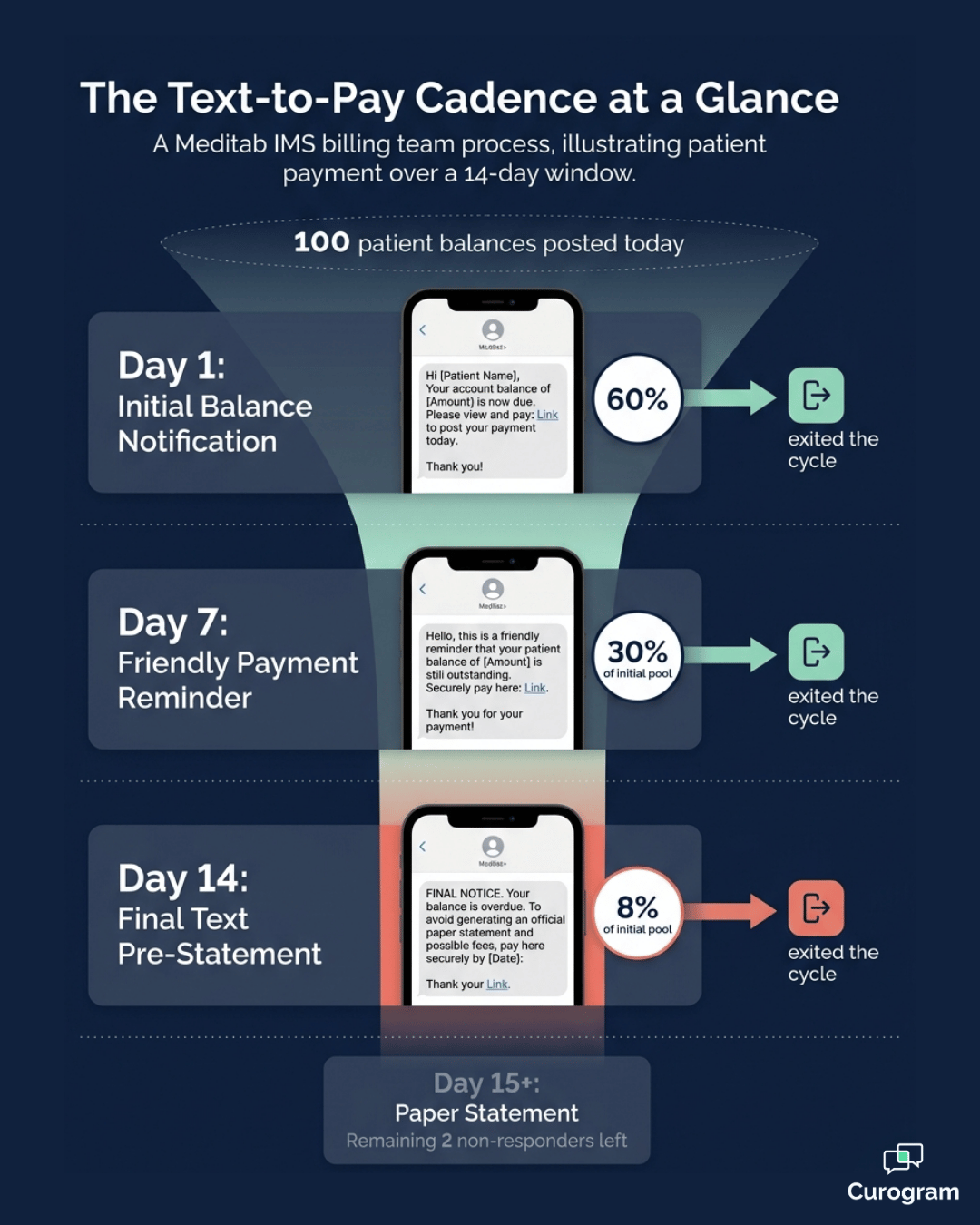
Text-to-pay cadence funnel showing Day 1, 7, and 14 SMS reminders for Meditab IMS billing teams.

Automated Payment Reminders That Do the Follow-Up for You

Curogram sends payment texts on a schedule your team controls.

A common cadence looks like this:

Day 1 when the balance posts, day 7 as a gentle reminder, and day 14 as the final nudge before a paper statement would be generated.

Patients who pay at any stage are removed from the sequence automatically. The billing team sets the rules once. The system runs continuously after that.

Most balances clear well before the first paper statement would have hit a mailbox.

That is the whole point of patient payment automation for an IMS billing team:

Catching the easy payments early so your staff can focus on the hard ones.

600 → 220 per month

Paper statements mailed after text-to-pay catches earlier payments Based on a sample multi-specialty IMS practice with ~$60,000 in monthly patient responsibility.

How It Connects to Meditab IMS

Your team exports patient balances out of IMS and uploads them to Curogram. Curogram sends the texts, processes the payments through a secure, mobile-optimized payment page, and produces a reconciliation feed that lines up with IMS billing records.

No rip-and-replace. No double system of truth. IMS continues to run the books. Curogram simply handles the outreach and the payment moment that IMS is not built to optimize.

Built for Multi-Specialty Operations

If you run a multi-specialty group, you already know that one collection strategy will not fit every line of business. Dermatology balances behave differently from gastroenterology balances. Pain management plans look different from primary care copays.

Curogram lets each department segment its outreach by balance type:

  • High-balance patients get personalized, longer-form messaging
  • Small-balance patients move through batch text campaigns
  • Payment plan patients receive recurring installment reminders

Your billing leaders own the strategy. Curogram executes it at scale.

This is the operational fit that quietly drives revenue cycle optimization for Meditab IMS text payments:

A single platform, multiple workflows, all reporting back into the same IMS billing process.

~15 hrs → ~4 hrs per week

Billing team time spent on patient collections after first-touch outreach is automated.

What Your AR Report Looks Like 90 Days In

The change in the AR aging report is the part most billing leaders feel first. The columns get shorter. The 60-and-over total starts to drop. The monthly meeting stops feeling like a postmortem.

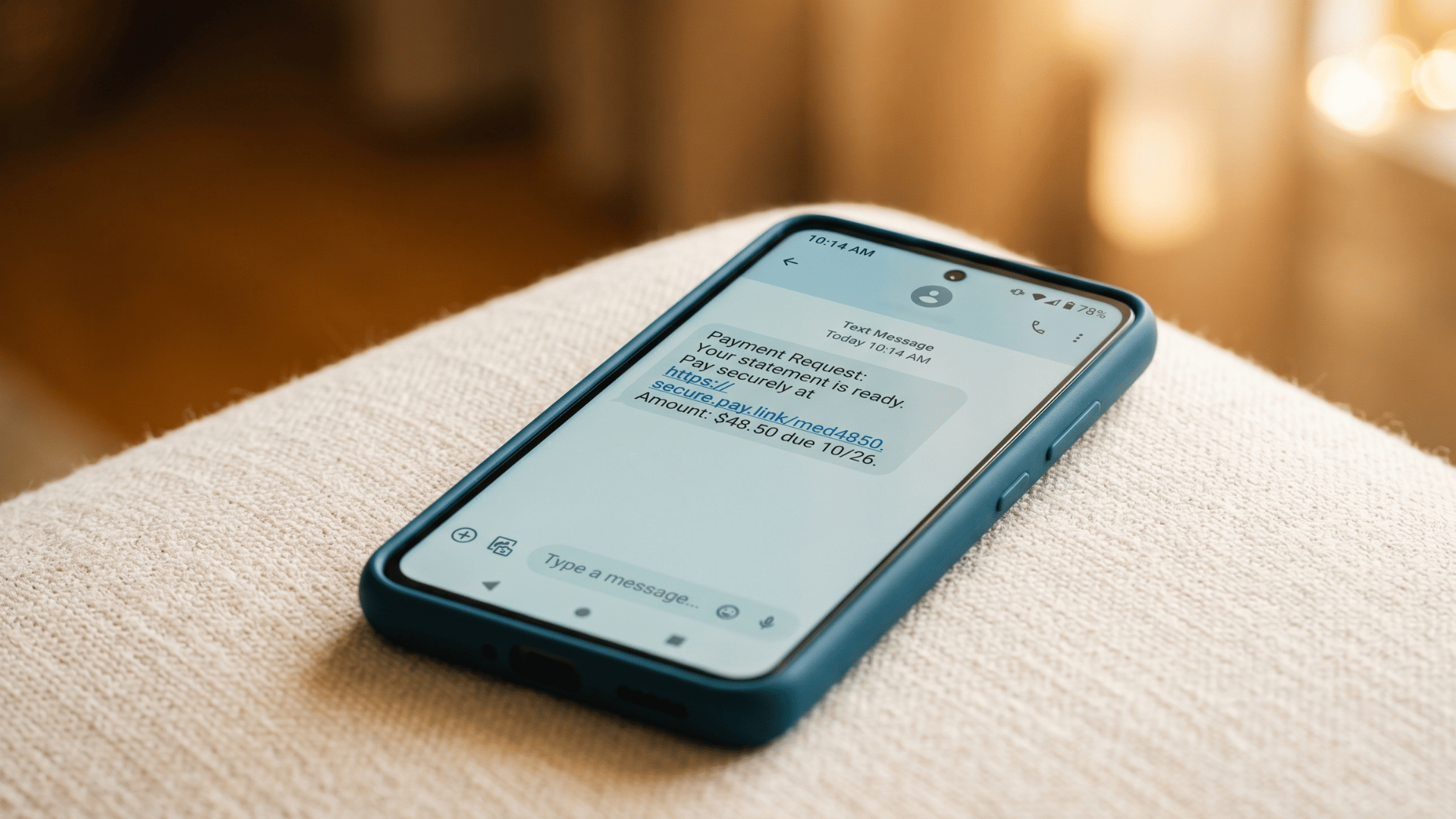
Smartphone displaying a secure SMS payment link, showing how patients pay balances through text-to-pay.

The Numbers Most Practices See

Across practices using text-to-pay, the pattern lands in roughly the same range every time:

  • 60–70% of patient balances collected within 7 days of the first text
  • 40–50% reduction in AR aging over 60 days
  • 50–70% drop in paper statement volume

For your team, that means three things at once. Cash flow gets faster. Mailing costs go down. And the number of patients in your "chase" pile gets smaller every week.

The Shift to a Proactive Revenue Cycle

The bigger change is cultural. The billing team stops reacting to old balances and starts collecting before balances get old.

The AR aging report becomes a forward-looking tool instead of a postmortem. The practice owner stops asking why collections are slow, because they aren't slow anymore.

Get paid faster! Strengthen your balance sheet by simplifying patient payments via secure SMS with Curogram.

That is what it looks like to reduce accounts receivable aging in a Meditab-based revenue cycle:

Not a single big win, but a steady weekly compounding of small ones.

Where the Savings Land

The faster the first touch, the fewer envelopes your team has to print, fold, and mail. Postage adds up quickly across a multi-specialty AR, and every text that closes a balance is a statement that never gets generated.

Stack the changes together and the impact is hard to ignore. Roughly $30,000 in faster cash.

About $570 a month saved on print and postage. Around 11 hours a week your billing team gets back to spend on higher-value revenue cycle work.

This is the most direct way to eliminate paper statements in Meditab IMS billing without leaving any patient uncontacted. Patients still get reached. They just get reached on the device they actually use, weeks before a mailed statement would have shown up.

Trade the Mailbox for the Inbox in Their Pocket

Your AR aging report has been telling you something for a long time. The current collection model is not failing because your team is not working hard enough. It is failing because the tools at the front of the cycle do not match the way patients pay anything else in their lives.

Paper statements and outbound calls are the most expensive tools in your stack. They are also the slowest.

A text with a secure payment link is the cheapest, the fastest, and the one your patients are already conditioned to act on.

Meditab IMS knows what every patient owes. Curogram makes paying it effortless for them and collecting it effortless for you. Your billing team keeps every system they already use. They just stop being the only people who can move a balance forward.

Most practices are live in about 48 hours. There is no long-term contract. The first text typically goes out the same week the workflow is configured, and most teams see a noticeable AR shift inside their first full billing cycle.

If your last three AR aging reports look almost identical, that is the signal. The system is stable, which means it will keep producing the same outcome until something in it changes.

Change the first touch. Watch the rest of the cycle catch up.

Schedule a Demo to see how a Meditab IMS billing team can accelerate patient collections with a text-to-pay workflow inside your own numbers. Bring your last AR aging report.


Frequently Asked Questions

How does the text-to-pay workflow fit with our existing IMS billing process?

Text-to-pay adds a collection channel. It does not replace your billing system. Your team continues to process claims and post balances through IMS exactly as they do now.

What payment methods do patients have through the text-to-pay link?

Patients can pay by credit card, debit card, or HSA/FSA card. The payment page is mobile-optimized and PCI-compliant, so it works smoothly on any phone and meets standard payment security requirements.

Can we set up payment plans through text-to-pay?

Yes. Curogram supports payment plan configurations where patients pay a set amount on a recurring schedule, with each installment reminder delivered by text.

Is text-to-pay HIPAA-compliant?

Yes. Curogram is built as a HIPAA-compliant platform, and the text messages themselves are written to keep PHI out of the SMS body.

What happens if a patient doesn't pay after the text reminders?

Anyone who has not paid by the end of the reminder window simply rolls into your existing paper statement and follow-up process. Nothing about your downstream workflow changes.


Text-to-Pay for Billing Staff | Stop Statement Backlogs Fast

Text-to-Pay for Billing Staff | Stop Statement Backlogs Fast

💡 Azalea Health billing staff can use Curogram text-to-pay to break the weekly cycle of printing aging reports, calling patients, and re-mailing...

Read More
Text-to-Pay for Azalea Health | Collect Patient Balances by Text

Text-to-Pay for Azalea Health | Collect Patient Balances by Text

💡 Text-to-pay for Azalea Health rural patient balance collection gives rural clinics a faster, cheaper way to collect copays and outstanding...

Read More
NextGen Collections Automation | End the Paper Statement Cycle

NextGen Collections Automation | End the Paper Statement Cycle

💡 Curogram's Automated Collections Workflow replaces the paper statement print-mail-wait cycle in NextGen Enterprise with automated SMS payment...

Read More