12 min read

How the Cost of Paper Patient Statements for MD Systems Adds Up

How the Cost of Paper Patient Statements for MD Systems Adds Up
💡 The cost of paper patient statements for MD Systems users runs about $1.50 per bill once you add up postage, paper, and staff time.
  • A practice sending 500 bills a month spends roughly $9,000 a year just on mailing
  • About 60% of first-round paper bills go ignored, which triples your cost
  • Text-based billing cuts that expense to nearly zero
  • Patients pay faster when they get a secure link on their phone
  • Switching to digital delivery can save $500–$1,000 per month in hard costs
Curogram's text-to-pay feature plugs into MD Systems, reads the balance, and sends patients a one-click payment link by SMS — replacing the mail room with a faster, cheaper workflow.

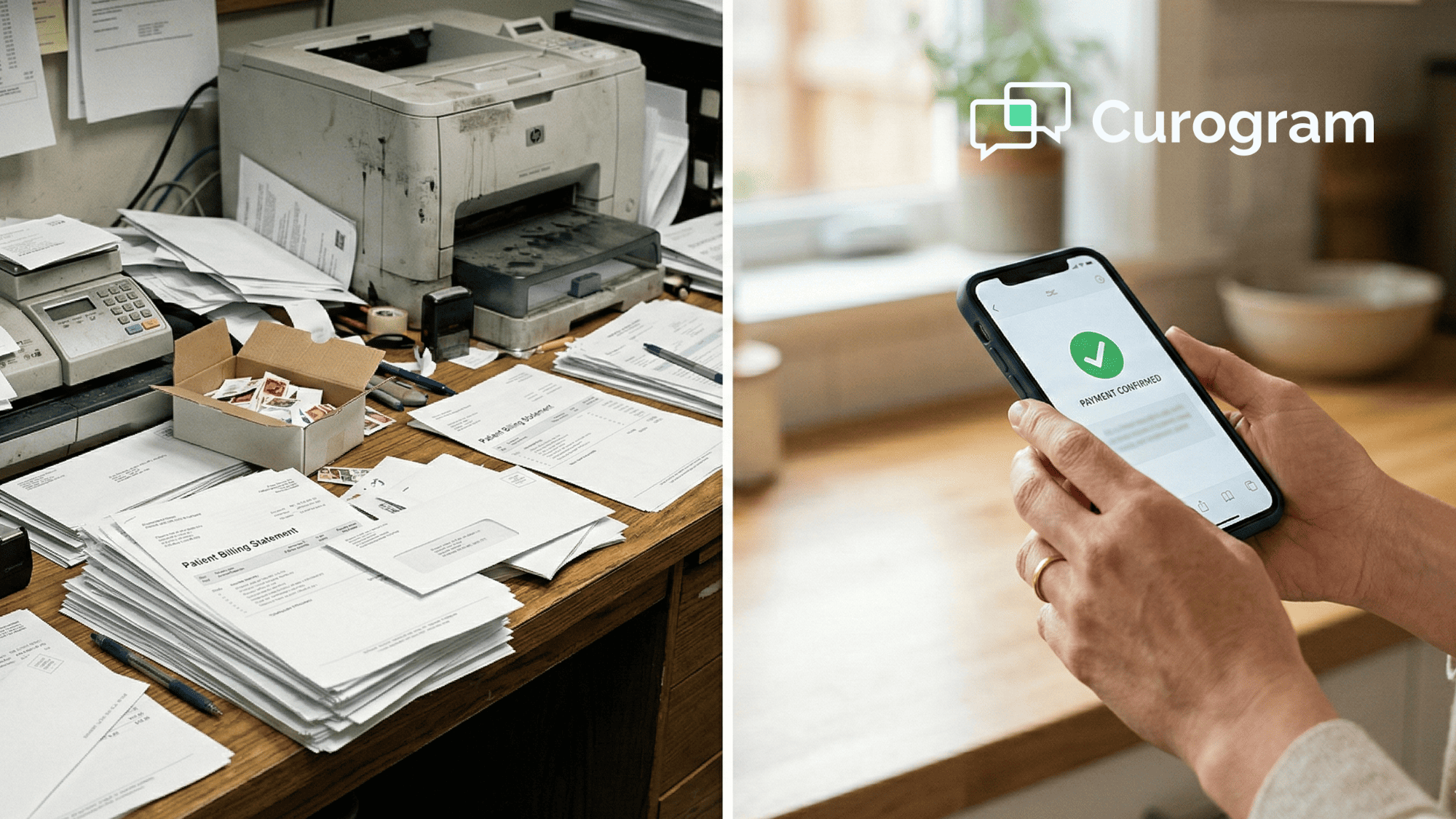
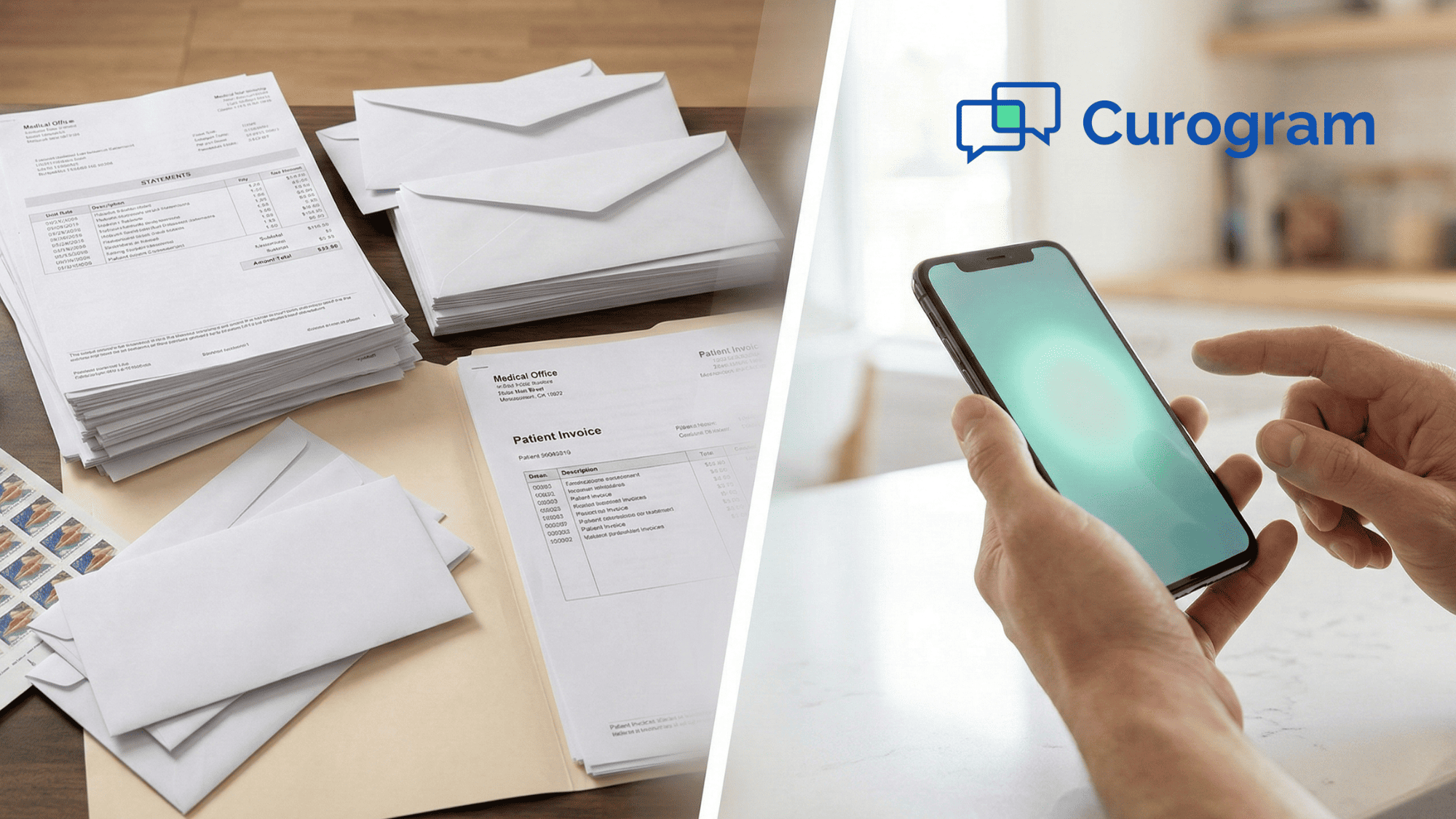
Picture this. Your front desk prints 500 patient bills this month. Someone folds each one, stuffs it in an envelope, and sticks a stamp on it. Three days later, it lands in a mailbox. Two weeks later, most patients still haven't paid.

Now, picture the bill. Not the patient's bill — yours. Every one of those 500 letters costs your practice close to $1.50 when you factor in paper, ink, envelopes, postage, and the staff time to get it all out the door. That's $750 a month walking out of your office before a single dollar comes back in.

The cost of paper patient statements for MD Systems is a quiet budget leak. It doesn't show up on a single line item.

It hides in your supply closet, your postage meter, and the hours your team spends on a task that could be done in seconds. Most practices never add it all up — and that's exactly why the number is so high.

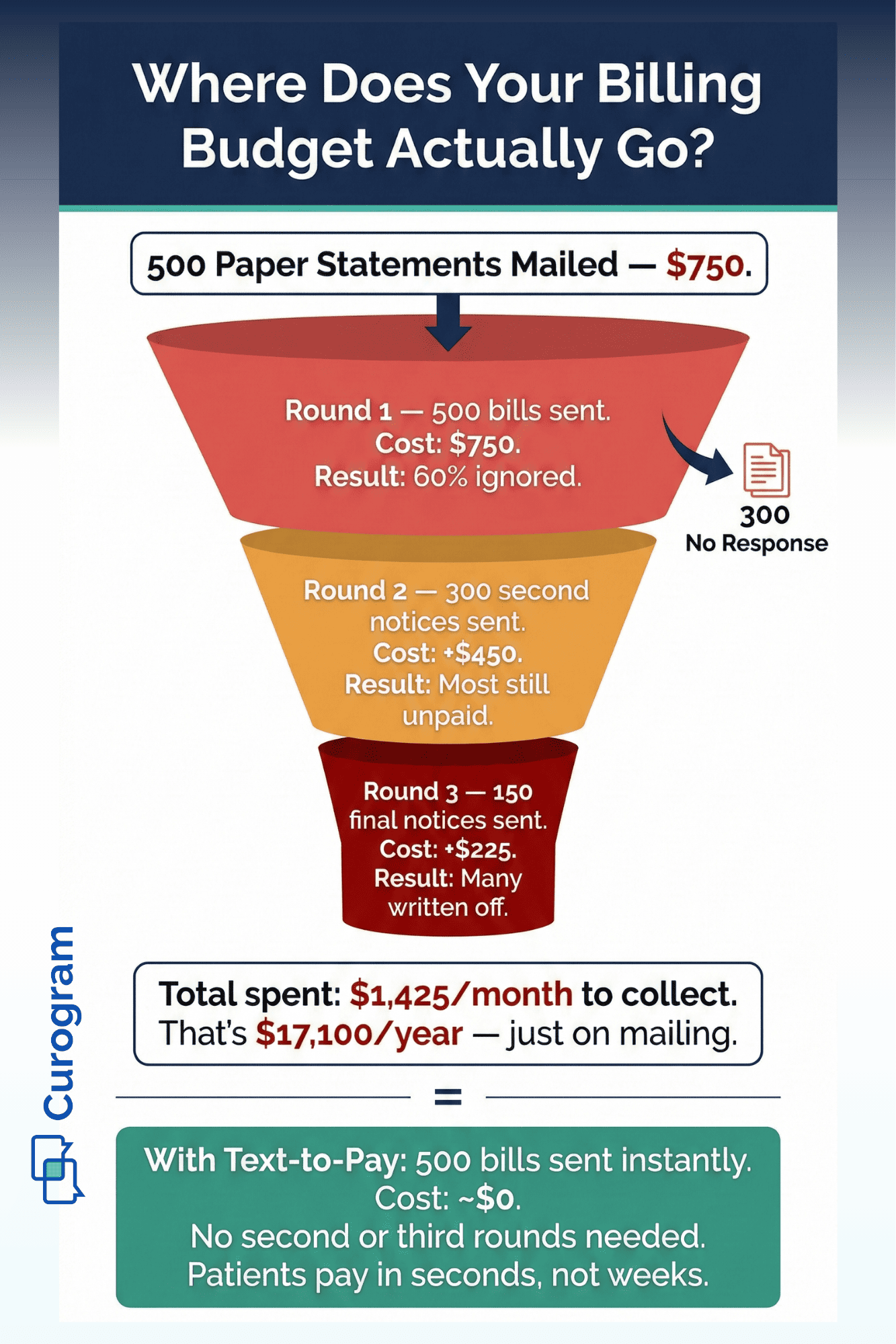
Here's the worst part: About 60% of patients ignore the first paper bill entirely. So you print, stuff, and stamp a second one. Then a third. Suddenly that $1.50 letter has cost you $4.50, and you're still waiting on a $15 co-pay.

There's a better way. Digital medical billing tools now let you send a secure payment link straight to a patient's phone. The bill arrives in seconds — not days. The patient taps, pays, and you're done.

In this article, we'll break down the real cost behind every paper statement, show you where the money goes, and explain how modernizing MD Systems collections with text-to-pay can put thousands of dollars back on your bottom line each year.

The Villain: The $1.50 Stamp

Most office managers think a paper statement costs about the price of a stamp. Right now, that's $0.73. Not cheap, but not a crisis either. The problem is that postage is only one slice of the real cost.

Let's walk through the full math:

Expense Cost per Statement
Paper + Envelope $0.15
Toner / Ink $0.10
Staff Labor (fold, stuff, seal) $0.50
Postage $0.73
Total $1.48


Round it up and call it $1.50. That's what it truly costs your office every time a bill goes out the door.

Now, let's scale that number:

A solo doctor with 500 patients billed per month spends about $750 just to mail those bills. Over a year, that's $9,000. A group practice with three providers could easily spend $2,250 a month — or $27,000 a year — on this one task alone.


And here's the part that really stings: You're often spending $1.50 to collect a $15 or $20 co-pay. That's a 10% "collection tax" right off the top. Think of it this way: for every ten dollars you collect, one dollar went to the Post Office.

But it gets worse. The first bill almost never does the job. Based on our internal data, roughly 60% of patients don't respond to the first mailed statement.

So what happens? Your team prints and mails a second notice. Then a third. Each round costs another $1.50 per patient.

Let's say 300 of your 500 patients ignore the first bill:

You send a second round — that's another $450. A third round for the remaining holdouts could run another $200 or more. So your original $750 monthly mailing budget has ballooned to over $1,400 — and many of those balances still haven't been paid.


This is the hidden trap of reducing postage costs that no one talks about. It's not just about the stamp. It's about the repeat mailings, the wasted labor, and the slow trickle of payments that drags out your cash flow for weeks.

There's also the time cost that never shows up on a bill. Think about your front desk staff. How long does it take one person to print, fold, stuff, and seal 500 envelopes?

Even at a brisk pace, that's a full day of work — maybe more. That's a day your team isn't answering phones, checking in patients, or handling claims.

At $18 an hour, that full day of labor costs you about $144. At $22 an hour, it's $176. Add that across multiple billing cycles per month, and you're paying hundreds of dollars in labor alone just to push paper out the door.

And none of this accounts for the soft costs. Late payments hurt your cash flow. Repeat mailings frustrate patients. Returned mail from bad addresses wastes time and money.

Mismatched patient statement ROI — where you spend more to collect than you actually bring in — chips away at your margins month after month.

The $1.50 stamp isn't just a stamp. It's a slow leak in your practice budget that quietly drains thousands of dollars a year. And for practices still running on MD Systems without a digital billing option, this is the single easiest line item to fix.

Funnel chart breaking down how paper billing costs reach $17,100 per year for MD Systems practices

The Guide: Digital Delivery

So what does "stop mailing bills" actually look like in practice? It's simpler than you might think.

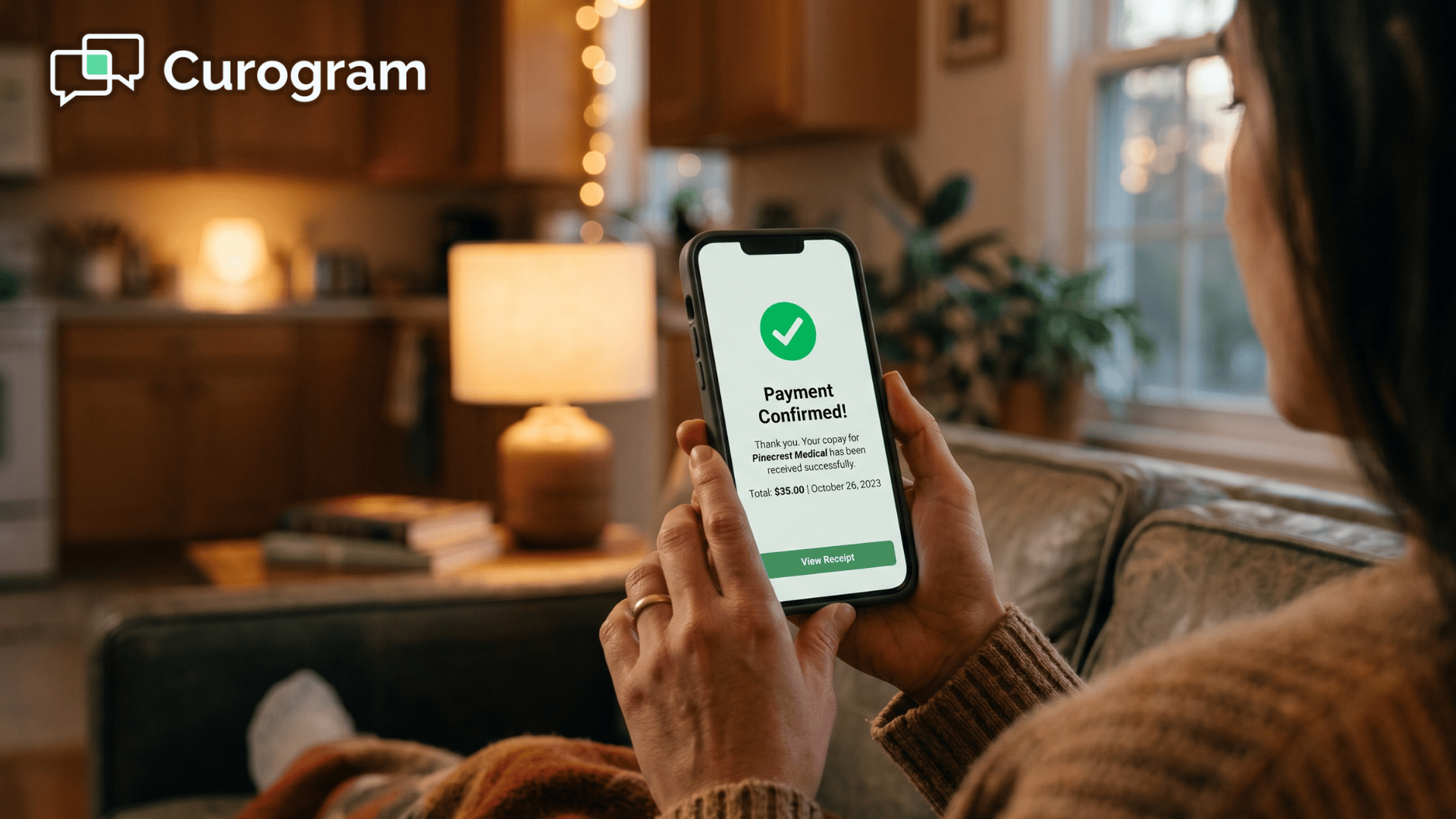
The concept is basic: Instead of printing a statement and mailing it, you send the patient a text with a secure link. They tap the link, see the amount owed, and pay right from their phone. No envelope. No stamp. No three-day wait.

Curogram makes this work by reading the patient balance straight from MD Systems. Once a charge is posted, the system can send a text to the patient's phone with a payment link.

The whole process takes seconds, not days. And for most practices, this replaces hundreds of hours of manual work each year.

Here's what a typical workflow looks like:

  1. A charge posts to the patient's account in MD Systems.

  2. Curogram picks up the balance and creates a secure payment link.

  3. The patient gets a text message with the link.

  4. They tap, review the amount, and pay — all in under a minute.

The cost of sending that text? Nearly zero. For most Curogram plans, text-based billing is included in the monthly fee. Compare that to the $1.50 you're spending on each mailed bill, and the savings are obvious.

But here's where it gets even better. One of the biggest reasons patients delay payment is confusion. They get a paper bill in the mail and think, "What is this for?"

They set it aside, meaning to call the office later. They never do. The bill sits on the counter, then moves to a junk drawer, and three weeks later, you're mailing another one.

Curogram solves this with a feature called Smart Attachments. When the text goes out, you can include a PDF of the full, itemized statement.

The patient opens the link, sees exactly what the charge is for, and pays on the spot. That one feature alone removes the number-one reason patients ignore their bills.

This is digital medical billing at its most useful — not a complex portal login, not an app download, just a simple text and a tap.

And the patient experience is better:

Think about how people handle their day-to-day payments. They pay for coffee with their phone. They split dinner tabs with Venmo. They tap to check out at the store. Asking them to open a letter, write a check, find a stamp, and mail it back feels like asking them to send a fax.


When you meet patients where they already are — on their phones — you remove the friction that causes late payments. Based on our internal research, practices using Curogram's text-to-pay see faster payment cycles because the bill shows up instantly and the pay button is right there.

This shift also frees up your front desk. Instead of spending a full day printing and stuffing envelopes, your staff can focus on tasks that actually need a human touch — like answering patient questions, handling claims, or checking in visitors.

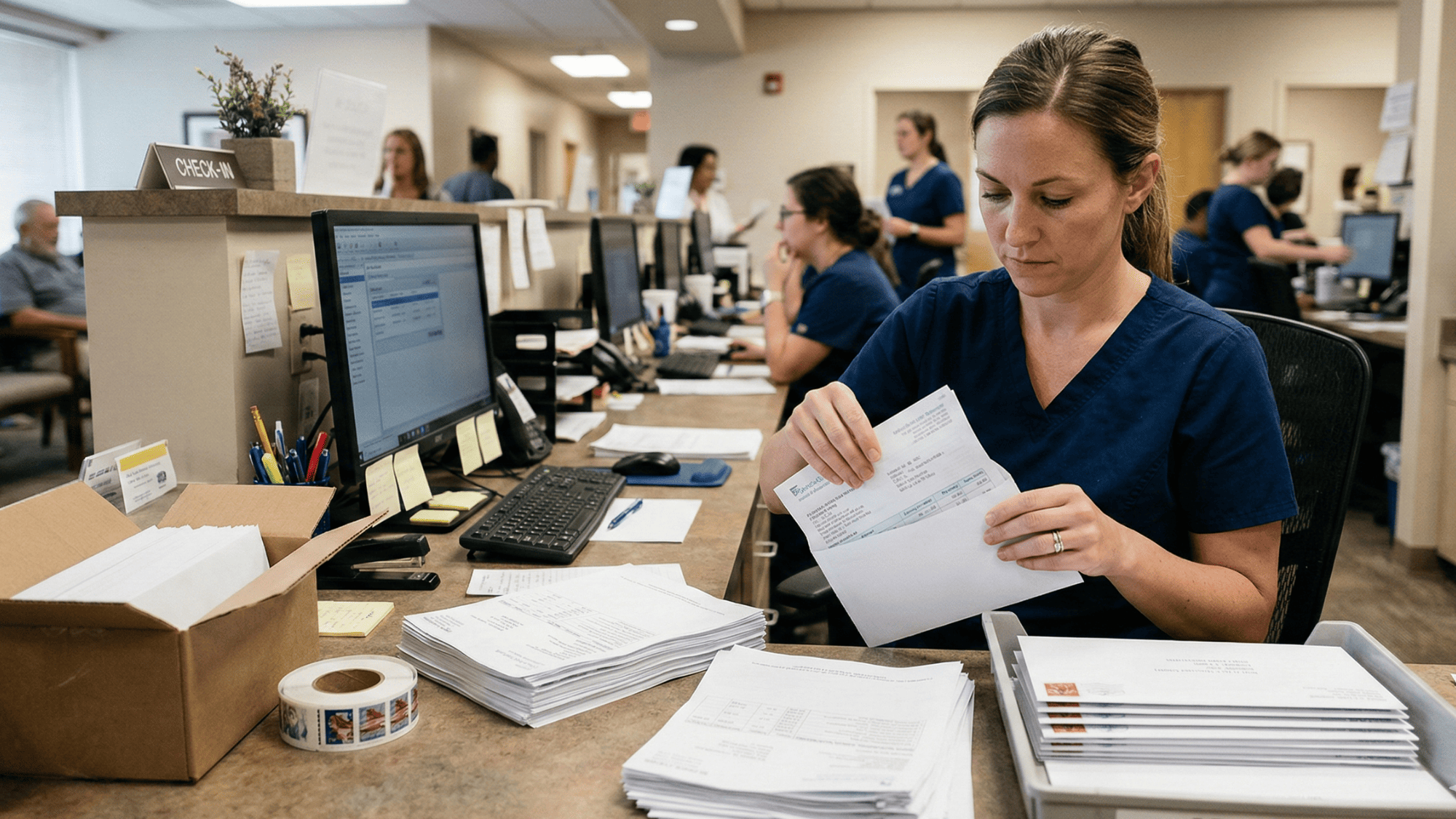
Medical office staff member folding paper patient statements into envelopes at a front desk

MD Systems billing efficiency improves across the board when you take paper out of the loop. Your billing staff works less on manual tasks

Patients get their bills faster. Payments come in sooner. And your supply closet stops eating through reams of paper and toner every month.

The switch doesn't have to be all-or-nothing, either. You can start by sending text bills to patients who have a mobile phone on file — which, for most practices, is about 90% of the patient list.

For the small group that doesn't have a phone, you keep mailing paper statements. Even that partial shift can save hundreds of dollars a month from day one.

The Success: 100% Margin Improvement

Let's talk real numbers. Cutting paper statements doesn't just save a few bucks here and there. For many practices, it's one of the fastest ways to boost the bottom line without adding a single new patient.

The Hard Dollar Savings

A solo practice sending 500 paper statements a month at $1.50 each spends $750 per month — or $9,000 per year. Switching to text-based billing cuts that hard cost to nearly nothing. That $9,000 goes straight to the bottom line.

For a group practice with three providers, the numbers are even more dramatic. At 1,500 bills per month, you're looking at $2,250 monthly in paper billing costs. That's $27,000 a year in postage, paper, ink, and labor — all to send bills that most patients ignore on the first try.

Here's a simple comparison:

  Paper Billing Text-to-Pay
Cost per bill ~$1.50 ~$0.00*
Monthly cost (500 bills) $750 Included
Annual cost $9,000 Included
Repeat mailings (60% rate) $4,500/year $0
Staff labor (printing/stuffing) ~$2,000/year $0
Total annual spend ~$15,500 Included in plan

*Text cost is included in standard Curogram plans.


That table tells a clear story. When you add up repeat mailings and labor, the true annual cost of paper billing can top $15,000 for even a small practice. Switching to text-based delivery eliminates nearly all of it.

Based on our internal data, practices that move to text-to-pay save an average of $500–$1,000 per month in hard mailing costs alone. That number climbs for larger offices.

The Speed Factor

But savings is only half the story. The other half is speed. A paper bill takes one to three days to reach the patient's mailbox — if the address is current.

Then the patient needs to open it, read it, write a check or log in to a portal, and mail it back. Start to finish, that cycle can take two to four weeks. Some patients take even longer.

A text-based bill arrives in three seconds. Not three days. Three seconds. The patient's phone buzzes, they see the amount, and they can pay right then. Many do.

That speed matters because cash flow is the lifeblood of any practice. Every week you wait for a payment is a week your bank account is lower than it needs to be. Faster payments mean fewer cash crunches, less reliance on credit lines, and more freedom to invest in your practice.

Think about it in simple terms. If you bill $50,000 in patient balances this month and the average paper turnaround is 30 days, you're floating $50,000 for a full month.

If text-to-pay cuts that turnaround to seven days, you recover most of that money three weeks sooner. Over a year, that shift can mean tens of thousands of dollars sitting in your account instead of floating in the mail.

The Collection Rate

Speed also helps your collection rate. The longer a bill sits unpaid, the less likely it is to ever be paid. Industry data shows that after 90 days, the chance of collecting a patient balance drops below 50%. After 120 days, it falls further.

Paper billing feeds this problem. Each mailing cycle adds weeks to the timeline. By the time a patient receives a third notice, three or four months may have passed. At that point, many practices write off the balance or send it to collections — both of which cost even more.

Text-based billing shortens the cycle at every step. The first bill arrives instantly. If the patient doesn't pay right away, a follow-up text goes out in days, not weeks. There's no printing, no postage, no delay. Just a quick nudge on the patient's phone.

As a result, more patients pay. They pay sooner. And fewer balances end up in the "write-off" pile.

The Margin Math

Here's where the "100% margin improvement" comes in. Every dollar you save on billing costs is a dollar that goes straight to profit. You don't have to earn it from a new patient visit. You don't have to negotiate a better payer rate. You just stop spending it on stamps.

Let's say your practice nets $200,000 a year in profit:

If paper billing costs you $15,000 annually in hard costs and you cut that to near zero, your profit jumps to $215,000. That's a 7.5% margin boost from a single operational change.

For smaller practices with tighter margins, the impact is even bigger. A practice netting $80,000 a year that saves $10,000 on billing sees a 12.5% jump in profit. That's real money.


And this doesn't even count the soft benefits: less wasted staff time, fewer patient complaints about confusing bills, and better cash flow that reduces stress and gives you more room to grow.

What This Means for Your Practice

Reducing postage costs and paper waste isn't just a nice-to-have. In today's market, where overhead keeps climbing and payer rates stay flat, every dollar of savings counts. Practices that ignore this line item are leaving money on the table every single month.

When you calculate the patient statement ROI of paper versus digital, the answer is clear. Paper billing costs more, takes longer, and collects less. Digital billing through text-to-pay costs less, works faster, and brings in more money.

The practices winning in 2026 are the ones that treat billing like a business process worth improving — not just a chore to get through. And for MD Systems users, Curogram makes that switch easy.

Want to see exactly how much your practice could save? Curogram's ROI Calculator for Copay Collection Efficiency lets you plug in your average monthly appointments, copay amount, and current collection rate to get a real number. 

Paper Billing Is a Problem You Can Solve Today

Every practice has line items that feel fixed — rent, payroll, insurance. Paper billing feels like one of those. But it's not. It's a cost you can cut tomorrow.

The tools exist right now. You don't need to overhaul your EMR. You don't need new hardware. You just need a platform that plugs into your existing MD Systems setup and handles the rest. Curogram does exactly that.

Today, your team prints 500 bills, stuffs 500 envelopes, and hauls them to the mailbox. Next month, after the switch, your team does none of that. Patients get a text. They pay. You move on.

The savings hit your bank account right away. No phase-in period. No long ramp-up. From the first month, your practice keeps the money it was handing to the Post Office.

And this change does more than save money. It changes how patients feel about paying. Nobody likes getting a paper bill.

But a quick text with a clear link? That feels modern. It feels easy. It matches how people already pay for everything else in their lives.

When practices are modernizing MD Systems collections, they're not just cutting costs — they're building a better experience for patients and staff alike.


How Curogram Turns a $1.50 Bill Into a 3-Second Payment


Curogram was built for practices that run on systems like MD Systems and want a modern way to handle patient billing. The platform plugs directly into your existing setup — no migration, no new software to learn, no IT team needed.

When a charge posts to a patient's account, Curogram reads the balance and sends a HIPAA-safe text to the patient.

That text includes a secure link where the patient can see the amount owed and pay with one tap. The whole process takes less time than it takes to fold a letter.

What sets Curogram apart is the Smart Attachments feature. Many patients ignore bills because they don't know what they're being charged for.

Curogram solves that by attaching a PDF of the itemized statement right inside the text. The patient opens the link, sees the breakdown, and pays — no phone call to your office needed.

Based on our internal research, practices using Curogram see faster payment cycles and higher collection rates compared to paper billing. That's because the bill arrives instantly and the payment option is right there. There's no delay, no portal login, and no friction.

Staff benefit, too. Based on our internal data, Curogram helps reduce phone call volume by up to 50% and boosts staff output by over 30%. Instead of spending hours on print-and-mail tasks, your team can handle work that actually needs their attention.

Curogram also supports automated reminders, two-way texting, online patient forms, and review requests — all from one platform. For practices looking to improve MD Systems billing efficiency across the board, it's a single tool that touches every part of the patient experience.

Conclusion: Stop Licking Envelopes

Paper billing is slow. It's pricey. And in 2026, it's outdated. Every mailed statement costs your practice close to $1.50 when you add up paper, ink, labor, and postage.

Most of those bills get ignored the first time, which means you pay again — and again. Over a year, that quiet expense adds up to thousands of dollars that never needed to leave your account.

The fix is simple. Send bills by text instead of by mail. Patients see the bill in seconds, not days. They pay with one tap. Your team skips the print-stuff-seal routine and focuses on work that actually matters.

Curogram's text-to-pay platform was built to work with MD Systems. It reads patient balances, sends a secure link via SMS, and even attaches a detailed statement so patients know exactly what they owe. 

The math is on your side. Practices that make this switch save $500–$1,000 a month in hard costs, based on our internal data.

That money goes straight to your bottom line — no extra patients needed, no payer rate talks, no new revenue streams to build. You just stop spending it.

And beyond the dollars, think about what changes for your team. No more printing days. No more stuffing runs. No more trips to the post office. Your front desk gets hours back every month — hours they can spend on patient care, phone calls, and claims.

Your patients also win. They get a fast, clear bill on their phone. They pay in under a minute. They move on with their day. No envelopes to open, no checks to write, no stamps to find.

Start collecting smarter. Schedule a demo with us to see how you can modernize your MD Systems billing workflow today.


Frequently Asked Questions

What if the patient doesn't have a smartphone?
You can filter your billing list. Send text-based bills to the 90% of patients who have a mobile phone on file. Print paper statements only for the small group who don't. Even a partial switch saves your practice hundreds each month.
How do we know if the patient received the bill?
Unlike mail, Curogram gives you a delivery receipt. You can see exactly when the text was delivered and when the patient opened it. No more guessing whether a bill got lost in the mail.
Can patients print a receipt after they pay?

Yes. After paying through the link, patients get an instant digital receipt. They can save it to their phone or print it for their HSA or FSA records.

How does text-to-pay handle patients who owe large balances?

Curogram sends the secure link with the full balance details. Patients can see the breakdown before they pay. For practices that offer payment plans, you can include that option in the message as well.

Why is text-to-pay more effective than a patient portal for collecting payments?

Most patient portals require a login, a password, and several clicks before patients can even see their balance. Text-to-pay skips all of that. The link goes straight to the payment screen, which removes the friction that causes people to put off paying.